
Families searching for an Ang Mo Kio Maths Tuition Centre Sec 3 Additional Maths, a Secondary 3 A-Math tutor or small-group Additional Mathematics tuition should look for more than attractive notes and large worksheet banks. Sec 3 A-Math is difficult because the subject is cumulative. Algebra supports quadratics and polynomials. Functions connect to graphs. Trigonometry depends on geometric interpretation. Calculus depends on algebraic fluency and function sense. A good tuition centre needs to understand these dependencies and diagnose where the chain first breaks.
Strong tuition should therefore combine diagnostic assessment, algebra repair, explicit modelling, guided practice, support fading, contrast practice, mixed-topic transfer, error tracking and delayed retesting. The best lesson is not the one where the tutor performs the most impressive solution. It is the one where the student leaves able to reproduce the reasoning independently.
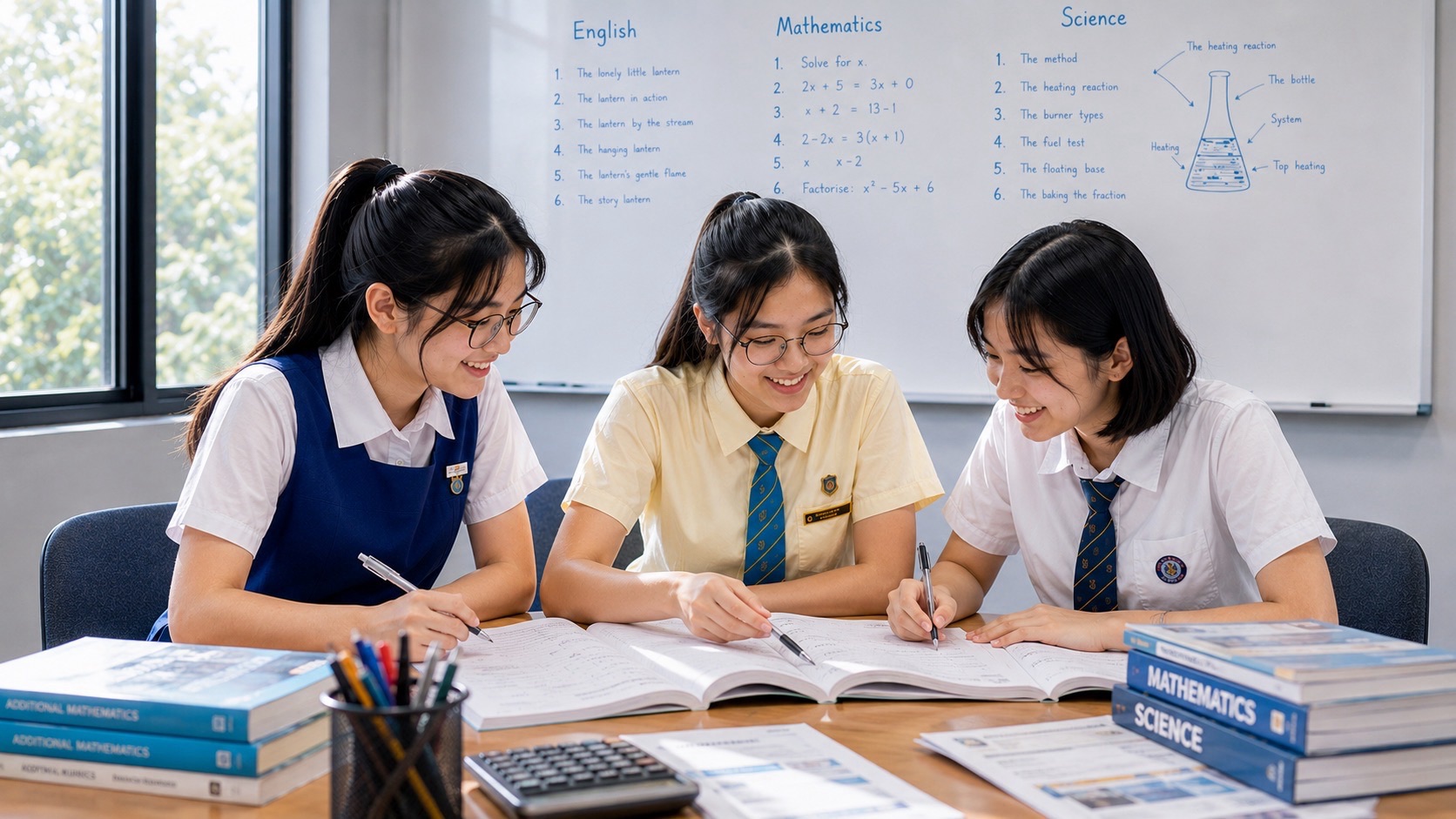
A three-student class can make this process highly visible. Every student must attempt. Every student’s working can be inspected. The tutor can compare methods, give individual feedback and then require each learner to complete a fresh transfer question alone.
What a Strong Sec 3 A-Math Tuition Centre Should Diagnose
- Does the student understand the concept?
- Can the student recognise the structure?
- Is algebraic manipulation accurate?
- Can the student choose a method without a hint?
- Is working organised enough to audit?
- Does the skill survive mixed practice?
- Does the skill survive a delayed retest?
Algebra Is Infrastructure
Expansion, factorisation, equations, fractions, indices and rearrangement should be treated as infrastructure rather than isolated topics. If these are unstable, every later chapter becomes more fragile.
Quadratics Need Multiple Representations
Students should know how expanded, factorised, completed-square and graphical forms relate. Each form reveals different information. The tuition centre should teach students to choose the representation that makes the problem easier.
Polynomials Need Structural Reading
Factor and remainder conditions often provide the shortest route through a polynomial problem. Students should be trained to identify these conditions before beginning lengthy manipulation.
Coordinate Geometry Requires Translation
Gradient, midpoint, distance and line conditions should move naturally between diagram and algebra. This translation skill is central to mixed problem solving.
Trigonometry Requires Controlled Choice
Students should identify the target and the relevant relationship before selecting formulas or identities. This reduces random manipulation and formula hunting.
Calculus Should Begin With Meaning
Differentiation should be introduced as rate of change and gradient. Once the concept is meaningful, fluency can be built through practice without turning the topic into rote symbol movement.
The Teaching Sequence Matters
- Cold attempt: see what the student can do independently.
- Diagnosis: identify the first weak link.
- Explicit model: show only the missing reasoning.
- Guided practice: allow supported success.
- Fade support: reduce prompts.
- Contrast: compare nearby methods.
- Mixed transfer: remove chapter labels.
- Delayed retest: verify retention.
Why Contrast Practice Matters
Students often know several methods but fail to choose between them. Contrast practice places similar-looking problems side by side and asks what feature changes the decision.
This trains recognition, one of the most important A-Math skills.
Error Tracking Should Be More Precise Than “Careless”
- sign lost after expansion;
- common factor incomplete;
- wrong quadratic route;
- graph information ignored;
- identity manipulated without target;
- working too compressed;
- method recalled only after a hint.
Specific errors create specific training responses.
What a 90-Minute Small-Group Lesson Can Look Like
- 10 minutes of retrieval.
- 15 minutes of cold diagnostic work.
- 20 minutes of targeted repair.
- 20 minutes of carefully varied practice.
- 15 minutes of contrast or mixed questions.
- 10 minutes of independent transfer and review.
The exact timing can change, but the lesson should include both teaching and evidence that the student can act independently.
The Independence Test
Can the student solve after the worked example is removed? After several days? Inside a mixed set? Under a reasonable time limit? Can the student explain why the chosen method fits?
How Parents Can Judge Progress
- the student starts questions with less prompting;
- repeated algebraic errors decrease;
- working becomes easier to audit;
- mixed practice causes less hesitation;
- the student can explain method choice;
- corrections survive later retesting.
Strong Students Need Depth
High-performing students should not spend every lesson repeating familiar questions. Extension can involve derivation, alternative methods, efficiency, counterexamples and unfamiliar combinations.
Students Who Are Behind Need Prerequisite Repair
If multiple chapters are weak, prioritise algebraic skills with the widest transfer value. Repairing expansion, factorisation, equations and fractions often improves several later topics at once.
Questions Parents Can Ask an A-Math Tuition Centre
- How do you diagnose the first weak link?
- How do you fade worked-example support?
- How do you train method recognition?
- How do you track recurring errors?
- When do you introduce mixed-topic practice?
- How do you test retention after a delay?
The Real Goal of an Ang Mo Kio Maths Tuition Centre for Sec 3 Additional Maths
A strong tuition centre should gradually transfer control from tutor to student. The learner should increasingly recognise, start, solve, check and explain without external prompting.
That independence makes final-year revision far more effective. Properly taught kids shine a bright light into the future.
Leave a Reply