
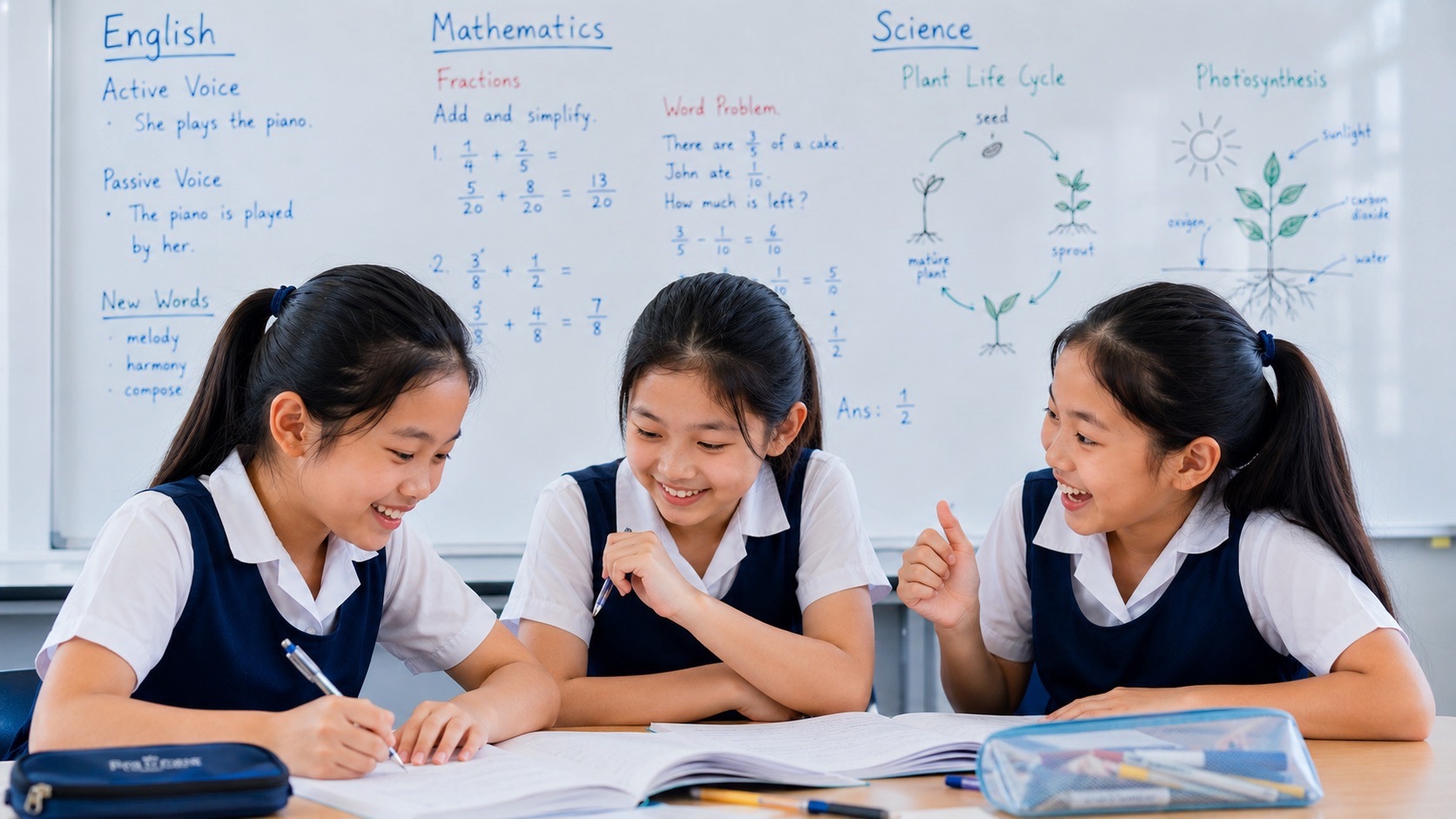
Families searching for Pri 3 Pasir Ris Science tuition, a Primary 3 Science tutor, Primary Science tuition Singapore, Science observation skills, changes over time, scientific keywords or help with open-ended Science questions are often seeing a child who can describe a single moment but struggles to describe a process. Primary 3 Science becomes more powerful when students learn to notice how something changes from one state to another across time.
Good Primary 3 Science tuition should therefore teach change-over-time reasoning. Students need to identify a starting state, observe what changes, record the sequence, use measurements where useful, distinguish gradual change from sudden change, and explain the process using appropriate scientific vocabulary. These habits later support life cycles, evaporation, melting, plant growth, tables, graphs, experiments and PSLE Science reasoning.
This rebuilt guide keeps the historical title Pri 3 Pasir Ris Science Tuition while giving the page one clear learning job: teach students how to describe a scientific process through time. The central idea is simple. Many Science ideas are not static facts. They are stories of change, and strong learners can explain what the system looked like before, what happened during the process and what was different afterwards.
Start State, Change, End State
A simple three-part frame helps young learners:
- Start state: what was true at the beginning?
- Change: what happened over time?
- End state: what was different afterwards?
This structure supports many Primary Science processes.
Worked Process: Melting
Start state: solid ice. Change: heat is gained from warmer surroundings. End state: liquid water.
The learner should distinguish the observed change from the explanation for why it happened.
Worked Process: Evaporation
Start state: liquid water. Change: some liquid water changes into water vapour over time. End state: less liquid water remains.
The child can then compare which conditions make that change happen faster or slower.
Worked Process: Plant Growth
Record height, number of leaves or another clearly defined measure over several days or weeks. The learner sees that growth is not one observation but a sequence of measurements.
Worked Process: Life Cycles
A life cycle is a structured sequence of stages. Students should describe what changes from one stage to the next and which parts of the cycle repeat.
Worked Process: Shadow Change
Change the position of the object or light source and record how the shadow changes. The learner connects a change in setup to a change in outcome.
Sequence Words Help Science Make Sense
- first;
- then;
- next;
- after that;
- over time;
- finally;
- as a result.
These words help the learner express order clearly.
Gradual and Sudden Changes Are Different
Some processes occur gradually, such as plant growth or evaporation. Others can appear more sudden, such as a switch opening a circuit or a magnet attracting an object once it comes close enough.
Students should notice the nature of the change, not just the final result.
Measurement Makes Change Easier to See
“The plant got bigger” is less precise than recording height at regular intervals. “The water went down” is less precise than measuring the volume remaining.
Simple measurements turn vague change into evidence.
Tables Organise Change Through Time
One column can show time and another the measurement. The learner can then compare the start, middle and end of the process.
Graphs Turn Time Into a Visual Pattern
A simple graph can show whether a quantity increases, decreases or stays similar over time. Students should read the axes and describe the pattern before explaining it.
Scientific Keywords Should Name the Process
Words such as melting, evaporation, condensation, germination and growth help the learner label specific changes.
The keyword is most useful when the child can explain what changed from the starting state to the ending state.
Prediction Can Extend the Sequence
After observing a pattern over time, ask what may happen next if the same conditions continue. The prediction should be based on the observed trend or scientific relationship.
Changing a Condition Can Change the Sequence
Move a wet material into moving air, change the light available to a plant, or alter the position of an object in a shadow setup. Ask how the sequence changes and why.
Corrections Should Identify the Sequence Error
- start state missing;
- steps out of order;
- process keyword wrong;
- measurement not connected to time;
- final state described inaccurately;
- explanation confused with observation.
Retest With a New Process
After learning start-change-end with melting, use the same structure for growth, life cycles or evaporation. The reasoning process transfers across topics.
Retrieval Practice Can Reconstruct a Sequence
Give the start and ask the learner to reconstruct the middle and end. Or give the final observation and ask what process could have produced it.
Small Groups Can Compare Sequences
Students can explain the same process in different ways. The group checks whether the order is correct, whether the process is named accurately and whether the final state follows logically.
A Weekly P3 Pasir Ris Change-Over-Time Routine
- Start: describe the initial state.
- Observe: record one or more changes.
- Measure: add a simple quantity where useful.
- Sequence: place events in order.
- Name: use the correct scientific process.
- Explain: connect the condition to the change.
- Predict: say what may happen next.
How Parents Can Support Change-Over-Time Thinking
- What was it like at the beginning?
- What changed first?
- What happened next?
- Can we measure the change?
- Which scientific word names the process?
- What do you predict will happen next?
What Should Be Stable Before Primary 4?
- describe starting and ending states;
- sequence changes correctly;
- use simple measurements over time;
- organise time-series observations in tables;
- read simple trends in graphs;
- use process vocabulary accurately;
- predict what may happen next from a pattern.
Final Perspective
The strongest job of Pri 3 Pasir Ris Science Tuition is to teach students how to see Science as change through time. Many important ideas are processes rather than static facts.
When a child can describe the starting state, track what changed, organise the sequence and explain the ending state, they begin to understand the dynamic nature of scientific systems.
Continue through eduKateYishun: Science Tuition & Learning Hub · Science Directory · Student Diagnostics Hub
Leave a Reply