
Families searching for Yishun Maths tuition Primary 6, a Primary 6 Maths tutor in Yishun or PSLE Maths tuition are usually not looking for another pile of worksheets. They are trying to solve a more urgent problem: how to turn six years of Primary Mathematics into dependable examination performance. By Primary 6, concepts such as fractions, ratio, percentage, rate, speed, geometry, area, volume, graphs, data and multi-step problem sums must work together. Good small-group Mathematics tuition therefore needs to diagnose the first weak link, repair it, practise it deliberately, then test whether the method survives a fresh question without prompting.
Current Singapore Primary Mathematics programmes commonly emphasise MOE-aligned teaching, model drawing, bar models, heuristics, challenging problem sums, structured working, timed practice, exam technique and targeted revision of weak topics. Those are useful search terms because they describe real PSLE demands, but the quality of tuition depends on how those ideas are taught. A student who memorises ten heuristics but cannot recognise which relationship a question contains is not yet independent. A student who can copy a bar model but cannot explain what each segment represents is not yet ready for transfer.
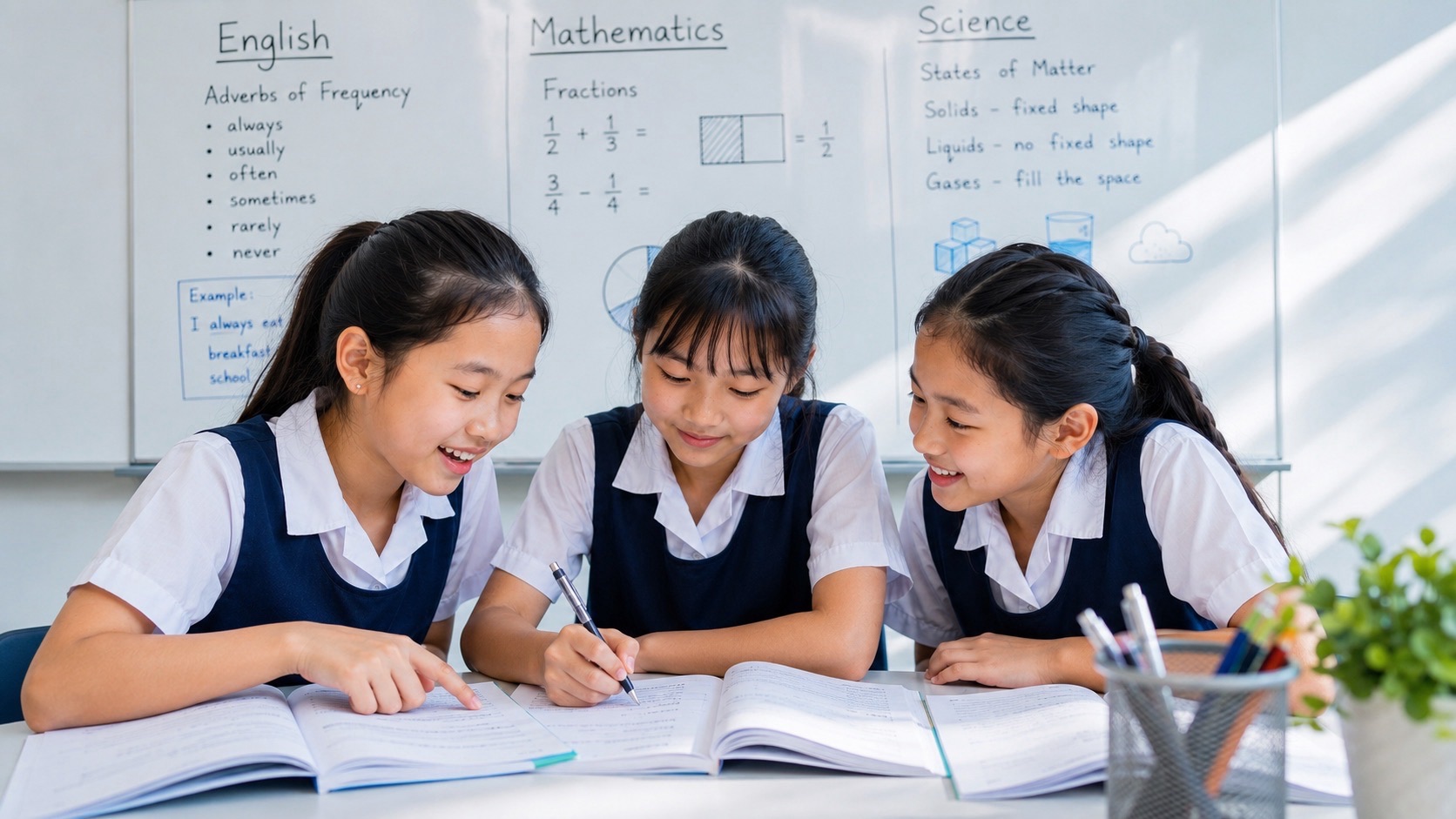
In a three-student tutorial, Primary 6 learning can become visible. One pupil may need ratio repaired, another may know the concept but lose marks through poor representation, and a third may simply need stronger paper control. The lesson should not treat all three as the same child. The useful loop is Read → Diagnose → Prioritise → Repair → Practise → Connect → Perform → Review. That is how a P6 learner moves from “I know this chapter” to “I can recognise, solve and check this problem under examination conditions.”
Primary 6 Is a Systems Year, Not Just a Revision Year
Primary 6 is often described as the year of PSLE revision. That description is incomplete. It is the year when the Mathematics system has to become coordinated. Fractions connect to ratio. Ratio connects to percentage. Percentage connects to rate and change. Geometry and measurement depend on accurate visual interpretation. Data questions require number sense and reading precision. Multi-step problem sums ask the student to hold several relationships in mind without losing track of what each intermediate number means.
This is why more papers do not automatically produce more learning. If the same misconception survives every paper, the student becomes faster at repeating the same error. Revision should therefore alternate between diagnosis and performance. Full papers show where the system breaks. Focused repair rebuilds the weak component. Mixed questions then test whether the repair transfers.
The First Weak Link Matters More Than the Final Wrong Answer
Suppose a student loses six marks on a multi-step problem. The final answer is wrong, but that tells us little. The useful question is: where did the reasoning first become unreliable?
- Did the student misunderstand the whole?
- Was the relationship between quantities represented incorrectly?
- Was a bar model drawn but labelled inaccurately?
- Was the correct method chosen but an arithmetic slip changed the result?
- Did the student forget what an intermediate answer represented?
- Was the unit wrong even though the calculation was correct?
- Did time pressure cause the student to abandon checking?
The earliest unstable step should be repaired first. Later mistakes may disappear once the first weak link is stable.
A Useful Primary 6 Diagnostic Has Four Layers
1. Concept
Does the student understand the mathematical idea? For ratio, can the learner explain what 3:5 means? For percentage, can the learner identify the correct whole? For speed, can the student distinguish distance, time and rate? For area and volume, can the learner identify the relevant dimensions rather than reaching immediately for a formula?
2. Representation
Can the relationship be converted into a bar model, diagram, table, equation or labelled sketch? Many P6 errors are not calculation errors. They are representation errors. The arithmetic is performed perfectly on the wrong mathematical picture.
3. Calculation
Can the student carry out fractions, decimals, percentage, multiplication, division and unit conversions accurately enough that higher-level reasoning is not constantly interrupted?
4. Execution
Can the student organise working, label intermediate values, manage time, interpret the final question correctly and check high-risk steps? Execution often separates a learner who understands Mathematics from a learner who can reliably demonstrate that understanding in an examination.
Bar Models Must Explain Relationships
Bar models remain powerful in upper-primary problem solving because they reduce language into visible relationships. But a model is only useful if the learner knows what the parts mean.
- What quantity does each bar represent?
- Which bars share the same whole?
- Which difference, total or repeated unit is known?
- Where is the unknown?
- What can be found first without guessing?
A strong P6 tutor should ask these questions before allowing the student to calculate. This slows down the beginning of the solution so the rest becomes faster and safer.
Heuristics Are Decisions, Not Decorations
Working backwards, guess-and-check, simplifying the problem, making a systematic list, finding an invariant, drawing a model and using the unitary method are all valuable. The mistake is to treat them like chapter labels.
The student should learn to ask what structure is present. If the final state is known and earlier states must be reversed, working backwards may fit. If a fixed total is redistributed, an invariant may matter. If several cases must be exhausted, a systematic list may prevent omissions. If a comparison changes while units remain meaningful, a bar model or unitary approach may expose the relationship.
The goal is method recognition. This is one of the most important transitions from topical practice to PSLE performance.
Fractions, Ratio and Percentage Should Be Taught as One Connected Family
Students often learn fractions, ratio and percentage in separate chapters, then struggle when one question moves between all three. Primary 6 tuition should reconnect them.
- A fraction describes a part in relation to a whole.
- A ratio compares relative quantities.
- A percentage describes a part per hundred.
The representations differ, but the reasoning repeatedly asks the same question: what is the reference quantity? If the whole changes, the fraction or percentage meaning may change even when the numerical value looks familiar. If a ratio is scaled, the relationship remains constant even though the actual quantities change.
Students should practise translating the same relationship among bar models, fractions, ratios and percentages. This creates flexibility instead of chapter dependence.
Rate and Speed Need Unit Discipline
Rate questions become difficult when students treat the formula as a magic triangle. The deeper idea is comparison: one quantity changes relative to another. Speed compares distance with time. Price per item compares cost with quantity. Flow rate compares amount with time.
A careful learner checks units before calculating. Kilometres and metres cannot be combined casually. Hours and minutes cannot be treated as interchangeable numbers. A strong lesson builds the habit of writing the unit beside the relationship so the formula remains meaningful.
Geometry Questions Reward Careful Reading of the Diagram
Geometry is often lost before any formula is used. A diagram contains facts, but not every apparent visual relationship is guaranteed. Students should label known lengths and angles, identify which properties are established, then select a formula or theorem that uses those facts.
This habit prevents common errors: treating a drawing as perfectly to scale, confusing radius and diameter, using slant length instead of perpendicular height, or applying an area formula to a perimeter question.
Challenging Problem Sums Need a Start Routine
Some students freeze because they cannot see the whole solution immediately. They need a reliable start routine:
- Read once for the situation.
- Read again for quantities and relationships.
- Underline the exact question.
- Represent before calculating.
- Find one dependable intermediate value.
- Label what that value means.
- Continue only when the next relationship is clear.
This routine turns “I do not know the answer” into “I know the next step.” That change is small, but it is a major form of independence.
Timed Practice Should Come After Method Stability
Timed papers are important, but timing unstable knowledge too early can reward guessing. A better progression is:
- Untimed concept repair.
- Short sets with method focus.
- Mixed sets with reduced prompts.
- Section timing.
- Full-paper simulation.
- Error analysis and retest.
The student should first know what to do, then learn to do it efficiently.
Paper Control Is a Mathematics Skill
Examination technique is not a collection of tricks. It is resource management. The student has limited time and attention. A dependable P6 strategy includes reading carefully, protecting easy marks, showing essential working, leaving a difficult question when necessary, and returning with enough time to check.
Checking should also be specific. “Check your work” is vague. Better routines include:
- re-read the final sentence of the question;
- check whether the answer is reasonable in size;
- check units;
- check copied numbers;
- check high-risk arithmetic;
- check whether the answer refers to the correct person or quantity.
Careless Mistakes Should Be Classified
Calling every lost mark “careless” hides useful information. A mistake can come from:
- attention drift;
- weak number facts;
- poor layout;
- unlabelled intermediate answers;
- unit confusion;
- copying error;
- time pressure;
- concept uncertainty disguised as haste.
Each cause needs a different repair. Better layout may reduce copying errors. Retrieval practice may reduce fact errors. More concept teaching may be necessary when “careless” answers cluster around the same topic.
What a Three-Student P6 Maths Lesson Can Look Like
- Retrieval: fractions, ratio, percentage, key facts or prior error patterns.
- Cold problem: a fresh mixed question shows what the student can do without help.
- Diagnosis: concept, representation, calculation or execution is identified.
- Repair: the tutor explains only the missing relationship.
- Focused practice: two or three related questions stabilise the repair.
- Contrast: a similar-looking question with a different structure tests method choice.
- Timed transfer: the student solves independently under a mild time limit.
- Review: the next revision priority is recorded.
The advantage of three students is visibility. Everyone must attempt. Everyone’s working can be inspected. The tutor can compare strategies without allowing one confident pupil to carry the group.
The Independence Test
A useful P6 tuition programme should eventually ask a simple question: can the student do this when the tutor is silent?
We can test independence by changing one condition at a time:
- remove the worked example;
- change the numbers;
- change the wording;
- mix the topic with another topic;
- delay the retest for several days;
- add a time limit;
- ask the student to explain why the method works.
If performance survives these changes, the learning is becoming durable.
How Parents Can Read a Marked P6 Paper
A marked paper is not just a score report. It is a diagnostic map. Parents can look for patterns:
- Are losses concentrated in problem sums?
- Are basic calculations unexpectedly slow?
- Are units frequently omitted?
- Are diagrams misread?
- Does the child abandon long questions early?
- Are errors clustered in one concept family?
- Does performance fall sharply in the final portion of the paper?
These patterns are more actionable than the total mark alone.
A Four-Week Repair Cycle
Week 1: Diagnose and prioritise
Use marked work and a short cold set to find the first weak link. Choose one or two high-impact weaknesses rather than trying to repair everything at once.
Week 2: Repair and practise
Rebuild the concept, representation or procedure, then complete carefully selected questions that vary one feature at a time.
Week 3: Mix and transfer
Interleave the repaired skill with other topics. Remove chapter labels. Ask the student to choose the method.
Week 4: Perform and review
Use timed sections or a paper, then compare the new error pattern with the original one. The cycle restarts from fresh evidence.
Strong Students Need Extension, Not Just More Volume
A high-scoring P6 pupil can stagnate if every lesson simply adds more of the same familiar questions. Extension should increase novelty and decision-making:
- solve the same problem using two methods;
- change one condition and predict what changes;
- construct a similar problem;
- explain why a tempting method fails;
- estimate before calculating;
- solve a non-routine problem without a chapter label.
Depth creates adaptability. That matters more than a taller stack of worksheets.
Students Who Are Behind Need Triage, Not Panic
When a P6 student has multiple gaps, the temptation is to rush through every chapter. A better approach identifies foundational concepts that unlock several later topics. Fraction sense, multiplication fluency, unit conversion, proportional reasoning and basic representation often have wide effects.
The aim is not to pretend there is unlimited time. It is to use the available time on the skills with the greatest transfer value, then test them in mixed work.
Questions Parents Can Ask a Yishun Primary 6 Maths Tutor
- How do you identify whether my child has a concept, representation or execution problem?
- How do you teach bar models beyond copying a diagram?
- How do you decide which heuristics to teach?
- When do you start timed papers?
- How do you track repeated mistakes?
- How do you reduce prompting over time?
- How do you support a strong student without only giving harder worksheets?
- How do you decide what to prioritise when the exam is near?
Related Mathematics Guides on eduKateYishun
Parents comparing Primary Mathematics support can also read the Primary Maths Tuition Centre in Yishun guide and the Yishun Tuition Centre for Maths guide. Families reviewing the build-up years can move backwards through Primary 5, Primary 4 and Primary 3.
What Progress Should Look Like
Progress is not only a higher mark. Before marks move, useful changes may appear:
- the student starts unfamiliar questions more quickly;
- working becomes easier to follow;
- bar models are labelled correctly;
- fewer intermediate values are forgotten;
- ratio and percentage questions are recognised more accurately;
- time spent on impossible routes falls;
- checking becomes deliberate rather than random;
- the student can explain why a method fits.
These are leading indicators of examination reliability.
The Real Goal of Yishun Maths Tuition Primary 6
The purpose of Primary 6 Maths tuition is not to make a child permanently dependent on a tutor. It is to make mathematical decisions clearer, methods more dependable and performance more independent. A tutor should gradually transfer responsibility back to the learner: read the question, choose a representation, select a method, calculate carefully, check intelligently and recover when the first attempt fails.
That is a more useful definition of PSLE readiness than simply completing another stack of papers. The student should leave the final Primary year with a stronger mathematical operating system—not just a memory of what the tutor did. Properly taught kids shine a bright light into the future.
Leave a Reply