
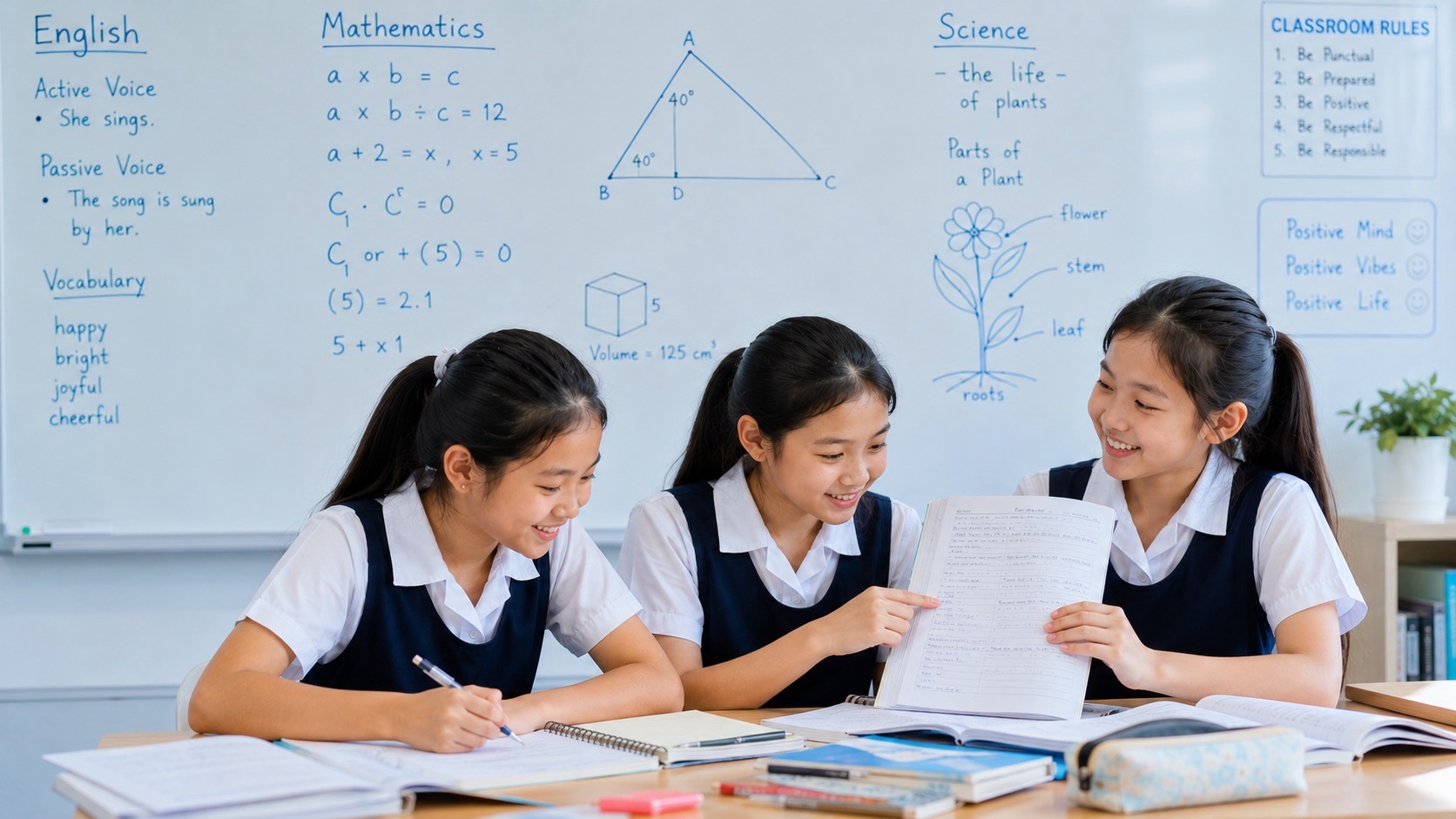
Families searching for Yishun Maths tuition Primary 3, a Primary 3 Maths tutor in Yishun or small-group Primary Mathematics tuition are often seeing the first major change in how Mathematics feels. Primary 3 introduces larger numbers, more demanding multiplication and division, fractions, measurement, area, perimeter, angles, data and longer word problems. The child can no longer rely only on fast arithmetic. Good tuition must help the learner read a problem, represent the relationship, choose a method and explain enough working to make the solution dependable.
Current Singapore Primary Mathematics programmes commonly highlight MOE-aligned teaching, number sense, bar models, model drawing, heuristics, word problems, problem-solving confidence, small classes and personalised feedback. Primary 3 is where those ideas should begin to connect. A student who knows multiplication facts but cannot recognise equal groups has a brittle skill. A student who can copy a bar model but cannot say what each section means is still borrowing the tutor’s thinking.
In a three-student tutorial, those differences are easy to see. One pupil may need place value strengthened, another may struggle to translate language into a model, and a third may understand the problem but make repeated multiplication errors. The useful loop is Read → Diagnose → Prioritise → Repair → Practise → Connect → Perform → Review. Primary 3 is the right year to build this loop because the Mathematics is becoming complex enough to require strategy, but there is still plenty of time to repair weak foundations before upper primary.
Primary 3 Is the First Big Mathematical Transition
Lower-primary Mathematics often feels concrete. Children count, add, subtract, compare and work with familiar quantities. Primary 3 expands the system. Numbers become larger. Multiplication and division become more central. Fractions gain importance. Measurement and geometry require more precise interpretation. Word problems begin to ask for multiple steps.
This is why P3 is a useful diagnostic year. Small weaknesses that were hidden by simple questions become visible. The goal is not to panic when this happens. The goal is to identify what kind of weakness has appeared.
Start With the First Weak Link
When a Primary 3 pupil gets a word problem wrong, ask where the reasoning first became unstable.
- Was the question misunderstood?
- Was the relationship represented incorrectly?
- Was multiplication chosen when division was needed?
- Was the bar model incomplete?
- Did a basic fact error spoil the later steps?
- Was the final unit missing or wrong?
That first weak link tells the tutor what to repair.
The Four Layers of P3 Mathematics
Concept
Does the child understand what the idea means? Multiplication describes equal groups. Division can describe sharing or grouping. A fraction describes part of a whole. Perimeter measures boundary while area measures surface.
Representation
Can the child draw a bar, table, array, number line or labelled diagram that preserves the relationship?
Calculation
Can the learner carry out addition, subtraction, multiplication and division accurately enough for reasoning to remain intact?
Execution
Can the learner organise the steps, label answers, use units correctly and check whether the result makes sense?
Place Value Must Stay Strong as Numbers Grow
Larger numbers are not just longer strings of digits. The child should understand the value of each digit, compare magnitude, partition numbers flexibly and estimate whether an answer is reasonable. Strong place value supports mental calculation and later work with decimals.
A learner who sees 4,382 as 4 thousands, 3 hundreds, 8 tens and 2 ones can regroup and estimate more confidently than a learner who treats the number as four unrelated digits.
Multiplication Should Begin With Equal Groups
Times tables matter, but memorisation is more durable when the structure is understood. Arrays, repeated addition and equal groups help students see why multiplication works.
Fluency should then be built through short, spaced retrieval. Fast recall frees working memory for problem solving, but speed without meaning creates fragile knowledge.
Division Has Two Useful Meanings
Division can mean sharing equally or finding how many groups fit. These meanings matter in word problems. If 24 sweets are shared among 6 children, we are finding the amount per child. If 24 sweets are packed 6 per bag, we are finding the number of bags.
Both calculations use division, but the story is different. Understanding that difference improves translation from words to Mathematics.
Fractions Need a Clear Whole
Primary 3 fractions should be taught visually before procedures become heavy. The child needs to know what the whole is, how it is divided into equal parts and what the numerator and denominator describe.
Fraction strips and bar models make equivalence and comparison easier to see. This visual foundation becomes important later when fractions connect to ratio and percentage.
Measurement Requires Unit Sense
Children can sometimes use a ruler correctly but still choose an unreasonable unit. Measurement teaching should connect quantity and unit: centimetres for smaller lengths, metres for room-scale distances, grams and kilograms for mass, millilitres and litres for capacity.
Students should estimate before measuring or calculating. Estimation develops magnitude sense and helps catch impossible answers.
Area and Perimeter Should Be Experienced as Different Quantities
Perimeter is the distance around. Area is the amount of surface covered. A child who only memorises formulas may confuse them. Drawing grids, tracing boundaries and comparing shapes makes the distinction visible.
Geometry Begins With Precise Language
Angles, right angles, parallel lines and shape properties should be named accurately. Mathematical vocabulary is not decoration. It lets the learner describe what a diagram guarantees and prevents decisions based only on appearance.
Bar Models Should Grow From the Story
Primary 3 is a key year for model drawing because word problems become more complex. A model should answer simple questions:
- Who or what is being compared?
- Which quantity is larger?
- What is known?
- What is unknown?
- What does each bar or segment represent?
When the child can explain the model, the drawing becomes a thinking tool rather than a copied template.
Heuristics Should Start as Simple Purposes
Primary 3 students do not need a huge catalogue of named heuristics. They need a few useful purposes: draw a model to make a relationship visible, make a list to organise cases, work backwards when the final state is known, or simplify a difficult situation into an easier one.
The method should grow from the problem, not from memorising a label.
Word Problems Need a Reading Routine
Many P3 learners can calculate but do not know how to begin a word problem. A dependable routine helps:
- Read the story once without calculating.
- Identify the known quantities.
- Underline the exact question.
- Say the relationship in simple words.
- Draw a model or diagram if useful.
- Choose the operation.
- Label the answer.
This routine reduces keyword guessing and gives the learner a stable starting point.
Keywords Are Not Enough
A pupil who learns “altogether means add” will eventually meet a question where that shortcut fails. Mathematical language must be read in context. The child should ask what happened to the quantities rather than hunt for a single trigger word.
Fluency Should Be Built in Small Daily Doses
Times tables, number bonds and division facts become more useful when retrieved frequently in short sessions. Ten focused minutes can be more effective than a long worksheet completed mechanically.
The goal is reliable recall that supports reasoning.
A Three-Student P3 Lesson Can Make Thinking Visible
- Retrieval: essential facts and one prior concept.
- Cold attempt: a fresh problem reveals independent thinking.
- Diagnosis: concept, representation, calculation or execution is identified.
- Repair: the missing relationship is explained clearly.
- Practice: a few related examples stabilise the skill.
- Compare: students discuss two possible representations.
- Transfer: each pupil solves a changed problem independently.
- Review: the tutor records the next weak link.
The class remains small enough that no pupil can disappear behind a stronger classmate.
Feedback Should Be Concrete
- “You chose multiplication, but the story is asking how many equal groups fit.”
- “Your bar model shows the total, but not the difference.”
- “The fraction is correct; label the whole.”
- “Your area calculation is fine, but the final unit should be square units.”
Specific feedback gives the child something useful to do on the next question.
The Independence Test
A skill is not secure simply because the child succeeds immediately after a demonstration. Change the numbers, change the wording, remove the hint or wait several days before retesting.
If the learner can still recognise the relationship, the skill is becoming durable.
How Parents Can Read a Primary 3 Marked Paper
- Are errors mostly arithmetic or word-problem translation?
- Are multiplication facts slowing everything down?
- Does the child understand division stories?
- Are fractions being compared by appearance rather than value?
- Are units missing?
- Does the child leave longer word problems blank?
These patterns show what tuition should prioritise.
A Useful P3 Weekly Routine
- Retrieve number facts.
- Review one key concept.
- Attempt one unfamiliar word problem.
- Repair the first weak link.
- Practise two variations.
- Explain one solution aloud.
- Complete a short mixed set.
- Retest the weak skill later in the week.
Strong P3 Students Need Better Questions, Not Just Bigger Numbers
Extension can ask a pupil to solve a problem another way, explain why a method works, create a similar question, change one condition or compare two diagrams. This builds flexible thinking without rushing unnecessarily into later-level procedures.
Students Who Are Behind Need Foundations Rebuilt Calmly
Weak place value, slow number facts and poor reading of mathematical language can make Primary 3 look much harder than it is. Repair these foundations first. A child who becomes more fluent with basic number relationships has more mental space for fractions, measurement and problem solving.
Questions Parents Can Ask a Yishun Primary 3 Maths Tutor
- How do you diagnose whether my child has a reading problem or a Mathematics problem?
- How do you teach multiplication and division conceptually?
- How do you introduce bar models?
- How do you build number-fact fluency without endless drills?
- How do you track recurring mistakes?
- How do you know when a child can solve independently?
Related Mathematics Guides on eduKateYishun
Parents can also read the Primary Maths Tuition Centre in Yishun guide and the Yishun Tuition Centre for Maths guide. To see the next stage, continue to Primary 4 Maths tuition in Yishun.
What Progress Should Look Like by the End of Primary 3
- place value is stable;
- multiplication and division facts are increasingly fluent;
- the child can explain simple fraction relationships;
- bar models make sense instead of being copied;
- word problems are started with a routine rather than avoided;
- units are used more accurately;
- the tutor gives fewer prompts.
The Real Goal of Yishun Maths Tuition Primary 3
Primary 3 should build a bridge from arithmetic into mathematical reasoning. Good tuition strengthens number sense, makes multiplication and division meaningful, introduces fractions and geometry clearly, teaches representation and gives the child a dependable way to start unfamiliar problems.
If that bridge is strong, upper-primary Mathematics becomes a progression rather than a shock. The learner can meet harder questions with a growing set of tools and, increasingly, decide what to do without waiting for an adult beside them. Properly taught kids shine a bright light into the future.
Leave a Reply