
Families searching for Yishun Maths tuition Primary 2, a Primary 2 Maths tutor in Yishun or small-group Primary Mathematics tuition are usually seeing a child move from early counting into a more structured mathematical world. Primary 2 asks pupils to handle place value, addition and subtraction, early multiplication and division, money, time, measurement, simple fractions, picture graphs and increasingly demanding word problems. Good tuition should therefore do more than make a child faster at worksheets. It should build number sense, accurate representation and the confidence to begin unfamiliar problems independently.
Current Singapore Primary Mathematics programmes commonly emphasise MOE-aligned teaching, number bonds, place value, mental maths, problem solving, bar models, word problems, small-group lessons and personalised feedback. Those ideas are useful because Primary 2 is still a foundation year. If a child can calculate 47 + 28 but does not understand tens and ones, the procedure is fragile. If a child knows a multiplication fact but cannot recognise equal groups, later division and fractions become harder. Strong P2 Maths tuition makes the meaning underneath the procedure visible.
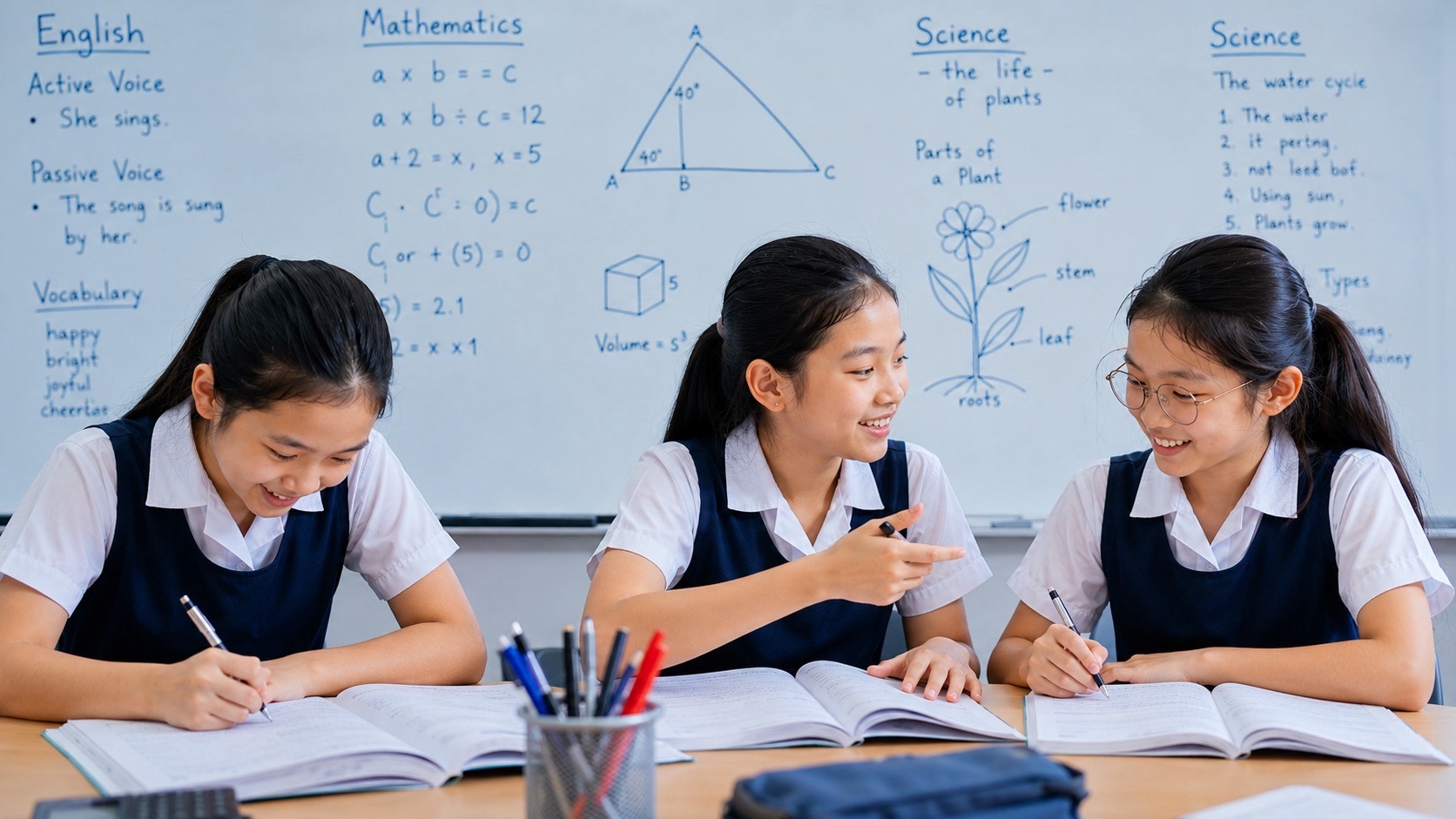
In a three-student tutorial, those foundations are easier to see. One pupil may count accurately but regroup poorly. Another may know number facts but misread the question. A third may understand the story yet lack a representation for it. The useful loop is Read → Diagnose → Prioritise → Repair → Practise → Connect → Perform → Review. Primary 2 is an excellent year to establish that learning habit before Primary 3 adds more topics and more multi-step reasoning.
Primary 2 Is About Seeing Relationships Between Numbers
At Primary 2, Mathematics should gradually move beyond “What answer do I get?” toward “How are these numbers related?” A child who understands that 46 is four tens and six ones can regroup more reliably. A child who sees 8 + 7 as 8 + 2 + 5 can use number bonds strategically. A child who understands that subtraction reverses addition has more ways to check an answer.
This relational thinking matters because later Mathematics becomes increasingly symbolic. Number sense is the operating system underneath those symbols.
The First Weak Link Matters
A wrong answer in Primary 2 can come from several different causes:
- weak place value;
- slow number facts;
- confusion between addition and subtraction;
- difficulty understanding the story in a word problem;
- poor working layout;
- misreading money, time or measurement units;
- guessing from keywords rather than understanding the relationship.
The tutor should identify the earliest unstable step rather than simply assigning ten more questions of the same type.
Four Layers of Primary 2 Mathematics
1. Concept
Does the child understand what the operation means? Addition combines or increases. Subtraction can remove, compare or find a difference. Multiplication begins as equal groups. Division begins as sharing or grouping.
2. Representation
Can the child show the relationship using objects, drawings, number bonds, bar models, arrays or a number line?
3. Calculation
Can the child perform the arithmetic accurately enough for the concept to remain visible?
4. Execution
Can the child read carefully, write working neatly, include the correct unit and check whether the answer makes sense?
Place Value Should Be Flexible, Not Mechanical
Place value is one of the highest-transfer skills in lower-primary Mathematics. A child should know that 352 can be seen as 3 hundreds, 5 tens and 2 ones, but also as 35 tens and 2 ones when regrouping is useful. This flexibility supports written algorithms, mental calculation and later decimals.
Useful practice includes building numbers, partitioning numbers in more than one way, comparing magnitude and estimating before calculating.
Addition and Subtraction Should Form One System
Children sometimes learn addition and subtraction as separate chapters. A stronger approach connects them. If 37 + 25 = 62, then 62 − 25 = 37 and 62 − 37 = 25. This inverse relationship makes checking easier and strengthens problem-solving choices.
Number bonds also help children decompose numbers strategically. Instead of counting every step, the learner can bridge through a ten or hundred. The goal is not one compulsory mental method. The goal is flexible and accurate number relationships.
Multiplication Should Begin With Equal Groups
At Primary 2, multiplication should feel like a meaningful structure before it becomes a table to memorise. Arrays, repeated addition and equal groups make the idea visible. Three groups of four can be represented as 4 + 4 + 4 or 3 × 4.
Times-table fluency can then grow through short, spaced retrieval. Memorisation is useful, but it is safer when the child knows what the fact represents.
Division Has Two Meanings
Division can mean sharing equally or finding how many groups fit. Twelve sweets shared among three children asks for the amount in each share. Twelve sweets packed four per bag asks for the number of groups. Both use division, but the story is different.
Teaching these two meanings early improves word-problem translation and prepares the child for fractions.
Simple Fractions Need a Clear Whole
A half, third or quarter only makes sense relative to a whole divided into equal parts. Children should work with shapes, sets and number-line representations so they do not think “the denominator is just the number underneath”.
Visual understanding is especially important because later fraction procedures become much easier when the concept is stable.
Money, Time and Measurement Are Mathematics in Context
Money, time and measurement reveal whether number knowledge transfers into daily situations. A child may add correctly yet struggle to interpret dollars and cents. A child may read a clock face but confuse elapsed time. A child may measure accurately but choose an unreasonable unit.
Good tuition connects these topics to real objects, routines and estimation. Before calculating, the child should ask what kind of quantity is being measured and what unit makes sense.
Picture Graphs Teach Data Reading
Picture graphs are an early form of data interpretation. The child must understand the key, compare quantities and answer questions about totals or differences. This looks simple, but it trains a valuable habit: read the representation before calculating.
Word Problems Need a Stable Reading Routine
Keyword hunting is fragile. “More” does not always mean add, and “left” does not always mean subtract. A better Primary 2 routine is:
- Read the story once.
- Identify what is known.
- Underline what is being asked.
- Say the relationship in simple words.
- Draw a bar or simple picture if useful.
- Choose the operation.
- Write the answer with the correct unit.
This gives the child something dependable to do even when the wording changes.
Bar Models Should Grow Naturally From the Story
Primary 2 is a good stage for simple part-whole and comparison bars. The child should be able to explain what each bar represents and where the unknown lies. The drawing does not need to be beautiful. It needs to preserve the relationship.
Fluency Should Support Reasoning
Fast recall of number bonds and early multiplication facts reduces cognitive load. But speed should not become the only goal. A child who answers quickly but cannot explain the relationship may struggle when the numbers or context change.
Short, frequent retrieval is generally more useful than long repetitive drill because it keeps the facts available without turning the lesson into endurance practice.
A Three-Student P2 Maths Lesson Can Make Learning Visible
- Retrieval: number bonds, place value or times-table facts.
- Cold attempt: a fresh word problem shows what the child can do alone.
- Diagnosis: identify concept, representation, calculation or execution.
- Repair: explain the missing relationship with a suitable model.
- Focused practice: complete a few carefully varied questions.
- Compare: discuss another possible method.
- Transfer: solve a changed question without hints.
- Review: record the next priority.
Three pupils are enough for peer explanation, but few enough that every attempt remains visible.
Feedback Should Name the Next Action
- “You added correctly, but this question compares two amounts.”
- “Your answer is right; now show the tens and ones regrouping clearly.”
- “The multiplication fact is correct, but the story describes sharing.”
- “You measured the length accurately, but the unit should be centimetres.”
Specific feedback gives the child a behaviour to change on the next attempt.
The Independence Test
A skill is not secure only because the child succeeds immediately after watching the tutor. Change the numbers, change the wording, remove the model or retest several days later. If the learner can still recognise the relationship, the learning is becoming durable.
How Parents Can Read a Primary 2 Marked Paper
- Are errors mostly in place value?
- Does regrouping break down?
- Does the child avoid word problems?
- Are multiplication and division stories confused?
- Are money or time units misread?
- Does the child rely on adult prompts to start?
These patterns reveal what tuition should actually repair.
A Useful Primary 2 Weekly Routine
- Review one place-value or number-bond idea.
- Retrieve a short set of facts.
- Attempt one unfamiliar word problem.
- Repair the first weak link.
- Practise two variations.
- Use one real-life money, time or measurement task.
- Explain one solution aloud.
- Retest later in the week.
Strong Primary 2 Learners Need Better Questions, Not Just Bigger Numbers
Extension can ask a child to solve the same problem another way, explain why a method works, create a similar question, estimate before calculating or identify a tempting wrong answer. These tasks grow reasoning without rushing unnecessarily into later-level topics.
Students Who Are Behind Need Calm Foundation Repair
Weak place value or number bonds can make almost every other topic harder. Repairing these foundations is often more valuable than pushing ahead through more worksheets. Once number relationships become clearer, calculation and word problems usually become less stressful.
Questions Parents Can Ask a Yishun Primary 2 Maths Tutor
- How do you diagnose whether my child lacks number sense or simply needs more fluency?
- How do you teach regrouping conceptually?
- How do you introduce multiplication and division?
- How do you teach word problems without keyword dependence?
- How do you track repeated errors?
- How do you know when a skill has become independent?
Related Mathematics Guides on eduKateYishun
Families can also read the Primary Maths Tuition Centre in Yishun guide and the Yishun Tuition Centre for Maths guide. To see the next transition, continue to Primary 3 Maths tuition in Yishun.
What Progress Should Look Like by the End of Primary 2
- place value is stable;
- number bonds are increasingly flexible;
- addition and subtraction are connected;
- multiplication and division have meaning;
- simple fractions make sense visually;
- word problems are started with a routine rather than avoided;
- money, time and measurement units are used more accurately;
- the tutor gives fewer prompts.
The Real Goal of Yishun Maths Tuition Primary 2
Primary 2 should build a mathematical foundation sturdy enough for the larger transition in Primary 3. Good tuition strengthens number sense, makes operations meaningful, teaches children to represent a word problem and gradually hands the thinking back to them.
The best sign of progress is not merely a faster worksheet. It is a child who can read, represent, calculate, check and explain with increasing independence. Properly taught kids shine a bright light into the future.
Leave a Reply