
Ownership note: this retained eduKateYishun URL keeps its Punggol Additional Mathematics search history, while its useful job is diagnosing symbolic reasoning, algebraic dependency and transfer in A-Math. Current Punggol Additional Mathematics tuition decisions belong with eduKatePunggol Additional Mathematics; deeper A-Math specialist depth belongs with Bukit Timah Tutor Additional Mathematics. This page remains a Yishun diagnostic/recovery companion.
Families searching for Punggol Maths Tuition Additional Maths, an Additional Mathematics tutor in Punggol or small-group A-Math tuition are usually dealing with a subject where symbolic reasoning becomes much denser than ordinary Mathematics. Additional Mathematics asks students to control algebra, quadratic functions, equations, polynomials, graphs, coordinate geometry, trigonometry and calculus as one connected system. Good tuition should therefore do more than demonstrate worked examples. It should diagnose the first weak link, repair it precisely and train the student to recognise methods without waiting for a hint.
Strong Additional Mathematics support should emphasise algebra fluency, quadratics, functions, polynomials, trigonometry, coordinate geometry, calculus, mixed-topic practice, error analysis and examination control. The important distinction is between knowing a procedure and knowing when to use it. A student may factorise well on a factorisation worksheet yet fail to recognise that factorisation is the opening move inside a graph or equation problem. A student may know differentiation rules but not see why the question is asking about rate of change.
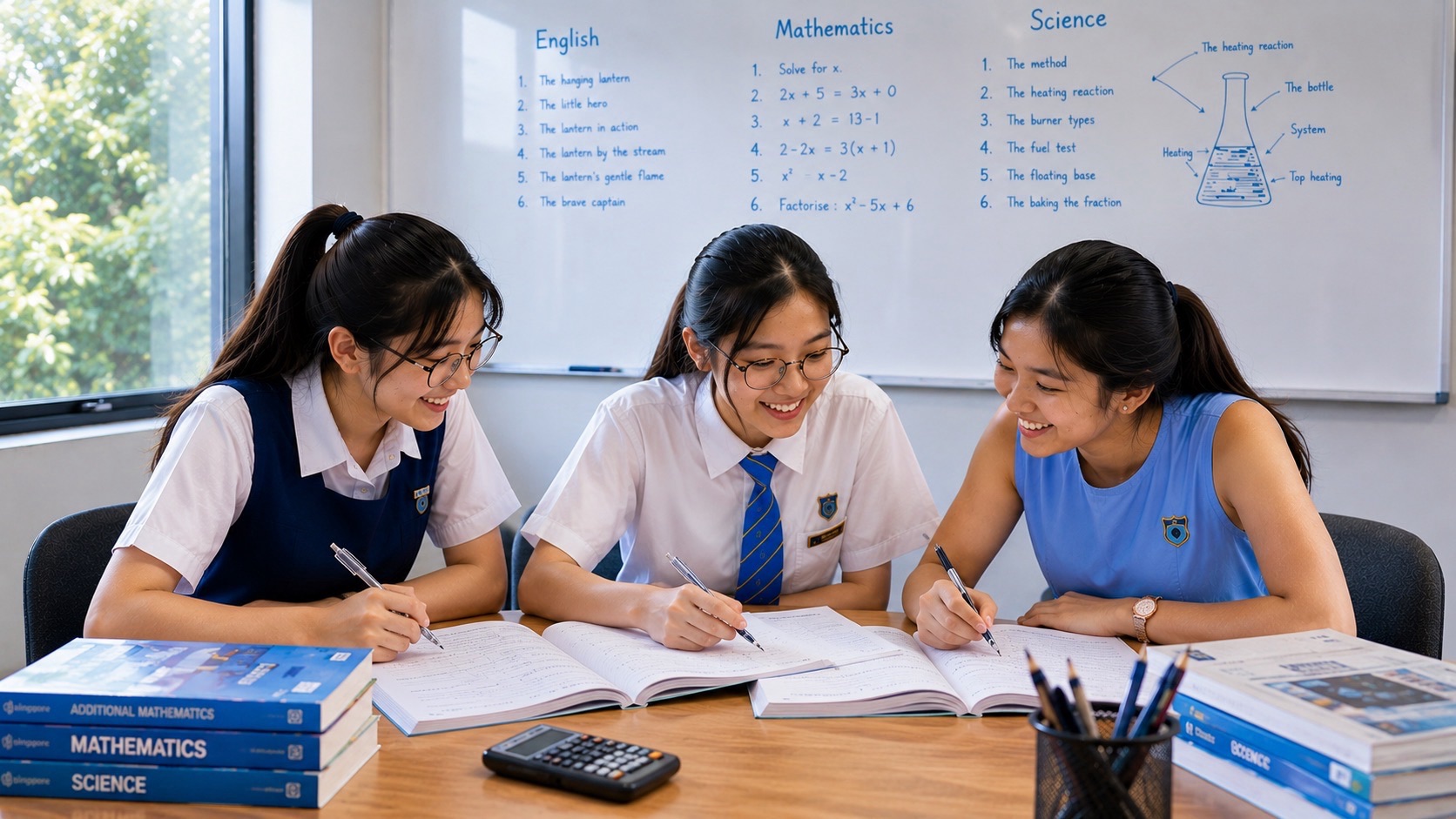
In a three-student tutorial, these differences become visible quickly. One student may lose signs while expanding brackets, another may understand quadratics but choose methods inefficiently, and a third may know the mathematics yet produce working that is too compressed to audit. The useful loop is Read → Diagnose → Prioritise → Repair → Practise → Connect → Perform → Review. The goal is an independent mathematical operating system, not permanent dependence on the tutor.
Why Additional Mathematics Feels Different
The subject increases symbolic density. A single line can contain brackets, fractions, indices, variables and several transformations. Every step must preserve the relationship. One small sign error can damage several later lines.
Additional Mathematics also rewards structural recognition. Students need to see whether an expression should be factorised, whether a quadratic should be solved or analysed as a function, whether a graph can reveal a relationship more clearly, and whether a calculus method is describing change or accumulation.
Algebra Is the Engine
Weak algebra makes every later topic expensive. Expansion, factorisation, algebraic fractions, indices, substitution and rearrangement should become reliable enough that attention can stay on the deeper problem.
Fluency should be built through short mixed retrieval rather than endless repetitive pages. The aim is dependable access, not speed without understanding.
Quadratics Should Be Seen in Several Forms
A quadratic can appear as an expression, equation, function or graph. Different forms reveal different information.
- Factorised form can make roots visible.
- Completed-square form can make turning-point structure clearer.
- Expanded form exposes coefficients.
- The graph shows how these algebraic facts behave visually.
Students become more flexible when they can move among these representations instead of memorising separate procedures.
Equations Need Method Selection
Not every equation should be solved by the same route. Factorisation may be efficient when structure is friendly. A general method may be safer in another case. The student should learn to inspect the expression before choosing the procedure.
Polynomials Reward Structural Reading
Polynomial questions often look long but can become compact when a factor or remainder relationship is recognised early. Students should translate verbal conditions into algebra before beginning lengthy manipulation.
Coordinate Geometry Connects Algebra and Shape
Gradient, midpoint, distance and line equations are geometric relationships written algebraically. Students should move comfortably between a diagram and an equation. This becomes especially important in mixed questions where the topic is not labelled.
Trigonometry Starts With Structure
Before selecting an identity or formula, identify what the diagram or expression is saying. Label known quantities, determine the relevant angle or relationship, and only then select the mathematical tool.
This reduces the common habit of trying formulas until one appears to fit.
Calculus Should Be Taught as Change and Accumulation
Differentiation is easier to remember when students understand it as rate of change and gradient. Integration is easier when students see it as accumulation or recovery of a quantity. Meaning makes the rules more durable.
Contrast Practice Trains Recognition
Place two similar-looking questions side by side and ask why they require different methods. This teaches the decision boundary between methods.
- Why does one quadratic factorise neatly while another needs a different route?
- Why is one graph question solved algebraically while another is interpreted geometrically?
- Why does one trigonometry question require an identity while another is a direct ratio problem?
Error Logs Should Record Causes
An error log is useful when mistakes are classified rather than merely copied.
- recognition error;
- sign error;
- factorisation error;
- formula or identity recall error;
- diagram-reading error;
- notation error;
- time-management error.
Patterns then become visible across chapters.
A Three-Student Additional Mathematics Lesson
- Retrieval: one high-transfer algebraic skill.
- Cold problem: observe independent method recognition.
- Diagnosis: find the first weak link.
- Repair: reteach the missing structure.
- Focused practice: stabilise the method.
- Contrast: compare with a similar-looking question needing another route.
- Independent transfer: solve without hints.
- Review: update the error map.
The Independence Test
A student has not mastered a method if it works only immediately after the tutor demonstrates it. Change the numbers, wording or representation. Delay the retest. Mix the topic with another one. Remove the prompt. Ask why the chosen method fits.
How Parents Can Read an A-Math Test
- Are marks lost mainly through algebraic slips?
- Does the student leave unfamiliar questions blank?
- Are methods known but selected slowly?
- Do long solutions become hard to follow?
- Are diagrams and graphs interpreted carefully?
- Can corrections be completed independently?
Strong Students Need Structural Depth
Extension can ask students to derive relationships, compare two methods, find a shorter route, explain why a shortcut fails or change one condition and predict the effect. These tasks build flexible control.
Students Who Are Behind Need Algebraic Triage
When several topics are weak, prioritise expansion, factorisation, equations, fractions, indices and rearrangement. These skills have wide transfer value across the subject.
Questions Parents Can Ask an Additional Mathematics Tutor
- How do you distinguish algebra errors from concept errors?
- How do you teach method recognition?
- How do you track repeated sign and manipulation errors?
- When do you introduce mixed-topic practice?
- How do you prepare students for timed examination work?
- How do you reduce prompting over time?
The Real Goal of Punggol Additional Mathematics Tuition
Additional Mathematics tuition should build a student who can read symbolic structure, select a method, manipulate accurately, connect algebra to graphs and geometry, and recover when the first route fails.
The strongest result is not a memory of hundreds of copied solutions. It is a working system for understanding unfamiliar Mathematics. Properly taught kids shine a bright light into the future.
Leave a Reply