
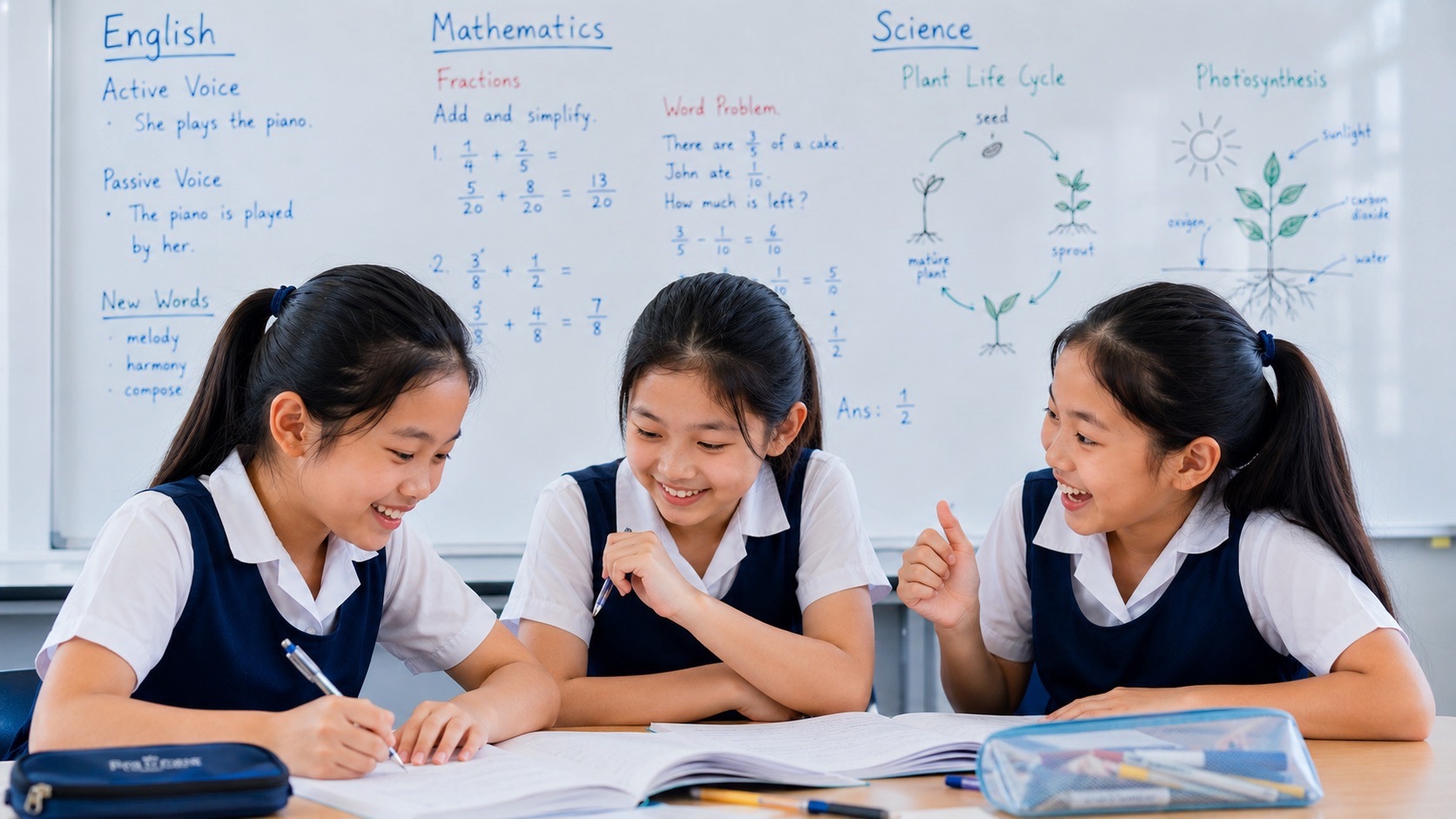
Ownership note: this retained eduKateYishun Punggol Primary 2 English tutorial URL remains useful for fluency, meaning and increasingly independent reading/writing. Present-day Punggol Primary 2 tuition and family decisions belong with eduKatePunggol Primary 2 English; specialist English language and examination depth belongs with the SETC English Atlas. Keep this page as a Yishun learning/recovery companion rather than a competing Punggol or English-specialist owner.
Primary 2 English Tutorials in Punggol should help a child cross an important bridge: from decoding and reading short texts toward fluent comprehension, connected speaking and early paragraph writing. Families searching for Primary 2 English tuition in Punggol, P2 English tutor, reading fluency, comprehension, grammar, vocabulary, spelling, writing or small-group English tutorials often notice that a child can read the words but does not always hold the meaning across several sentences.
Primary 2 is the right year to strengthen the connection between phrased reading, retelling, vocabulary in context, pronoun reference, sequence, cause and effect, sentence combining and paragraph meaning. Strong tuition should not treat these as unrelated worksheet components. Each one supports the next.
A useful tutorial loop is read fluently → retell → locate evidence → explain the relationship → write a connected response → reread and revise. The goal is to help the child carry meaning across a short text rather than process one sentence at a time.
Primary 2 fluency should free attention for meaning
When reading remains effortful, much of the child’s attention is spent recognising words. As common words become automatic and phrasing improves, more attention becomes available for comprehension.
- read in meaningful phrases;
- pause at punctuation;
- reread difficult sentences;
- notice when a sentence does not make sense;
- self-correct where possible.
Fluency is valuable because it supports understanding, not because fast reading wins a race.
Retelling should become more structured
Primary 2 students can begin retelling with sequence and causality.
- At first…
- Then…
- Because…
- So…
- Finally…
These connectors help the child hold the story as a chain rather than a collection of details.
Pronoun reference is a real comprehension skill
Words such as he, she, it, they, this and that can quietly break comprehension if the child loses track of what they refer to.
- Who does “he” refer to?
- What does “it” refer to?
- What event does “this” describe?
Tracing reference strengthens both reading and writing.
Vocabulary should be learned from context
Primary 2 students can start using surrounding clues to infer meaning.
- What happened before the word?
- What happened after?
- Is the character pleased, worried or angry?
- Which word could replace it without changing the sentence too much?
The child should then use the new word in a different sentence to prove understanding.
Literal comprehension should become evidence-based
Even direct questions should train evidence habits.
- Read the question.
- Find the relevant sentence.
- Check exactly what is being asked.
- Answer in a complete form.
- Return to the text to verify.
This creates the groundwork for inference in later Primary years.
Cause and effect should appear in reading and writing
Ask the child to connect events rather than merely list them.
| Reading question | Writing transfer |
|---|---|
| Why did the character run? | Write what caused an action |
| What happened because of the rain? | Show a consequence |
| Why did the plan fail? | Connect problem to outcome |
One relationship can therefore strengthen comprehension and composition together.
Sentence combining builds early paragraph control
Instead of writing five disconnected simple sentences, students can learn to combine related ideas.
- and for addition;
- but for contrast;
- because for cause;
- so for consequence;
- when for time.
The aim is not longer sentences for their own sake. The aim is clearer relationships.
Paragraphs should have one clear centre
A Primary 2 paragraph can be taught as a small cluster of sentences about one main event or idea.
- opening sentence introduces the event;
- middle sentences develop it;
- final sentence closes or leads onward.
This is a gentle bridge toward fuller composition writing.
Grammar should be used to improve clarity
Grammar correction should answer the question: what meaning does the correct form protect?
- tense keeps time consistent;
- pronouns keep reference clear;
- subject-verb agreement keeps sentence structure stable;
- punctuation separates ideas.
Students remember grammar better when it solves a communication problem.
Spelling should move into independent checking
The tutor can teach a simple check:
- say the word slowly;
- look for known chunks;
- write the best attempt;
- compare with the correct form;
- retrieve it again later.
The child begins to become responsible for noticing uncertainty.
Oral work should become more complete
Instead of one-word responses, encourage:
- answer + reason;
- observation + explanation;
- opinion + example;
- retelling + sequence.
Longer oral responses make later writing less intimidating because the child has already practised organising ideas aloud.
A Primary 2 tutorial should diagnose where meaning breaks
- word recognition;
- sentence meaning;
- reference words;
- sequence;
- cause and effect;
- vocabulary;
- writing connection.
Repair the earliest broken layer rather than assuming every weak comprehension score needs more comprehension worksheets.
Small groups can compare retellings
One child may notice the main event, another may remember a detail and a third may explain the cause. The tutor can combine the strengths, then ask each learner to retell independently.
Shared discussion should lead to individual control.
Homework should connect reading and writing
- read a short passage;
- retell it orally;
- answer one evidence question;
- use one new word;
- write a short connected paragraph.
A small connected task is often more useful than several unrelated worksheets.
What parents should ask about Primary 2 English tutorials
- Is fluency linked to comprehension?
- Does the tutor teach reference words and sequence?
- Is vocabulary learned in context?
- Do reading relationships transfer into writing?
- Are paragraphs taught as connected ideas?
- How is independent checking developed?
What progress looks like
- Reading becomes smoother without losing meaning.
- Retellings include clearer sequence.
- Reference words cause less confusion.
- Vocabulary is used more flexibly.
- Sentences connect more naturally.
- Paragraphs stay on one idea longer.
The deeper purpose of Primary 2 English
Primary 2 is where literacy begins to feel less like a set of beginning skills and more like a system for understanding and communicating ideas.
A child who can read fluently, hold meaning across several sentences, explain relationships and write a connected paragraph is entering Primary 3 with a much stronger base for academic reading.
Related English guides
- Primary 1 English Tutorials in Punggol
- Primary 3 English Tutorials in Punggol
- MOE English Language Syllabus 2020 — Primary
Continue through Primary 2 English: Primary 1–3 article index · Primary English directory · English by area & school · Diagnostics · Examinations · Library
Leave a Reply