
Locality and ownership note: this retained eduKateYishun Kovan Primary 1 Mathematics URL is historical search continuity, not evidence of a current eduKate Kovan branch, tutor assignment, class or vacancy. Specialist Primary 1 Mathematics teaching belongs with the BTT Primary Mathematics Learning Hub. eduKateYishun keeps the diagnostic, recovery and return-to-learning layer. Preserve the Kovan title for URL/history continuity rather than treating it as a current locality service claim.
Families searching for Kovan Maths Tuition Primary 1, a Primary 1 Maths tutor in Kovan or small-group Primary Mathematics tuition are usually trying to help a young child build confidence and strong foundations from the beginning. Primary 1 Mathematics develops number sense, counting, comparing quantities, addition, subtraction, simple shapes, measurement, time, money, patterns and early word-problem reasoning. Good tuition should make these ideas understandable, not merely make the child finish worksheets faster.
Strong Primary 1 support should therefore build number sense, number bonds, place value, addition and subtraction, visual models, simple bar models, problem-solving language, mental Maths and checking habits. A child who sees 8 as 5 + 3, 4 + 4 and 10 − 2 is developing flexible number sense. A child who can explain why an answer makes sense is building something more durable than speed alone.
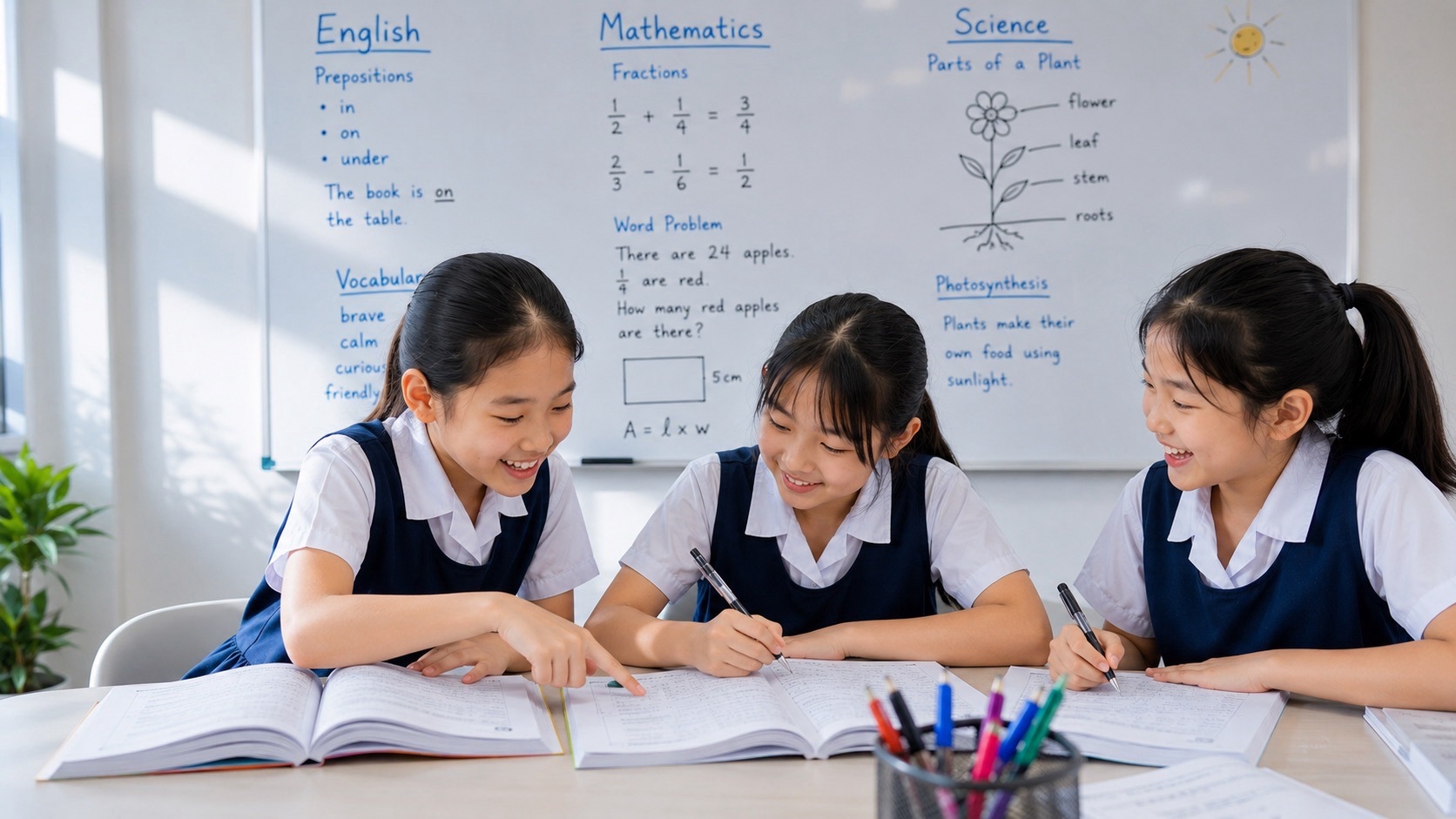
In a three-student tutorial, early misunderstandings become visible. One child may count accurately but not recognise groups, another may confuse addition and subtraction stories, and a third may understand the arithmetic but struggle to express what a simple word problem is asking. The useful loop is Read → Diagnose → Prioritise → Repair → Practise → Connect → Perform → Review, adapted gently for young learners.
Primary 1 Mathematics Should Begin With Meaning
Young children need to know what numbers represent before speed matters. Counting objects, comparing groups and using number lines help them build a mental picture of quantity.
Speed can grow later. Understanding should come first.
Number Sense Is the First Big Foundation
Number sense includes recognising quantity, comparing numbers, seeing part-whole relationships and estimating. A child with strong number sense can often solve a simple problem in several ways.
- 7 can be 5 + 2.
- 10 can be 6 + 4 or 7 + 3.
- 9 is one less than 10.
- 12 is two more than 10.
These relationships later support mental arithmetic, regrouping and multiplication.
Place Value Begins With Tens and Ones
When children move beyond single-digit numbers, they should understand that 34 means three tens and four ones. This makes larger numbers meaningful and prepares the child for addition and subtraction with regrouping later.
Addition Should Be Seen as Combining and Increasing
Children can connect addition to real situations: combining two groups, adding more objects or moving forward on a number line. Number bonds show how parts form a whole.
Subtraction Has More Than One Meaning
Subtraction can mean taking away, finding what remains or comparing two quantities. Understanding these different stories helps the child rely less on keywords.
Number Bonds Build Flexible Mental Maths
Number bonds help children decompose a number into useful parts. Instead of counting 8 + 5 one-by-one, the child can make ten: 8 + 2 + 3 = 13.
The goal is not one compulsory method. It is a flexible toolkit.
Word Problems Are Stories About Quantities
A simple Primary 1 routine can be:
- Read the story.
- Identify the quantities.
- Say what is happening.
- Draw a simple picture or bar if useful.
- Choose the operation.
- Answer with the correct object or unit.
This is safer than memorising that one word always means one operation.
Simple Bar Models Can Begin Early
A whole bar can show the total. Two smaller bars can show parts. A comparison model can show which quantity is larger and by how much. The child should always explain what the model represents.
Shapes and Measurement Should Stay Concrete
Young learners benefit from handling and observing real objects. They can compare lengths, sort shapes, identify corners and sides, and measure with familiar units. Mathematical language becomes easier when it is connected to things they can see.
Time and Money Build Everyday Confidence
Reading simple clock times, counting coins and comparing amounts show the child that Mathematics describes everyday life, not only worksheets.
Patterns Develop Early Algebraic Thinking
A repeating or growing pattern encourages the child to ask what stays the same and what changes. This is an early form of algebraic reasoning.
Fluency Should Grow Through Short Retrieval
Number bonds and basic facts can be strengthened in short, frequent sessions. A few focused minutes often help more than a long worksheet completed after attention has faded.
Feedback Should Be Clear and Encouraging
- “You counted accurately; now see whether you can make ten first.”
- “Your answer is right. Show me the number bond.”
- “You chose subtraction. Tell me what is being compared.”
- “The picture is useful. Label what each part means.”
A Three-Student Primary 1 Maths Lesson
- Warm-up: quick number recognition and relationships.
- Concrete task: make the idea visible with objects or drawings.
- Guided practice: solve several examples together.
- Independent attempt: each child solves without copying.
- Compare: discuss another way to see the relationship.
- Word problem: connect the skill to a story.
- Review: decide what needs another short cycle.
The Independence Test
Change the numbers, picture or wording and remove the worked example. If the child can still explain the idea and solve, the learning is becoming durable.
How Parents Can Read Primary 1 Maths Work
- Does the child count every time rather than seeing number relationships?
- Are tens and ones understood?
- Are addition and subtraction stories confused?
- Can the child explain a simple model?
- Does the child avoid word problems?
- Can the child check whether an answer is sensible?
Strong Primary 1 Learners Need Better Questions
Extension can ask children to find another way, create a similar problem, explain why two answers differ or predict what happens when one quantity changes. This deepens thinking without rushing into later-level content.
Students Who Are Struggling Need Calm Foundation Repair
If a child struggles with number recognition, counting or part-whole relationships, repair these explicitly and patiently. Confidence grows when the child experiences successful understanding.
Questions Parents Can Ask a Primary 1 Maths Tutor
- How do you build number sense before speed?
- How do you teach number bonds and place value?
- How do you introduce word problems?
- How do you use models without creating dependence?
- How do you track repeated misconceptions?
- How do you know when a child can work independently?
What Progress Should Look Like in Primary 1
- numbers feel meaningful rather than abstract;
- number bonds become more flexible;
- addition and subtraction stories are distinguished more accurately;
- simple models can be explained;
- word problems are approached with less anxiety;
- the child solves more without adult prompting.
The Real Goal of Kovan Maths Tuition Primary 1
Primary 1 tuition should help a young learner become curious, accurate and increasingly independent. The foundations built here—number sense, representation, careful reading and confidence—support every later year of Mathematics.
The strongest outcome is not a child who finishes worksheets fastest. It is a child who can explain what the numbers mean and begin solving with confidence. Properly taught kids shine a bright light into the future.
Leave a Reply