
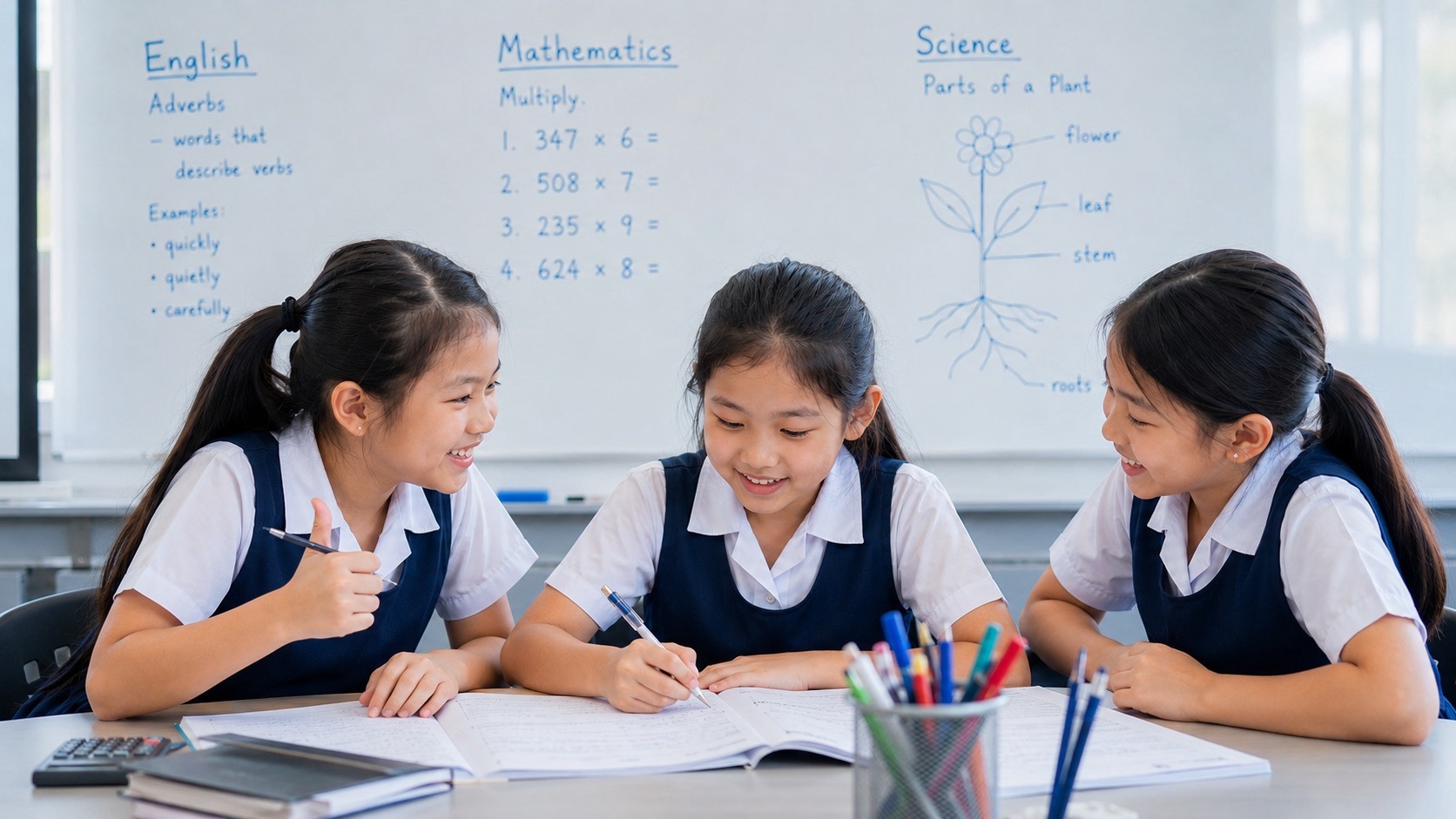
A student can know many Primary 4 Science facts and still be fragile. The problem appears when the question changes shape. The diagram is unfamiliar. The object is replaced. Two topics are combined. The wording looks different. The child suddenly stops seeing Science and starts seeing uncertainty.
This guide is about what happens next. It is designed for students who need to move beyond memorised answers into reasoning that can travel. The central question is not only, “Does the student know the fact?” It is, “Can the student recognise when the fact applies, connect it to evidence, reject tempting wrong ideas, and use the idea in a new situation?”
Primary 4 is an excellent stage for this work because the Science is concrete enough to investigate directly while already rich enough to expose misconceptions. Students meet matter, plant parts and functions, the digestive system, light and heat, while continuing to draw on earlier learning about materials, life cycles and magnets. The curriculum is not a pile of isolated chapters. It is a network of ideas about how things behave, change, interact and form systems.
Choose the route that matches the problem
- The child memorises but cannot explain.
- The child has persistent wrong ideas.
- The child is fine with familiar worksheets but struggles with new contexts.
- The child understands orally but writes weak answers.
- The child is strong and needs deeper reasoning.
Route 1 — From memory to explanation
Read Chapters 1 to 6. The focus is on moving from labels and definitions to mechanisms. The child should be able to say not only what something is, but what it does, what causes it and what would happen if a condition changed.
Route 2 — Repair wrong models
Read Chapters 7 to 12. These sections address common misconceptions about matter, plants, digestion, light, heat and magnets. The goal is not to overwrite an incorrect sentence with a correct one. The child needs evidence that makes the old model fail.
Route 3 — Learn to transfer
Read Chapters 13 to 18. The work here is recognising the underlying scientific relationship when the surface features change. Transfer is what separates genuine understanding from pattern matching.
Route 4 — Turn thinking into marks
Read Chapters 19 to 22. These chapters focus on command words, evidence selection, causal language, comparison and correction. The child may understand the lesson but still need a reliable way to express that understanding under assessment conditions.
Route 5 — Build independence
Read Chapters 23 to 25 and attempt the workshops. Strong students need questions that resist immediate recognition. They should practise identifying assumptions, designing tests, judging evidence and explaining why tempting alternatives are wrong.
Contents
Part I — What understanding really means
1. Knowing is not the same as understanding
2. Build relationships, not lists
3. Structure and function
4. Cause and mechanism
5. Conditions matter
6. Explain both directions
Part II — Common misconceptions
7. Matter: melting is not dissolving
8. Plants do not eat soil
9. Digestion is not absorption
10. Eyes do not send out light
11. Heat is not temperature
12. Not every metal is magnetic
Part III — Transfer and unfamiliar questions
13. Change the object, keep the idea
14. System mapping
15. Relevant versus irrelevant properties
16. Mixed-topic questions
17. Predict before you calculate
18. Use counterexamples
Part IV — Turn reasoning into strong answers
19. Read the job of the question
20. Evidence, idea, link
21. Comparisons and contrasts
22. Correct errors properly
Part V — Independence and long-term growth
23. Retrieval and spacing
24. A four-week transfer cycle
25. Becoming a self-correcting learner
1. Knowing is not the same as understanding
Ask a Primary 4 student what roots do and you may receive a perfect answer: “Roots absorb water and mineral salts and anchor the plant.” That is useful knowledge. Now change the question. A plant is placed in a container where its roots are damaged but its leaves remain intact. After several days the plant wilts. Explain why.
The memorised sentence is still relevant, but the student must now use it. The damaged roots cannot perform their functions properly. Less water can be absorbed. The plant system is affected. Wilting is an outcome of a failure in a connected system. That movement from statement to application is understanding.
The same difference appears in every topic. A child may know that light travels in straight lines but fail to predict a shadow when the source moves. A child may know that heat moves from a warmer region to a cooler region but still say that a metal spoon “creates heat”. A child may know the names of digestive organs but fail to explain why food must be broken into simpler substances before nutrients can be absorbed effectively.
Understanding means the idea can do work. It can predict, explain, compare and survive variation. A definition stored in memory is only the starting point.
We therefore use a simple test after every new concept: Can you explain it, reverse it and transfer it? Explain it means say why it happens. Reverse it means infer the cause from the outcome. Transfer it means use the same relationship in a new setting. If the child can do all three, the concept is beginning to become robust.
2. Build relationships, not lists
Science notebooks are often organised as lists. Parts of a plant. States of matter. Properties of materials. Stages of digestion. Characteristics of magnets. Lists are useful for retrieval, but they can hide the relationships that make Science usable.
Relationships matter because questions almost always involve change or comparison. Roots are connected to water uptake. Water uptake is connected to plant condition. Materials have properties. Properties affect suitability for a use. Light travels from a source and interacts with objects. Blocking light can create a shadow. Heat transfer produces temperature change. The digestive system changes food so useful substances can be absorbed.
One useful note-making format is a relationship chain rather than a page of isolated definitions. For example:
opaque material → blocks light → less light reaches the region behind the object → shadow forms
damaged roots → reduced water absorption → plant system receives less water → wilting may occur
warmer object next to cooler object → heat transfers from warmer to cooler → temperatures change
These chains are not model answers to memorise. They are maps of causality. The wording can change while the relationship remains.
3. Structure and function
A recurring scientific question is: why is something built this way? Structure and function are linked. A root’s branching pattern increases contact with soil. A stem provides support and transport. A transparent window allows light to pass. A pan handle is made from a material chosen to reduce unwanted heat transfer to the hand. Teeth have shapes suited to different mechanical jobs in food processing.
Students often memorise the structure and the function separately. Transfer improves when they connect them. If the function changes, what structure would help? If the structure is damaged, what function would be affected?
For example, consider a fictional plant with extremely shallow roots in dry soil. What problem might arise? The student should reason from root function to access to water, not search for an exact textbook sentence. Or imagine a cooking tool with a metal handle. What risk appears? The answer comes from heat transfer and material choice.
This structure-function lens becomes a powerful transfer tool because it applies across living and non-living systems.
4. Cause and mechanism
Primary Science answers often fail because the student gives a cause without the mechanism. “The water evaporated because it was hot.” “The plant grew poorly because there was less light.” “The ice melted because the room was warm.” These statements may point in the right direction but still leave the central process unstated.
A mechanism tells the story between the condition and the outcome. In the ice example, heat transfers from the warmer surroundings to the colder ice. In a light question, a material blocks or transmits light. In a plant question, a change in available water or light affects processes in the plant system. In digestion, physical and chemical changes make food simpler so nutrients can be absorbed.
We teach a flexible causal frame: condition → process → outcome. It is not a formula to write mechanically. It is a way to check whether the middle of the explanation exists.
If a student cannot name the process, we return to the concept. If the process is known but omitted in writing, we train answer construction. Diagnosis matters because the two problems look similar on paper but require different teaching.
5. Conditions matter
Students like universal rules because they are easy to memorise. Science often teaches conditional rules instead.
“Metals conduct heat well” is useful, but not every metal object behaves identically in every situation because thickness, shape and temperature conditions matter. “Objects cast shadows” is incomplete because a shadow depends on a light source, an object that blocks enough light and a surface or region where the difference can be observed. “Plants need light” is meaningful only when we also consider time, plant type, water supply and other environmental conditions.
This is why scientific language often includes phrases such as “under the same conditions”, “when other factors are kept constant” or “based on the data provided”. Conditions protect us from overgeneralising.
A strong student asks: When is this rule true? What conditions does it depend on? What would make the result different? Those questions deepen understanding without requiring advanced content beyond Primary 4.
6. Explain both directions
Students are usually taught from cause to effect. Add heat and a solid may melt. Block light and a shadow may form. Damage roots and a plant may wilt. Stronger reasoning also travels backward from effect to possible cause.
If a student observes that a shadow became larger, what changes could have caused it? The position of the light source, object or screen may have changed. If one cup cooled faster, which conditions could explain the difference? Material, surface exposure, volume or starting temperature might matter. If a plant wilted, lack of water is one possibility but not the only one.
Backward reasoning prevents the child from believing that one outcome has only one possible explanation. It also prepares them to evaluate experiments because they begin to ask whether another factor could have caused the observed result.
A useful exercise is “many causes, one effect”. Give an observation and ask for three scientifically plausible causes. Then ask what evidence would distinguish among them. This turns a simple question into genuine inquiry.
7. Matter misconception: melting is not dissolving
Children often use the word “disappear” for both melting and dissolving. That everyday word hides an important distinction.
When ice melts, solid water changes state to liquid water. The substance remains water. When sugar dissolves in water, the sugar does not become liquid sugar. It becomes distributed throughout the water to form a solution. These are different processes.
The misconception survives if students only copy definitions. It weakens when they encounter contrasting evidence. Melt ice and recover the water. Dissolve salt and then evaporate the water carefully to recover the salt. The processes produce different observable outcomes.
Another useful contrast is melting versus evaporation. Melting changes a solid to a liquid. Evaporation changes a liquid to a gas at the surface. A puddle does not “melt away”. Precise verbs organise precise thinking.
Quick diagnostic
Ask the student to classify four situations: an ice cube becoming water, sugar mixed into water, a wet floor drying, and water droplets forming on the outside of a cold cup. Require a reason for every label. The reasons reveal whether the process is understood.
8. Plant misconception: plants do not eat soil
Young children sometimes imagine roots eating soil because roots are underground and plants grow larger. The picture is intuitive but scientifically weak.
Roots absorb water and mineral salts from the soil and anchor the plant. The plant’s mass does not simply come from soil disappearing into the roots as food. At later levels students learn more about photosynthesis, but even in Primary 4 the key correction is clear: soil provides water and mineral salts; roots perform absorption and support functions.
A useful evidence question is: if plants ate soil directly, what changes in soil mass would we expect as a plant grew? Historical experiments eventually helped scientists realise the story was more complicated. We need not teach that history in detail to Primary 4 students, but the reasoning move is valuable: ask what evidence the misconception predicts.
Students should also avoid another misconception: roots “drink” in the same way humans drink. Everyday language can be useful for young learners, but as scientific understanding grows, replace it with the more precise verb absorb.
9. Digestion misconception: digestion is not absorption
Digestion and absorption are connected, which makes them easy to collapse into one idea. They should be separated before they are reconnected.
Digestion breaks food into simpler substances. Absorption is the movement of digested nutrients into the body where they can be transported and used. One prepares; the other transfers.
A student who says “food is absorbed in the stomach because it is digested there” may be mixing the processes. A better system view follows the journey: food is physically broken down and chemically digested in stages; simpler substances are then absorbed mainly through the intestines according to the Primary curriculum.
We use a transport analogy carefully. Imagine a large parcel that cannot fit through a small opening. Digestion is like breaking the parcel into smaller packages; absorption is like moving the smaller packages across the boundary. The analogy is not literal biology, but it highlights the distinction.
10. Light misconception: eyes do not send out light
Many children intuitively think seeing happens because the eye somehow reaches outward toward an object. The misconception is ancient; even early theories of vision struggled with it.
At Primary 4, the useful model is straightforward: light from a source reaches an object; some light is reflected from the object; that light enters the eye. In complete darkness, the object can still exist while remaining difficult or impossible to see because insufficient light reaches our eyes from it.
This model also supports shadow reasoning. Light travels in straight lines. An opaque object blocks the light. A region behind the object receives less light, producing a shadow.
A good misconception check asks: if eyes sent out light, why would a dark room prevent us from seeing? The contradiction gives the student a reason to revise the model.
11. Heat misconception: heat is not temperature
Heat and temperature are related but not identical. Temperature measures how hot or cold an object is. Heat is energy transferred because of a temperature difference.
Students often say “the object has more heat because its temperature is higher”. At Primary 4 we do not need to introduce complicated thermal-energy calculations, but we do need the conceptual distinction. A thermometer measures temperature. Heat transfer can change temperature.
Another misconception is that cold flows into a warmer object. If an ice cube is placed in water, students may say coldness moves from the ice into the water. The more useful explanation is that heat transfers from the warmer water to the colder ice.
Everyday language will continue to say “the cold came in” or “the heat escaped”. Scientific learning does not require banning everyday speech. It requires knowing when more precise language is necessary.
12. Magnet misconception: not every metal is magnetic
Because many familiar magnets stick to steel objects, children often generalise that all metals are attracted to magnets. Aluminium foil, copper wire and other examples quickly challenge that rule.
The correction is not “some metals are magnetic” as another sentence to memorise. The correction should include testing. Give several samples and let the evidence force a new classification.
A second misconception is that anything attracted to a magnet must itself be a magnet. A steel paper clip can be attracted without functioning like a permanent bar magnet. Repulsion is especially informative because unlike simple attraction to magnetic material, repulsion requires interacting magnetic poles.
This topic teaches an important reasoning principle: some observations discriminate between explanations better than others.
13. Change the object, keep the idea
Transfer training begins by changing surface details while preserving the scientific relationship.
If a student learns heat transfer with a metal spoon, change the spoon to a metal rod. Then to a pan handle. Then to two materials in contact. If the concept survives, the student understands more than a picture. If performance collapses, the student may have memorised the original context.
The same can be done with light. Start with a torch, object and screen. Then use sunlight through a window. Then use a lamp and several materials. The underlying questions remain: where is the light source, what path does light take, what blocks or transmits it, and how does the observer receive the light?
With plants, change the species, diagram orientation or container while preserving the root-stem-leaf relationships. With matter, change the substance but ask the same state-change reasoning. With experiments, change the topic while retaining the fair-test structure.
Variation is not decoration. It is how we test whether knowledge has become portable.
14. System mapping
When a question looks complicated, map the system before trying to name the topic.
- What are the parts?
- What enters?
- What leaves?
- What changes?
- What interacts?
- What is measured?
Consider a covered plant placed under a lamp. Parts include the plant, covering material, lamp and surrounding air. Inputs include light and water. The covering can change how much light reaches the plant. The plant’s condition or growth may be measured. Immediately the question becomes less mysterious.
Or consider a cup of hot water wrapped in different materials. Parts include water, cup, wrapping and surroundings. Energy transfers across the system boundary. Temperature is measured over time. The scientific task becomes tracing transfer rather than searching memory for a worksheet that looks similar.
System mapping is especially useful for mixed questions because it gives the child an entry point before the correct chapter label is obvious.
15. Relevant versus irrelevant properties
Unfamiliar questions often include details that attract attention without helping the explanation. A red container, a heavy block, a shiny wrapper, a large plant. The child must decide which properties matter.
If a shadow forms, colour may be less important than whether the material blocks light. If a cooking utensil is being designed, attractiveness may matter commercially, but heat transfer and strength matter scientifically for the function. If two plants grow differently, pot colour may be irrelevant unless it changes another condition.
We train students to ask: If this feature changed, would my explanation change? If not, the property may be irrelevant to the question.
This skill is vital in examinations because distractors are often scientifically possible facts that do not answer the actual question.
16. Mixed-topic questions
A good mixed question forces students to cross boundaries. Imagine an opaque box with a small opening, a lamp inside and a thermometer placed outside. Or a plant watered with equal amounts but kept behind materials that transmit different amounts of light. Or food placed in different temperature conditions and observed over time.
The student should not panic because several topics appear. Break the problem into relationships. Material property affects light transmission. Light condition affects what reaches the plant. Temperature changes may reveal heat transfer. Digestion questions may involve structure, sequence and function.
Mixed questions are valuable because real systems are mixed. They also prevent the learner from treating chapter headings as walls.
A useful teaching sequence is: first solve the problem with guidance, then explain which ideas came from which topics, then solve a fresh mixed problem without topic labels. This helps students notice connections explicitly before expecting independent transfer.
17. Predict before you calculate or choose
Before looking at answer choices or performing a calculation, ask what direction of change makes sense.
If a light source moves closer to an object, what do you expect to happen to the shadow size? If a better insulating material is used, should the water cool faster or slower? If roots are damaged, should water uptake improve or worsen? Prediction creates a reference point that helps the student detect nonsensical answers.
Prediction also reduces dependence on options in multiple-choice questions. A student who reads the options first can be pulled toward a familiar phrase. A student who predicts first compares the options against an internal model.
The prediction does not need to be exact. “Temperature should fall more slowly” may be enough before reading specific graph choices. The habit makes reasoning active.
18. Use counterexamples
A counterexample is one case that shows a rule is too broad. It is one of the fastest ways to repair misconceptions.
Rule: all metals are magnetic. Counterexample: aluminium foil is metal but is not strongly attracted to a classroom magnet in the way steel is. Rule: all heavy objects sink. Counterexample: a large ship can float. Rule: if something disappears in water, it melted. Counterexample: salt dissolves without melting.
Counterexamples teach children to be careful with words such as all, always and never. Scientific rules have scope.
Strong students can be asked to generate their own counterexample to an overgeneralised claim. This is harder than recalling the correct statement because they must understand why the rule fails.
19. Read the job of the question
Many marks are lost before the scientific reasoning even begins because the student misidentifies the task.
| Question job | What the answer should do |
|---|---|
| State | Give the required fact directly. |
| Describe | Say what happens or what pattern appears. |
| Explain | Give the scientific reason or mechanism. |
| Compare | Use the same property or measure for both items. |
| Predict | Use a pattern or concept to infer a likely outcome. |
| Suggest | Offer a reasonable possibility supported by Science. |
Students should also identify the object of the command. “Explain why the shadow becomes smaller” is different from “Explain why a shadow forms”. One asks about size change; the other asks about formation.
A useful two-second check is: What exactly must my answer change, compare or explain?
20. Evidence, idea, link
For many open-ended questions, a strong answer contains three elements:
- Evidence: what the question shows.
- Idea: the scientific concept that matters.
- Link: how the idea explains the evidence or outcome.
Example: Plant B received less water and wilted. Roots absorb water needed by the plant. With less water available for absorption, the plant could not maintain normal functions as effectively and wilted.
Example: Cup A remained warmer than cup B after the same time. Material A reduced heat transfer more effectively, so less heat was transferred from the hot water to the cooler surroundings during that period.
Example: A shadow formed behind the cardboard. The cardboard was opaque and blocked light travelling from the source, so less light reached the region behind it.
The structure is flexible. Its purpose is to stop answers from becoming either evidence-only descriptions or generic fact dumps.
21. Comparisons and contrasts
Comparison questions demand symmetry. Both sides should be described using the same criterion.
Weak: “Material A is waterproof while material B is used for a bag.” Better: “Material A allows less water through than material B under the same test conditions.” Weak: “Plant A is taller but Plant B was in the dark.” Better: “Plant A increased in height more than Plant B over the same period.”
Contrasts are useful for learning too. Put commonly confused concepts side by side:
| Concept A | Concept B | Key difference |
|---|---|---|
| Melting | Dissolving | State change versus forming a solution. |
| Heat | Temperature | Energy transfer versus measure of hotness. |
| Digestion | Absorption | Breaking food down versus taking digested nutrients into the body. |
| Observation | Inference | What is directly seen/measured versus what is concluded. |
| Magnetic material | Magnet | Can be attracted versus possesses poles and can repel another magnet. |
Contrast forces discrimination, and discrimination is the heart of precise thinking.
22. Correct errors properly
A copied model answer can hide whether the misconception is gone. A proper correction has four parts:
- What did I think?
- Why was it wrong or incomplete?
- What evidence or concept fixes it?
- What will I notice next time?
Correction example: shadow
Old idea: The shadow formed because the object was black.
Why weak: Colour is not the relevant variable; opaque white objects can also form shadows.
Repair: A shadow forms because the object blocks light travelling from the source.
Next-time cue: Ask whether the material transmits or blocks light.
Correction example: metal
Old idea: All metals are magnetic.
Why weak: Testing aluminium and copper gives counterexamples.
Repair: Some common metals and alloys are magnetic while others are not.
Next-time cue: Do not infer magnetism from the word “metal” alone.
Correction example: heat
Old idea: Coldness moved from the ice into the water.
Why weak: The more useful scientific model is heat transfer from warmer to cooler regions.
Repair: Heat transferred from the warmer water to the colder ice.
Next-time cue: Identify which object is warmer and which is cooler.
Corrections become powerful when they change the learner’s future attention.
23. Retrieval and spacing
Understanding still needs memory. The best reasoning is useless if the relevant concept cannot be retrieved when needed.
Retrieval practice means trying to recall an idea before looking at notes. A short oral explanation, blank-page diagram, quick quiz or “teach it back” exercise can be enough. The effort of retrieval strengthens access and reveals what is fragile.
Spacing means revisiting concepts after time has passed. A student might study light this week, then answer one light question next week inside a mixed set. The delay makes retrieval harder, which is useful because examinations do not announce the concept immediately before asking for it.
Interleaving different topics also trains discrimination. A mixed page containing matter, plants, light and experiments forces the child to decide which idea applies rather than merely repeat the chapter currently being studied.
Good revision therefore alternates three modes: focused learning, spaced retrieval and mixed transfer.
24. A four-week transfer cycle
Week 1 — Diagnose the model
Use a small mixed diagnostic. Ask for one explanation from each major area rather than many repetitive questions. Label errors as concept, misconception, reading, evidence, transfer or expression.
Week 2 — Repair with contrasts
Use paired examples: melting versus dissolving, heat versus temperature, observation versus inference, magnet versus magnetic material. Ask the learner to explain why each pair differs.
Week 3 — Vary the surface
Keep the scientific relationship but change the object, diagram, wording and order. If the concept survives variation, transfer is improving.
Week 4 — Fresh mixed case
Give a new problem that combines two or three topics and includes evidence that must be interpreted. Require the student to identify the system, select the relevant concept and justify the answer.
Then compare the error pattern with Week 1. Progress may appear as fewer misconceptions, faster recognition of relevant evidence, more precise explanations and better self-correction even before a dramatic score change occurs.
25. Becoming a self-correcting learner
The strongest long-term outcome is not a perfect worksheet. It is a child who notices when an answer does not make sense and knows how to repair it.
A self-correcting learner can say, “I used colour, but the question is really about whether light is blocked.” Or, “I said all metals are magnetic, but I know a counterexample.” Or, “My answer describes the graph but does not explain the mechanism.” Or, “This experiment changed two conditions, so the conclusion is weak.”
This kind of metacognition is not an extra topic. It is how knowledge becomes durable. The child begins to monitor their own reasoning rather than depend entirely on external marking.
Primary 4 is early enough to build this habit gently. We do not need to make every lesson abstract or difficult. We simply make reflection normal: What did you think? What changed your mind? Which evidence mattered? What would you do differently next time?
Five transfer workshops
Workshop 1 — The mystery material
A new material is flexible, waterproof and allows very little light through. A student says it is automatically the best material for an umbrella, a greenhouse roof and a food container. Decide which uses are reasonable and which require different properties.
Discussion
The material may suit an umbrella because waterproofness and flexibility can be useful. It may be poor for a greenhouse roof if light transmission is required. It may or may not suit a food container depending on strength, heat transfer and other requirements. The key idea is that “best material” depends on function.
Workshop 2 — The shrinking shadow
A lamp, toy and wall remain in the same line. The shadow becomes smaller after one object is moved. Give two possible changes that could cause this and explain how you would identify which one actually happened.
Discussion
The position of the lamp, object or wall could affect shadow size. The student should reason from straight-line light geometry and seek evidence about distances. The task trains backward reasoning from effect to cause.
Workshop 3 — The plant behind two screens
Two identical plants receive the same water and are kept for the same time. Plant A is behind a transparent screen. Plant B is behind an opaque screen. Predict differences, identify the relevant property and name one important variable that should be controlled.
Discussion
The relevant material property is light transmission. Other conditions such as water, plant type, starting size and duration should be controlled. The student should avoid adding unsupported claims about exact growth unless data is provided.
Workshop 4 — The spoon that feels colder
A metal spoon and wooden spoon have been in the same room for a long time. The metal spoon feels colder to the hand. Does this necessarily mean the metal spoon has a lower temperature? Explain cautiously.
Discussion
After sufficient time in the same room, they may be at similar temperatures. Metal can transfer heat away from the hand faster than wood, making it feel colder. The lesson is to distinguish sensation from measured temperature and to reason about heat transfer.
Workshop 5 — The false rule
A student proposes: “If an object is heavier, it will always sink.” Find a counterexample, explain why the rule is too broad and suggest what evidence would be needed to make a better prediction for a specific object.
Discussion
Large ships provide a familiar counterexample. At Primary 4, the student need not use advanced density calculations unless taught. The important reasoning move is that mass alone is not sufficient to predict whether an object floats or sinks; material, shape and the interaction with water matter.
Marked-paper diagnostic
A marked paper should be read as a map of reasoning, not merely a total score. We classify mistakes so that the repair matches the cause.
| Error | What it looks like | Repair |
|---|---|---|
| Memory gap | The student cannot recall the required fact. | Retrieval and spaced review. |
| Misconception | The student gives a confident but wrong model. | Use evidence and counterexamples. |
| Transfer failure | Correct on familiar examples, wrong on a changed context. | Vary surface features systematically. |
| Relevance failure | Writes true facts that do not answer the question. | Identify the question job and evidence source. |
| Mechanism gap | States cause and result but omits the process. | Use condition → process → outcome. |
| Language gap | Understands orally but writes vague phrases. | Practise precise scientific verbs and comparisons. |
This prevents random revision. If the problem is a misconception about heat, another ten pages of generic mixed questions may reinforce confusion. If the concept is sound but the child ignores command words, the repair belongs in reading and answer construction.
How parents can support reasoning
Parents do not need to become subject specialists. The most useful questions are often diagnostic:
- How do you know?
- What evidence in the question matters?
- What else could cause the same result?
- Which detail is irrelevant?
- Can you give a counterexample?
- What changed your mind?
- Can you explain the same idea using a different object?
These questions reward reasoning rather than speed. They also normalise revision of ideas. In Science, changing your mind because the evidence is better is a strength.
Current syllabus reference
This guide is aligned to the current Ministry of Education Primary Science framework. Primary 4 develops matter, plant parts and functions, the digestive system, light and heat within the wider themes of Diversity, Cycles, Systems, Interactions and Energy. The syllabus also emphasises scientific practices such as questioning, observing, comparing, investigating, interpreting evidence and communicating explanations.
Official reference: Ministry of Education, Singapore — Primary Science Teaching and Learning Syllabus.
Final idea
A fragile learner recognises an answer. A robust learner recognises a relationship.
That difference explains why some children perform well on familiar worksheets and struggle when the diagram changes. Their knowledge is attached to the surface. Our job is to help them detach the idea from the example and rebuild it as something portable.
Primary 4 Science becomes much more powerful when children learn to test their own thinking. Is this observation or inference? Which property matters? What mechanism connects the cause to the result? Does my rule have a counterexample? What conditions must stay the same? Which evidence would change my mind?
When those questions become normal, the child is no longer simply preparing for the next Science paper. The child is learning how to think scientifically.
Role in the Primary 4 Science system: this page focuses on misconceptions, reasoning and transfer. For the full year-level route, return to Primary 4 Science Tuition in Yishun.
Leave a Reply