
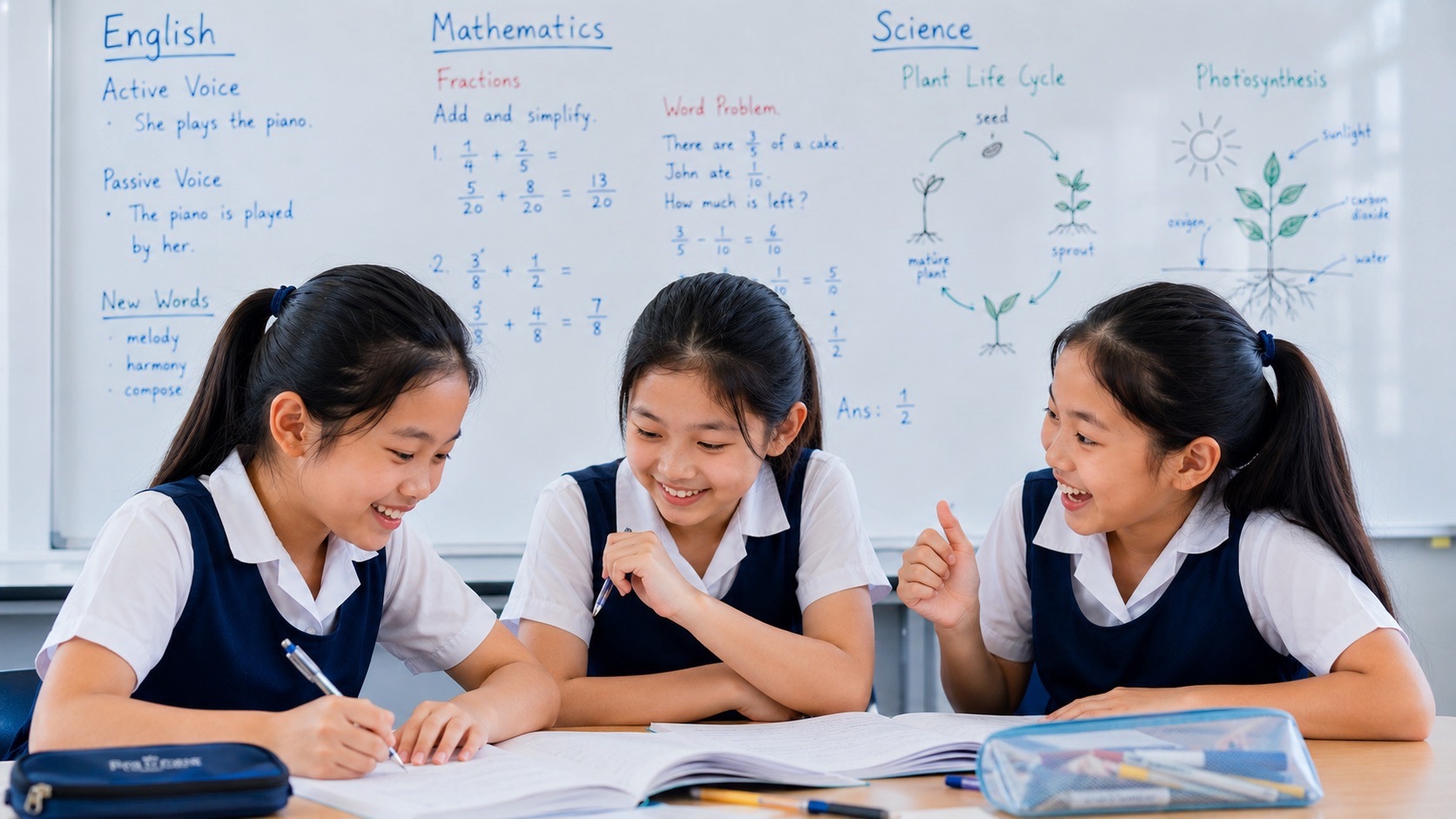
Yishun Science Tuition Primary 3 is a historical 2019 title rebuilt as a practical roadmap for Primary 3 Science tuition Yishun, Primary Science tuition Singapore, P3 Science concepts, scientific inquiry, Science experiments, observation skills, classification, materials, magnets, life cycles and PSLE Science foundations. Primary 3 is where many pupils first begin formal Science learning in a sustained way, and the most important job is not early examination drilling. It is building the habits that later Science depends on.
A strong Primary 3 Science programme should help a child move from everyday curiosity into disciplined scientific thinking: notice carefully → describe accurately → compare → classify → predict → test → explain → record → retrieve → apply. If these habits become stable at P3, later work on experiments, graphs, systems and open-ended questions becomes much easier.
This page therefore owns one precise job: provide a full Primary 3 Science learning roadmap. The old location, contact, promotional and historical service claims are not treated as current. The title and URL remain for continuity. The rebuilt article focuses on how P3 pupils can learn Science deeply without turning the subject into an encyclopaedia of facts.
Primary 3 is where curiosity learns discipline
Young children already ask scientific questions:
- Why does this float?
- Why is this object attracted to a magnet?
- Why do some plants look different?
- Why does one material bend while another snaps?
- Why do animals grow through different stages?
The educational task is not to replace curiosity with memorisation.
It is to teach children how to investigate curiosity more carefully.
The first P3 habit: observe before explaining
Observation asks:
“What can I actually see, measure or notice?”
Explanation asks:
“Why did it happen?”
These are different jobs.
A pupil who says “the plant is unhealthy” may be making an inference.
A more direct observation might be:
“The leaves are yellow and the plant is shorter than the other plant.”
Separating observation from interpretation is foundational.
Use the camera test
Ask:
Could a camera or measuring tool record this directly?
If yes, it is likely an observation.
If the sentence contains a cause, intention or conclusion, it is probably an inference or explanation.
The second P3 habit: compare one property at a time
Children notice many differences at once.
Science comparison requires a basis.
Ask:
Compared in terms of what?
Examples:
- flexibility;
- transparency;
- waterproofing;
- magnetic attraction;
- number of life-cycle stages;
- visible size.
The comparison becomes scientific when the property is explicit.
The third P3 habit: classify using a rule
Classification is not just putting things into groups.
It is choosing a characteristic and applying it consistently.
Ask:
- What is your grouping rule?
- Does every item in this group satisfy it?
- Can you classify a new item using the same rule?
A classification rule should survive a fresh example.
Materials: connect property to purpose
P3 materials learning becomes useful when pupils ask why a property matters.
Use:
object part → job → useful property → suitable material
Example:
A raincoat needs to prevent water from passing through easily, so waterproofing is relevant.
The child learns to connect observable properties to design choices.
Do not teach “best material” without a job
No material is simply best.
A transparent material may be useful for a window but unsuitable for another purpose.
A rigid material may be useful for support but poor for a flexible strap.
Suitability is conditional.
Use materials around the child
Science can begin with:
- school bags;
- water bottles;
- umbrellas;
- pencil cases;
- food containers;
- windows;
- clothing.
Ask which part performs which job and why the material suits that role.
Magnets: prediction before testing
Before bringing a magnet near an object, ask:
- Will it be attracted?
- Why do you think so?
- What did you observe?
- Did the observation support your prediction?
This simple routine introduces the idea that predictions should meet evidence.
Magnets are excellent for misconception repair
A common overgeneralisation is:
“All metals are magnetic.”
Instead of correcting verbally, test a range of objects.
The child sees that the category “metal” is too broad to predict magnetic attraction reliably.
Life cycles: teach process, not circular artwork
Pupils often memorise a neat cycle diagram.
Then scramble the stages.
Ask them to reconstruct:
- which stage comes first;
- what changes next;
- how the organism reaches adulthood;
- how the next generation begins.
The cycle should survive the loss of the familiar circle.
Use more than one organism
Compare life cycles.
Ask:
- Which stages are similar?
- Which stages differ?
- Does the young resemble the adult?
- Where does the greatest visible change occur?
Comparison strengthens concept boundaries.
Diversity: notice characteristics before labels
When pupils classify living things, ask what observable characteristic supports the grouping.
A label without a criterion can become memorised vocabulary.
The learner should know why an organism belongs in the category.
Use examples and non-examples
To understand a concept, show:
- a clear example;
- a clear non-example;
- a tricky borderline case.
Ask which characteristic decides the category.
Primary 3 Science language should be precise but not inflated
Pupils need accurate terms.
They do not need unnecessarily advanced vocabulary.
Teach the word when it helps describe or explain the relationship more precisely.
Build the sentence after the idea
If a child struggles to write, first ask for the explanation orally.
Then refine it into scientific language.
Do not let difficult wording hide whether the Science itself is understood.
Use “because” carefully
“Because” does not automatically create an explanation.
Weak:
“The magnet attracts it because it is attracted.”
Ask for the relevant property or relationship.
The second half should add causal meaning.
Start simple fair-test thinking
P3 pupils can learn the logic of fair comparison before mastering formal variable terminology.
Ask:
- What are we changing?
- What are we observing?
- What should we keep the same?
- Why?
The aim is understanding, not vocabulary display.
A simple P3 investigation
Suppose pupils want to compare absorbency of materials.
They should think about:
- same size of material sample;
- same amount of water;
- same method of testing;
- clear observation of how much is absorbed.
This introduces controlled comparison naturally.
Teach measurement as part of observation
Where appropriate, move from:
“This is bigger.”
to:
“This is 4 cm longer.”
Numbers make observation more precise when the quantity is relevant.
Units belong with measurements
A value should travel with its unit.
5 cm is not the same information as 5 g.
This habit later supports graphs, experiments and data interpretation.
Teach diagrams as thinking tools
A P3 diagram should help the child see:
- parts;
- labels;
- sequence;
- comparison;
- direction.
Do not let diagram work become colouring without reasoning.
Ask pupils to explain a diagram without labels
Hide the labels.
Ask the child to identify the important parts and explain what the diagram shows.
This reveals whether the picture is understood or merely recognised.
Teach words ↔ diagrams
Give a short paragraph and ask the pupil to sketch it.
Then give a simple diagram and ask the pupil to explain it in words.
This representation switching prepares pupils for later Science questions.
Retrieval should begin in P3
Do not teach a topic, test it and forget it.
Each week, bring back one old idea.
Examples:
- one material property;
- one classification rule;
- one life-cycle sequence;
- one magnet misconception.
Small retrieval now prevents large forgetting later.
Use blank-page recall
Ask the child to draw or write everything remembered about a topic for two minutes.
Then compare with notes.
The missing ideas show what needs another retrieval attempt.
Do not turn retrieval into punishment
Low-stakes recall should feel like checking the mind, not catching the child out.
Use it to decide what to revisit.
Mix topics gently
Once individual topics are stable, mix two or three.
The child should decide:
- Which concept belongs here?
- What clue tells me?
This begins concept selection.
Use unfamiliar objects with familiar concepts
Instead of another classroom magnet object, use a different household object.
Instead of the same material example, use a new product.
The concept should travel.
Primary 3 open-ended questions should remain developmentally sensible
Do not force adult-style essays.
Teach pupils to give:
- a direct answer;
- the relevant property or process;
- a clear reason.
Clarity before length.
Use the “minimum complete answer” early
Question:
Why is material X suitable for an umbrella?
Answer:
“Material X is waterproof, so water does not pass through it easily.”
Short, specific and connected.
Corrections should produce future rules
Weak correction:
“Wrong.”
Useful correction:
“I grouped by colour when the question asked for material property. Next time I will underline the property being tested.”
The child learns how to improve the next attempt.
Use an early Science error ledger
| Error | Repair rule |
|---|---|
| guessed before observing | look first, explain later |
| classification rule changes halfway | state criterion before grouping |
| property not linked to use | job → property → material |
| all metals assumed magnetic | test magnetic property |
| life cycle remembered as picture only | reconstruct stages in new format |
Small groups can make P3 thinking visible
Three pupils may classify the same objects differently.
Ask each to state the rule.
Now the group can test whether the rule is consistent.
The discussion becomes scientific, not merely social.
Protect individual thinking before discussion
Let each child predict or classify first.
Then discuss.
If the strongest child answers first every time, the tutor loses information about the other pupils’ thinking.
Hints should be light
Start with:
“What are you comparing?”
not:
“The answer is flexibility.”
The child should perform as much of the thinking as possible.
Parents can support P3 Science through ordinary life
Use:
- cooking;
- rain;
- packaging;
- plants;
- toys;
- shadows;
- magnets;
- recycling materials.
Ask what the child observes, compares and predicts.
Good home questions
- What do you notice?
- How are these two different?
- What rule did you use?
- What do you predict?
- How could we test that?
- What evidence changed your mind?
Avoid answering too quickly for the child
A small pause creates space for retrieval.
If the child is stuck, give one cue rather than the whole explanation.
Independence begins in small moments.
A practical weekly P3 Science structure
| Segment | Main job |
|---|---|
| 10 min | retrieval of one older idea |
| 20 min | new concept through observation or model |
| 15 min | compare / classify / predict |
| 15 min | simple experiment or evidence task |
| 15 min | short questions and explanation |
| 10 min | changed-context transfer |
| 5 min | error rule and recap |
What progress should look like by the end of P3
- observations are more precise;
- classification rules are stated clearly;
- predictions include reasons;
- properties are linked to functions;
- life cycles can be reconstructed in new formats;
- simple fair comparisons make sense;
- the child can explain a diagram in words;
- older topics can still be retrieved;
- new-looking questions create less hesitation.
When tuition may not be necessary
A Primary 3 pupil who is curious, learning securely in school, retrieving older ideas and explaining observations independently may not need additional formal Science tuition.
Reading, projects and ordinary exploration may be enough.
Frequently asked questions
Should Primary 3 Science tuition focus on PSLE techniques?
Not primarily. Build observation, comparison, classification, prediction, evidence and explanation first. These become the foundation for later PSLE application.
How much memorisation is needed?
Some facts and vocabulary must be remembered, but they should be connected to examples, relationships and retrieval practice rather than copied repeatedly.
What is the biggest mistake in P3 Science learning?
Treating Science as a list of facts instead of teaching the child how to observe, compare, classify, predict and explain.
Should P3 pupils do experiments?
Simple safe investigations can be valuable when they teach prediction, fair comparison, observation and evidence rather than just entertainment.
What is the strongest sign the child is ready for P4?
The pupil can learn a concept, retrieve it later and apply it when the example changes, with progressively less adult prompting.
Continue through eduKateYishun
- Science Tuition & Learning Hub
- Student Diagnostics Hub
- Learning Problems Hub
- How Scientific Experiments Work
Official reference
Yishun Science Tuition Primary 3: the larger lesson
Primary 3 Science should not make children feel that the world has suddenly become a textbook.
It should teach them how to look at the world more carefully.
Observe. Compare. Classify. Predict. Test. Explain. Retrieve. Apply.
Those habits are the real beginning of scientific independence.
Leave a Reply