
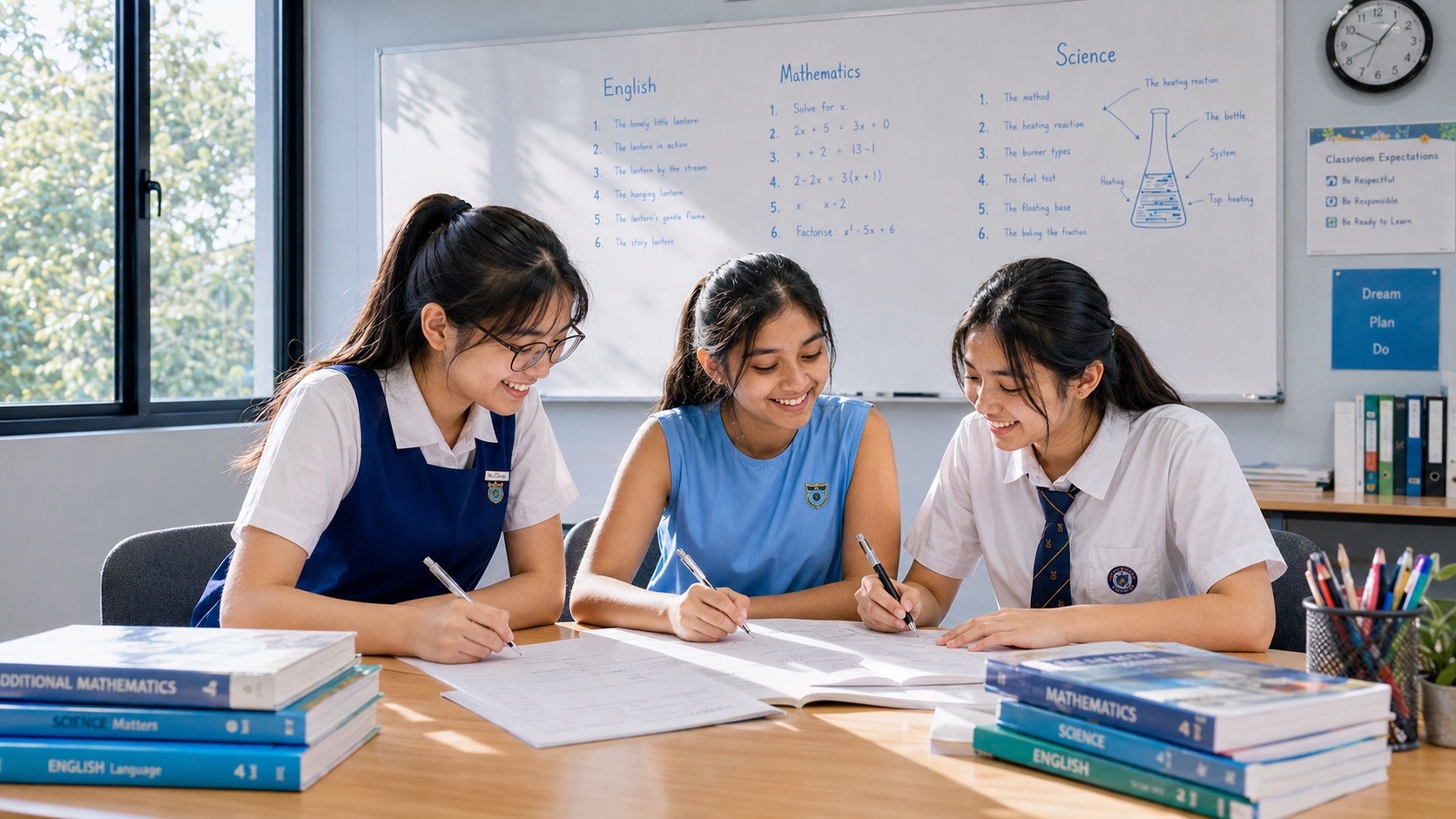
Punggol English Tuition Centre Sec 3 Secondary 3 Schools is a legacy title for families searching for Secondary 3 English tuition in Punggol, Sec 3 English tutor, English tuition centre Punggol, G1/G2/G3 English tuition, 2027 Singapore-Cambridge SEC English, writing, comprehension, summary, editing, oral communication and listening. Secondary 3 is the runway year: school English becomes more demanding at the same time that the student must begin translating school assessment performance into the habits needed for the next national-examination stage.
Parents comparing Punggol English tuition, Secondary English tuition Singapore, Sec 3 writing classes, comprehension tuition, summary writing, oral English or small-group English tuition should look for a programme that connects two worlds. The centre must follow the student’s actual school tests, teacher feedback and subject level now, while steadily building the deeper reading, writing, timing and independence needed for upper-secondary examination work.
For the 2026 Secondary 3 cohort, the national framework changes in 2027. SEAB lists English Language as K100 at G1, K200 at G2 and K300 at G3 under the Singapore-Cambridge Secondary Education Certificate, with earlier GCE codes shown for reference. The right tuition response is not to abandon school-specific learning for generic exam drilling. It is to build a runway from today’s school evidence to tomorrow’s SEC-level execution.
This page retains its original 2019 title and URL. It is an educational guide for families researching Secondary 3 English support in Punggol and does not claim a current eduKate physical centre at a specific Punggol address.
Secondary 3 Is a Runway, Not a Holding Year
Secondary 3 sits between lower-secondary consolidation and final-year execution.
The student is expected to manage harder reading, longer writing, broader issues and more independent revision, yet there is still enough time to repair weak methods before the final year.
That makes Sec 3 uniquely valuable.
A good centre uses the year to convert school feedback into durable upper-secondary routines.
The Runway Has Two Ends
| Current end | Future end |
|---|---|
| School WAs, assignments, teacher feedback | SEC-level independent execution |
| Known school formats | Unfamiliar national-exam contexts |
| Tutor prompts | Self-directed method selection |
| Component practice | Integrated paper performance |
| Untimed learning | Timed reliable performance |
The programme should connect these ends gradually.
School Evidence Comes First
The centre begins with what the student is actually doing in school.
Bring recent writing, comprehension scripts, teacher comments and assessment schedules. Identify repeated patterns.
School evidence prevents tuition from becoming detached from the student’s immediate reality.
But School Familiarity Is Not Enough
A student can perform well on familiar school tasks and still struggle when wording, topic or structure changes.
The centre therefore uses unseen transfer regularly.
The goal is portability: can the method travel beyond one teacher’s format?
The Sec 3 Runway Audit
| Area | Current school question | Runway question |
|---|---|---|
| Reading | Can student answer current passage? | Can method survive unfamiliar text? |
| Writing | Can student complete school format? | Can student choose and develop under new topic? |
| Grammar | Can student correct known patterns? | Can student detect under writing load? |
| Vocabulary | Can student recognise school lists? | Can student retrieve precise academic language? |
| Oral | Can student answer rehearsed questions? | Can student respond flexibly to follow-up? |
| Listening | Can student follow familiar task? | Can student track distractors and changed information? |
| Time | Can student finish current test? | Can student manage mixed upper-secondary load? |
The audit identifies which part of the runway still needs construction.
Reading Runway: From Paragraph Map to Argument Map
Lower-secondary mapping identifies what each paragraph does. Sec 3 extends that skill into argument structure.
Students identify claim, evidence, example, concession, counterargument, reframing and conclusion.
This prepares them for more demanding comprehension and analytical writing.
Worked Argument Map
Many companies adopted remote work because it reduced commuting and office costs. Employees initially welcomed the flexibility. Over time, however, some teams found collaboration more difficult and junior employees reported fewer informal learning opportunities. The debate has therefore shifted from whether remote work is possible to how organisations should combine flexibility with shared working time.
The movement is adoption reason → benefit → emerging cost → reframed question.
A Sec 3 student should be able to see that architecture quickly.
Question Runway: From Type Recognition to Demand Precision
A student may know labels such as inference or language effect but still answer inaccurately.
The next level is demand precision: what exactly must this question prove about this text?
The student identifies target, relationship and evidence range before writing.
Evidence Runway: From Relevant to Strongest
Sec 3 students should not merely find relevant evidence. They should rank it.
Which detail is most direct? Does a second detail add a new dimension? Which detail is only background?
Evidence ranking improves both comprehension and argument.
Inference Runway: Calibration
Upper-secondary reading requires more interpretation but also more restraint.
Students practise three boundaries: too literal, defensible, too broad.
The centre should make those boundaries visible through competing answers.
Language Effect Runway
Students move from identifying a device to explaining why the choice matters.
The sequence is phrase → image/impression → significance in context.
This prevents empty technique naming.
Summary Runway: Semantic Selection
Summary becomes more reliable when students think in meaning units rather than sentences.
Repeated phrases may represent one idea. One sentence may contain two distinct ideas.
The student selects semantic points first, then compresses.
Writing Runway: From Topic to Proposition
A Sec 3 essay should have a central proposition more precise than the topic.
Topic: technology in education. Weak proposition: technology is useful. Stronger proposition: technology improves learning when it reduces friction around access and feedback without replacing the cognitive work students need to perform themselves.
The stronger proposition creates real paragraph work.
Paragraph Runway: From PEEL to Reasoning
Frameworks such as PEEL can be useful early, but students should understand the reasoning beneath them.
A paragraph needs a claim, explanation, support and a connection to the wider argument. It may also need consequence or qualification.
The student should not write to fill boxes.
Counterargument Runway
Sec 3 is a good year to learn how to represent an opposing view fairly.
The strongest counterargument is used, not a weak straw man.
The final position becomes more credible because it survives a real challenge.
Qualification Runway
Students learn to reduce overclaiming through words and structures such as often, under certain conditions, to some extent, unless and provided that.
Qualification is a thinking skill as much as a language skill.
Narrative Runway: Control Over Drama
Students who choose narrative should learn to prioritise causality over spectacle.
A smaller, believable conflict with a meaningful choice is easier to control under time.
The story should show change through consequences, not announce a moral at the end.
Functional Writing Runway
Role, audience, purpose and context remain central.
Sec 3 students should also become better at selecting supporting details and maintaining tone across a longer response.
The reader’s needs become the organising principle.
Editing Runway: From Rule to Automatic Search
By Sec 3, common grammar patterns should increasingly be detected without labels.
Students run a personal search order based on recurring errors.
The goal is a faster internal editor before the final year.
Vocabulary Runway: Academic Precision
Students need language for relationships and judgement: constraint, significance, ambivalent, consequence, perspective, justify, mitigate, inevitable.
Words should be learned with collocations and concepts.
The student must retrieve them in live use.
Oral Runway: From Prepared Answer to Interaction
A planned response is only one part of oral performance.
Students should practise follow-up questions that shift angle, challenge the position or require a specific example.
Responsiveness becomes increasingly important.
Listening Runway: Distractor Awareness
Students learn common distractor patterns: first-mentioned information later changed, similar names, number reversals, negatives and conditional statements.
After an error, identify the pattern.
Listening becomes diagnosable rather than random.
Time Runway: Add Load Gradually
Do not wait until Sec 4 to discover that the student’s method collapses under time.
Once a skill is stable untimed, add moderate time limits. Then mix components. Record where quality drops.
Time pressure should test a method, not replace teaching.
The School-to-SEC Error Ledger
| School error | Runway interpretation | Next move |
|---|---|---|
| Misses unfamiliar question wording | Method tied to surface form | Vary command and context |
| Essay point thin | Upper-secondary reasoning not developed | Mechanism + example + qualification |
| Grammar slips in long writing | Detection under load weak | Self-edit under time |
| Vocabulary generic | Retrieval insufficient | Concept-network practice |
| Oral follow-up weak | Prepared answer too rigid | Interaction drills |
| Finishes school tests but not mixed work | Load fragility | Timed interleaving |
The ledger connects immediate errors to future readiness.
A 90-Minute Runway Lesson
| Phase | Current-school job | Future-readiness job |
|---|---|---|
| School scan | Review recent demand | Identify transferable issue |
| Cold transfer | Use unseen material | Test portability |
| Teaching | Repair mechanism | Make decision explicit |
| Guided practice | Stabilise | Use school-like example |
| Variation | Change surface | Prepare for unfamiliar context |
| Timed finish | Add moderate load | Build execution |
| Review | Update ledger | Set next runway target |
The lesson serves both ends of the runway.
A Six-Week School-to-SEC Cycle
Week 1 — school-script audit
Map repeated weaknesses.
Week 2 — unseen transfer
Test whether the same skill survives new contexts.
Week 3 — writing reasoning
Thesis, paragraph development and counterargument.
Week 4 — language under load
Editing, vocabulary and timed writing.
Week 5 — oral/listening flexibility
Follow-up, distractors and live retrieval.
Week 6 — integrated timed set
Compare the new error profile with Week 1.
When School Marks Are Strong
Strong marks are useful evidence but should be stress-tested occasionally.
Use a different text type or unfamiliar topic. If the method survives, the skill is portable.
If performance collapses, the high mark may have depended on familiarity.
When School Marks Are Weak
Do not assume the student is unready for the entire future exam framework.
Find the exact school error. A weak writing task may be one new format, a time issue or an idea-development gap.
Repair the mechanism and retest.
When the Student Is Strong but Too Dependent
Some high-performing students rely heavily on teacher notes and models.
Introduce cold attempts, delayed feedback and student-generated checklists.
The runway requires independence, not only correctness.
When the Student Is Independent but Imprecise
Another student may work confidently but lose marks through broad answers and unsupported claims.
Use evidence ranking, word limits and revision standards.
Independence is valuable only when paired with quality control.
When the Student Is Overloaded
Sec 3 has heavier subject demands.
The centre should prioritise and integrate. Use school scripts as practice material. Assign focused retrieval rather than large parallel homework.
The runway must be sustainable.
World Knowledge as Runway Fuel
Upper-secondary writing and oral become easier when students possess more concepts and examples.
A sustainable reading diet can include technology, environment, education, community, sport, culture and social issues.
One well-processed article is more useful than many headlines.
Current Affairs Processing
- Identify the issue.
- Name stakeholders.
- Trace cause and consequence.
- Identify one trade-off.
- State one counter-view.
- Connect to a broader concept.
This creates reusable material for writing and oral.
The Sec 3 Portfolio
Keep a small portfolio across the year: one early essay, one revised essay, one comprehension script, one oral reflection and the error ledger.
The student can see whether reasoning, language and independence are improving.
The portfolio becomes part of the Sec 4 handover.
The Sec 3 to Sec 4 Handover
| Area | Ready for Sec 4 when… |
|---|---|
| Reading | Unseen texts remain navigable |
| Comprehension | Evidence and inference are precise |
| Writing | Student can choose, plan and develop |
| Editing | Common errors are self-detected |
| Vocabulary | Academic language is retrievable |
| Oral | Student responds beyond prepared material |
| Listening | Distractor patterns are understood |
| Time | Mixed work remains stable under realistic load |
| Independence | Tutor prompts are minimal |
The handover should identify any remaining amber areas for early Sec 4.
The 2027 SEC Context
SEAB’s 2027 SEC school-candidate listings show English Language as K100 for G1, K200 for G2 and K300 for G3. The SEC replaces the separate N- and O-Level certificates while reflecting the subject levels sat.
For the 2026 Sec 3 cohort, this is the national-examination destination. School guidance still determines the student’s actual subject level and progression.
SEAB — Secondary Education Certificate
SEAB — 2027 G3 Syllabuses
Ministry of Education Singapore
What a Sec 3 Runway Programme Should Not Do
- Do not abandon school alignment for generic national-exam drilling.
- Do not use only familiar school tasks.
- Do not wait until Sec 4 to test time pressure.
- Do not memorise essays as a substitute for reasoning.
- Do not keep grammar separate from original writing.
- Do not ignore oral and listening.
- Do not keep prompts unchanged.
- Do not enter Sec 4 without a handover of remaining weak links.
Frequently Asked Questions
Should Sec 3 students already practise SEC-style work?
They should understand the direction of their subject level and build the underlying skills, but school alignment and strong foundations remain central. Final-year simulation should increase progressively rather than dominate the entire year.
How often should unseen material be used?
Regularly enough to test transfer. Familiar school material is useful for teaching; unseen material shows whether the method travels.
How much current affairs is useful?
A manageable amount processed deeply. The goal is concepts and examples, not headline collection.
What if the student is already scoring well?
Use deeper analysis, variation, timing and reduced prompts. Strong marks should be made portable.
What is the clearest sign of Sec 4 readiness?
The student can select and execute methods on unfamiliar tasks under realistic load with minimal tutor prompting.
The Sec 3 Readiness Gate: What Must Be True Before Sec 4 Begins?
A runway needs a take-off point. Before Secondary 4 begins, several English capabilities should be stable enough that the final year can focus on execution rather than rebuilding basic process. The student does not need perfection, but the system should function under unfamiliarity and moderate time.
- Read an unseen text and identify its structure without excessive rereading.
- Recognise varied question wording and identify the actual demand.
- Support inference with evidence rather than intuition alone.
- Select summary points before paraphrasing.
- Choose a writing direction and build a workable plan.
- Develop paragraphs beyond one claim and one example.
- Detect common grammar errors inside original writing.
- Retrieve useful academic vocabulary without a visible list.
- Develop an oral answer and handle a follow-up question.
- Track changed information in listening.
- Complete mixed work with a reasonable time plan.
- Name personal recurring error patterns.
If several of these remain red, the first months of Sec 4 will be spent repairing the runway. Sec 3 is the better place to do that work.
The School-Script Translation Exercise
A school paper contains local evidence. The centre’s job is to translate that evidence into a transferable skill target.
| School feedback | Weak translation | Useful translation |
|---|---|---|
| “Needs more detail” | Write longer | Develop mechanism, example and consequence |
| “Not answering question” | Read carefully | Identify command, target and required relationship |
| “Expression unclear” | Improve vocabulary | Check sentence structure, reference and precision |
| “Summary too wordy” | Use shorter words | Select and group points before paraphrasing |
| “Oral response too brief” | Speak more | Add reason, specific example and reflection |
| “Careless mistakes” | Be careful | Classify the repeated detection or checking failure |
This translation step keeps tuition from reacting superficially to teacher comments.
The School-to-SEC Writing Ladder
Sec 3 writing should gradually move through four stages.
Stage 1 — school-format competence
The student understands the current school’s writing demands and can complete them accurately.
Stage 2 — unfamiliar-topic transfer
The same writing method works on issues and prompts not recently practised.
Stage 3 — timed selection
The student can choose a viable direction, plan and draft under moderate time.
Stage 4 — revision independence
The student can identify the weakest part of a draft and improve it without tutor rewriting.
The final stage is a major readiness signal because Sec 4 requires faster self-correction.
The School-to-SEC Comprehension Ladder
Comprehension also moves through stages. First the student answers familiar school question types. Then the same reasoning is tested with new wording. Next, answer length and evidence precision are tightened. Finally, the student works under time while preserving accuracy.
The centre should know which stage the learner currently occupies. A student who is accurate but slow needs a different intervention from one who is fast but over-infers.
The School-to-SEC Summary Ladder
- Identify the summary focus.
- Mark the relevant passage range.
- Extract candidate points.
- Group repeated meaning.
- Remove examples and elaboration.
- Paraphrase accurately.
- Compress language without losing content.
- Check word economy under time.
The ladder makes summary less mysterious. If the student fails at point selection, later language work cannot fix the content set.
The School-to-SEC Editing Ladder
Editing progresses from known grammar categories to mixed detection and then into self-editing of original writing. The final runway test is whether the student catches familiar personal errors without being told where to look.
A student who can correct an editing passage but repeatedly makes the same error in an essay has not yet transferred the skill.
The School-to-SEC Oral Ladder
Oral progression begins with a complete response, then adds specific examples, broader issue awareness, qualification and responsive follow-up. By the end of Sec 3, the student should not need a memorised script to keep speaking.
The strongest sign of readiness is flexible development: the student can change angle when the question changes.
The School-to-SEC Listening Ladder
Listening starts with accurate detail, then adds sequence tracking, correction markers, distractor control and recovery after uncertainty. Students should learn to hold early information provisionally until the speaker’s final meaning is clear.
This habit also supports classroom listening and note-taking.
The Sec 3 Runway Portfolio
A useful portfolio can contain six pieces: an early school script, a later unseen comprehension task, one writing piece before and after revision, one summary task, one oral reflection and the current error ledger. The portfolio is small enough to review and rich enough to show progression.
The purpose is not display. It is diagnosis and handover.
The Unseen-Material Ratio
A Sec 3 programme should deliberately balance familiar school material and unseen material. Familiar material makes teaching efficient because context is known. Unseen material tests portability.
The exact ratio can change through the year. Early repair may use more familiar contexts. Later runway testing should increase unfamiliarity so the student learns to recognise underlying methods.
The Timed-Transfer Ratio
Time pressure should also increase progressively. A student who is still learning a concept should not be punished with unnecessary speed. Once the concept is stable, timed transfer becomes useful.
The centre can move from untimed accuracy, to soft time targets, to mixed timed sections, to full simulation. This sequence protects learning while building execution.
The Sec 3 Current-Affairs Runway
Upper-secondary English benefits from a bank of understood issues. Students do not need daily news consumption. They need a manageable set of topics processed deeply.
| Issue family | Questions to ask |
|---|---|
| Technology | What problem does it solve? What new dependency does it create? |
| Environment | Who bears the cost of change? What trade-off exists? |
| Education | What is the purpose of the policy? Who benefits or struggles? |
| Community | What improves access, belonging or responsibility? |
| Media | Who controls attention, framing or trust? |
| Work | How do flexibility, productivity and fairness interact? |
These questions help students create conceptual examples rather than isolated facts.
The Concept Bank
Alongside current affairs, students can build a concept bank: fairness, access, responsibility, autonomy, trust, sustainability, identity, regulation, opportunity and trade-offs.
When a new issue appears, the student asks which concepts apply. This makes unfamiliar topics easier because the thinking categories are familiar.
The Sec 3 Vocabulary Runway
Vocabulary growth should increasingly serve concepts. Words such as constraint, trade-off, marginalise, legitimise, significant, ambivalent, contingent and mitigate allow students to express relationships more precisely.
Every word should be learned with a phrase, contrast and original use. Precision remains more important than difficulty.
The Runway Revision Protocol
Students should revise by priority. First ask whether the response answers the task. Then check central proposition, paragraph logic, evidence, development, cohesion, language and surface accuracy.
This order prevents polishing material that should have been replaced.
The Runway Peer-Review Protocol
In a small group, students can review one another’s plans or paragraphs using narrow questions. Does the paragraph prove something distinct? Is the evidence relevant? Is the inference defensible? Is the example specific?
The tutor verifies feedback and prevents peer review from becoming subjective preference.
The Runway Recovery Drill
Students need to learn what to do when an unfamiliar question feels difficult. The drill is simple: identify the demand, locate what is known, make the best evidence-based attempt, mark the item if time is being lost and move on.
Recovery becomes more important as tasks become longer and the cost of fixation increases.
The Sec 3 Time Log
| Task | What to record |
|---|---|
| Writing choice | Time taken to commit to prompt |
| Planning | Time before drafting begins |
| Comprehension | Questions causing repeated rereading |
| Summary | Time spent selecting versus paraphrasing |
| Editing | Time spent scanning versus deciding |
| Review | Actual time left for checking |
The log reveals whether the student is genuinely slow or simply losing time at one decision point.
The Runway Independence Audit
- Can the student explain the current school feedback without tutor translation?
- Can the student choose a method on an unseen task?
- Can the student identify the strongest evidence?
- Can the student revise a paragraph independently?
- Can the student retrieve common vocabulary and grammar rules?
- Can the student handle a follow-up oral question?
- Can the student use a stop-loss rule under time?
- Can the student describe the current personal error ledger?
The audit should become more positive as Sec 3 progresses.
The Final Sec 3 Term
The last term should not become Sec 4 panic in advance. It should be a controlled handover. Stable skills are maintained; amber skills are strengthened; one or two red skills receive focused repair. Students are exposed to more mixed timed work and more independent planning.
The aim is readiness, not exhaustion.
The Sec 4 Handover Meeting
A short handover can state: current subject level, strongest components, active risks, timing status, prompt level, reading/vocabulary habits and the first Sec 4 priorities.
This prevents the final year from starting with another broad diagnosis.
The Student Who Is Not Yet Ready
If the audit shows several red skills, be honest and prioritise. The first Sec 4 months may need continued foundational repair. This is better than pretending the student is ready and covering advanced material superficially.
The runway can still be repaired, but the plan should reflect reality.
The Student Who Is Ahead
If the student is already highly independent, extension can focus on sharper argument, deeper reading, stricter answer economy and more challenging unseen material. There is no need to repeat comfortable exercises simply because they appear in the year’s scheme.
Runway extension means higher standards.
The Sec 3 Runway Quality-Control Checklist
Before a skill is treated as ready for Secondary 4, the centre should verify more than one successful attempt. The student should show the method on at least two fresh contexts, after a delay, with reduced prompting. This protects against false confidence created by immediate practice or favourable topics.
Quality control asks four questions: Was the task unfamiliar enough to require selection? Was the skill executed accurately? Did the student manage time without excessive tutor rescue? Could the student explain why the method worked? A skill that passes all four can move into maintenance.
The Student’s Own Runway Report
Students should be able to write a short readiness report in their own words. For example: I can map unseen passages and usually identify strong evidence. I still over-explain inference answers when time is short. My writing plans are stable, but my examples can be generic. I need more practice with specific evidence and timed Paper 2 sections.
This report is valuable because it shows metacognition. The student is no longer receiving a label from the centre; the student understands the learning system and can participate in the Sec 4 plan.
The Sec 3 Runway Simulation
Near the end of the year, run a mixed simulation that is shorter than a full national paper but broad enough to test transfer. Include one unseen reading passage, several varied question demands, one summary-selection task, two writing prompts for rapid choice, one editing section and one oral follow-up. The student must shift between modes without advance labels.
The purpose is not to predict a future examination score. It is to expose remaining friction before Sec 4. If method selection remains stable, the runway is working. If one component collapses, the first Sec 4 cycle already has a clear target.
The Final Runway Principle: Do Not Carry Unnecessary Scaffolds Into Sec 4
Checklists and prompts are useful while a method is being learned, but they should shrink as the year ends. A student who still needs a full page of instructions for every task may know the content without owning the process. The final Sec 3 term should therefore compress external scaffolds into a few personal reminders.
This makes the transition psychologically important as well as academic. Sec 4 begins with a learner who recognises the system and knows how to restart it after difficulty.
The Final Sec 3 Evidence Review
Before the year closes, compare the earliest school script in the portfolio with the most recent unseen transfer task. Look for changes in how the student starts, selects evidence, develops writing, checks language and manages time. The comparison should focus on process, not only marks.
If the student now needs fewer prompts, makes more precise decisions and can explain personal error patterns, the runway has improved even if one or two skills still need early-Sec-4 attention. The handover should name those remaining risks clearly so the final year begins with direction rather than another broad restart.
The Runway Should End With Fewer Surprises
The practical purpose of the Sec 3 runway is simple: unfamiliar work should stop feeling like a completely new subject. The student may still find difficult questions difficult, but there should be a known first move—map the text, identify the demand, choose evidence, build the response and check the personal risk. That reduction in surprise is one of the strongest signs that the learner is ready to enter the final year with a functioning system rather than a collection of disconnected techniques.
The final handover should also identify one habit the student will protect in the first month of Secondary 4—perhaps evidence-first comprehension, five-minute writing plans or a personal editing routine—so the runway continues smoothly rather than resetting after the school year changes.
The final handover should identify one habit the student will protect in the first month of Secondary 4, such as evidence-first comprehension, short writing plans or a personal editing routine. Keeping one proven habit stable helps the runway continue smoothly instead of resetting when the school year changes.
Punggol English Tuition Centre Sec 3 Secondary 3 Schools: Build the Runway From School to SEC
Secondary 3 should connect present evidence to future independence.
Use school scripts. Test transfer. Deepen reasoning. Build time. Broaden knowledge. Reduce prompts. Keep oral and listening alive.
For a struggling student, repair the runway foundations. For a stable student, strengthen portability. For a strong student, raise the standard of judgement and execution.
The runway is ready when Secondary 4 feels like the next stage of a working system rather than a sudden new emergency.
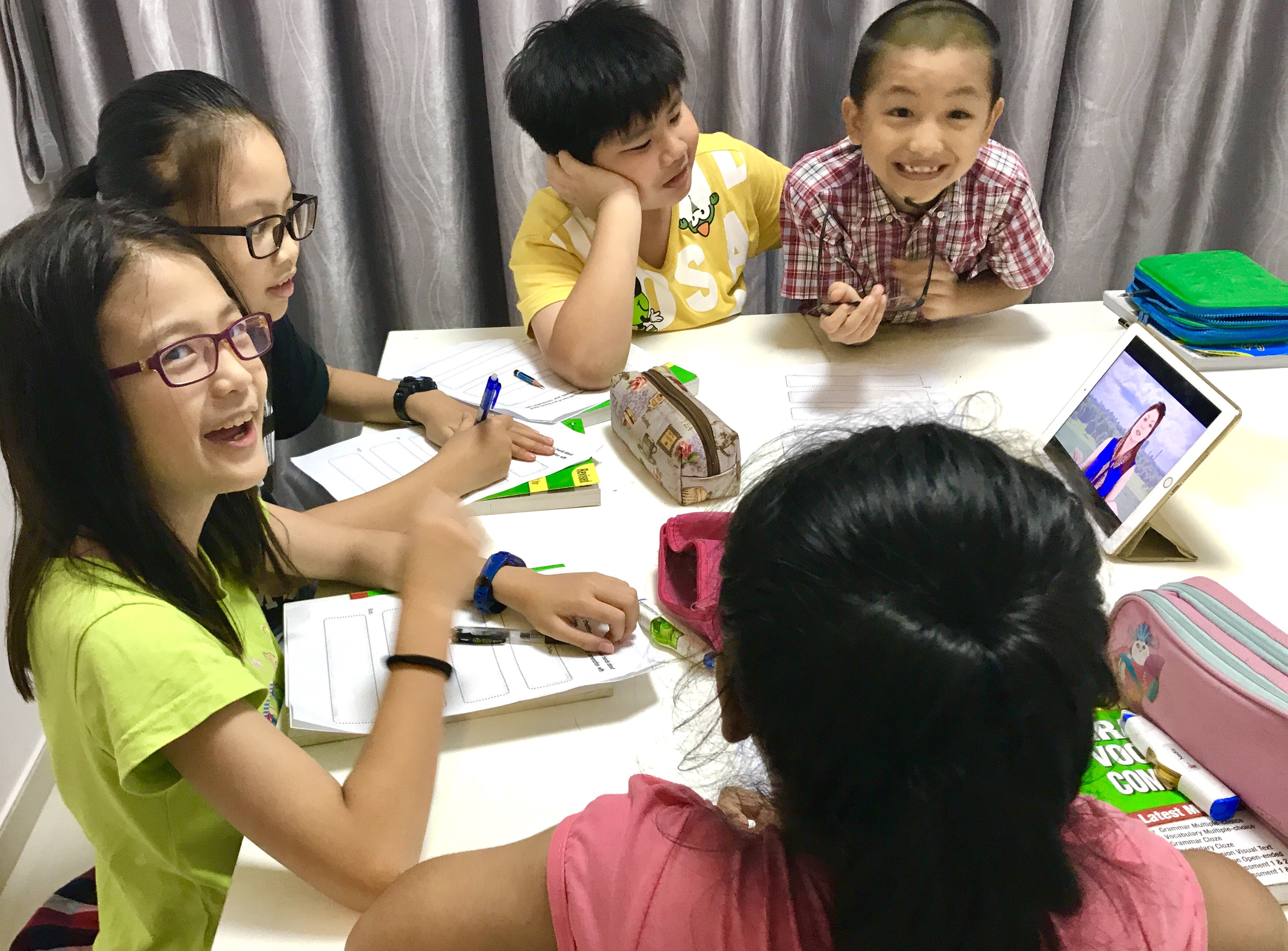
Properly taught kids shine a bright light into the future.
Historical image archive















Leave a Reply