

How to read this 2019 title: “Yishun Primary English Tuition Centre (Small Group Tutorials)” is retained for archive and search continuity. The rewritten page now owns the Primary 1→6 small-group English progression and tutorial method; it is not proof of a current physical branch, fee, timetable or class opening. Use the Yishun Tuition & Learning Guide for current information and the Primary English Directory for curriculum routes.
Families searching for Yishun Primary English Tuition Centre (Small Group Tutorials), Primary English tuition Yishun, P1 P2 P3 P4 P5 P6 English tuition, small-group English tuition Singapore, reading, grammar, vocabulary, composition, comprehension, oral communication and PSLE preparation are usually trying to understand whether one programme can support a child across the entire primary-school journey without turning every year into the same worksheet cycle. The answer depends on progression: each primary level has a different learning job even though the same English language system runs underneath.
A strong Yishun Primary English tuition centre using small-group tutorials should therefore combine two architectures at once. The first is developmental: P1 builds early literacy, P2 strengthens reading-to-writing control, P3 builds inference and independence, P4 opens the upper-primary corridor, P5 integrates PSLE foundations, and P6 stabilises performance. The second is tutorial: every learner should remain visible through personal error maps, active explanation, prompt fading, retrieval and transfer checks.
This page keeps its exact 2019 title, URL and full embedded-image sequence while replacing the old legacy body with a current P1→P6 progression and small-group tutorial system. Its owner job is broad but specific: how a Yishun Primary English centre can preserve continuity across six years while still differentiating each child’s reading, writing, language-use and performance needs inside very small classes.
50-Second Router: Where Is the Child in the Primary Journey?

- Primary 1 — sound, word, sentence and classroom routines.
- Primary 2 — reading-to-writing control, grammar, vocabulary and connected sentences.
- Primary 3 — inference, grammar cloze, paragraphing and independent starts.
- Primary 4 — upper-primary corridor: synthesis, deeper comprehension, structured composition and checking.
- Primary 5 — PSLE foundation: integration, transfer, revision and moderate timing.
- Primary 6 — performance: precision, timing, simulation, prelim analysis and taper.
The centre should know the developmental job before selecting materials. Harder worksheets are not a substitute for a clear progression.
One English System, Six Levels of Independence

Reading, writing, speaking, listening, grammar and vocabulary remain connected across all six years. What changes is the complexity of the language, the independence expected and the amount of performance pressure.
A P1 child may need help forming a complete sentence. A P6 child may need that sentence control to remain stable inside a timed composition. The same underlying system matures.
Small Groups Should Preserve Individual Visibility

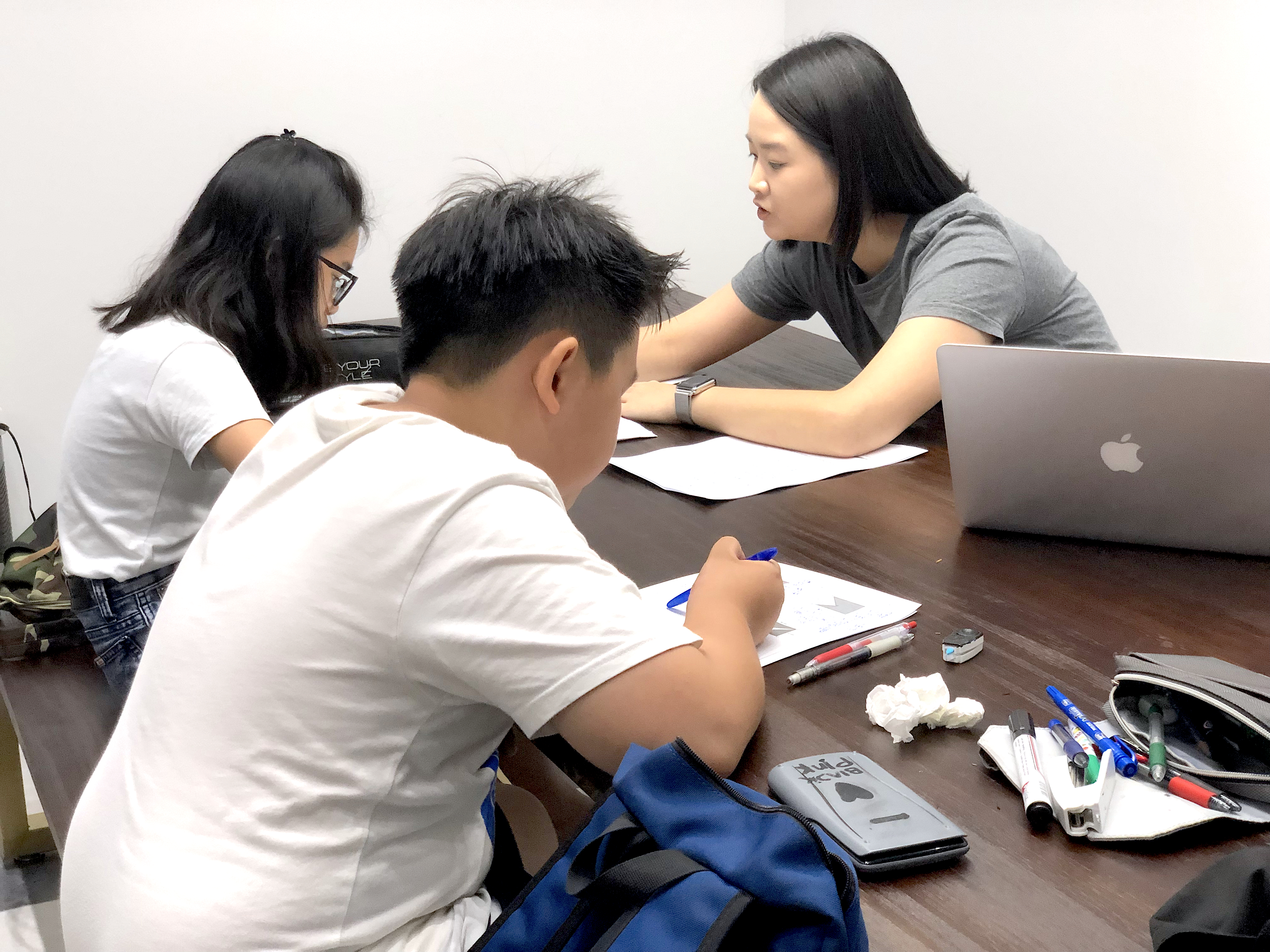
A group of around three can use one story, one passage or one writing topic while still maintaining separate targets. One child may need inference, another sentence control and another vocabulary retrieval.
The small-group advantage appears when shared learning leads to personal diagnosis rather than identical correction.
Every Student Should Make a First Attempt

Before discussion, students should read, mark, plan or write independently.
This protects honest diagnostic evidence and prevents one confident child from becoming the answer source for everyone else.
Rotate Roles to Make Thinking Audible

- Reader — identifies the instruction or text structure.
- Evidence checker — points to the clue or support.
- Explainer — states why the answer works.
- Language checker — checks sentence clarity and accuracy.
Roles rotate so every learner practises the full reasoning process over time.
Keep Individual Error Maps
A centre-wide programme should use a shared error language but keep individual histories separate.
One student may repeat scope errors, another tense errors and another writing-structure problems. The same class should not produce the same target list for every child.
Use a Shared Error Taxonomy
- Task error — the instruction or question was misunderstood.
- Evidence error — support was missing, excessive or irrelevant.
- Reasoning error — the conclusion did not follow.
- Structure error — ideas were poorly organised.
- Language error — grammar, vocabulary, spelling or punctuation reduced clarity.
- Transfer error — a known method was not recognised in a new task.
- Performance error — timing, fatigue or anxiety disrupted execution.

The taxonomy becomes more sophisticated as the student gets older, but the principle remains useful from middle primary onward.
Primary 1: Build Early Literacy and Classroom Routines
P1 should connect sound awareness, word reading, vocabulary, oral language and simple sentence writing.

The child also learns how to begin a task, follow an instruction, attempt before asking for help and reread when meaning breaks.
Primary 1: Reading Accuracy Must Return to Meaning
Phonics and decoding matter, but every word-solving routine should return to the sentence and story.

The centre should build both accurate word recognition and language understanding from the start.
Primary 2: Build Reading-to-Writing Control
P2 strengthens fluency, vocabulary, grammar, spelling, comprehension and connected sentence writing.

Retelling becomes a useful bridge from oral understanding to written sequence.
Primary 2: Build Sentence Reliability
Complete sentences, useful connectors, basic tense and punctuation should become increasingly stable.
These foundations make the Primary 3 independence jump far easier to manage.

Primary 3: Build the Middle-Primary Operating System
P3 adds more inference, grammar cloze, paragraphing and independent task starts.
Students should learn to use question words as scope signals and textual clues as evidence.

Primary 3: Move From Captions to Composition
Picture writing should become connected narrative. The child identifies the central event, cause, response and outcome.
Sentence control remains important, but organisation now matters more.

Primary 4: Build the Upper-Primary Corridor
P4 deepens evidence, inference, language-use reasoning, synthesis, editing and composition planning.
Light timing can begin once methods are accurate, but the year should still prioritise building rather than cramming.

Primary 5: Integrate and Retrieve
P5 brings the components together more consistently. Students retrieve old grammar, use vocabulary in context, revise writing and work on mixed comprehension.
The programme should identify the highest-leverage weaknesses before the final primary year begins.

Primary 6: Stabilise Performance
P6 increasingly focuses on accurate execution under realistic conditions: writing task fulfilment, comprehension scope, language-use retrieval, oral/listening readiness, timing and recovery.
The programme should become more selective as PSLE approaches.
Reading Progression Across Primary School

Early primary emphasises accurate meaningful reading. Middle primary adds inference, reference and text structure. Upper primary adds precision, mixed comprehension and performance under time.
The centre should preserve earlier habits rather than replace them with disconnected new systems each year.
Vocabulary Progression Across Primary School

Early vocabulary grows through categories, pictures, oral use and word families. Middle primary adds context inference and synonym precision. Upper primary adds collocation, connotation and retrieval under writing pressure.
Vocabulary should always return to real reading, writing and speaking.
Grammar Progression Across Primary School

Early grammar focuses on complete sentences and basic relationships. Middle primary expands tense, agreement, connectors and cloze reasoning. Upper primary demands transfer into writing, synthesis and editing.
The long-term target is self-editing, not endless rule recognition.
Writing Progression Across Primary School

P1 and P2 build complete sentences and sequence. P3 develops connected paragraphs. P4 strengthens causal planning and revision. P5 integrates situational and continuous writing. P6 stabilises task fulfilment and timing.
Structure should always come before decoration.
Oral Progression Across Primary School

Early primary builds complete responses and confidence. Middle primary adds reasons, examples and inference. Upper primary adds flexibility, follow-up and performance stability.
Oral should remain part of the programme throughout the year, not become a last-minute component.
Listening Progression Across Primary School
Young learners follow instructions and sequence. Older students track main ideas, corrections, relevant details and recovery after missed information.

Listening supports classroom learning as well as formal assessment.
The Centre Should Diagnose Before Teaching
A short cold task shows what the student can do before help arrives.

The tutor names the first unstable decision rather than treating an entire component as weak.
The Centre Should Model Hidden Thinking
Tutors should show how they read a question, select evidence, plan a paragraph or check a sentence.

Modelling makes expert decisions visible so students can imitate the process before working independently.
The Centre Should Require Retry
Feedback is not complete when the tutor explains. The learner should produce the corrected answer, sentence or paragraph.
A fresh example then tests whether the method transferred.
The Centre Should Retrieve Old Learning
Vocabulary, grammar, comprehension habits and writing rules should reappear after delays.

Retrieval prevents one successful lesson from being mistaken for mastery.
The Centre Should Interleave
After a skill is stable, mix it with other skills so the learner must decide when it applies.

This becomes increasingly important toward upper primary because real assessments are mixed.
The Centre Should Fade Prompts
- Modelled — tutor demonstrates.
- Guided — structured questions support.
- Prompted — one brief cue remains.
- Independent — student activates the method alone.
Prompt reduction is one of the strongest progress signals across the primary years.

Use Cold Transfer Tasks
Give unfamiliar material without naming the method.
Transfer shows whether the learning belongs to the student or remains tied to familiar tuition materials.

School Work Should Feed the Centre
Selected marked scripts show authentic performance. The centre compares school feedback with its own error maps.
Tuition should strengthen school learning rather than create a disconnected second curriculum.
Homework Should Have a Declared Job
A task may retrieve vocabulary, test transfer, revise a paragraph or practise timing.
Purposeful homework is easier to review and less likely to become mindless volume.

Build a Cumulative Reading Portfolio
Keep representative reading samples rather than every worksheet.
One early passage, one corrected inference and one later independent task can reveal more about growth than a thick archive.
Build a Cumulative Writing Portfolio
Keep an early sample, a meaningful revision, a later independent piece and, in upper primary, selected timed work.
Compare structure, language, prompt level and self-editing across time.
Use Monthly Error Reviews

Which repeated error has declined? Which remains? Which stable skill can leave the priority list?
The programme should change when the student changes.
Use Monthly Prompt Reviews

Which skills still require tutor cues? Which now begin independently?
This makes growing independence visible even when school assessments vary.
Use Success Analysis

When work goes well, identify why. Which evidence choice, planning move or checking routine protected the result?
Students learn what to reproduce, not only what to avoid.
Use Wider Reading Across All Levels

Books, stories, articles and age-appropriate non-fiction build vocabulary, sentence patterns and background knowledge.
Not every text should become a worksheet. Conversation and curiosity matter too.
Small Groups Need Active Participation

Every learner should regularly read, explain, write and speak.
Small group size is educationally valuable only when visibility and adaptation actually change the lesson.
A 90-Minute Primary Small-Group Lesson
- 10 minutes — personalised retrieval.
- 20 minutes — reading/comprehension appropriate to level.
- 15 minutes — grammar, vocabulary, cloze, synthesis or editing.
- 25 minutes — sentence, paragraph, situational or continuous writing.
- 10 minutes — oral/listening.
- 10 minutes — unseen transfer or correction.

The proportions change with age, but independent performance should always appear.
Use Level-Appropriate Timing
Young children may only need short focus routines. Middle-primary students can time small sections. Upper-primary students can use realistic component timing once accuracy is stable.

Timing should reveal performance, not replace learning.
Use Level-Appropriate Revision
Lower-primary revision may mean rewriting one sentence. Middle primary may revise a paragraph. Upper primary may revise a full writing plan or comprehension strategy.

The principle stays constant: feedback must lead to changed output.
Use Level-Appropriate Independence
Independence does not mean leaving a child alone. It means giving only the support needed now and removing it when the learner can carry the step.

The centre should always know which prompt it plans to fade next.
Transition Reviews Between Every Level
At year end, create a short map of stable skills, recurring errors, prompt level and the next level’s priorities.
This prevents annual resets and gives the next tutor a clear starting point.
P1 to P2 Handover
Carry forward meaningful reading, complete sentences, early vocabulary and the habit of attempting before asking for help.
P2 to P3 Handover

Carry forward reading fluency, basic evidence, connected sentences, spelling transfer and simple self-checking.
P3 to P4 Handover
Carry forward inference, grammar-cloze reasoning, paragraph structure and stronger independent task starts.

P4 to P5 Handover
Carry forward upper-primary methods, synthesis, revision and light timing while narrowing the active error list.
P5 to P6 Handover

Carry forward a compact error map, reliable component methods and enough timed experience to know which processes become unstable.
A Centre-Wide 12-Week Cycle
- Weeks 1–2 — diagnose and select priorities.
- Weeks 3–4 — teach the first high-value mechanism.
- Weeks 5–6 — vary context and fade prompts.
- Weeks 7–8 — retrieve after delays and interleave.
- Weeks 9–10 — add age-appropriate complexity or timing.
- Weeks 11–12 — unseen transfer and next-cycle review.

The same cycle can operate from P1 to P6 while the tasks become more demanding.
Parent Communication Should Be Mechanism-Based
A useful update says what changed: “scope errors have declined; paragraph planning is independent; tense remains the next target.”

This is more actionable than a vague statement that English is improving.
Student Communication Should Grow With Age
A young child may say, “I am checking full stops.” An older student may say, “I over-copy when the question asks for one reason.”
The language of self-diagnosis should mature alongside English skill.

Protect Strong Skills
Stable skills should move to maintenance so lesson time can shift toward the next constraint.
This keeps the programme efficient and shows students that progress changes what they need to practise.
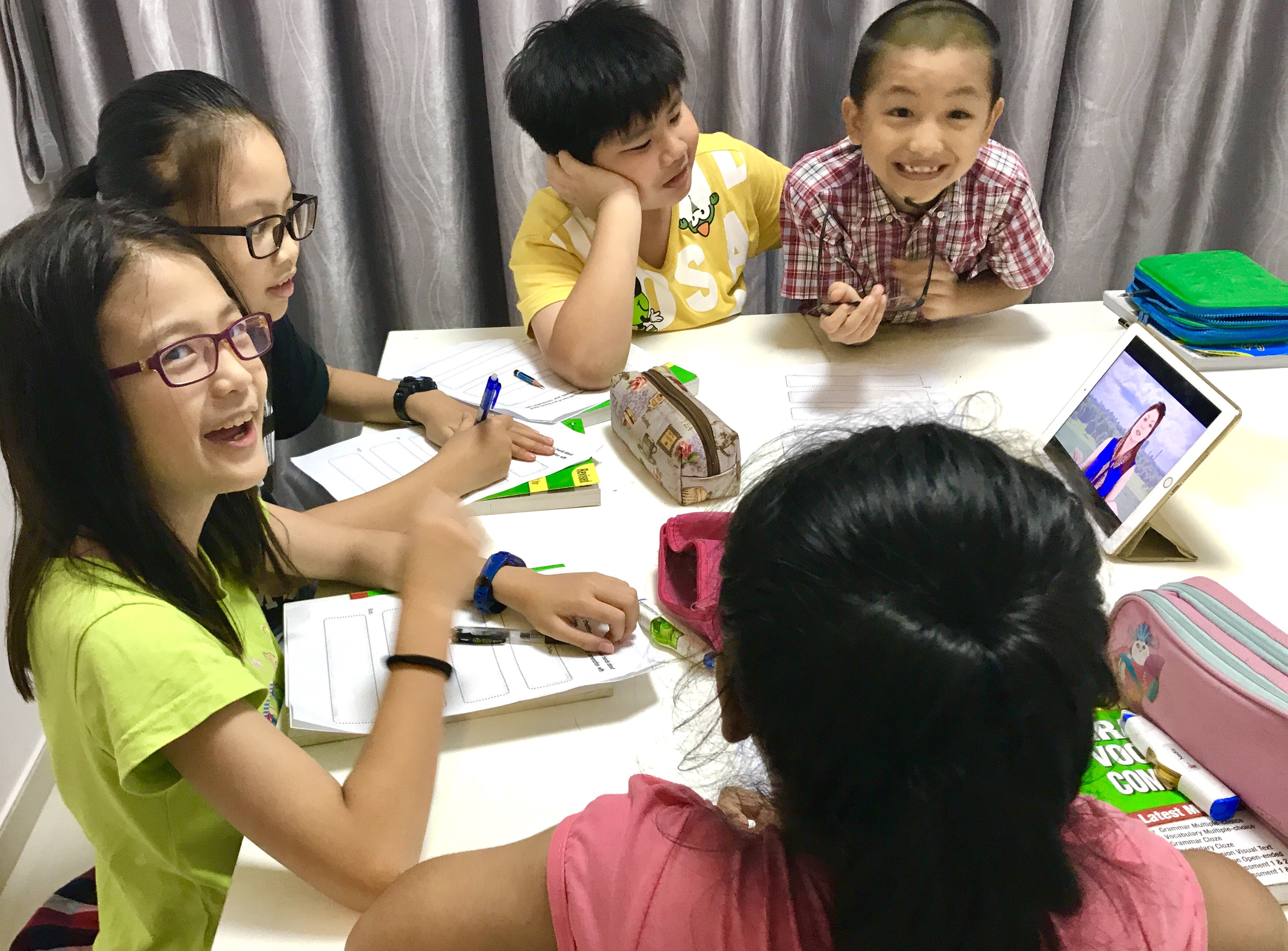
Questions Families Often Ask About Yishun Primary English Tuition Centre Small Group Tutorials
Can one centre support P1 to P6? Yes, if the programme changes complexity, scaffolding and performance expectations by level rather than using the same lesson at every age.
Why small groups? Small groups can make every learner visible and allow precise adaptation, provided individual error maps are maintained.

Should lower primary prepare for PSLE? Lower primary should build the literacy, vocabulary, grammar, writing and independence PSLE later depends on, not drill final-year papers prematurely.
What should parents track besides marks? Error recurrence, prompt level, independent starts, revision quality and transfer to school work are useful indicators.
What should happen before P6? The student should have a compact error map, reliable component methods and some experience of timed performance without losing the core process.
Primary Centre Checklist
- There is a visible P1-to-P6 progression.
- Every learner is active in the small group.
- Individual error maps are preserved.
- Corrections require retry.
- Old learning is retrieved.
- Prompts reduce over time.
- School work informs priorities.
- Wider reading remains part of the programme.
- Timing grows with age and accuracy.
- The P6 year narrows rather than expands the system endlessly.
The Deeper Centre Goal: Continuous Growth Without Dependency
The most valuable outcome of Yishun Primary English Tuition Centre (Small Group Tutorials) is a six-year pathway in which the child gradually carries more of the English process: reading, understanding, selecting evidence, constructing sentences, organising ideas, revising and checking.
Families can refer to the MOE Primary English Language Syllabus for the national curriculum framework and current SEAB PSLE information when the child reaches the examination years.
For families comparing Primary English tuition in Yishun, ask how the centre changes from P1 to P6, how it uses small groups, retrieves old learning, tracks recurring errors and reduces dependence. A strong programme should produce continuity, not six years of supervised worksheets.

Worked Centre Case: The Child Who Joins in Primary 3
A new Primary 3 student should not be forced through all Primary 1 and Primary 2 material. The centre should use the progression map to test foundations quickly: reading accuracy, comprehension, sentence control, vocabulary and independent task starts.
If one lower-primary mechanism is missing, repair it directly and preserve everything else that already works. Progression architecture should guide diagnosis, not become a rigid ladder that every child must climb from the beginning.
Worked Centre Case: The Primary 5 Student With a Primary 2 Gap
An older child may still have a basic sentence-boundary, spelling-transfer or pronoun-reference problem. Age does not automatically repair a foundational weakness.
The centre should fix the gap explicitly but efficiently, then return the learner to upper-primary work. Strong progression protects the child from both under-teaching and unnecessary repetition.
Worked Centre Case: The Strong Student Who Needs Less Repetition
A student may already have stable grammar, fluent reading and strong narrative control. The centre should move those strengths to maintenance and challenge judgment, precision, wider reading or more complex explanation.
A good programme does not equate challenge with simply moving the child into an older worksheet. Depth is often a better next step than acceleration.
Worked Centre Case: The Student Whose Marks Fall During a Transition
A falling mark in Primary 3, Primary 4 or Primary 5 may reflect a changed demand rather than a sudden loss of ability. Passages may be longer, questions more inferential or writing more independent.
The centre should compare old and new tasks, identify which requirement changed and train that mechanism. This prevents families from responding to transition difficulty with random volume.
Worked Centre Case: The Student Who Is Dependent on Tuition
A child may perform strongly beside the tutor and struggle at school because the method appears only after prompts. The centre should identify which cues are doing too much of the work.
Cold tasks, delayed retrieval and prompt fading reveal whether the learner owns the process. Strong tuition should make itself less necessary at the moment of performance.
Small-Group Quality Means Diagnostic Precision
The educational benefit of a small group should be visible in the feedback. The tutor should know which student needs scope, which needs sentence control and which needs retrieval, even when the class uses shared material.
If every learner receives identical correction despite different error patterns, the group is small in size but not yet diagnostic in method.
Small-Group Quality Means Active Participation
Every learner should regularly read, explain, write and speak. A student should not be able to disappear behind a confident classmate.
Silent think time, rotating roles and individual exit tasks protect personal performance while preserving the value of discussion.
Small-Group Quality Means Personal Prompt Fading
One child may still need a question-word cue while another activates the method independently. The tutor should not hold both learners at the same support level for convenience.
Prompt level is personal. The shared goal is independent activation, reached at different speeds.
Small-Group Quality Means Differentiated Follow-Up
A shared lesson can lead to different homework: one inference task, one paragraph revision and one spelling-transfer exercise.
The personalised layer should remain small enough to stay purposeful. Differentiation should sharpen practice rather than multiply workload.
Use Year-End Handover Notes
At the end of every level, record stable skills, recurring errors, prompt level and the next two or three priorities.
The note should be short enough for the next tutor and the family to use immediately. Continuity is lost when handovers become long reports nobody reads.
Use a Cumulative Error History
Some weaknesses disappear and return under pressure. A tense error that was repaired in Primary 3 may reappear during timed Primary 5 writing.
A compact history helps the centre recognise recurrence quickly and avoid treating the problem as completely new.
Use a Cumulative Strength History
Strong skills should be recorded too. A child may have excellent oral reasoning, reliable literal comprehension or strong story structure.
Knowing what is stable allows the centre to protect the base floor and spend more time on the next real constraint.
Quality Assurance: Does the Error Decline?
Teaching should eventually reduce the repeated error across fresh tasks. If the same mistake remains unchanged after several lessons, the intervention should be reconsidered.
The centre may need different examples, more retrieval, simpler modelling or less prompting. Repetition of the same worksheet is not quality assurance by itself.
Quality Assurance: Does the Prompt Reduce?
The student should gradually move from modelled to guided to prompted to independent performance.
If a method still requires the same cue months later, the centre should ask whether the skill is truly mastered or merely familiar.
Quality Assurance: Does the Method Travel?
Change the topic, wording, text type or timing. If the student still recognises and uses the method, transfer is emerging.
Fresh tasks should be routine because real schoolwork will not always look like tuition material.
Use Student Reflection at Every Age
Young children can name one target: “I am checking full stops.” Older students can explain more precise risks such as over-copying or weak paragraph development.
The language of reflection should become more sophisticated as the child’s English and self-awareness grow.
Use Parent Communication That Explains Mechanisms
A useful update says what changed, what still repeats and what happens next. “Your child now identifies scope independently; inference explanation remains the next target” is actionable.
Mechanism-based communication helps families see progress even when one school paper is unusually difficult.
Protect Enjoyment and Wider Reading
A primary English programme should leave room for stories, information texts, humour, curiosity and discussion.
Not every text needs a comprehension worksheet. Wider reading grows vocabulary, background knowledge and familiarity with different sentence patterns in ways exam practice alone cannot provide.
Protect Sustainable Workload
Primary students need cognitive freshness for reading, memory and writing. Homework volume should be tied to a purpose and age-appropriate independence.
Large amounts of assisted work can produce pages without producing honest evidence of what the child can do alone.
Use Age-Appropriate Technology
Digital text, typing and multimedia become more common as children grow. The centre can help students transfer reading architecture and language habits across formats.
Technology should support the language goal rather than become the lesson’s main distraction.
Build an Independence Audit Into Every Transition
Before moving levels, give unfamiliar but age-appropriate work without naming the method. Can the student read the task, choose a process, make a serious attempt, check a personal risk and ask a specific question if still uncertain?
The complexity changes from P1 to P6, but the independence question remains useful throughout the primary journey.
The P1 Independence Standard
A Primary 1 child should increasingly read simple instructions, decode or recognise age-appropriate words, understand short sentences, write a complete sentence and begin familiar tasks with less adult help.
The learner does not need advanced techniques. The goal is a reliable first language system.
The P2 Independence Standard
A Primary 2 child should increasingly read short passages for meaning, answer common question types, write several connected sentences and check basic spelling, punctuation and grammar.
These habits prepare the child for the middle-primary independence jump.
The P3 Independence Standard
A Primary 3 student should increasingly use evidence for comprehension, explain simple inference, make grammar choices in context and organise connected paragraphs.
The learner should also begin identifying personal errors and asking more precise help questions.
The P4 Independence Standard
A Primary 4 student should increasingly handle upper-primary language-use tasks, deeper comprehension, composition planning and basic self-editing without constant prompting.
The year should finish with a clear P5 handover rather than a generic revision list.
The P5 Independence Standard
A Primary 5 student should increasingly integrate components, retrieve old learning, revise writing meaningfully and handle light timing without losing the underlying method.
The student should know which weak links must be repaired before the final primary year.
The P6 Independence Standard
A Primary 6 student should be able to apply a compact playbook under realistic examination conditions, manage time, use strategic checking and recover after difficulty.
The final-year programme should become smaller and more selective as the learner becomes more capable.
A Parent’s Six-Year View
Parents can evaluate the programme by asking whether the child is carrying more of the English process each year. Is the student more able to begin, explain, revise, retrieve and recover?
This longitudinal view is more meaningful than judging the entire programme from one isolated school mark.
A Student’s Six-Year View
The student should gradually move from “Tell me what to do” toward “I know what kind of problem this is and which method I should try.”
That shift is the clearest sign that tuition is creating an independent learner rather than permanent dependence on tuition.
The Final Centre Standard
A strong Yishun Primary English Tuition Centre (Small Group Tutorials) should be able to explain how the curriculum develops from P1 to P6, how each child is diagnosed inside the small group and how prompts are deliberately reduced over time.
The centre’s deepest product is continuity: preserved strengths, repaired weak links, cumulative vocabulary and language control, and an increasingly student-owned operating system that remains available when the exact worksheet, teacher or examination changes.
The Final P1-to-P6 Transition Map
The broad centre should finish each year with a map that is short enough to use: stable reading and writing capabilities, active error patterns, current prompt level and the next two priorities. This creates continuity across tutors and school years without burying the child in an administrative file.
The map also protects strengths. A skill that remains reliable across fresh work does not need to be retaught at full intensity merely because the school calendar moved forward. It can stay in spaced maintenance while attention shifts to the next constraint.
The Final Small-Group Quality Test
A strong small group should produce evidence that every learner is visible: individual first attempts, individual error maps, individual prompt levels and individual handovers. Shared discussion should sharpen judgment, but each important method must end in personal transfer.
If students can succeed only while sitting beside the tutor or copying the logic of a classmate, the format is still too dependent. The educational goal is a learner who carries the method into schoolwork and examinations independently.
The Final Parent Check
Parents can ask whether the centre can explain how today’s lesson fits the child’s current level, personal weak link and next transition. A useful answer should name both what is being built and what is no longer being prioritised because it has become stable.
That clarity is what turns six years of English tuition into one coherent progression rather than a long sequence of disconnected worksheets.
The Final Primary Centre Principle
From Primary 1 to Primary 6, the child should gradually move from supported language learning toward independent language performance. Reading becomes more analytical, writing becomes more organised, vocabulary becomes more precise, grammar becomes more self-edited and communication becomes more flexible.
That is the durable outcome of a strong Yishun Primary English small-group centre: a student who finishes each year with stronger language and less dependence on external prompting, ready to carry the same operating system into the next stage.
For families, the closing quality signal is continuity with increasing independence. The centre should be able to show how a reading habit learned in lower primary becomes evidence control in upper primary, how sentence work becomes paragraph and composition control, and how tutor prompts shrink as the learner becomes more capable. The student should enter each new year carrying preserved strengths, a short list of active weak links and a clear method for beginning unfamiliar work. This continuity prevents annual resets, reduces unnecessary repetition and makes small-group tuition genuinely cumulative rather than simply smaller in class size. That is durable progression. That is durable progression. That is durable progression. That is durable progression. That is durable progression. That is durable progression. That is durable progression. That is durable progression. That is durable progression. That is durable
Leave a Reply