
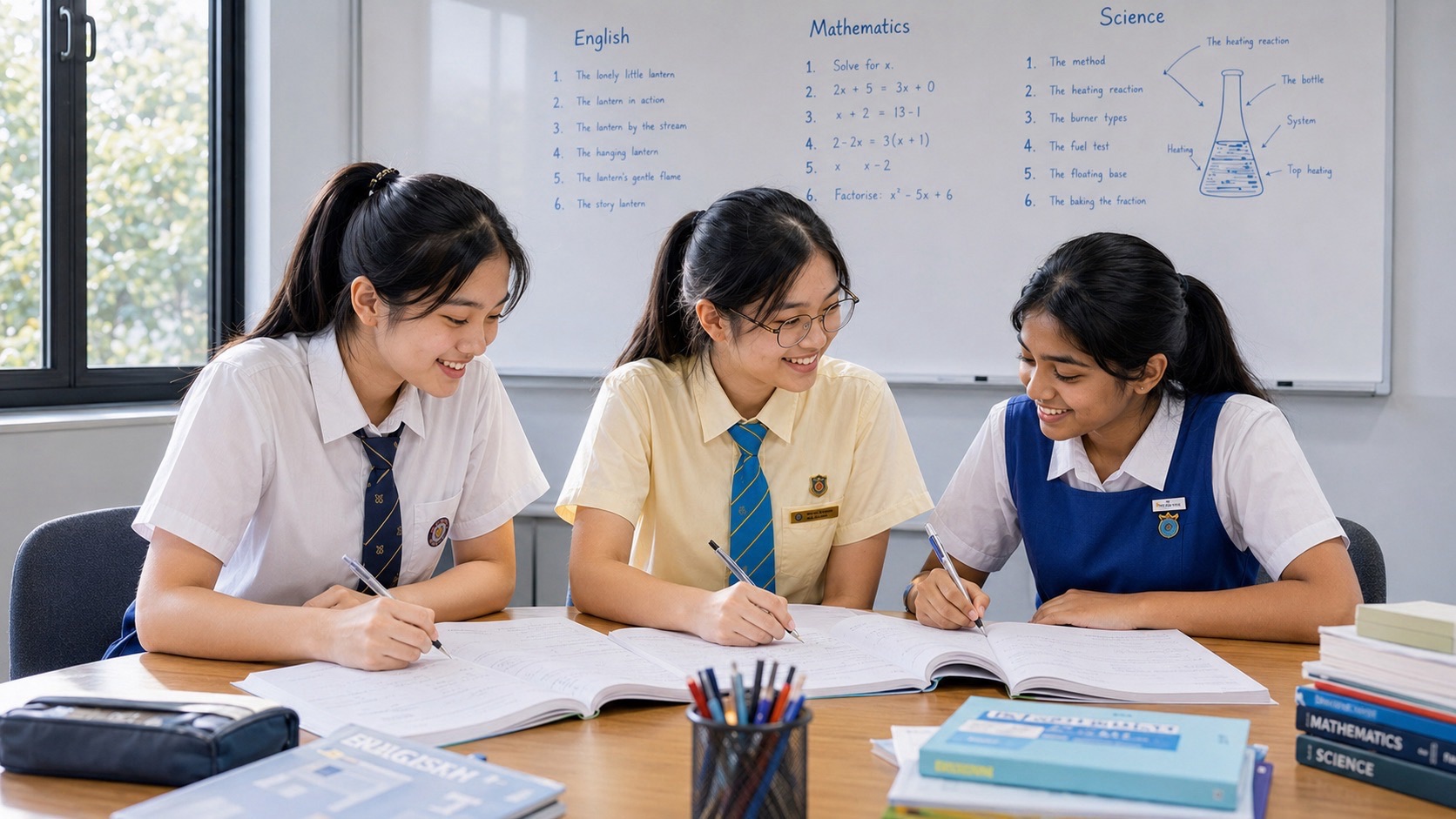
eduKate Yishun · Secondary 4 English · 2027 SEC Writing · G1 K100 · G2 K200 · G3 K300
Writing improves when every sentence knows what job it is doing.
A student can know hundreds of good words and still produce a weak examination response. The failure may happen before the first sentence: the task was misread, the audience was forgotten, a required point was not developed, the plan had no progression, or the student began writing before deciding what the piece needed to accomplish.
For the 2027 SEC, students should train against the exact English Language subject level registered by their school: G1 K100, G2 K200 or G3 K300. This guide does not collapse those syllabuses into one paper. Instead, it teaches the writing decisions that support performance across the appropriate route: task, purpose, audience, content, organisation, language control, editing and independent checking.
Choose your writing route
I do not know how to start
Go to Task Before Sentence.
I go off-topic
Go to Planning and Paragraph Jobs.
My situational writing loses marks
Go to Situational Writing.
My continuous writing is flat
Go to Continuous Writing.
My grammar breaks down
Go to Editing the Draft.
Examinations are near
Go to Timed Writing.
Full contents
1. 2027 SEC writing: use the correct route
SEAB lists English Language as K100 at G1, K200 at G2 and K300 at G3 for 2027. The exact assessment demands differ by subject level. At G1 K100, Paper 1 Writing includes Editing, Situational Writing and Continuous Writing. The published syllabus specifies at least 180 words for Situational Writing and at least 120 words for Continuous Writing. G2 and G3 students must use their own current syllabus specifications rather than borrowing G1 task assumptions.
The common principle is communicative control. Writing is assessed because it reveals whether a student can understand a task, select relevant content, organise ideas and use language effectively for a reader.
2. The task comes before the sentence
When students ask for a “good introduction”, the useful reply is: good for what job? An opening for a proposal, a narrative, a reflective response and an argument cannot be judged by the same template.
- What am I being asked to produce?
- What must the reader understand?
- What must the reader feel, consider or do?
- Which content is compulsory?
- What tone is appropriate?
These questions take less than a minute and prevent minutes of irrelevant writing.
3. Audience and purpose change language
Imagine the same idea: the school should create a quiet study area after lessons. A message to a close friend may be casual and compressed. A proposal to a school leader needs context, reasons, practical details and a respectful request. The underlying idea is unchanged; the communication changes because the reader changes.
Students should stop thinking of tone as a list of formal words. Tone is a relationship between writer, reader and purpose. Respect can be expressed through clarity, reasonable claims and an appropriate request without becoming stiff or flattering.
4. Planning and paragraph jobs
A plan is not useful because it exists on paper. It is useful if it predicts movement. Before drafting, state each paragraph’s job in one sentence.
| Paragraph | Possible job in an argument | Possible job in a narrative |
|---|---|---|
| 1 | Establish position and issue | Establish normal state and desire |
| 2 | Develop strongest reason | Introduce disturbance |
| 3 | Develop second dimension | Escalate difficulty |
| 4 | Consider counterargument | Force decisive choice |
| 5 | Respond and qualify | Show consequence |
| 6 | Conclude with judgement | Reveal changed understanding |
If the student cannot explain why paragraph four exists, paragraph four is likely to wander.
5. Situational writing: complete the communicative job
Situational writing rewards disciplined reading. A student can write fluent English and still underperform by omitting a required point, failing to develop it or choosing an inappropriate register.
Use the APCC check: Audience, Purpose, Context, Content. Mark the task before drafting. Convert every required point into a communication job rather than a copied phrase.
Situational writing workshop
Situation: Your class would like the school library to remain open for one additional hour twice a week during an examination period. Write to the appropriate member of staff proposing the arrangement.
- Explain the need.
- Suggest which two days would be most useful and why.
- Explain how students could use the space responsibly.
- Address one practical concern.
- Make a realistic request.
Development, not mention
“Students need a place to study” merely states a point. Development explains the consequence: some students remain in school for activities and have a gap before travelling home; a supervised quiet area could let them use that time productively instead of trying to work in noisy common spaces.
6. Continuous writing: create controlled movement
Continuous writing is open enough to reward individuality but structured enough to punish drift. Decide what the reader should understand by the end and build a sequence that earns that ending.
A story is not a list of events. An argument is not a list of points. A reflection is not a list of feelings. Each form requires movement.
7. Narrative: pressure, choice and consequence
Strong narratives often turn on a decision. A character wants something. A difficulty creates pressure. The character chooses. The consequence changes the situation or the character’s understanding.
Prompt: Write about a time when keeping a promise became difficult.
Thin plan: promised to help → became busy → helped anyway → everyone happy.
Stronger plan: a student promises to attend a younger sibling’s first public performance. On the same afternoon, a rare opportunity appears to join friends at an event the student has wanted to attend for months. The story turns on the attempt to justify breaking the promise, the moment of decision and the consequence. The conflict gives ordinary events meaning.
Dialogue must change something
Do not add dialogue merely because stories “need dialogue”. A spoken line should reveal character, increase pressure, provide information or change a relationship. If removing the line changes nothing, it may not be earning its space.
8. Argument and discussion: build a line of thought
A mature essay does more than collect three reasons. It develops a judgement. One paragraph may establish the practical case, another may expose a limitation, and a counterargument may force the writer to qualify the original position.
Topic: Should schools create more spaces where students can spend time without buying anything?
A simplistic response says yes because students need places to relax. A developed response might examine social access, supervision, competing uses of school space, student responsibility and whether such spaces support belonging. The final position can still be yes, but it is now a judgement rather than a slogan.
9. Description and reflection: make observation do work
“The hall was very beautiful and magnificent” tells the reader what to think. “Sunlight caught the dust above the empty chairs, and every footstep returned from the high ceiling” gives the reader evidence.
Reflection goes one step further. It asks what changed in the writer’s understanding. What did I assume before? What happened? What did I notice? What do I now understand differently? Reflection is movement in thought.
10. Paragraph development: claim is only the beginning
A paragraph can be tested with four questions: What is its job? What is its main claim or event? What evidence, example or detail develops it? How does it connect to the larger piece?
Weak: Public libraries are useful because students can study there.
Developed: Public libraries provide a study environment that some students cannot easily reproduce at home. A shared bedroom, younger siblings or household activity can make sustained concentration difficult; a quiet public space therefore offers not luxury but access to conditions needed for focused work.
11. Sentence control: syntax should serve thought
Sentence variety is useful only when it serves meaning. Short sentences can emphasise a turn. Longer sentences can show relationship or accumulate detail. The aim is not to tick off sentence types but to control pace and logic.
Check sentence boundaries first. A sophisticated idea cannot survive if clauses are joined carelessly or
Comments
One response to “Secondary 4 English Writing Yishun | 2027 SEC G1 G2 G3 Writing Guide”
-
[…] guide at Secondary 4 English Tutor Yishun | 2027 SEC G1 G2 G3 Learning Guide, the writing guide at Secondary 4 English Writing Yishun, and the comprehension guide at Secondary 4 English Comprehension in […]
Leave a Reply