
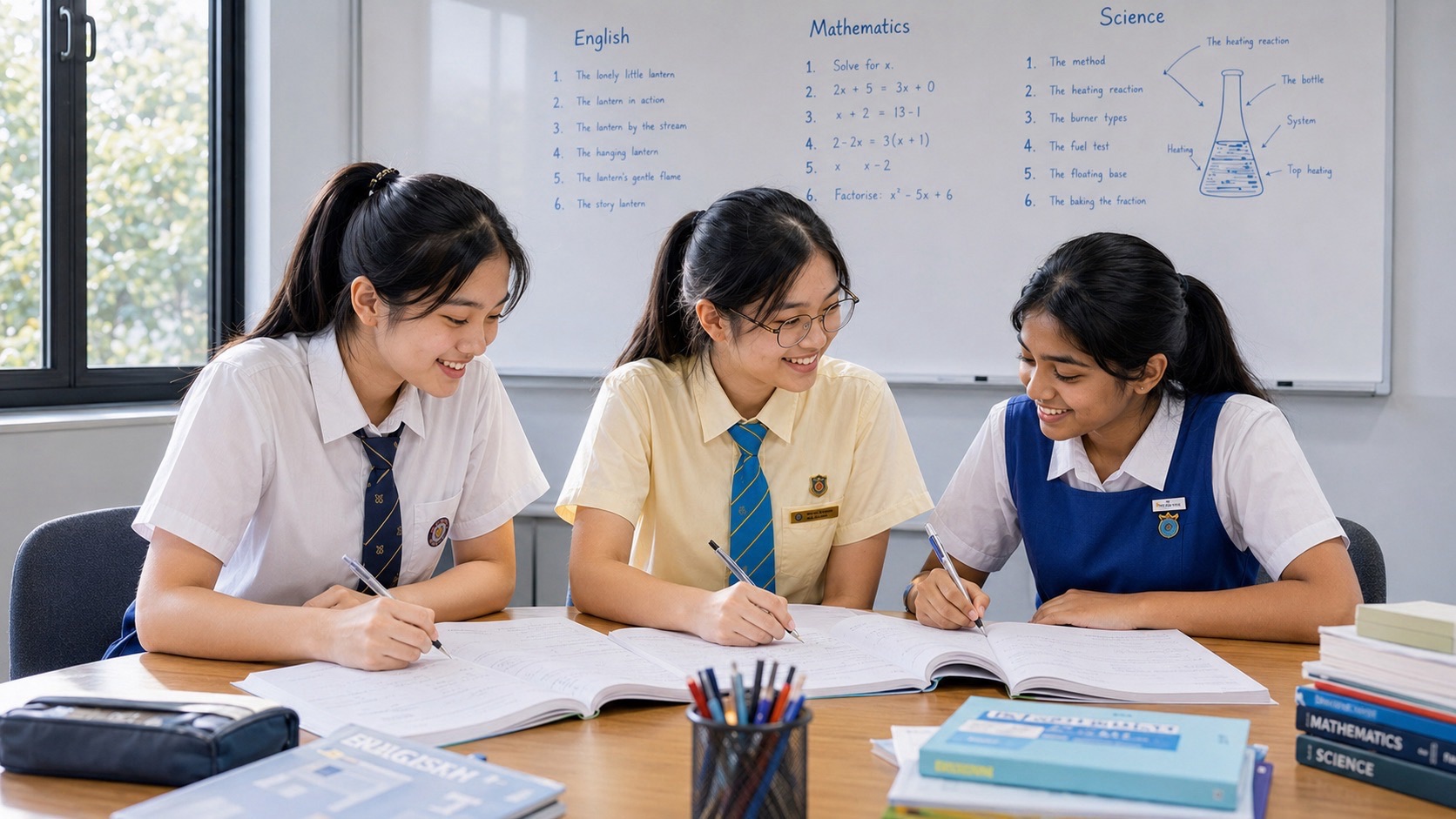
Secondary English Tuition Yishun Northland Secondary School: building continuity from Secondary 1 to Secondary 4
Families searching for Secondary English Tuition Yishun Northland Secondary School, Secondary English tuition in Yishun, a Secondary English tutor, comprehension tuition, essay writing support, vocabulary, grammar, oral communication or examination preparation are usually trying to solve something larger than one worksheet. A student may have been comfortable in Primary school, then feel increasingly uncertain as English becomes denser, more inferential and more independent. Another may cope in lower secondary and then discover in upper secondary that familiar habits no longer produce familiar results.
The useful idea is continuity. English should not feel like four unrelated school years. The demands change, but the underlying capabilities remain connected: read closely, identify the task, select relevant evidence, infer responsibly, organise ideas, choose precise language, speak and write for an audience, revise, check and recover under time. Each year should make those capabilities more independent and more transferable.
This rebuilt guide gives the legacy page one clear learning job: show how Secondary English develops across the four-year journey. It keeps the original 2019 title and URL while replacing the old repetitive promotional body. This is an eduKateYishun educational resource and does not claim affiliation with Northland Secondary School. The aim is to help parents and students understand what should become stronger each year, how to diagnose a break in the chain and how tuition can repair without creating permanent dependence.

Secondary English is a progression in independence
At the beginning of Secondary 1, a student may still rely on familiar Primary-school routines. The teacher tells the class what to annotate, the worksheet heading suggests the method, and the student expects that the “right answer” can be located somewhere near the question. By Secondary 4, this dependence becomes costly. The student is expected to recognise the structure of a text, infer without overreaching, plan an argument, adapt tone, manage time and recover when something unfamiliar appears.
That progression can be described simply: supported recognition → guided reasoning → independent selection → controlled performance. Tuition should know which stage the learner is currently in. A Secondary 3 student who still needs the tutor to identify every question type is not merely “weak at comprehension”; the student has a selection problem. A Secondary 2 student who can write well after discussion but freezes on a fresh topic has a transfer problem. A Secondary 4 student who knows the content but cannot finish has an execution problem.
When the stage is named accurately, the repair becomes more efficient.
A four-year English continuity map
| Year | Main transition | What should become stronger | Common risk |
|---|---|---|---|
| Secondary 1 | Primary to secondary | Text structure, evidence, paragraph purpose, independent instructions | Using Primary-school habits on denser tasks |
| Secondary 2 | Consolidation | Transfer, vocabulary precision, longer reasoning, self-correction | Knowing methods only when the topic is obvious |
| Secondary 3 | Upper-secondary complexity | Inference, comparison, argument, tone, mixed-task control | Procedures without judgement |
| Secondary 4 | Examination performance | Timing, selection, recovery, checking, consistency | Knowledge that collapses under pressure |
The table is not a rigid syllabus. Students develop unevenly. A Secondary 1 student may already be a strong writer but weak at comprehension. A Secondary 4 student may still need a foundational grammar repair. The map simply shows the direction of travel: less external prompting and more self-managed reasoning.
Secondary 1: the language of school becomes denser
The first secondary year changes the reading environment. Texts may be longer, vocabulary less predictable and questions more dependent on interpretation. Students also encounter a wider range of writing purposes. The underlying challenge is not that English suddenly becomes a different subject. It is that the student must carry more of the thinking.
A useful Secondary 1 tuition programme therefore teaches routines explicitly. How do I identify the paragraph job? What does a contrast word tell me? How do I find evidence? How do I know whether an answer is literal or inferential? How do I plan before writing? What should I check?
These routines reduce noise. The student begins to see the architecture beneath different tasks.
Secondary 1 reading: learn to map before answering
Many students read line by line and remember local details without understanding how the passage is built. Mapping changes that. Each paragraph receives a short role: introduces problem, gives example, shifts viewpoint, explains cause, qualifies earlier claim, concludes.
The labels need not be elegant. Their purpose is navigation. A question about the writer’s change in attitude becomes easier when the student can see where the shift occurred. A comparison question becomes easier when the relevant sections have already been mentally separated.
Tuition should then fade the visible labels. The final goal is not a heavily annotated page but an internal sense of structure.
Secondary 1 writing: paragraphs need jobs
Primary-school writing can sometimes be carried by story familiarity or a memorised composition structure. Secondary writing increasingly requires conscious purpose. Each paragraph should do something distinct.
A simple lesson asks the student to plan in verbs: introduce, explain, contrast, illustrate, qualify, conclude. These verbs are stronger than topic labels because they describe movement. “Social media” is a topic. “Explain how comparison affects self-perception” is a paragraph job.
When students learn this early, later argumentative and discursive writing becomes much easier to organise.
Secondary 1 grammar: rebuild the sentence as a relationship
Some learners arrive in Secondary 1 with many grammar rules but weak sentence awareness. They recognise exercises on subject-verb agreement or tense, yet those rules disappear when they write quickly. Tuition should reconnect grammar to meaning. A sentence has a main relationship between subject and verb, then additional clauses and phrases that modify, explain or qualify.
When students learn to locate the main clause, several later problems become easier: fragments, run-ons, misplaced modifiers, unclear pronouns and punctuation. Grammar becomes less like a cabinet of rules and more like a map of how ideas are joined.
Secondary 1 vocabulary: meaning before decoration
The first secondary year is also when many students begin collecting “good vocabulary”. The risk is decorative language used without control. A useful vocabulary notebook records the word, a natural collocation, a contrast, the tone and an original sentence.
For example, “reluctant” becomes “reluctant to admit”, is contrasted with “eager” or “willing”, and is used in a sentence that shows hesitation. The word should then reappear in reading and oral discussion. The goal is not to impress the marker with rare words. The goal is to make meaning more exact.
Secondary 2: recognition must become transfer
Secondary 2 often feels comfortable because students recognise school routines. That comfort can hide dependence. The key question is whether the method survives when the worksheet changes.
If the lesson heading says “Inference”, can the student do inference? More importantly, if the heading is removed and inference appears among vocabulary, comparison and language-effect questions, can the student recognise it? If an essay topic changes from school life to technology or community, can the same paragraph-development method still operate?
This is where mixed practice becomes important. Students learn to select a method instead of waiting to be told which one is required.
Secondary 2 vocabulary: move from definition to use
A student can know many definitions and still write vaguely. Usable vocabulary requires connections. Each word should be learned with a natural phrase, tone, contrast and original use.
Take reluctant. The student learns “reluctant to admit”, contrasts it with “eager” or “willing”, notices that it often implies hesitation, and creates a sentence. Later the word appears in reading, oral discussion and writing.
The goal is a working vocabulary network, not a decorative list. Precision helps every component because better word knowledge improves both interpretation and expression.
Secondary 2 grammar: explain the relationship, not only the rule
Grammar becomes more durable when the student understands what the sentence is doing. Subject-verb agreement, pronoun reference, sentence boundaries and tense are relationships, not isolated correction marks.
For example, in “The collection of photographs is on the table”, the nearby plural noun can distract the eye, but “collection” controls the verb. Once the student sees the relationship, the rule becomes easier to retrieve inside real writing.
Tuition should therefore connect grammar exercises back to composition. A rule that appears only on a worksheet may not survive the cognitive load of an essay.
Secondary 2 reading: distinguish evidence from answer
Many students still copy phrases because they have correctly located the evidence but do not know what to do next. Tuition should teach a three-part distinction: evidence is what the passage gives; interpretation is what that evidence means; answer is the interpretation expressed to meet the question.
This distinction helps students avoid both extremes. They stop copying without explanation, but they also stop giving unsupported opinions. The passage remains the anchor while the student learns to transform information rather than merely reproduce it.
Secondary 2 writing: one paragraph should develop, not list
At this stage, students often produce paragraphs with several examples but little explanation. The paragraph looks full yet feels thin. A useful development engine is claim → reason → example → warrant → implication.
The warrant answers the question many students skip: why does this example prove the claim? The implication asks what follows from the reasoning. These two moves create depth without demanding longer and longer essays.
Secondary 3: upper-secondary English requires calibrated judgement
By Secondary 3, students are asked to make more decisions with less certainty. They must distinguish reasonable inference from speculation, evaluate language choices, compare viewpoints, develop argumentative positions and use examples with explanation.
The central skill is judgement. The student may know what a metaphor is, but can the student explain why this metaphor matters here? The student may know a paragraph structure, but can the student decide when a counter-position is useful? The student may have an example, but can the student scale the claim so the example actually supports it?
Upper-secondary tuition should therefore move beyond procedures toward calibration.
Inference: evidence sets the boundary
Inference is often described as reading between the lines. A better method is evidence → reasonable conclusion → question connection. The evidence constrains the imagination.
Suppose a character smiles politely when receiving results, then takes a longer route home and ignores messages. The student may reasonably infer disappointment or a desire for solitude. The text does not justify a dramatic claim about hatred, betrayal or permanent withdrawal.
Practising “too small, just right, too large” inferences helps students calibrate how much the evidence can support.
Comparison: use a shared axis
A comparison answer is not two summaries placed beside each other. The student needs a shared axis: attitude, purpose, method, effect, degree, cause or consequence. Once the axis is clear, the relevant details become easier to select.
If two speakers both support a change but one considers it overdue while the other worries about implementation, the student can compare degree and reason rather than label one “positive” and one “negative”. This same skill strengthens essay comparison because the writer learns to decide what dimension matters before discussing details.
Language effect: why this word, here?
Students should not treat language-effect questions as device hunting. A metaphor name is useful only if the student can explain the specific association and its significance.
If a crowded train platform is described as “a tide pressing against the doors”, “tide” suggests a large collective force and “pressing” adds confinement. The point is not the label. The point is how the language shapes the reader’s sense of the scene.
Tuition can use substitution: replace “pressed” with “stood”. What is lost? This makes language choice visible.
Tone: read patterns rather than guess adjectives
Students often select a tone word quickly and then search for evidence after the fact. A stronger process works in the opposite direction. Look for clusters: repeated verbs, sentence rhythm, punctuation, what the writer notices, what is omitted, where the language becomes more or less intense.
Only then name the tone. “Restrained disappointment” may be more accurate than “angry” if the writer avoids accusation and focuses on missed opportunities. The tone label becomes a summary of evidence rather than a guess.
Argument: claims need reasons, evidence and warrants
A strong argumentative paragraph contains more than an opinion and an example. The student needs a claim, a reason, evidence or example, and a warrant explaining why that evidence supports the claim.
Suppose the claim is that peer teaching can strengthen learning. An example might describe students explaining a concept to classmates. The warrant is that explanation forces the speaker to organise knowledge, detect gaps and translate abstract ideas into clearer language. That is the mechanism.
Without the warrant, essays become lists of examples. With it, the reasoning becomes visible.
Counter-position is a test of understanding
A counter-argument should not be ceremonial. Its purpose is to stress-test the student’s claim. A mature writer can represent a reasonable opposing view fairly and then decide whether it limits, changes or fails to overturn the main position.
For example, a student arguing for more outdoor learning may acknowledge travel time and weather. The final claim becomes more precise: outdoor learning is most valuable when used selectively for topics that gain from direct observation.
The counter-position has not weakened the essay. It has made the main argument more defensible.
Secondary 3 oral communication: structure without scripting
Upper-secondary oral work exposes whether the student can think beyond a prepared line. Memorised scripts are fragile because follow-up questions change direction. A more robust unit is point → reason → example → implication.
The student can prepare two or three perspectives rather than complete sentences. What do I think personally? What might a school, family or community member think? This creates flexibility. It also strengthens writing because the same spoken reasoning can later become paragraph structure.
Secondary 4: the problem becomes coordination under time
By the final secondary year, many students know a great deal of English. The challenge is making that knowledge appear reliably in examinations. Reading, reasoning, planning, language control, timing and checking must work together.
This is where a student can be “good at English” and still produce inconsistent results. One difficult question consumes attention. An essay plan takes too long. A final section is rushed. The student changes correct answers because checking has no target.
Secondary 4 tuition must therefore include execution, not only knowledge.
Time should be added after method is stable
A stopwatch does not teach a method. If a student cannot reliably explain inference untimed, timing the task simply compresses confusion. The sequence should be understanding first, then accurate practice, then independent retrieval, then controlled timing.
Timed practice can begin with one small unit: a comprehension cluster, a writing plan, one developed paragraph or a final checking pass. These micro-timings reveal where time disappears.
Only later should tasks be combined into full simulations.
The move rule protects the whole paper
Students need permission to leave a resistant question temporarily. A pre-agreed move rule can prevent one item from consuming marks elsewhere. The student makes a reasonable first attempt, marks the uncertainty, continues, and returns if time permits.
This is not avoidance. It is allocation. The whole paper has value.
Practising the move rule before the examination helps students use it without panic. Recovery becomes a learned behaviour.
Checking must be targeted
“Check your work” is too vague. The student should know personal risk patterns. One learner checks sentence boundaries and tense. Another checks question demand and evidence match. Another checks required situational-writing content.
A useful sequence is completeness first, then correctness. Has every required part been attempted? After that, inspect the errors most likely for this student.
Targeted checking is faster because attention has a job.
The Secondary English gap taxonomy
| Gap | What it looks like | Repair direction |
|---|---|---|
| Missing knowledge | Does not know concept or word | Teach explicitly |
| Broken connection | Knows parts but cannot link them | Make relationships visible |
| Weak retrieval | Understands in lesson, forgets later | Spaced retrieval |
| Selection | Knows methods but chooses wrong one | Mixed practice |
| Translation | Can explain orally but not write | Oral-to-written bridge |
| Transfer | Works only on familiar tasks | Fresh contexts |
| Calibration | Over-infers or over-claims | Evidence-bounded judgement |
| Regulation | Method collapses under time or stress | Timed control and recovery |
The taxonomy prevents a broad label such as “weak in English” from becoming the plan. Different gaps require different teaching.
Reading continuity: one method across many texts
Students should learn a small set of durable reading questions: What is this paragraph doing? What changed? What does this detail suggest? Which word controls the meaning? Where does the writer qualify the claim? What evidence actually supports my answer?
These questions work across narrative and non-fiction. They can be applied to school passages, articles and oral stimuli. The content changes; the reasoning remains recognisable.
When students internalise these questions, unfamiliar texts feel less shapeless.
Writing continuity: one development engine across topics
The same is true for writing. Students need a transferable development engine. A useful version is claim → reason → example → warrant → implication. It works on technology, school, community, responsibility and many other topics.
The examples change, but the reasoning process remains. This reduces dependence on memorised model essays because the student knows how to build a paragraph from first principles.
Model essays can still be studied, but the student extracts structure rather than copies sentences.
Situational writing: purpose and audience connect the details
Situational writing can appear format-driven, but the deeper structure is rhetorical. Who am I? Who am I writing to? What action or understanding do I want? Which details from the stimulus serve that purpose?
Students should transform rather than copy. The same fact may be emphasised differently when writing to classmates, a teacher or a community organiser. This trains judgement because the student is selecting and ordering information for a reader.
Oral continuity: speech can strengthen writing
Some students reason better aloud. Tuition can use this strength. Ask the student to explain a point verbally, then identify the claim, reason, example and implication inside the spoken answer. That becomes a paragraph plan.
Oral discussion also reveals whether vocabulary is truly usable. A word recognised on a worksheet but unavailable in speech may not yet be ready for timed writing.
The goal is cross-component transfer. English becomes one connected system rather than separate papers.
Listening continuity: attention and evidence
Listening trains selective attention. Before audio begins, the student predicts the information type required: reason, number, sequence, viewpoint, location or contrast. During listening, notes remain economical. If one item is missed, the student re-enters rather than mentally chasing the lost phrase.
That recovery habit transfers to examinations generally. The student learns not to let one difficult moment consume the next opportunity.
Summary writing: a bridge to studying
Summary is not only an examination component. It teaches students to distinguish main ideas from support, combine overlap and compress without distortion. Those skills improve note-making across subjects.
A useful summary routine begins with the exact category requested. Every selected point must answer that category. Examples and decorative detail are removed unless necessary for meaning.
This is a form of information discipline that supports later academic learning.
Sentence control: clarity before complexity
Students sometimes try to sound mature by making sentences longer. Length is not sophistication. A strong sentence makes its relationships clear. Complexity should be added only when the student can control it.
One useful exercise expands a simple sentence step by step: claim, cause, qualification, contrast. Another exercise does the reverse: split an overloaded sentence into two clean units. Students learn that style is a set of choices, not a competition for the longest structure.
Punctuation: teach the logic behind the mark
Punctuation supports the reader’s understanding of sentence relationships. A full stop creates a boundary. A comma may separate a dependent opening phrase, list items or clauses in particular structures, but it cannot safely join every complete sentence. A colon can introduce explanation or expansion.
Instead of correcting punctuation by instinct, students should ask what relationship they want the reader to see. This makes punctuation part of meaning rather than surface decoration.
Error diagnosis: the first wrong move matters most
The visible mistake is often the end of a longer chain. A vague comprehension answer may begin with a misread qualifier. An off-topic essay may begin with a broad interpretation of the prompt. A grammar error may appear because the sentence became too ambitious under time.
Good tuition traces backwards. Where did the student first lose the correct path? That is the point worth repairing.
Repeating the entire chapter when one link is weak wastes time and can increase frustration.
An error ledger makes patterns visible
The student records recurring errors, not every mistake. Each entry contains the error type, example, cause, correction rule and fresh test.
Example: “Inference too large. I added a motive not supported by the passage. Rule: state the smallest conclusion the evidence clearly supports. Test: next unseen passage.”
The ledger becomes a compact history of learning. Over time, errors should disappear, change form or require less prompting.
Delayed retrieval tests whether learning survived
A student can perform well five minutes after an explanation because the method is still active in working memory. The real test comes later. Can the student retrieve it next week? Can the method survive a different topic and layout?
Tuition should therefore bring old skills back without warning. An inference routine taught in one passage reappears later inside a mixed set. A paragraph-development method taught for technology appears again on a community topic.
This is learning continuity: usable understanding remains connected across time and context.
Mixed practice teaches method selection
Blocked practice is useful when a skill is new. Ten similar questions allow the student to focus on one method. But examinations do not announce the method. Mixed practice is needed later so the student must recognise what kind of task is present.
The transition should be deliberate: blocked practice → varied examples → mixed practice → timed transfer.
Students who skip the mixed stage may know many methods yet remain inconsistent because they cannot select efficiently.
Learning synchrony: repair what the next step depends on
Good teaching is partly timing. A student who cannot identify sentence boundaries may not benefit from advanced stylistic variation. A student who cannot distinguish evidence from inference may not be ready for subtle tone analysis. A student who already controls those skills needs deeper work, not endless repetition.
Learning synchrony means aligning prerequisite, current instruction, readiness, practice load and next demand. The tutor asks: what must be stable for the next school task to become learnable?
This prevents both rushing ahead and holding a student back with work already mastered.
Homework should preserve the lesson, not bury it
More homework is not automatically better. Continuation work should reinforce the exact skill trained, then later require retrieval in a mixed context. If the lesson focused on paragraph warrants, a small number of carefully selected paragraphs may be more useful than an entire essay plus unrelated worksheets.
The student should know why the homework exists. “This task checks whether you can identify evidence without prompts” creates a different learning experience from “finish pages 12 to 20”. Purpose helps students evaluate their own work.
Parents need a readable progress story
Parents should not have to infer learning from one test score. A useful progress update can say: the student now identifies passage structure independently; inference remains too broad in unfamiliar texts; paragraph planning is faster; sentence fragments have reduced; the next cycle will focus on evidence calibration and timed transfer.
This is more useful than a general statement such as “doing better”. It explains what changed, what evidence supports the change and what the next learning job is.
Three pathways: repair, stabilise, extend
Repair
The repair student is losing access to the subject. Homework takes too long, corrections feel mysterious, and school lessons move faster than understanding. The immediate aim is to locate the earliest weak link, reduce unnecessary complexity and rebuild connection to current work.
Stabilise
The stabilisation student can perform well but results vary sharply. The problem may be transfer, timing, careless execution or dependence on familiar topics. The aim is to make performance less sensitive to surface changes.
Extend
The extension student is secure and needs greater depth: ambiguous texts, stronger counter-arguments, subtler tone, more efficient synthesis and richer vocabulary. Extension should deepen judgement rather than simply rush through more content.
A typical 90-minute continuity lesson
A lesson can begin with ten minutes of retrieval from earlier learning. The next ten minutes examine recent school evidence. Twenty minutes teach or refine one mechanism. Twenty minutes use guided practice with prompts. Twenty minutes require independent transfer on fresh material. The final ten minutes review the error ledger and set one continuation task.
The exact timing changes. The stable feature is the handover: support is gradually removed. The student must eventually do the noticing, selecting and checking.
A twelve-week continuity cycle
Weeks one and two establish baseline evidence across reading, writing and execution. Weeks three and four repair the largest bottleneck. Weeks five and six introduce delayed retrieval and mixed practice. Weeks seven and eight connect a second skill. Weeks nine and ten add realistic timing or unfamiliar contexts. Weeks eleven and twelve test independence and decide the next cycle.
The plan updates when evidence changes. Diagnosis is not a fixed label. It is a working explanation tested against performance.
Worked example: Secondary 1 reading repair
A student answers every comprehension question by copying the nearest sentence. The tutor does not simply say “do not copy”. The student learns to separate evidence from answer. First underline the relevant detail. Then paraphrase what it means. Then decide whether the question wants literal information or an inference.
On a fresh passage, the tutor removes the prompt. The student must perform the three moves independently. Progress is visible when copying declines because the student now knows what should replace it.
Worked example: Secondary 2 transfer repair
A student writes strong argumentative paragraphs after a class discussion but weak ones on unseen topics. The diagnosis is not necessarily weak writing. It may be dependence on pre-generated ideas.
The repair uses rapid planning across several unfamiliar prompts. The student has five minutes to state a position, two paragraph jobs and one example for each. Full essays are not required. The aim is to practise idea generation and structure repeatedly.
Later, one of those plans becomes a timed essay. The student experiences that the method can travel.
Worked example: Secondary 3 calibration repair
A student regularly writes dramatic inference answers unsupported by the passage. The tutor introduces a scale: literal fact, reasonable inference, speculation. Several examples are sorted. The student must point to the evidence for each inference.
Then the same calibration moves into argumentative writing. Broad claims are rewritten until the evidence can support them. One concept—claim size—strengthens both reading and writing.
Worked example: Secondary 4 execution repair
A student understands the entire paper but repeatedly fails to finish. Timing records show that the first writing paragraph consumes too much time because the student keeps rewriting the opening.
The repair is not “write faster”. It is an opening threshold. Once the introduction establishes issue, position and direction, the student moves. Later refinement happens only if time remains.
After several timed practices, the saved minutes protect the final checking pass. The score can improve even though the student’s vocabulary has not changed.
Worked example: turning oral reasoning into writing
A student says, “I know what I mean but I cannot write it.” The tutor asks for a spoken explanation. The student gives a clear two-minute answer with a claim, reason and example. Together they identify those parts and place them into a paragraph plan.
The student then writes from the plan, not from a blank page. Over several weeks, the spoken scaffold becomes shorter until the structure is generated internally. The problem was translation, not absence of ideas.
Worked example: turning correction into self-checking
A student repeatedly receives corrections for comma splices. Instead of marking every instance, the tutor teaches one diagnostic question: do I have two complete sentences joined only by a comma? The student practises identifying and repairing examples, then scans a fresh essay for the same pattern.
Later, the tutor stops mentioning the error. The student must initiate the check. The repair is complete only when the student can detect the pattern independently.
What parents can bring to a consultation
Bring varied evidence: one recent examination, one ordinary assignment, one piece of writing, teacher comments if available and a sense of how long homework takes. Include a task the student found unexpectedly hard and one that felt easy.
Parents do not need to diagnose first. Observations such as “She understands during tuition but forgets later” or “He writes for a long time and still does not finish” are useful starting points.
The tutor’s job is to convert observations into testable learning questions.
What progress looks like before a large score jump
Progress may first appear as faster starts, fewer prompts, clearer plans, shorter but more precise comprehension answers, fewer repeated grammar errors, stronger retrieval of old methods and better recovery after difficult questions.
These are not secondary outcomes. They are the mechanisms that make scores more stable later.
A student who can explain why an answer is wrong is further along than one who merely copies the correction.
Current examination context
Singapore is moving to the Singapore-Cambridge Secondary Education Certificate from 2027, with subjects taken at G1, G2 or G3. SEAB lists English Language as a G3 subject under the 2027 SEC framework. The durable tuition response is to build capabilities that survive labels: writing, comprehension, listening, oral communication, vocabulary, grammar, reasoning, timing and independent control.
Families should use the official SEAB Secondary Education Certificate page for current examination information rather than relying on historical tuition copy.
FAQ: Secondary English Tuition Yishun Northland Secondary School
Is this an official Northland Secondary School page?
No. It is an eduKateYishun educational article whose legacy 2019 title and URL are retained. It does not claim school affiliation.
Should a Secondary 1 student already be doing examination papers?
Some examination-style exposure can be useful, but the priority should be establishing reading, writing and checking routines. Full-paper volume is less useful if the student does not yet understand the methods being tested.
What changes most from Secondary 2 to Secondary 3?
Students generally face greater demand for inference, comparison, language analysis, argument and independent selection. The shift is not only harder content; it is more judgement with less prompting.
How should a Secondary 4 student revise English?
Use a mixture of retrieval, fresh passages, targeted writing, error-ledger review, timed sections and full simulations. The balance should follow the student’s actual bottlenecks.
Are vocabulary lists useful?
They can be, but vocabulary becomes more usable when words are learned with collocations, contrast, tone and original sentences, then retrieved in speaking and writing.
How can a student improve comprehension inference?
Begin with evidence, state the smallest reasonable conclusion supported by that evidence, and connect it to the question. Practise calibration rather than guessing.
What if the student is inconsistent rather than weak?
Investigate transfer, timing, attention and checking. Inconsistency often means a skill exists but is not reliably retrieved or regulated under changing conditions.
How do parents know tuition is becoming less necessary?
Look for reduced prompting, stronger self-correction, better method selection, more independent planning and the ability to explain errors. Progress includes the student taking over decisions previously supplied by the tutor.
Should tuition always follow the school’s exact weekly sequence?
School coordination matters, especially before assessments, but tuition also needs to protect prerequisites and long-term continuity. Sometimes the most efficient way to support the current chapter is to repair an earlier reading, grammar or writing connection first.
What does a strong Secondary English tutor actually diagnose?
Not only right and wrong answers. The tutor looks at how the student reads the task, where attention goes, what evidence is selected, how paragraphs are planned, whether errors repeat, how much prompting is needed and what changes when time pressure is added.
A compact weekly continuity routine
One day: a short unseen passage. Another: one developed paragraph. Another: vocabulary retrieval and sentence repair. Later: an oral prompt or listening task. At the end of the week: a mixed task that quietly revisits an older skill.
The routine is small enough to sustain but varied enough to keep connections alive. Near major assessments, the pieces can be combined into longer timed practice.
The purpose is not constant volume. It is continuity: important methods remain available when the context changes.
Related reading
- eduKateYishun Well Being: understanding, diagnosis and recovery
- Secondary English Tuition in Singapore
- SEAB: Singapore-Cambridge Secondary Education Certificate
Final perspective: the four years should connect
The strongest Secondary English journey is not four annual resets. Secondary 1 establishes structure. Secondary 2 strengthens transfer. Secondary 3 deepens judgement. Secondary 4 coordinates everything under examination conditions. At every stage, old learning should remain usable while new demands are added.
That is why continuity matters more than chasing isolated tricks. A student who understands how evidence supports inference, how paragraph jobs create structure, how vocabulary carries precision, how checking targets recurring errors and how to recover when uncertain is building a system that can survive unfamiliar questions.
For families arriving through the historical search phrase Secondary English Tuition Yishun Northland Secondary School, that is the useful standard to compare: not how many worksheets a programme can provide, but whether the student becomes more capable of reading, deciding, expressing, checking and continuing without someone beside them supplying the next move.
The destination is independence. Tuition is the temporary architecture that helps the student get there.
Leave a Reply