
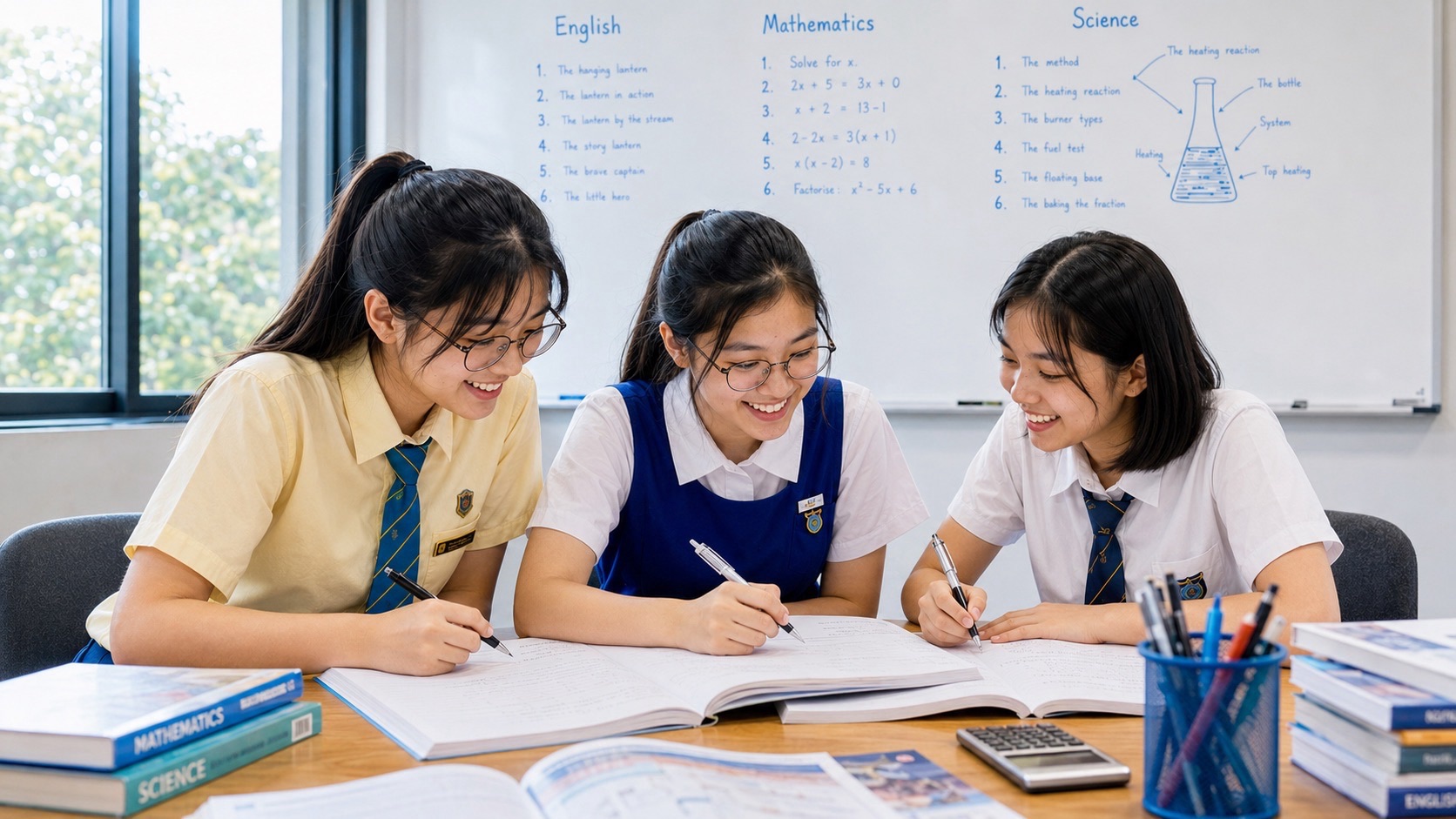
Yishun English Tuition for Junyuan Secondary School is retained as a historical 2019 page title. The renewed article focuses on apposition and parenthetical information. Families searching for Secondary English tuition in Yishun, English tuition Yishun, Secondary English, comprehension, writing, grammar, SEC English, IP English and small-group English tuition need sentence-level control that transfers into whole-text performance.
This page now has one clear learning job: teach apposition, parenthesis, supplementary information, punctuation and sentence clarity. Students move from identification to explanation, controlled rewriting and independent transfer.
The historical URL remains unchanged while the old generic body is rebuilt as a focused Secondary English reference.


Archive note: this school label is preserved only because it belongs to the historical page title and URL. eduKate is independent of Junyuan Secondary School and does not claim affiliation, endorsement, access to internal materials or a current school-specific programme.
The Core Idea
Apposition and parenthetical information gives students a precise way to explain how English packages and connects meaning. The terminology matters only when it improves reading or writing decisions.
Start With the Sentence
Identify the exact words and grammatical boundaries before making an interpretation. Strong analysis begins with what is visibly present.
Meaning Before Labels
Paraphrase the sentence in plain English first. Then use the technical label to explain how that meaning is organised.
Information Load
Ask how much new information the sentence asks the reader to process and where that information is placed.
Reader Guidance
Good writing guides attention. Word order, reference and punctuation should help the reader know what connects to what.
Local Cohesion
Check how the sentence links to the one before it through reference, repeated vocabulary, semantic relation or shared topic.
Paragraph Progression
A paragraph should move rather than circle. Track what each sentence inherits and what new information it adds.
Precision
Prefer the most exact noun, verb or modifier that the evidence supports. Precision reduces the need for later repair.
Compression
English can compress substantial information into phrases, but compression becomes a problem when the reader cannot recover the relationships.
Expansion
When a sentence is overloaded, unpack one relationship into a separate clause or sentence.
Punctuation
Punctuation marks structural relationships; it should clarify rather than decorate.
Reference
Pronouns and demonstratives must have recoverable referents. Ambiguous reference creates unnecessary reader work.
Register
Dense academic phrasing can be appropriate in analytical writing but awkward in dialogue or informal communication.
Comprehension Transfer
In reading, identify how the structure directs attention, establishes relationships and controls what counts as new information.
Writing Transfer
In writing, use the structure deliberately to improve flow, precision and emphasis rather than to sound sophisticated.
Editing Transfer
Read the paragraph sentence by sentence and ask: what does this sentence connect to, and what new job does it perform?
Fictional Learner
Mira writes grammatically correct sentences that feel disconnected. Her tutor maps the information carried forward from one sentence to the next. Mira revises the openings and reference chains, and the paragraph becomes easier to follow.
Contrastive Laboratory
Compare a dense original sentence with a clearer revision. Identify exactly what moved, what was unpacked and what relationship became easier to recover.
A 90-Minute Lesson
Use 10 minutes for concept orientation, 15 for sentence analysis, 15 for contrastive examples, 15 for paragraph flow, 15 for rewriting, 15 for independent transfer and 5 for retrieval.
Independence Test
Give a fresh paragraph containing one strong structure, one overloaded sentence and one cohesion break. Ask the student to diagnose each and revise only what is necessary.
What Progress Looks Like
Students explain structure with evidence, produce fewer ambiguous sentences, connect paragraphs more deliberately and revise for reader effort rather than surface complexity.
Larger Goal
Apposition and parenthetical information becomes useful when it helps students control how information reaches the reader.
Leave a Reply