
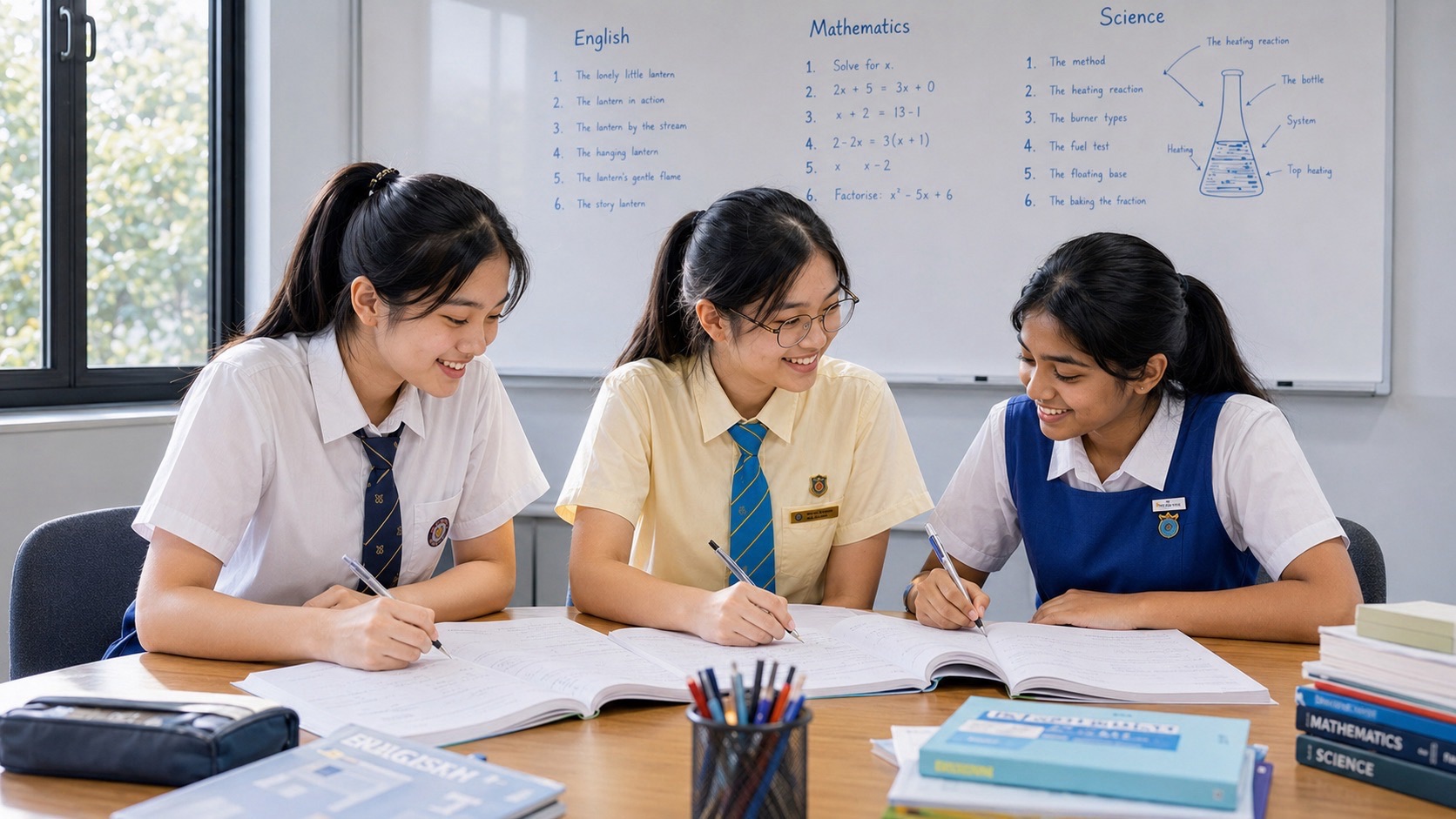
eduKate Yishun Secondary English Learning Guide
A strong reader does more than understand a passage. A strong reader knows what to notice, what to ignore, how to connect evidence, how to distinguish what is stated from what is implied, and how to convert that understanding into an answer that is precise enough to earn marks.
This guide is for families who arrived here while searching for Yishun English tuition for a Broadrick Secondary School student. It is not affiliated with the school and does not reproduce any school’s internal programme. Its purpose is to develop a different part of the eduKate English library: reading as a decision system that feeds comprehension, vocabulary, writing, oral communication and examination performance.
The fictional learner in this guide is Maya. Maya reads fluently, but she often confuses understanding with answering. She can explain a passage in conversation, yet her written responses sometimes lose marks because she gives the general idea instead of the exact idea, names an emotion instead of explaining the evidence, or notices a striking phrase without explaining why it matters.
Maya does not need to read more quickly. She needs to read with better control.
Choose Your Reading Route
- I understand passages but lose marks — begin with question demand and answer precision.
- Inference feels uncertain — begin with evidence, fit and restraint.
- Language-use questions are difficult — begin with picture, quality and effect.
- My writing lacks depth — begin with reading-to-writing transfer.
- I need a complete system — use the weekly reading-and-writing operating plan near the end.
Contents — Reading Foundations
Contents — Comprehension Reasoning
Contents — Reading Into Writing
Contents — Language and Performance
Contents — Transfer and Examination Readiness
If You Understand Passages but Still Lose Marks
1. Read for the Job
Maya used to think the main challenge was understanding the passage. That matters, but the question determines what part of understanding becomes relevant.
One question may ask what happened. Another may ask why it happened. Another may ask how the writer shows a reaction. Another may ask what the reaction suggests about the character. The same lines can support all four questions, but each requires a different mental operation.
Before answering, Maya completes the silent sentence, “This question wants me to…”
This creates a small but important pause between reading and writing. The pause prevents a common error: producing a true statement that does not answer the exact task.
Reading for the job also reduces unnecessary rereading. Once the student knows what is being searched for — cause, evidence, contrast, attitude or effect — attention becomes selective.
2. Separate Fact From Interpretation
Good reasoning begins with a clean boundary between what the text says and what the reader concludes.
If a character avoids eye contact, changes the subject and leaves the room when one topic appears, those are observable details. Guilt, embarrassment, fear or reluctance are interpretations. Context decides which interpretation is best supported.
Maya improves when she marks the evidence before naming the conclusion. The order matters. Evidence first reduces the temptation to choose an interpretation and then search selectively for support.
This distinction also helps writing. In argumentative paragraphs, students should know which sentences contain claims and which contain evidence. In narrative writing, they should know whether a detail shows emotion or merely tells it.
3. Locate, Select, Reshape
Literal questions still require judgement.
First locate the relevant area. Then select the exact idea. Finally reshape it into the form required by the question.
Suppose a passage says, “Although the rain had stopped, the field remained waterlogged, so the organisers moved the event indoors.” A question asks why the event moved. The correct selection is the waterlogged field. The fact that the rain had stopped is nearby but not causal.
Maya used to copy a whole sentence because copying felt safe. Now she understands that proximity does not equal relevance.
Reading workshop — Locate, select, reshape
Take five straightforward questions. Before writing, underline only the words that contain the answer. Then say the answer aloud without looking at the passage. Finally write it in a direct sentence. This trains selection before expression.
4. Follow Relationships Between Ideas
Strong readers do not process sentences as isolated units. They track relationships.
Words such as although, therefore, however, because, despite, consequently, instead and meanwhile signal movement. They tell the reader whether the writer is adding, contrasting, qualifying, explaining cause or showing consequence.
Maya learns to notice these relationships because many questions depend on them. If a paragraph begins by praising a proposal and ends by identifying a serious limitation, the writer’s overall stance may be qualified rather than fully supportive.
Tracking relationships also improves summary. Students who understand how ideas connect are less likely to treat examples, explanations and main points as equivalent.
5. Build an Evidence Habit
Evidence should become automatic.
If Maya claims that a character is frustrated, she should be able to point to the behaviour, wording or sequence that supports the claim. If she says a writer becomes more critical, she should identify the shift in language or argument.
Evidence is not only for comprehension. It is the backbone of good argument, oral explanation and even self-correction.
A useful classroom habit is to ask, “What makes you say that?” often enough that students begin asking themselves.
If Inference Feels Uncertain
6. Inference: Evidence, Fit and Restraint
Inference is not permission to guess. It is a conclusion constrained by evidence.
Imagine a student folding a test paper twice, placing it face-down and waiting until the room is nearly empty before putting it away. The passage does not name an emotion. The behaviour strongly suggests a desire to hide the result.
Maya uses three checks. Evidence: which details support the conclusion? Fit: does the conclusion explain all relevant details? Restraint: am I adding information the passage does not provide?
Embarrassment may fit. Shame may fit depending on context. Fear of punishment at home needs additional evidence.
Strong inference is narrow enough to defend.
7. Comparison
Comparison questions require a shared dimension.
Describing two characters separately does not automatically compare them. Maya needs to identify what both are being compared on.
If one character welcomes criticism while another becomes defensive, the shared dimension is response to feedback. A strong answer states the relationship directly.
The same principle applies outside narrative. Two policies can be compared by cost, effectiveness, fairness or feasibility. Two stages can be compared by speed, confidence or complexity.
Comparison becomes easier when the axis is named.
If Language-Use Questions Are Difficult
8. Language Effect: Picture, Quality, Effect
Students often name a literary device and stop. The mark-worthy work usually lies in explaining what the wording contributes.
If criticism “pours in,” the verb creates a picture of liquid arriving in volume and speed. The relevant qualities are abundance and difficult control. In context, the phrase can make the criticism feel overwhelming.
If rumours “seep” through an office, the image suggests slow, quiet movement through gaps. The effect may be to show information spreading despite attempts to contain it.
Maya uses the same method across metaphors, personification and vivid verbs: picture, quality, effect.
This keeps attention on meaning rather than technique spotting.
9. Tone and Attitude
Tone should be inferred from patterns rather than one isolated adjective.
A writer may begin optimistically, introduce reservations and end cautiously. Calling the tone simply “positive” misses the movement.
Maya learns to collect clues: evaluative words, contrast markers, examples selected by the writer, degree of certainty and what receives emphasis.
Then she chooses the most precise label she can defend: enthusiastic, sceptical, resigned, critical, cautiously optimistic, doubtful, admiring or another suitable term.
Precision matters more than sophistication. A common word used accurately is better than a rare word used loosely.
10. Summary
Summary requires the reader to distinguish central information from support.
First define the target: reasons, benefits, problems, effects, measures or another category. Then classify candidate material as target point, example, explanation, repetition or background.
Next, merge overlap. Two sentences may describe the same underlying idea using different wording.
Only then compress language.
Maya improves when she stops trying to shorten every sentence and starts deciding which ideas deserve to survive.
If Writing Lacks Depth
Reading and writing should not be taught as separate rooms. Good reading supplies models for structure, vocabulary, sentence control and reasoning.
11. Borrow Structures, Not Sentences
Students should not copy published sentences into their own writing. They should notice what those sentences do.
A writer may introduce a claim, qualify it, provide an example and then widen the implication. That sequence can be learned as structure.
A narrative writer may slow time around one decisive moment by expanding sensory detail and compress several uneventful hours into one sentence. That pacing principle can transfer without copying the prose.
Maya begins to read with a writer’s question: what job is this paragraph doing?
That question turns reading into apprenticeship.
12. Paragraph Purpose
A paragraph should move the reader somewhere.
In expository writing, one paragraph might define, another explain cause, another compare, another qualify and another evaluate. In narrative writing, one might establish desire, another introduce conflict and another reveal consequence.
Maya asks, “If this paragraph disappeared, what would the reader lose?”
If the answer is unclear, the paragraph may lack purpose.
This habit also improves editing because the student can remove material that sounds good but does no work.
13. Narrative Reading and Consequence
When reading narrative, Maya now tracks desire, obstacle, choice, cost and consequence.
This helps comprehension because character behaviour becomes easier to interpret. It also helps writing because stories gain structure without depending on dramatic events.
A simple event can become meaningful if the character must choose. A friend has copied work. A promise has been broken. A lost object belongs to someone else. The depth comes from conflicting values and consequences.
Reading stories this way teaches students that plot is not merely a sequence of events. It is a sequence of decisions and consequences.
14. Argument Reading and Reasoning
When reading argumentative or explanatory texts, Maya looks for claim, mechanism, evidence, counterargument and qualification.
If a writer claims that volunteering develops responsibility, Maya asks how. The mechanism may be that other people depend on attendance, preparation and task completion. Examples then illustrate that mechanism.
She also notices limitations. A claim becomes stronger when the writer recognises conditions under which it may fail.
This reading habit transfers directly to expository writing. Students learn that examples do not replace reasoning.
15. Vocabulary From Context
Vocabulary is more memorable when it enters through meaningful context.
Maya first infers a provisional meaning from the sentence. Then she checks the word, compares it with neighbours and records its grammatical behaviour and common combinations.
Reluctant is compared with hesitant, unwilling and apprehensive. Persistent is compared with determined and stubborn. Assertive is compared with aggressive.
Students should also learn word families: justify, justification, justifiable, unjustified; coherent, coherence, coherently.
For extended vocabulary study, use the eduKate Vocabulary Learning Hub alongside the broader eduKateSingapore learning library.
16. Sentence Patterns
Reading exposes students to sentence relationships in action.
“Although the team trained every day, it still lost because its defence remained disorganised.” This sentence makes concession and cause visible.
Maya begins to notice how competent writers use clauses to encode relationships rather than merely make sentences longer.
She then practises sentence combining and sentence splitting. The aim is control, not complexity for display.
17. Editing Through Reading
Editing requires the student to read differently.
While composing, Maya reads for meaning. While editing, she reads for failure.
One pass checks sentence boundaries. Another checks tense and agreement. Another checks pronouns, articles and prepositions. Another checks repeated wording. A final pass checks whether the writing actually fulfils the task.
The passes should reflect personal error history. A repeated tense problem deserves more attention than an isolated typo.
Five-minute editing routine
- Minute 1: sentence boundaries and missing words.
- Minute 2: tense and verb agreement.
- Minute 3: pronouns, articles and prepositions.
- Minute 4: repeated wording and awkward expressions.
- Minute 5: task fulfilment.
18. Oral Response
Speaking tests whether reading has become thought.
After reading an article, Maya is asked for a position. A weak response says, “I agree because it is useful.” A stronger response identifies the claim, gives a reason, develops the reason, adds an example and qualifies where necessary.
Follow-up questions make reasoning visible: What do you mean? Why does that matter? Is it always true? What evidence in the text influenced you?
Oral practice therefore becomes another bridge from reading to writing.
19. Listening Structure
Listening resembles reading at speed. The learner must track structure while information continues moving.
Before listening, Maya predicts likely information types: reason, sequence, contrast, attitude, time, location or choice. During listening, she notices signposts.
If one phrase is missed, she marks the gap and returns attention to the present audio. One missed phrase should remain one missed phrase.
This is another form of reading control: preserve the structure even when every detail cannot be captured.
20. Knowledge Building
Reading comprehension depends partly on what the reader already knows.
A passage about urban transport is easier to understand if the student already knows ideas such as congestion, accessibility, infrastructure, trade-offs and public spending. A passage about social media is easier if the learner recognises attention, incentives, privacy and network effects.
This is why broad reading matters. English is strengthened by knowledge of the world English is used to discuss.
For wider general reading, students can use How X Works, eduKateSingapore, and the English-specific library at Singapore English Tuition Centre.
21. Timed Reading
Reading control must eventually survive time pressure.
Timed practice should be graduated. First answer accurately without severe pressure. Then practise short timed sections. Then mix question types. Finally simulate a full paper.
Maya uses checkpoints and exit rules. If one question remains uncertain after a reasonable attempt, she makes the strongest defensible response, marks it and moves on.
One difficult mark should not consume the time required for several available marks later.
22. Error Patterns
A useful error log records patterns rather than every isolated mistake.
Maya’s watchlist might contain: misread comparison questions, inference too broad, language effect underexplained, tense shift during narrative reflection.
When a pattern stabilises across several fresh tasks, it leaves the watchlist. Another enters.
This makes improvement visible and keeps attention selective.
23. A Four-Week Reading Cycle
Week 1: Diagnose. Use marked work to identify repeated reading and answer-construction errors.
Week 2: Model. Teach one high-cost decision explicitly and contrast strong and weak answers.
Week 3: Vary. Change the topic and passage type while preserving the same reasoning demand. Mix question families.
Week 4: Test unseen. Use a fresh passage without announcing which old weakness is being tested.
If the skill appears only when the learner is reminded, it has not yet become independent.
24. What Parents Can Observe
Parents can look for changes in how the student talks about reading.
Can the student explain what a question is asking? Can the student point to evidence before giving an interpretation? Can the student distinguish a claim from an example? Can the student explain what a paragraph is doing? Can the student identify a repeated error pattern?
These are signs that reading is becoming active and strategic.
Parents can also protect reading that is not immediately converted into homework. Curiosity matters. Discussion can remain light but precise: what surprised you, what did the writer assume, which claim was strongest, what changed your mind?
A Complete Weekly Reading-and-Writing Operating Plan
- Deep reading: one demanding text read for structure, evidence, vocabulary and writer choices.
- Targeted comprehension: a small set of questions chosen from the active watchlist.
- Vocabulary retrieval: revisit old words and contrast nearby meanings.
- Writing transfer: borrow one structural move from the reading and apply it to a new topic.
- Editing: use targeted passes based on recurring errors.
- Oral discussion: state a position, support it and answer follow-up questions.
- Timed mixed practice: classify varied question types under realistic constraints.
- Review: ask what transferred, what still required prompting and what remains on the watchlist.
25. The Unseen-Passage Test
At the end of the cycle, Maya receives a passage on an unfamiliar topic.
The first question asks about a change in attitude. Maya marks the before-and-after evidence and names the shift precisely. The next question asks for an inference. She uses evidence, fit and restraint.
A language-use question follows. She explains picture, quality and effect. In the summary, she identifies the target before selecting points.
Later, in writing, Maya uses a paragraph structure she noticed during reading, but the content is entirely her own. She edits by error class and catches a repeated tense problem without being prompted.
The important change is not that every answer is perfect. It is that reading has become a system of decisions that feeds the rest of English.
That is what strong Secondary English tuition should build: a learner who can read for purpose, reason from evidence, notice how language works, transfer structures into writing and carry the process into unfamiliar work.
Continue Through the eduKate English Library
- Boon Lay Secondary School — English that transfers
- Montfort Secondary School — diagnosis and weak-link repair
- New Town Secondary School — evidence-led English
- North View Secondary School — reading under pressure
- Ping Yi Secondary School — precision
- Springfield Secondary School — reading to reasoning
- Assumption English School — independent English
- Bartley Secondary School — effort to transfer
- Bedok Green Secondary School — reliable English
- Secondary 1 English
- Secondary 2 English
- Secondary 3 English
- Secondary 4 English
- Vocabulary Learning Hub
- How X Works
- eduKateSingapore Learning Library
- Singapore English Tuition Centre
Leave a Reply