
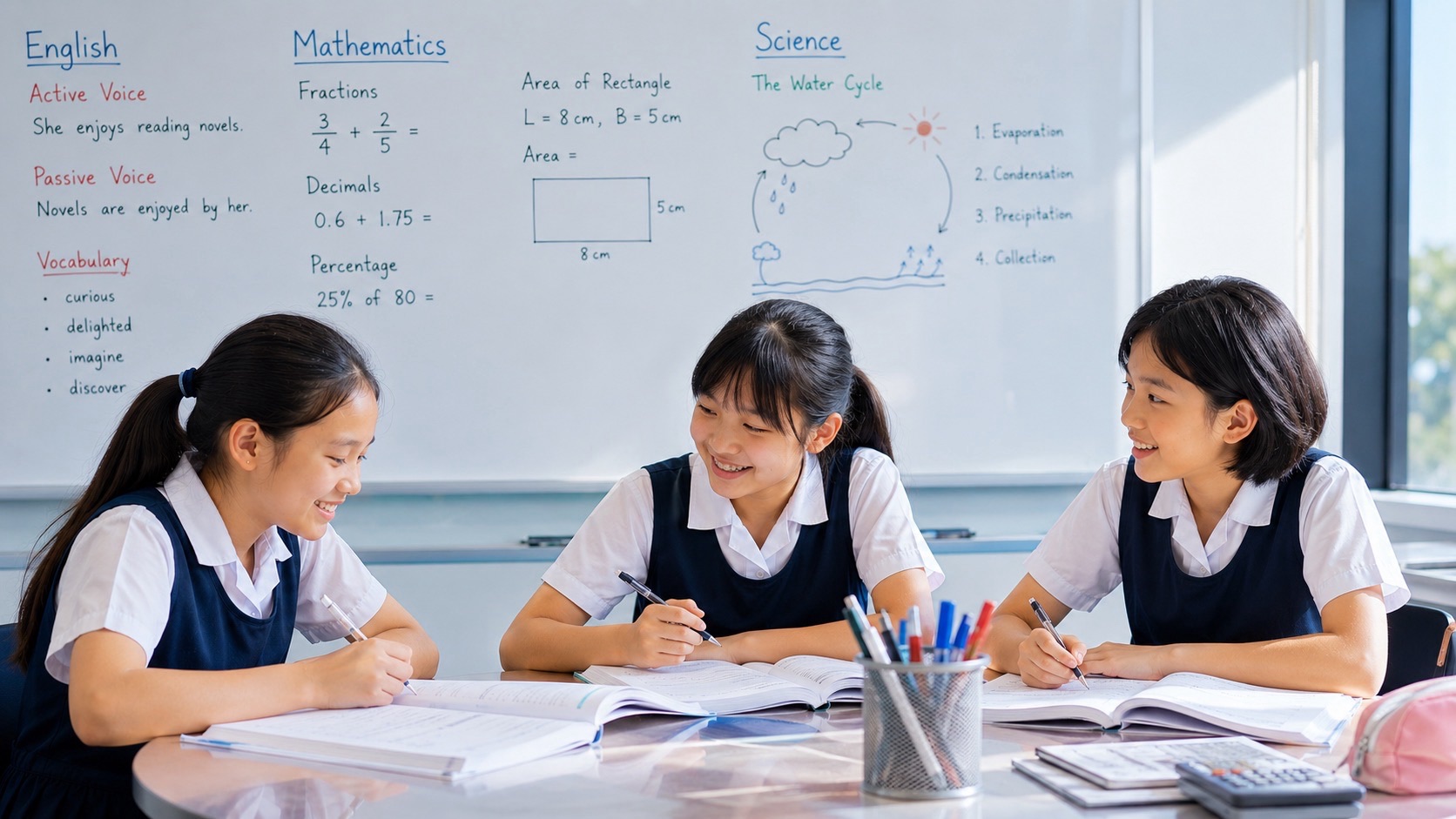
Yishun English Tuition Endeavour Primary School is rebuilt as a focused Primary English guide to reflexive and reciprocal pronouns: forms such as myself, yourself, himself, herself, itself, ourselves, yourselves, themselves and expressions such as each other and one another. Families searching for Primary English tuition in Yishun, Endeavour Primary School English tuition, PSLE English, grammar, comprehension, composition writing, oral communication and small-group English tuition often see pupils use these forms because they sound formal rather than because the sentence requires them.
Maya herself checked the form does not mean the same thing as Maya checked herself. In the first, herself adds emphasis to Maya as the person who performed the action. In the second, Maya is both the person performing and receiving the checking. Likewise, Ben and Maya helped each other describes a reciprocal relationship rather than two separate acts of self-help.
This page therefore owns one distinct learning job: how pronouns express self-reference, emphasis and reciprocal action without creating vague or incorrect relationships.
This article retains a historical school-name title for archive continuity. It does not claim affiliation with, endorsement by, or a current programme operated by Endeavour Primary School.
The 50-Second Pronoun Check
When a reflexive or reciprocal expression appears, ask:
- Who performs the action?
- Who receives the action?
- Are those two participants the same?
- Is the pronoun required for meaning, or merely adding emphasis?
- If two people are involved, are they acting on themselves or on one another?
Reflexive Pronouns Point Back to the Subject
Maya introduced herself.
Maya performs the introducing and is also the person introduced.
The reflexive pronoun is required because the object refers back to the subject.
Do Not Replace Ordinary Object Pronouns Randomly
The teacher spoke to Maya and me.
Not The teacher spoke to Maya and myself merely because myself sounds formal.
The object does not refer back to the subject teacher.
The Simple Removal Test
In I completed the task myself, removing myself still leaves a complete sentence: I completed the task.
The reflexive is emphatic.
In I introduced myself, removing it leaves I introduced, which no longer expresses the intended object relationship.
Emphatic Reflexives Highlight Responsibility
The organiser herself checked the final list.
The sentence emphasises that the organiser personally did the checking.
Position Can Change Rhythm, Not Core Emphasis
The organiser herself checked the list.
The organiser checked the list herself.
Both can emphasise the organiser’s direct involvement in a suitable context.
Reflexive Pronouns Must Agree With the Referent
- I → myself
- you → yourself / yourselves
- he → himself
- she → herself
- it → itself
- we → ourselves
- they → themselves
Watch Singular and Plural You
You should check yourself. — one person.
You should check yourselves. — more than one person.
Reflexives With Body and Personal Care Actions
He cut himself.
She prepared herself for the presentation.
Context determines whether a reflexive is necessary and what relationship it expresses.
Not Every Same-Person Action Needs an Explicit Reflexive
English uses some verbs naturally without a reflexive where other languages might include one.
Teach the actual English pattern in context rather than transferring a rule mechanically from another language.
By Myself Can Mean Alone
I completed the model by myself.
This usually means without another person’s help.
Compare I completed the model myself, which can emphasise personal responsibility rather than physical solitude.
Each Other Expresses Reciprocal Action
Maya and Ben helped each other.
Maya helped Ben and Ben helped Maya.
One Another Can Also Express Reciprocity
In modern English, each other and one another can overlap substantially.
For Primary teaching, focus on the reciprocal meaning rather than inventing a rigid two-person versus three-person rule that ordinary usage does not consistently maintain.
Reflexive and Reciprocal Meanings Are Different
Maya and Ben blamed themselves.
Each person may blame himself or herself.
Maya and Ben blamed each other.
Each blames the other.
Reciprocal Possession
The pupils checked each other’s work.
Each pupil checks the work belonging to another pupil in the reciprocal group.
Do Not Lose the Possessive Apostrophe
each other’s folders
one another’s ideas
The expression carries a possessive relationship.
Reflexive Pronouns in Instructions
Check your answer yourself before asking for help.
The first your identifies ownership; yourself emphasises who performs the checking.
Reflexive Pronouns in Comprehension
If a passage says Leena blamed herself, do not answer that another character blamed Leena.
The action loops back to Leena.
Reciprocal Pronouns in Comprehension
If two friends encouraged each other, both performed and received encouragement.
Reflexives and Source Attribution
Ben said that Maya had completed the work herself.
Herself refers to Maya, not Ben.
Pronoun interpretation must remain attached to the correct noun.
A Fictional Learner: Amir and Myself
Imagine Amir, a fictional Primary 5 pupil. He writes:
My teacher spoke to my friend and myself.
His tutor removes my friend and temporarily. My teacher spoke to myself sounds wrong because the object does not refer back to the subject.
Amir restores the ordinary object pronoun: My teacher spoke to my friend and me.
A Second Fictional Learner: Priya and Each Other
Priya writes, The two girls prepared themselves for the interview when she means they helped prepare one another.
The tutor asks whether each girl acted on herself or on the other.
Priya revises the sentence according to the actual event.
Reading Laboratory
Original passage: Maya and Leena were preparing a display. Maya cut the labels herself while Leena arranged the folders. Later, they checked each other’s work. Leena noticed that one label had been attached upside down, and Maya corrected it herself. Before leaving, both pupils reminded themselves to return the borrowed scissors.
Ask:
- Who cut the labels? Maya.
- What does herself add in the first sentence? Emphasis on Maya doing the cutting personally.
- What does each other’s work mean? Maya checked Leena’s work and Leena checked Maya’s.
- Who corrected the label? Maya personally.
- What does reminded themselves mean? Each pupil retained the reminder for herself within the plural group.
Diagnostic
- Repair: The teacher spoke to Ben and myself.
- Explain Maya completed the task herself.
- Explain Maya completed the task by herself.
- Explain the difference between They blamed themselves and They blamed each other.
- Choose: The pupils checked each other’s / themselves work.
- Complete: We prepared ___ for the presentation.
Possible Answers
The teacher spoke to Ben and me. Herself emphasises Maya’s own involvement. By herself can mean alone. Themselves loops actions back to each member; each other makes the action reciprocal. Use each other’s work. Use ourselves for the final item.
Writing Clinic
Faulty draft: “My friend and myself checked the project. We helped ourselves with the difficult parts and the teacher herself spoke to ourselves.”
A clearer version might be:
My friend and I checked the project. We helped each other with the difficult parts, and the teacher herself spoke to us.
The repair depends on role, not formality.
Primary 3 and Primary 4
Begin with simple reflexive actions and clear reciprocal pairs.
Primary 5
Add emphatic reflexives, by + reflexive and possessive reciprocal forms.
Primary 6 and PSLE English
Pupils should interpret these forms rapidly inside longer sentences and use them accurately in writing.
A 90-Minute Pronoun Lesson
- 10 min: subject-object role check.
- 15 min: required reflexives.
- 15 min: emphatic reflexives.
- 15 min: by + reflexive.
- 15 min: each other / one another.
- 15 min: comprehension and writing transfer.
- 5 min: fresh independent check.
What Parents Can Look For
- myself is no longer used as a formal substitute for me;
- reflexives agree with their referents;
- emphasis is distinguished from self-directed action;
- each other is used for reciprocal relationships;
- pronoun reference stays clear inside reported speech;
- the child can explain who acts on whom.
The Independence Test
Give a fresh paragraph containing one required reflexive, one emphatic reflexive, one by myself-type expression and one reciprocal action. Ask the pupil to explain each relationship and rewrite one ambiguous sentence.
The Larger Goal
Pronouns are efficient only when their relationships are clear. Reflexive and reciprocal forms give English precise ways to show self-action, personal emphasis and mutual action.
Related eduKate Yishun Reading
Official Reference
Ministry of Education: English Language Syllabus 2020 Primary
Leave a Reply