
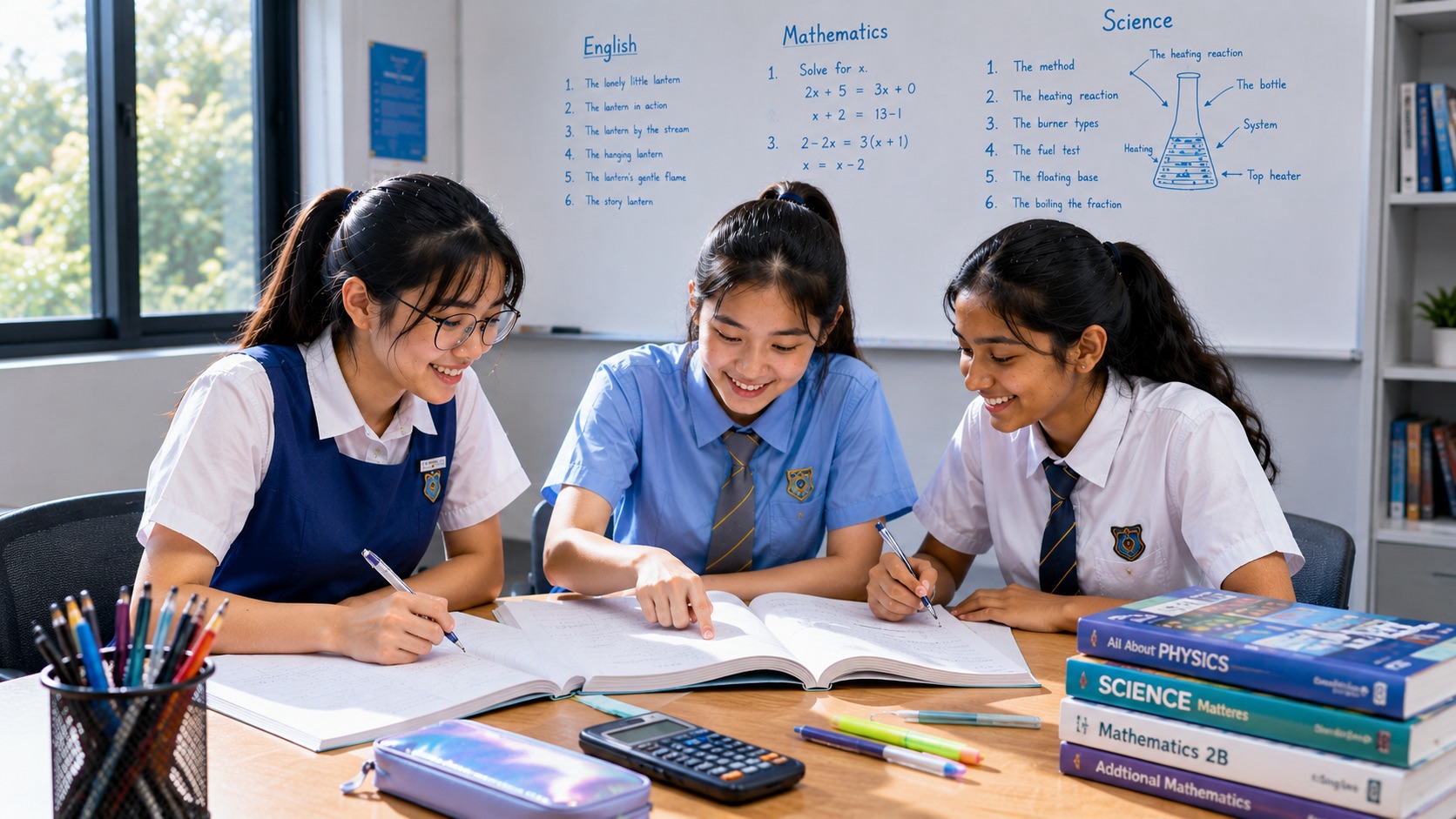
Secondary English Tuition at Yishun Punggol Orchard is rebuilt as a current Secondary English transition-and-diagnostic guide for families searching for Secondary English tuition in Singapore, small-group English tuition, Sec 1 to Sec 4 English, MOE English syllabus support, G1 G2 G3 English, O-Level English 1184, SEC G3 English K300, situational writing, continuous writing, comprehension, summary writing, listening and oral communication. Its job is to show how Secondary English changes from Primary English and how to diagnose the first weak link before simply adding more worksheets.
In 2026, upper-secondary students may still be preparing for the Singapore-Cambridge GCE O-Level English Language syllabus 1184, while the Singapore-Cambridge Secondary Education Certificate (SEC) G3 English Language K300 becomes the reference code from 2027. The language demands remain broad: students must write for purpose, audience and context; understand written and multimodal texts at literal, inferential and evaluative levels; synthesise and summarise information; listen accurately; and communicate ideas clearly in planned response and spoken interaction. Secondary English tuition therefore cannot be reduced to composition templates or grammar drills alone.
The practical eduKate Yishun approach is read the marked work → locate the first repeated failure → separate knowledge from execution → repair the smallest useful skill → practise under increasing complexity → connect the skill across papers → retest independently. Lower Secondary English should build analysis, vocabulary, paragraph control, reading inference and writing range. Upper Secondary English adds stronger exam craft, summary compression, situational writing, continuous writing, visual-text interpretation, editing, listening and oral performance. Small groups are useful because the tutor can see which step breaks for each student rather than treating the class as one average learner.
1. Secondary English is not Primary English with longer passages
The transition is qualitative. Primary pupils are already asked to infer, explain and write coherently, but Secondary English increases abstraction, text density, viewpoint analysis and the need to sustain ideas over longer answers. Students must increasingly justify interpretations, distinguish evidence from assumption and write for different purposes beyond narrative storytelling.
2. The first diagnostic question is: where are marks actually lost?
A weak English grade can hide very different causes. One student misreads questions. Another cannot infer. Another has ideas but weak sentence control. Another writes fluently but does not answer the task. Another understands passages but cannot compress a summary. Effective tuition begins by separating these causes.
3. Writing has several different jobs
Editing, situational writing and continuous writing require different decisions. Editing asks the student to diagnose language errors. Situational writing asks the student to manage purpose, audience, context, content points and register. Continuous writing asks for sustained development, organisation and language control across a longer piece.
4. Situational writing is an information-management task
The student must identify role, audience, purpose, required content and tone before drafting. A well-written response can still lose marks if it omits a content point or uses the wrong register. The safest habit is to map the task before writing.
5. Continuous writing is a decision system
Students need to choose a question they can actually develop, not simply the one that sounds interesting. Planning should identify the central position or narrative conflict, paragraph jobs and ending before drafting begins. Good prose cannot rescue an essay that drifts off-task.
6. Lower Secondary should expand writing range
Sec 1 and Sec 2 are useful years for moving beyond one comfortable genre. Students should practise narrative, reflective, expository and discursive structures in age-appropriate ways so that upper-secondary essay choices do not feel completely new.
7. Comprehension is a reasoning paper
Students need literal understanding, inference, evaluation, vocabulary-in-context and explanation of language effect. “Find the answer and copy it” becomes increasingly unreliable as questions ask for paraphrase, interpretation and justification.
8. Evidence must be connected to the answer
Quoting a line is not the same as explaining it. A strong response often follows claim → evidence → implication → direct answer. The student should show why the selected evidence proves the point.
9. Visual and multimodal texts require design reading
Students may need to interpret image, layout, headline, colour emphasis, captions, source and audience together. The visual is not decoration around the words; it is part of the message.
10. Summary writing is controlled compression
The student must identify relevant points, remove duplication, paraphrase where possible and stay within the required word limit. The skill is not “write shorter”. It is select → group → paraphrase → compress → count → check.
11. Vocabulary must become usable
Secondary students need more than word lists. They need collocation, register, connotation and word-family knowledge. A word is mastered when the student can recognise it in reading and use it naturally in a fresh sentence.
12. Grammar should be connected to real errors
If a student repeatedly loses control of tense, agreement, modifiers or sentence boundaries in composition, those errors should become the grammar syllabus for that student. Isolated worksheets have limited value if the same mistake returns in authentic writing.
13. Editing needs an error taxonomy
Students improve faster when errors are classified: tense, agreement, word form, preposition, article, pronoun, connector, modifier or verb pattern. “Careless” is not a diagnosis. A named error can be practised and tracked.
14. Oral communication requires developed ideas
Short answers are rarely enough. Students should state a position, explain a reason, give an example and connect back to the question. They should also learn to listen to follow-up questions rather than repeat a memorised response.
15. Planned response needs structure without sounding scripted
A useful plan may identify the main point, two supporting ideas, one example and a concluding link. The aim is organised spontaneity: enough preparation to speak coherently without sounding as if a paragraph has been memorised.
16. Spoken interaction is responsive
Students need to extend, clarify, compare and qualify ideas as the discussion develops. Small groups can help because classmates provide real alternative viewpoints rather than one-sided rehearsal.
17. Listening is active meaning selection
Strong listeners anticipate likely information, recognise paraphrase and contrast, recover after missing a phrase and distinguish main ideas from distractors. Trying to remember every word is usually inefficient.
18. Sec 1 is a transition year
Students need to stabilise paragraph structure, comprehension reasoning, vocabulary habits and sentence control while adapting to greater text complexity. The goal is not premature O-Level drilling; it is building mechanisms that later exam work can depend on.
19. Sec 2 is a consolidation and expansion year
Students should handle longer texts, compare viewpoints, write more developed expository and discursive paragraphs, improve summary habits and become more independent in editing their own work.
20. Sec 3 is where exam architecture becomes explicit
Upper-secondary students should connect skills to paper demands: editing, situational writing, continuous writing, visual text, comprehension, summary, listening and oral. Technique should sit on top of language ability, not replace it.
21. Sec 4 is a performance year
By Sec 4, the issue is increasingly execution under time. Students need stable planning, reliable question reading, predictable checking routines, timed full-paper practice and a revision system based on their actual error history.
22. Full SBB makes level labels less useful than skill diagnosis
Whether a student is working within G1, G2 or G3 English, the tutor still needs to know what the learner can currently do independently. The useful question is not only “Which level?” but “Which language operation is failing first?”
23. A simple diagnostic matrix
- Reads but misunderstands questions: command words and answer scope.
- Finds evidence but cannot explain: inference and reasoning links.
- Has ideas but weak paragraphs: topic sentence, development and cohesion.
- Writes fluently but off-task: planning and task analysis.
- Summary too long: selection and compression.
- Grammar errors repeat: personal error map and retrieval practice.
- Oral answers are short: reason-example-connection development.
24. Small-group tuition should make thinking visible
With a small group, one student’s answer can become material for comparison. Why is one inference better supported? Why is one opening more focused? Why does one summary retain the point with fewer words? Students learn not only from correction but from seeing alternatives.
25. Feedback should change the next attempt
“Add details” is weak feedback. “Your reason is clear but the example does not prove it” gives the student a repair target. Useful feedback names the failed operation and requires the student to perform it again.
26. Independence is the final test
A method is not mastered because the student can follow it beside a tutor. It is mastered when the student can recognise the problem, choose the method and execute it alone under realistic conditions.
27. A four-stage Secondary English cycle
Stage 1 — diagnose: read current scripts and marked work. Stage 2 — repair: teach the smallest missing mechanism. Stage 3 — transfer: use it across new texts and tasks. Stage 4 — perform: test under time and review the error map.
28. What progress looks like
Progress appears when question reading becomes more accurate, evidence is explained rather than copied, paragraphs develop one idea fully, summary points are compressed without distortion, grammar errors become less repetitive and oral responses grow more independently.
29. 2026–2027 examination context
For students sitting the 2026 national examination, the familiar O-Level English Language reference is syllabus 1184. SEAB lists English Language as K300 under the 2027 Singapore-Cambridge Secondary Education Certificate G3 syllabuses. Families should always confirm the current official syllabus for the student’s own cohort rather than relying on an older tuition page.
30. What this historical page means today
This article keeps its 2019 title, Secondary English Tuition at Yishun Punggol Orchard, while the body now functions as an eduKate Yishun Secondary English transition-and-diagnostic guide. The historical multi-location wording remains because the title and URL are being preserved; it should not be read as a current statement of class location or availability.
The old duplicated promotional copy, obsolete contact/location statements and outdated examination wording have been replaced with a current learning system centred on diagnosis, repair, transfer and independent performance.
Continue Through the eduKate Yishun English System
Secondary English becomes manageable when the subject is broken into visible operations. Read accurately. Infer with evidence. Develop one idea fully. Write for purpose and audience. Compress without distorting. Speak with reasons and examples. Edit recurring errors. The student does not need more random English work; the student needs the right repair in the right order.
Leave a Reply