
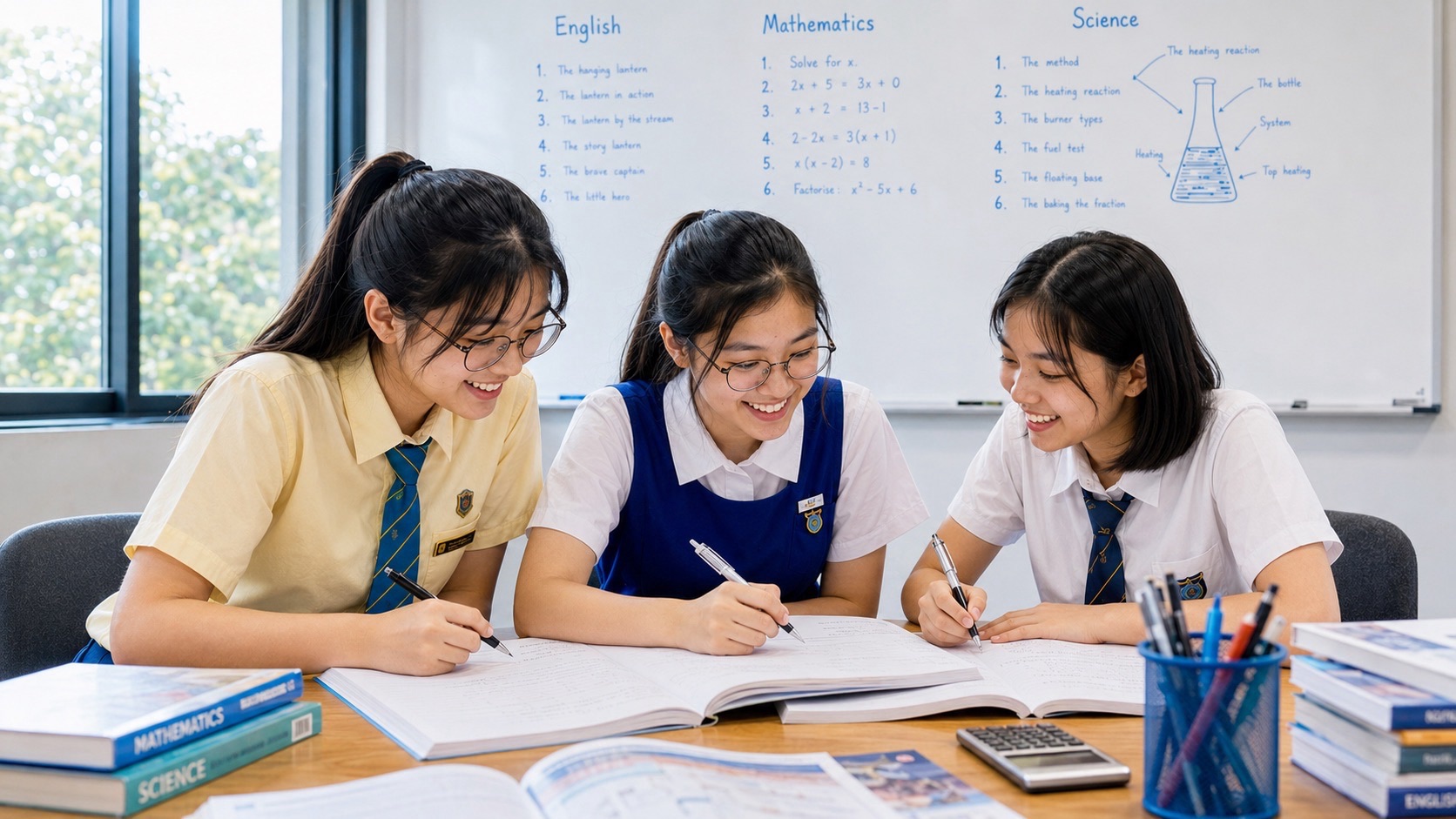
Simei Science Tuition is a historical 2019 title rebuilt around a skill that sits at the heart of Primary Science tuition Singapore, Simei Science tuition, PSLE Science tuition, application questions, unfamiliar contexts, concept mastery, scientific reasoning and open-ended Science questions: recognising the same scientific mechanism when the surface story changes.
A pupil may understand evaporation when the question shows a saucer of water, then fail when the same idea appears inside a wet cloth, a puddle, a cooling experiment or an unfamiliar container. The facts have not disappeared. The difficulty is analogical transfer: seeing that two situations share a deeper relationship even though the objects, pictures and wording look different.
This page therefore owns one precise job: teach pupils to move from surface features → deep structure → analogy → prediction → check → transfer. The old location, phone, promotional and historical class claims are not treated as current. The title and URL remain for continuity. The new article focuses on how Science knowledge becomes portable.
Science transfer begins when the picture changes
Children often learn examples together with the concept.
That is natural.
The problem appears when the example becomes the memory.
The learner remembers:
“This was the question with the beaker.”
Instead of:
“This was the question about changing one condition and observing how a process responds.”
Strong Science learning shifts memory from the picture to the relationship.
Surface features and deep structure are different
Surface features include:
- the organism;
- the apparatus;
- the colour of the diagram;
- the story context;
- the object name;
- the order in which information is presented.
Deep structure includes:
- which variable changed;
- which process is involved;
- which parts depend on one another;
- which direction of change is expected;
- which evidence can support the explanation.
Transfer improves when pupils learn to search for deep structure first.
The analogy question: “What is this like?”
When a new question feels unfamiliar, ask:
What familiar Science situation has the same relationship?
The aim is not to find a story that looks similar.
The aim is to find a mechanism that works similarly.
Good analogies preserve the important relationship
Suppose a pupil understands that increasing exposed surface can affect evaporation under comparable conditions.
A new question may involve:
- a wide tray;
- a wet towel;
- water spread over a plate;
- a shallow puddle;
- two differently shaped containers.
The surface changes.
The relationship can remain the same.
Bad analogies match appearance instead of mechanism
Two questions can both contain plants but test entirely different ideas.
Two questions can both contain water but involve different processes.
Two questions can both show bulbs but use different circuit arrangements.
Do not ask only:
“Have I seen this object before?”
Ask:
“What is the system doing?”
Use the deep-structure checklist
| Question | What to identify |
|---|---|
| What changed? | condition or variable |
| What responded? | measured or observed outcome |
| What process connects them? | mechanism |
| What stayed comparable? | relevant controls |
| What evidence matters? | data, observation or diagram |
Primary 3: start with concrete analogies
P3 pupils can compare familiar objects while learning to focus on properties rather than names.
For materials:
- an umbrella and raincoat may use different materials;
- both still require useful properties for keeping water out;
- the relevant analogy is the function-property relationship.
This teaches transfer without abstract language.
P3 magnets: change the object set
After pupils learn magnetic attraction with one set of classroom objects, change the set completely.
Ask them to predict using the relevant property rather than object familiarity.
The student begins to understand that the Science travels.
P3 life cycles: preserve the idea, vary the organism
A life cycle has recurring structural features:
- stages;
- growth or change;
- adult reproduction;
- continuation into a new generation.
Different organisms may have different stages.
The deep structure is cyclical continuation, not one memorised picture.
Primary 4: analogies become process-based
P4 pupils can compare situations involving:
- heat transfer;
- state changes;
- light and shadows;
- plant systems;
- digestive-system functions.
The key question becomes:
“Which process is operating here?”
P4 evaporation: one mechanism, many surfaces
Compare:
- water in a saucer;
- a wet floor;
- clothes drying;
- water on skin.
Ask which features are merely contextual and which conditions actually affect the process.
P4 condensation: transfer beyond the cold cup
A familiar example is water droplets on a cold cup.
Transfer contexts can include:
- a cold bottle;
- spectacles entering a warm humid area;
- a chilled container;
- a cool surface near moist air.
The pupil should identify the same state-change mechanism without needing the original cup picture.
P4 light: analogy must preserve geometry
Two shadow questions may look different but share the same spatial relationship.
Ask the pupil to identify:
- light source;
- object;
- screen or surface;
- which distance changed.
Then the transfer becomes structural.
Primary 5: analogies should support experiments
At P5, many application questions can be reduced to experimental logic.
Ask:
- What factor changed?
- What was measured?
- Which result pattern appeared?
- What familiar relationship explains it?
A new apparatus can still contain an old experiment skeleton.
P5 electricity: do not transfer slogans blindly
Analogy is useful only when the connection pattern is comparable.
Two circuits may both contain two bulbs, yet their arrangements differ.
Before applying a familiar rule, check whether the structural conditions match.
P5 body systems: use route analogies carefully
A route map can help pupils understand movement through a system.
But do not turn the analogy into literal equivalence.
The useful mapping is:
- entry;
- movement;
- function at each part;
- downstream consequence.
Analogy supports structure; Science determines the details.
Primary 6: unfamiliar contexts become normal
By P6, strong pupils should expect questions that use new organisms, devices, diagrams and combinations.
The response should be:
- ignore decorative novelty;
- identify the evidence;
- find the deep relationship;
- retrieve a familiar mechanism;
- check that its conditions fit;
- apply it cautiously.
P6 forces: strip the story away
A force question can describe:
- a toy;
- a cart;
- a parachute;
- a magnetic object;
- a moving ball.
The story changes.
The deep questions remain:
- which object;
- which force;
- which direction;
- which effect.
P6 photosynthesis: transfer the condition-process relationship
The plant species can change.
The diagram can change.
The measured indicator can change.
The pupil still needs to ask which condition affects the relevant process and how the observed outcome follows.
P6 environment: networks can be abstracted
A food web with unfamiliar organism names can still be read as:
- resource;
- consumer;
- predator;
- dependency;
- population change.
Abstraction removes the intimidation of unfamiliar names.
Abstraction is compression
A complex question can often be reduced to a compact form:
changed condition → affected process → observed result
or:
part → function → dependency → consequence
or:
evidence → concept → mechanism → conclusion
These forms help pupils recognise familiar reasoning inside new contexts.
Do not teach templates without meaning
A structure is useful only if the child knows what each slot means scientifically.
“Condition → process → result” is not a magical answer formula.
It is a reminder to make causality visible.
Use paired examples
Show two different-looking questions with the same deep structure.
Ask:
- What looks different?
- What is scientifically the same?
- Which rule transfers?
- Which details do not transfer?
Pairing makes abstraction explicit.
Use near-miss pairs
Now show two questions that look similar but require different Science.
This prevents pupils from relying on appearance alone.
Near-miss pairs are excellent for teaching concept selection.
Use one mechanism across five topics
Take the general reasoning skill “changed condition → measurable effect”.
Apply it to:
- evaporation;
- plant growth;
- circuit output;
- force and motion;
- environmental populations.
The content changes, but the reasoning architecture persists.
Use analogies to predict
A good transfer test asks the pupil to predict before seeing the answer.
If the learner says:
“This is like the earlier setup because the same variable-process relationship is present, so I predict…”
the analogy is doing real cognitive work.
Then test the analogy against evidence
Analogies can mislead.
After predicting, ask:
- Did the evidence match?
- Which part of the analogy held?
- Which part did not?
- What condition was different?
Scientific analogies should be testable.
The “same, different, therefore” routine
- Same: What deep relationship matches the familiar problem?
- Different: Which conditions or structures differ?
- Therefore: Which part of the old reasoning can be transferred safely?
This routine protects against overgeneralisation.
MCQ transfer questions: predict before options
When useful, ask the pupil to predict the relationship before looking at the options.
Then test each option against the deep structure.
This reduces distractor attraction.
Booklet B transfer questions: rebuild the mechanism
Do not ask:
“Which model answer does this resemble?”
Ask:
“Which scientific relationship is operating here?”
Then rebuild the explanation in the new context.
Use an analogy error ledger
| Error | Future rule |
|---|---|
| Matched by object name | Identify mechanism first |
| Transferred slogan blindly | Check conditions |
| Ignored structural difference | Use same/different/therefore |
| Copied old sentence | Rebuild from new evidence |
| Analogy treated as literal identity | State limit of mapping |
Small groups are ideal for analogy debates
Give three pupils an unfamiliar question.
Each proposes a familiar analogue.
The group must decide:
- which analogy preserves the mechanism;
- which analogy only looks similar;
- which conditions need checking.
This makes deep structure visible.
Parents can support transfer with simple questions
- What familiar Science idea is hiding here?
- What looks different but does not matter?
- What condition must stay the same for your rule to work?
- What evidence would prove your analogy useful?
Parents do not need to provide the answer.
When tuition may not be necessary
A pupil who independently recognises deep relationships, transfers concepts across unfamiliar contexts and checks analogy boundaries may not need additional formal Science tuition.
School work, reading and projects can continue strengthening the same ability.
A six-week transfer cycle
| Week | Main job |
|---|---|
| 1 | Surface versus deep structure |
| 2 | Paired analogies |
| 3 | Near-miss discrimination |
| 4 | Condition checking and analogy limits |
| 5 | Cross-topic transfer |
| 6 | Mixed unfamiliar-question application |
Frequently asked questions
Why does my child perform well on familiar worksheets but poorly on application questions?
The concept may be stored together with the familiar example. Practise identifying the deep relationship and applying it when objects, diagrams and wording change.
Is analogy just another word for example?
No. An analogy maps a relevant relationship from one context to another. A useful analogy explains why the two situations are structurally similar.
Can analogies be wrong?
Yes. That is why pupils should check which features match, which differ and whether the same mechanism actually applies.
How does this support PSLE Science?
Application and inquiry questions often place familiar concepts in unfamiliar contexts. Transfer depends on seeing through the surface to the scientific relationship underneath.
What is the strongest sign transfer is improving?
The pupil can meet a new-looking question, identify the familiar mechanism, state the conditions under which it applies and explain the new result independently.
Continue through eduKateYishun
- Science Tuition & Learning Hub
- Simei Science Tuition — Representation Switching
- Simei Science Tuition Centre — Visual Models and Diagram Reasoning
- How Scientific Evidence Works
Official references
Simei Science Tuition: the larger lesson
Transfer happens when the pupil stops asking, “Have I seen this question before?”
and starts asking, “Which relationship have I seen before?”
Objects change. Diagrams change. Stories change.
The mechanism can remain.
That is how Science knowledge becomes portable.