
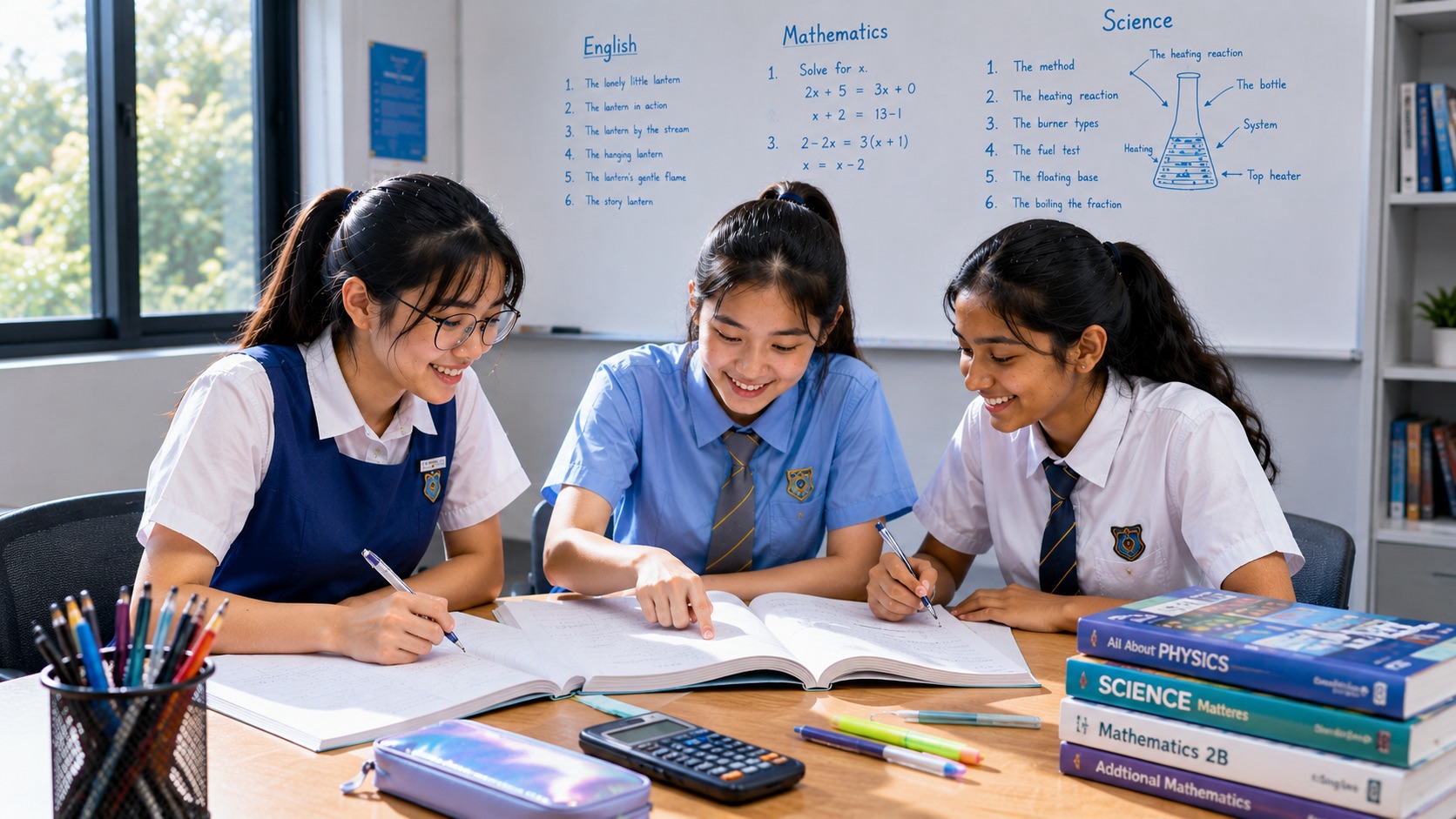
Choa Chu Kang Science Tuition is a legacy title with a precise modern learning job: families searching for Choa Chu Kang Science tuition, Primary Science tuition Singapore, PSLE Science tuition, Primary 5 Science, Primary 6 Science, Science answering techniques, open-ended Science questions, experiments, scientific inquiry, graphs, data interpretation and concept mastery often need help with a skill that sits underneath all of them—prediction. Can the pupil use a scientific idea and the evidence in front of them to say what should happen next, and can the pupil explain why?
Strong Primary Science tuition should therefore develop more than MOE Science syllabus coverage, keywords, Booklet A MCQ technique, Booklet B structured answering, process skills and higher-order thinking. Pupils need to move through a disciplined loop: observe a pattern, build or retrieve a model, make a prediction, compare the prediction with evidence, revise the model if necessary, and communicate the reasoning clearly. Prediction turns stored knowledge into a testable expectation.
The revised 2026 PSLE Science paper reinforces this. Standard Science now contains 30 multiple-choice questions in Booklet A for 60 marks and 10–11 structured questions in Booklet B for 40 marks, with 1 hour 45 minutes for the paper. The official assessment objectives include applying scientific facts, concepts and principles; making predictions and formulating hypotheses; interpreting and analysing information; evaluating observations, information and methods; and communicating explanations and reasoning. The 2023 MOE syllabus continues to organise Core Ideas through Diversity, Cycles, Systems, Energy and Interactions.
Scope note: this article preserves its historical title and URL. It does not claim a current Choa Chu Kang teaching location or local affiliation. Its distinct educational job is prediction, evidence and the next useful test: how to teach pupils to use Science prospectively rather than only describe what has already happened.
Prediction is where a concept proves that it can move
A child who memorises “plants need light” can repeat the sentence.
A child who understands the relationship can answer:
- What would you expect if light availability were reduced?
- What observation would support that prediction?
- What other conditions must be controlled before attributing the result to light?
- What result would make you question your original explanation?
Prediction forces the model to work forward.
That is why it is such a powerful diagnostic tool.
The prediction loop
Observe → model → predict → test → compare → revise → explain
This loop is simple enough for Primary Science and deep enough to support later scientific thinking.
The pupil begins with evidence or prior knowledge. A model captures the relevant relationship. The model generates an expectation. New evidence either fits reasonably well or creates tension. The pupil updates the explanation and communicates what changed.
Science tuition should use this loop frequently, not save it for one chapter labelled “experiments”.
A prediction is not a guess with a scientific word attached
Ask pupils to complete two sentences:
I predict ______.
because ______.
The second sentence is where the Science lives.
If the reason is “because I think so”, the prediction is a guess.
If the reason uses a relevant scientific relationship and the conditions in the question, the prediction becomes defensible.
Three levels of prediction
| Level | Pupil response | Teaching move |
|---|---|---|
| Level 1: Direction | “It will increase.” | Ask what relationship creates the increase. |
| Level 2: Mechanism | “It will increase because this condition affects this process.” | Ask what evidence would test the claim. |
| Level 3: Conditional | “It should increase if the other relevant conditions remain comparable.” | Ask what alternative explanation remains possible. |
The aim is not to make Primary pupils sound like researchers. It is to help them see that predictions depend on assumptions and evidence.
Worked prediction example 1: evaporation
Imagine two identical shallow containers with equal volumes of water. One is placed where moving air passes over it; the other is placed in still air. Other relevant conditions are controlled.
Before revealing any result, ask:
- Which container do you predict will lose water faster?
- Which scientific relationship supports your prediction?
- What should be measured?
- What must be kept comparable?
- What pattern in the data would support your prediction?
- What unexpected result would make you re-check the setup or model?
The pupil now practises prediction, variables, measurement, fair testing, data interpretation and evaluation in one compact activity.
Worked prediction example 2: electrical systems
Show a simple circuit and ask what happens if one connection is broken.
Do not accept “the bulb goes off” as the end.
Ask:
- Why?
- What feature of the system changed?
- What would happen if the connection were restored?
- What if a different component were changed?
The child uses the system model prospectively.
Then show a different circuit arrangement and repeat. The surface changes; the reasoning habit remains.
Worked prediction example 3: forces and surfaces
Suppose the same object is moved across two surfaces. One surface provides greater frictional opposition.
Ask the pupil to predict which setup will require a greater applied force to produce the intended movement, within the conditions described.
Then ask what observation would support the prediction.
Finally, change the object or surface and ask again.
This prevents the child from memorising one demonstration.
Worked prediction example 4: plant systems
Give a plant scenario where one environmental condition changes.
The pupil must first identify which plant process is relevant. This step matters because “plant question” is not a concept. Photosynthesis, water transport, reproduction and growth are different scientific jobs.
Only after selecting the process should the pupil predict the likely effect and explain the chain.
Prediction and graphs: draw the expected shape first
Before pupils see experimental data, ask them to sketch what they expect the graph to look like.
This is powerful because a graph becomes an expression of a model.
After real data are revealed, compare:
- Was the direction correct?
- Was the relationship linear, curved, constant or variable?
- Where did the prediction diverge?
- Could measurement uncertainty or another condition explain the difference?
- Does the scientific model need revision?
Pupils stop treating graphs as finished objects and begin seeing them as evidence about relationships.
Prediction and MCQ: answer before looking at the options
One useful Booklet A technique is to hide the options temporarily.
Read the question stem and predict what a correct answer should say.
Then reveal the options.
This reduces the pull of distractors because the pupil enters the choice set with an evidence-based expectation.
After selecting, ask:
- Which option matched the prediction?
- Why were the others tempting?
- Did any option expose a misconception?
Booklet A now carries 60 marks, so the quality of option selection matters greatly.
Prediction and Booklet B: write the causal chain before polishing the sentence
For structured questions, prediction can be used as a pre-writing tool.
Before writing the final answer, the pupil notes:
changed condition → affected process → expected effect → observable result
Then convert the chain into one or two complete sentences, depending on the question.
This reduces the chance that the pupil writes a keyword but omits the mechanism.
Hypothesis: keep it age-appropriate and testable
The official assessment objectives refer to predictions and hypotheses. At Primary level, the most useful teaching point is that a hypothesis should express a relationship that evidence can test.
Instead of:
“Plants grow better.”
Try:
“If the amount of available light increases while the other relevant conditions remain comparable, then the plant may show greater growth over the observation period.”
The exact language can be simplified according to age. The important structure is:
- condition;
- expected outcome;
- relationship;
- testable evidence.
The next useful test
When evidence is uncertain, pupils often want the tutor to reveal the answer.
Teach a better question:
What could we observe or test next that would reduce the uncertainty?
This changes the pupil from answer consumer to investigator.
Worked “next test” example: two competing explanations
Suppose two plants show different growth. One pupil says light caused the difference. Another says water availability caused it.
Rather than voting, ask:
- What evidence do we already have?
- Were light and water both controlled?
- If not, can the current experiment distinguish the explanations?
- What new setup would isolate one factor?
- What result would support each explanation?
The lesson becomes one of experimental design and evidence quality.
Fair tests: prediction makes control variables meaningful
Pupils sometimes memorise “keep everything the same except one variable” without understanding why.
Prediction supplies the reason.
If we want to predict the effect of Condition X, other relevant conditions must remain comparable so that a changed result can reasonably be linked to X rather than something else.
Control variables are therefore not bureaucratic rules. They protect the interpretation.
Measurement: predict what should be measured, not merely what should be watched
A weak investigation may say, “See which plant grows better.”
A stronger investigation specifies a measurable outcome appropriate to the question.
Teach pupils to ask:
- What quantity would show the change?
- Which tool can measure it?
- What unit should be used?
- When should measurements be taken?
- Would repeated measurements improve confidence?
Prediction becomes more precise when measurement becomes more precise.
Prediction errors reveal misconceptions quickly
Before teaching a topic, ask a prediction question.
Examples:
- Will all metal objects be attracted to a magnet?
- Will a larger object always sink?
- Will a plant kept in darkness continue to produce food in the same way?
- Will adding more batteries always produce the same change in every circuit arrangement?
The answer is less important than the reason.
A confident wrong prediction reveals the pupil’s current model. That is useful teaching data.
Use discrepant events carefully
A discrepant event is a result that conflicts with what the pupil expected.
It can be powerful because surprise creates attention.
The teaching sequence:
- Ask for a prediction.
- Require a reason.
- Reveal or observe the result.
- Let the pupil identify the mismatch.
- Rebuild the model.
- Predict a new case immediately.
The last step matters. It proves that the revised model does new work.
Prediction across the five MOE themes
Diversity
After learning properties and classification rules, predict where a new item belongs and justify the rule.
Cycles
Given one stage and conditions, predict the next stage or consequence and explain the sequence.
Systems
Change one component and predict how the system’s function will be affected.
Energy
Change a condition involving an energy process and predict the observable result at the appropriate syllabus level.
Interactions
Change an object, force, organism or environmental factor and predict how the interaction changes.
Prediction is therefore not a separate topic. It is a practice that can run through the whole syllabus.
Primary 3: prediction should feel like disciplined curiosity
At P3, keep predictions concrete.
- Which material do you think will be most suitable?
- Which object will a magnet attract?
- What do you think will happen if we change this condition?
Always ask why, then compare with evidence.
The goal is not to punish wrong predictions. It is to teach that ideas can be tested.
Primary 4: connect prediction to diagrams and processes
P4 pupils can begin using representations more deliberately. Show a process diagram, change one condition and ask for the likely effect. Require the pupil to point to the part of the model used.
Primary 5: prediction becomes experimental reasoning
P5 should connect prediction with fair tests, variables, graphs and evidence.
Before an experiment question, ask the pupil to predict the expected relationship. After seeing the data, compare expectation with evidence.
This is an excellent year to normalise model revision.
Primary 6: prediction under mixed and timed conditions
By P6, prediction should be fast enough to support examination control.
Use:
- short MCQ prediction before option reveal;
- graph shape prediction;
- experiment outcome prediction;
- structured answer planning;
- mixed-topic “what happens next?” questions;
- timed sets where pupils must preserve the reasoning routine.
The child should not need a long ritual. The routine should become internal.
When predictions fail: four possible reasons
1. The concept was wrong
Repair the scientific model.
2. The concept was correct but the conditions were misread
Repair question reading and evidence selection.
3. An uncontrolled condition affected the outcome
Repair experimental design and conclusion strength.
4. The model was too simple for the evidence
At Primary level, acknowledge that scientific models are simplified and return to the syllabus-appropriate explanation. The key habit is intellectual flexibility: evidence can require revision.
Do not reward lucky predictions as if they prove understanding
A pupil guesses correctly and beams.
Ask why.
If the reason is scientifically incoherent, the correct outcome is luck, not mastery.
Likewise, a wrong prediction with sound reasoning from incomplete evidence may be more educationally interesting than a lucky correct answer.
Tuition should reward the quality of the process.
Prediction journals: a simple long-term tool
For selected questions, keep a four-column record:
| Prediction | Reason | Evidence | Revision |
|---|---|---|---|
| What I expected | Which model I used | What the result showed | What I would now change |
Over time, pupils see that revision is normal. They also notice which kinds of models they repeatedly misuse.
Prediction and misconceptions: examples, non-examples, boundary cases
Suppose a pupil predicts that every metal object will be attracted to a magnet.
Do not just say “wrong”.
Use a set of objects that includes magnetic and non-magnetic metals. The child makes predictions, tests them, then revises the category.
The revised statement becomes more precise because evidence forced it to.
Prediction and scientific vocabulary
Vocabulary should sharpen the reason after the relationship is understood.
For example, a pupil may first say:
“It will bend more because it is bendier.”
The tutor refines:
“The material is more flexible, so under the stated condition it can bend more without breaking.”
The word flexible improves precision. It does not replace the reasoning.
Prediction and transfer: change the surface
Once a pupil predicts correctly in one context, change the object.
If the prediction depends on a true scientific relationship, the pupil should be able to explain whether it still applies.
This is where prediction and transfer meet.
A 90-minute prediction-centred lesson
| Stage | Time | Purpose |
|---|---|---|
| Cold prediction | 10 min | Reveal current models before teaching. |
| Concept repair | 20 min | Build the scientific relationship from evidence. |
| Guided test | 15 min | Predict and compare with a worked setup. |
| Independent experiment reasoning | 15 min | Identify variables and expected outcome. |
| Graph or table interpretation | 10 min | Compare prediction with data. |
| Transfer question | 10 min | Use the model in a different context. |
| Exit prediction | 10 min | Test independence with no hints. |
Not every lesson needs this exact structure. The point is to make prediction an active cognitive tool.
Post-paper analysis: what did the pupil expect?
When an MCQ is wrong, ask what the pupil predicted before choosing the option.
This separates two failure types:
- the prediction itself was scientifically wrong;
- the prediction was sound, but the pupil was pulled away by a distractor.
The first needs concept repair. The second needs examination control.
Same wrong mark. Different teaching.
The “next useful test” after a correction
Never let a correction end with “I understand now.”
Ask:
What new question would prove that?
Then give one.
If the pupil transfers the repaired model, confidence is earned.
When a pupil is strong: deepen prediction instead of rushing ahead
A high-performing Primary pupil can be stretched by asking:
- What evidence would make you change your mind?
- What alternative explanation could fit the same observation?
- How would you design a fairer test?
- Which measurement would reduce uncertainty most?
- What would the graph look like if your model were correct?
- Which result would be surprising?
These deepen scientific habits without requiring premature Secondary syllabus content.
Uncertainty belongs in Science
Children often think a good Science student always knows.
A more useful standard is:
A good Science student knows how to respond when the answer is not immediately obvious.
The pupil can:
- identify known evidence;
- state what remains uncertain;
- select a plausible model;
- make a prediction;
- ask what evidence would test it;
- revise when necessary.
This is a calm, disciplined response to uncertainty.
Parent checklist: is tuition teaching prediction or only reaction?
Ask:
- Does my child make predictions before results are shown?
- Must the prediction include a reason?
- Are pupils asked what evidence would support or challenge the prediction?
- Do experiment questions include variable control?
- Are graphs used to compare expectation with actual data?
- Are wrong predictions analysed rather than simply corrected?
- Does the tutor use changed contexts to test transfer?
- Are MCQ options sometimes hidden until the pupil predicts?
- Does the child learn how to propose a next useful test?
- Does support decrease over time?
These questions reveal whether Science learning is forward-looking.
A twelve-week prediction and evidence cycle
Weeks 1–2: reveal the existing models
Use prediction questions across several topics. Record confident wrong answers; they are high-value misconceptions.
Weeks 3–4: repair the model
Use examples, non-examples and evidence. Require the pupil to predict a fresh case immediately after correction.
Weeks 5–6: connect prediction to experiments
Identify variables, fair comparisons and measurable outcomes. Ask what result should appear if the model is correct.
Weeks 7–8: connect prediction to graphs
Sketch expected patterns, then compare with actual or provided data.
Weeks 9–10: mix contexts and remove labels
Hide topic headings. Use unfamiliar objects. Require evidence-based model selection before prediction.
Weeks 11–12: add timing and self-checking
Use mixed PSLE-style sets. The pupil predicts, solves, checks and explains errors with progressively less tutor input.
Where this page sits in the eduKateYishun Science system
This page owns the prediction-and-next-test job. For the Primary 3–6 developmental architecture, use Science Tuition Primary. For tutor diagnosis and error repair, use Punggol Science Tutor MOE Teacher NIE Trained. For small-group reasoning, read Punggol Science Tutors Small Groups. For evidence-to-explanation architecture, read Singapore Science Tuition. For model-based transfer, read Bukit Timah Science Tuition.
The standard: can the model predict before the answer appears?
Science education becomes much more powerful when pupils stop using concepts only to explain answers they have already seen.
A usable concept should help the pupil look forward.
What should happen?
Why?
What evidence would support that?
What result would make us reconsider?
What should we test next?
Those questions turn Science from a memory archive into an operating system.
A pupil who can predict from a model, compare with evidence and revise when necessary is doing something more important than recalling the correct phrase.
The child is learning how scientific knowledge earns its keep.
Current official references
The prediction casebook: six ways pupils get the future wrong
Wrong predictions are useful because they expose the model a pupil is actually using. The tutor should not treat every wrong prediction as the same error.
Case 1: prediction by appearance
A pupil predicts that a large object must sink because it “looks heavy”. The child is using appearance as a rule.
The tutor should not jump straight to the correct answer. Ask what property or relationship actually determines the outcome in the context being studied. Then provide examples that break the appearance rule. The pupil makes a revised prediction using the better model.
Case 2: prediction by keyword
The question contains the word “metal”, so the pupil predicts that the object will be attracted to a magnet. The keyword has triggered an overgeneralisation.
Repair with examples and non-examples. The child learns that “metal” is not sufficient evidence for magnetic attraction. Then test a fresh set of materials.
Case 3: prediction without controlling conditions
Two plants grow differently. The pupil predicts that light caused the difference, but the plants also received different amounts of water.
The issue is not the light concept. The issue is causal attribution. Teach the pupil that a prediction about one factor requires other relevant conditions to be comparable if the test is meant to isolate that factor.
Case 4: prediction that ignores the measured outcome
An experiment changes temperature but measures time. The pupil describes what should happen to temperature instead of predicting the measured time.
This is a variable-reading error. Ask, “What is the experiment actually recording?” Prediction must target the dependent outcome, not merely the most familiar concept.
Case 5: correct prediction, wrong reason
The pupil predicts the correct result but gives a scientifically incorrect explanation.
Do not award the process as fully secure. Ask the pupil to explain the mechanism and then predict a changed case. Lucky outcomes should not masquerade as understanding.
Case 6: reasonable prediction, unexpected evidence
The pupil makes a defensible prediction but the supplied data do not match.
This is an opportunity to teach scientific humility. Check the setup, assumptions, measurements and whether another factor could matter. The pupil learns that evidence has the final say.
Evidence can support, weaken or fail to decide
Primary pupils often think evidence must either “prove” or “disprove” an idea. Introduce a more careful vocabulary where appropriate:
- supports: the observation fits what the model predicted;
- weakens: the observation conflicts with an important prediction;
- insufficient: the setup or data do not distinguish the explanations clearly.
This is especially helpful in experiment questions. Pupils learn that “we cannot tell from this experiment” can be a scientifically strong answer when the evidence truly cannot decide.
Predict the evidence, not just the answer
After a pupil states what should happen, ask what evidence they expect to see.
For example:
“If your model is correct, what should the graph look like?”
“Which container should lose more mass?”
“Which bulb should light?”
“What measurement should be larger?”
This makes the prediction observable.
The two-prediction routine
For some questions, ask pupils to make two predictions:
- What do you think will happen?
- What would happen if the key condition were reversed?
This checks whether the pupil understands the direction of the relationship rather than merely remembers one outcome.
Predict before the experiment, predict again after the first data point
Longer investigations can use sequential prediction.
Before any data, the pupil predicts the overall pattern. After one or two results, ask the pupil to update the prediction. Then reveal more evidence.
This trains the child to use accumulating information rather than clinging to the first idea.
Measurement uncertainty: teach caution without overcomplication
Primary Science does not need a university treatment of uncertainty. Pupils can still learn several useful habits.
- Measurements may vary slightly.
- Reading instruments carefully matters.
- Repeating a measurement can increase confidence.
- One unusual result should be checked before building a large conclusion around it.
- A conclusion should match the quality and amount of evidence available.
These ideas make prediction-and-evidence work more realistic.
What if the prediction is obvious?
Even obvious predictions can be useful if the tutor changes the question.
If every pupil knows that breaking a circuit will stop the bulb from lighting, ask:
- Which specific break matters in this diagram?
- What change would restore the path?
- What if the material inserted in the gap were changed?
- What evidence would show whether the inserted material conducts electricity in the setup?
The prediction becomes a gateway to experimental reasoning.
From prediction to explanation to evaluation
A mature Primary Science response can move through three jobs:
- Predict: state the expected outcome from a model.
- Explain: connect the model to the outcome.
- Evaluate: decide whether the evidence actually supports the claim.
These jobs can appear in different questions, but training them together creates coherence.
The family version: how parents can use prediction at home
Parents do not need laboratory equipment. Everyday moments work.
Before ice melts, ask what the child expects and why.
Before placing an object in water, ask for a prediction and the rule being used.
Before switching a lamp circuit, ask which components must be connected.
Before watering two plants differently for a simple observation activity, ask what outcome the child expects and what else should remain comparable.
The educational value comes from the “why” and the later comparison with evidence.
Do not turn every family moment into a quiz
Curiosity disappears if every dinner table becomes a test centre.
Use prediction lightly. One good question is enough:
“What do you think will happen?”
Then listen.
If the child is interested, ask why. If not, leave it. Science should retain some wonder.
A prediction-focused error log
| Error type | What happened | Next practice |
|---|---|---|
| Model error | Prediction came from an incorrect scientific idea. | Rebuild concept with examples and non-examples. |
| Condition error | Pupil missed what changed. | Variable-identification questions. |
| Evidence error | Pupil ignored graph, table or diagram information. | Evidence-first routines. |
| Control error | Pupil attributed result to one factor when several changed. | Fair-test critique. |
| Transfer error | Model worked only in familiar context. | Same concept, new surface. |
| Exam-control error | Sound model abandoned under time pressure. | Short timed prediction-and-check sets. |
The categories tell the tutor what kind of “more practice” is actually needed.
The prediction ladder for one topic
Take any concept and move through four stages:
Stage 1: familiar prediction
Use the same representation as the teaching example. Check whether the pupil can apply the newly learned relationship.
Stage 2: changed surface
Change the object or wording while keeping the same underlying relationship.
Stage 3: competing concepts
Use a mixed context where more than one idea seems possible. The pupil must choose from evidence.
Stage 4: evaluation
Present data that do not perfectly match the prediction and ask what should be checked next.
This ladder turns prediction into a full learning progression.
How prediction builds confidence without teaching overconfidence
Real confidence is not the feeling that every first answer will be correct.
It is the knowledge that the pupil has a process:
- make the best prediction available;
- state the reason;
- look at evidence;
- revise if necessary;
- try again.
This kind of confidence is resilient because being wrong does not destroy it.
The tutor should model revision publicly
Occasionally, the tutor can say:
“My first interpretation would be X because of this relationship. But this part of the graph does not fit. So I need to reconsider.”
Pupils see that revision is not embarrassment. It is competent reasoning.
This is especially valuable for high-achieving pupils who have learned to equate intelligence with immediate correctness.
Prediction as preparation for Secondary Science
Primary Science does not need to imitate Secondary Science. It can prepare the habits that make later learning easier.
Pupils who can:
- state a testable expectation;
- identify variables;
- read data;
- compare evidence with a model;
- revise explanations;
- communicate reasoning clearly;
arrive at Secondary Science with something more valuable than extra chapter vocabulary. They arrive with an operating method.
The final prediction challenge
Give the pupil an unfamiliar question with no chapter label.
Before seeing options or model answers, require:
- the likely relevant concept;
- the predicted outcome;
- the reason;
- the evidence that would support it;
- one result that would make the pupil reconsider.
Then reveal the full question or data.
If the pupil can compare prediction with evidence and revise intelligently, the skill is becoming independent.
That is the real destination of prediction training: not guessing the future, but using scientific knowledge to make expectations that evidence can test.
A final habit worth keeping
Before accepting any scientific prediction, ask one last question: what would I expect to observe if this explanation were actually true?
That habit ties knowledge to evidence. It also gives pupils a practical way to check themselves when the context is unfamiliar. A prediction becomes more than an answer; it becomes a bridge between a model and the world.
When pupils can build that bridge independently, they are no longer waiting for Science to tell them what happened. They are learning to reason about what should happen next—and to let evidence decide whether they were right.