
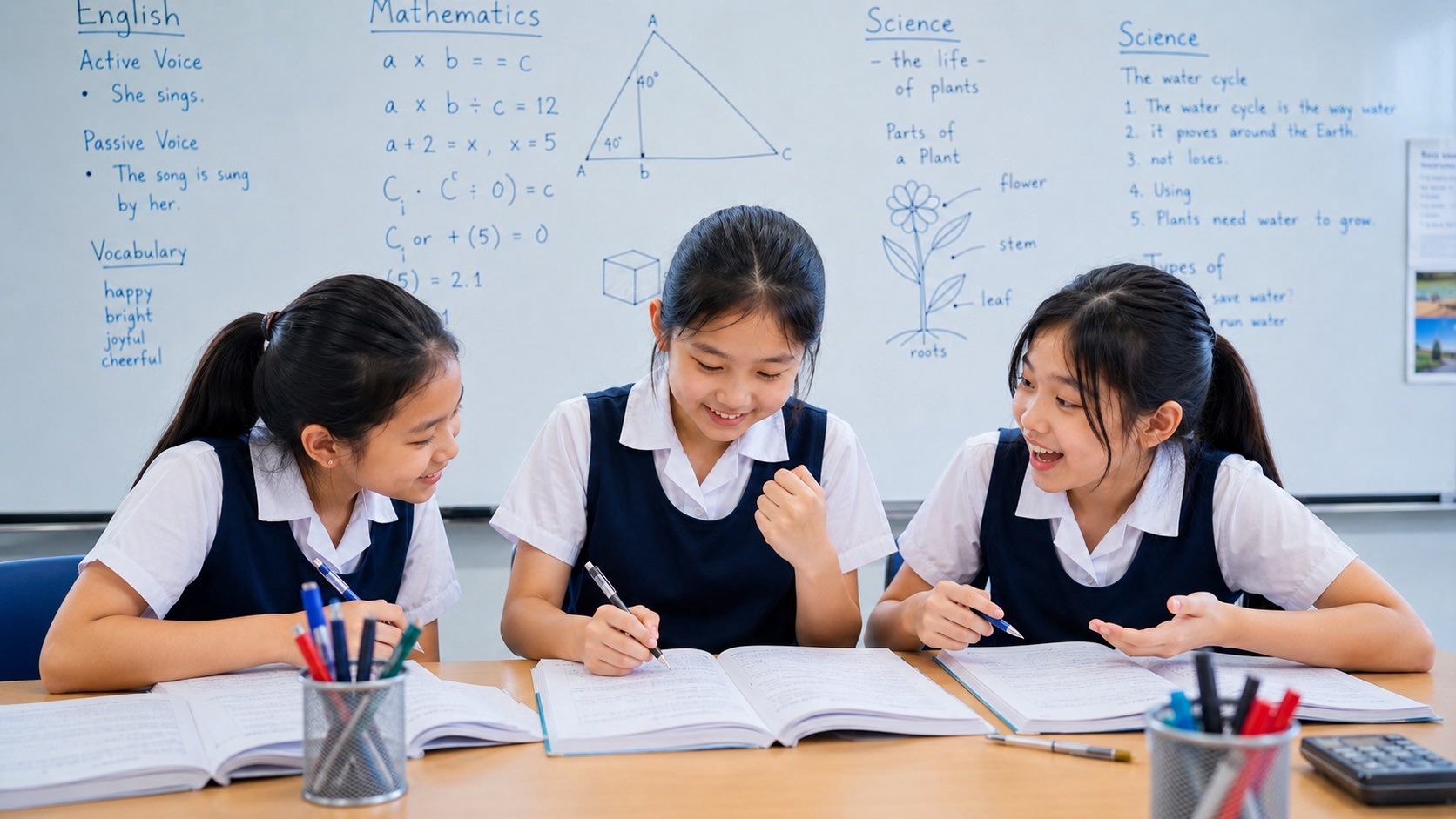
English Teacher Edgefield Primary School Yishun should help Primary pupils use relative clauses to identify, describe and combine information without creating ambiguity. Families searching for Primary English tuition in Yishun, Edgefield Primary School English tuition, PSLE English, grammar, relative clauses, relative pronouns, sentence construction, comprehension, composition writing, synthesis and transformation, small-group English tuition and personalised feedback are often looking at a child who can write short sentences correctly but becomes uncertain with who, whom, whose, which, that, where and when.
Current Primary English tuition programmes in Singapore commonly foreground PSLE English preparation, grammar mastery, comprehension, composition writing, vocabulary development, synthesis and transformation, editing, oral communication, targeted feedback and small-group learning. Relative clauses connect these areas because they allow writers to attach information to a noun. “The girl won the race. She sits beside me.” can become “The girl who sits beside me won the race.” The grammar becomes more compact, but the relationship must remain clear.
This 2019 legacy page keeps its historical title and URL; no school affiliation or endorsement is implied. Its modern educational job is specific: teach Primary pupils how relative pronouns and relative clauses attach information accurately from P1 to P6. The focus is identifying antecedents, who, whom, whose, which, that, where, when, defining and non-defining information, punctuation, clause placement, omitted relative pronouns, sentence combining, ambiguity, comprehension, editing and the gradual move from “join two sentences” to “attach the extra information to the exact noun it belongs to.”
A Relative Clause Adds Information to a Noun
Compare:
- The boy smiled.
- The boy won the race.
Combined:
The boy who won the race smiled.
The relative clause identifies or describes the boy.
noun → relative word → attached information
Primary 1–2: Begin With Who and Which
- The girl who is wearing a red hat is my sister.
- The book which is on the desk belongs to Ben.
Young pupils should first see that the clause helps identify which person or thing we mean.
Who Usually Refers to People
- the teacher who helped us;
- the boy who called;
- the pupils who arrived early.
The relative pronoun links the noun to the clause and can perform a grammatical role inside that clause.
Which Usually Refers to Things
- the bus which stopped outside;
- the book which I borrowed;
- the idea which changed our plan.
In many defining clauses, that can also refer to people or things, depending on context and style.
That Is Common in Defining Clauses
- The bag that was left outside is mine.
- The pupil that answered first received a token.
In careful formal usage, some writers prefer who for people, but that is common and grammatical in restrictive clauses referring to people.
Primary 3–4: Find the Antecedent
The antecedent is the noun or noun phrase the relative clause refers back to.
The bicycle that had a broken chain was left near the gate.
The antecedent is the bicycle.
Before choosing a relative pronoun, ask:
- What noun is being described?
- Is it a person, thing, place, time or possession relationship?
- What job will the relative word perform inside the clause?
Whose Expresses Possession
The girl whose bag was missing went to the office.
Whose shows that the bag belongs to the girl.
This is more precise than awkward combinations such as “the girl which her bag was missing”.
Where Can Introduce Place Information
This is the library where we met.
The clause identifies or adds information about a place.
When Can Introduce Time Information
I remember the day when we first visited the museum.
The relative clause attaches an event to a time expression.
Whom Is an Object Form
Traditional formal grammar uses whom when the relative pronoun is an object:
The teacher whom we met was helpful.
In contemporary everyday English, who is very common in object position too:
The teacher who we met was helpful.
Pupils should recognise both while following the register expected by the task and school context.
Object Relative Pronouns Can Sometimes Be Omitted
- The book that I borrowed was useful.
- The book I borrowed was useful.
The omission is possible because the relative pronoun is the object of borrowed, not the subject.
Compare:
- The boy who won smiled.
- The boy won smiled. — incorrect.
The subject relative pronoun cannot simply disappear in this structure.
Primary 5–6: Defining Clauses Identify Which One
The pupils who completed the task may leave.
The relative clause restricts the meaning. Only the pupils who completed the task may leave.
Removing the clause changes which pupils are included.
Non-Defining Clauses Add Extra Information
Mrs Lim, who teaches my sister, organised the event.
The person is already identified as Mrs Lim. The clause adds extra information and is set off with commas.
Removing it leaves the main identification intact:
Mrs Lim organised the event.
Punctuation Can Change the Meaning
Compare:
- The pupils who had finished left the room.
- The pupils, who had finished, left the room.
The first can imply only some pupils had finished and those pupils left. The second presents the finishing as extra information about the already identified group of pupils.
Commas are therefore meaning, not decoration.
That Is Normally Avoided in Non-Defining Clauses
In standard formal English, non-defining relative clauses usually use who or which, not that:
My bicycle, which I bought last year, needs repair.
Clause Placement Must Be Close to the Noun It Describes
Awkward version:
I saw a dog in the park that had a red collar.
Does that had a red collar describe the dog or the park?
Better:
In the park, I saw a dog that had a red collar.
Attach the clause close to its intended antecedent.
Misplaced Relative Clauses Create Accidental Humour
She served sandwiches to the pupils that were stale.
The grammar appears to describe the pupils as stale.
Better:
She served the pupils sandwiches that were stale.
Or better still, if clarity matters:
She served the pupils stale sandwiches.
Relative Clauses Support Sentence Combining
Two short sentences:
- The boy found the wallet.
- The boy was waiting near the gate.
Combined:
The boy who was waiting near the gate found the wallet.
The writer must decide which information is main and which becomes embedded.
Sentence Combining Is an Information-Hierarchy Decision
Compare:
- The girl who wore a red cap won the race.
- The girl who won the race wore a red cap.
The facts overlap, but the main assertion changes. In the first, winning is central. In the second, the red cap is central.
Grammar determines what the sentence presents as main versus supporting information.
Relative Clauses Support Comprehension
Long noun phrases often contain relative clauses:
The proposal that the committee rejected last month was revised.
The core sentence is:
The proposal was revised.
The relative clause tells us which proposal.
Stripping the clause temporarily can help pupils recover the sentence skeleton.
Relative Pronouns Carry Grammatical Roles Inside Their Clauses
- The girl who called… — who is subject of called.
- The girl whom I called… — whom is object of called.
- The girl whose bag disappeared… — whose marks possession.
Understanding this role helps pupils choose and omit relative pronouns accurately.
Relative Clauses Support Synthesis and Transformation
Pupils may need to combine information while preserving reference and meaning.
The common failure is to attach the clause to the wrong noun or change the time relationship.
- identify repeated noun;
- decide main clause;
- choose relative word;
- preserve tense;
- place clause next to antecedent;
- check whether commas are needed.
Relative Clauses Support Composition Variety
A controlled relative clause can add description without creating a separate sentence:
The security guard, who had been watching the entrance, stepped forward.
But overuse creates heavy sentences. Not every detail needs embedding.
Relative Clauses Can Create Narrative Timing
The envelope, which had arrived that morning, still lay unopened on the table.
The clause quietly supplies earlier context while the main clause keeps the present narrative focus.
The “Find the Antecedent” Drill
Underline each relative pronoun and draw an arrow to the noun it modifies.
If two arrows seem possible, the sentence may be ambiguous.
The “Remove the Clause” Drill
Remove the relative clause temporarily.
- Does the remaining sentence stay grammatical?
- Does the identity of the noun remain clear?
- Did removing the clause change who or what is included?
These questions help distinguish defining from non-defining information.
The “Who, Which, Whose, Where or When?” Drill
Give antecedents from different categories:
- person;
- thing;
- possession;
- place;
- time.
Pupils select a natural relative form and create a complete sentence.
The “Move the Clause” Drill
Move a relative clause away from its noun and observe the ambiguity. Then restore it to the nearest clear position.
This makes attachment visible.
The “Two Sentences to One” Drill
Combine two sentences in two different ways and ask how information hierarchy changes.
This prevents sentence combining from becoming a single-answer mechanical exercise.
Relative-Clause Errors Should Be Classified
| Error family | Symptom | Repair |
|---|---|---|
| antecedent | clause attaches to wrong noun | move clause beside intended noun |
| relative word | which used for possession / where for person | identify person/thing/place/time/possession |
| subject omission | subject relative deleted | identify clause subject |
| punctuation | defining/non-defining meaning blurred | test whether clause is essential to identification |
| pronoun duplication | the boy who he won | let relative pronoun fill its clause role |
| overloading | too many embedded clauses | split sentence where clarity suffers |
The Relative-Clause Error Ledger
- wrong relative word;
- clause too far from noun;
- subject relative omitted;
- who + he duplication;
- commas change intended group meaning;
- sentence overloaded with clauses.
Each recurring error should become one future question such as “Which exact noun does this clause describe?”
A Three-Student Tutorial Can Compare Sentence Hierarchy
Give three pupils the same two facts. Each combines them differently, choosing a different fact as the main clause.
The group compares what each sentence makes central and what becomes supporting information.
A 90-Minute Relative-Clause Lesson
| Time | Learning job |
|---|---|
| 10 min | who/which/that retrieval |
| 15 min | antecedent and clause-role identification |
| 15 min | whose/where/when and object relatives |
| 15 min | defining vs non-defining punctuation |
| 15 min | Synthesis / Transformation combining |
| 15 min | fresh composition/comprehension transfer |
| 5 min | record one relative-clause rule |
Home Practice Can Use One Sentence From Reading
Choose one sentence containing who, which, that, whose, where or when.
- What noun does the clause describe?
- What information does it add?
- Could the clause be removed?
- Would the noun still be identified clearly?
This makes authentic reading a grammar lesson without interrupting every paragraph.
When Extra English Tuition May Not Be Necessary
A pupil who attaches relative clauses accurately, chooses natural relative pronouns, understands punctuation differences, combines sentences independently and continues progressing through school feedback may not need additional formal tuition.
Questions Parents Can Ask an English Tutor
- How do you teach pupils to identify the antecedent?
- How are who, which, that and whose distinguished?
- How do pupils learn when an object relative can be omitted?
- How are defining and non-defining clauses taught?
- How does punctuation change relative-clause meaning?
- How do relative clauses support comprehension?
- How do they transfer into Synthesis / Transformation and composition?
- How are attachment errors retested in fresh writing?
Frequently Asked Questions
What does a relative clause do?
It adds information about a noun or noun phrase, either identifying which one is meant or supplying additional information about an already identified referent.
Can “that” refer to people?
Yes, that is common in defining relative clauses referring to people, although who is often preferred in many formal contexts.
Why do commas matter in relative clauses?
Commas often mark non-defining information. Their presence can change whether the clause identifies a subset or merely adds extra information about an already known noun.
What is the best sign relative-clause control is becoming independent?
The pupil can attach information to the correct noun, choose the relative form from its grammatical role, control punctuation and combine sentences without changing the intended meaning.
English Teacher Edgefield Primary School Yishun: The Larger Lesson
Relative clauses are information attachment systems.
Which noun is being described?
What role does the relative word play inside the clause?
Is the information essential to identification or extra?
When pupils can answer those questions, sentence combining becomes precise and controlled rather than merely longer. That is the modern learning job of English Teacher Edgefield Primary School Yishun. No school affiliation or endorsement is implied.
Current Routes
Continue through Primary English: General Learning 2019 A · Primary English directory · English by area & school · Diagnostics · Examinations · Library
Leave a Reply