
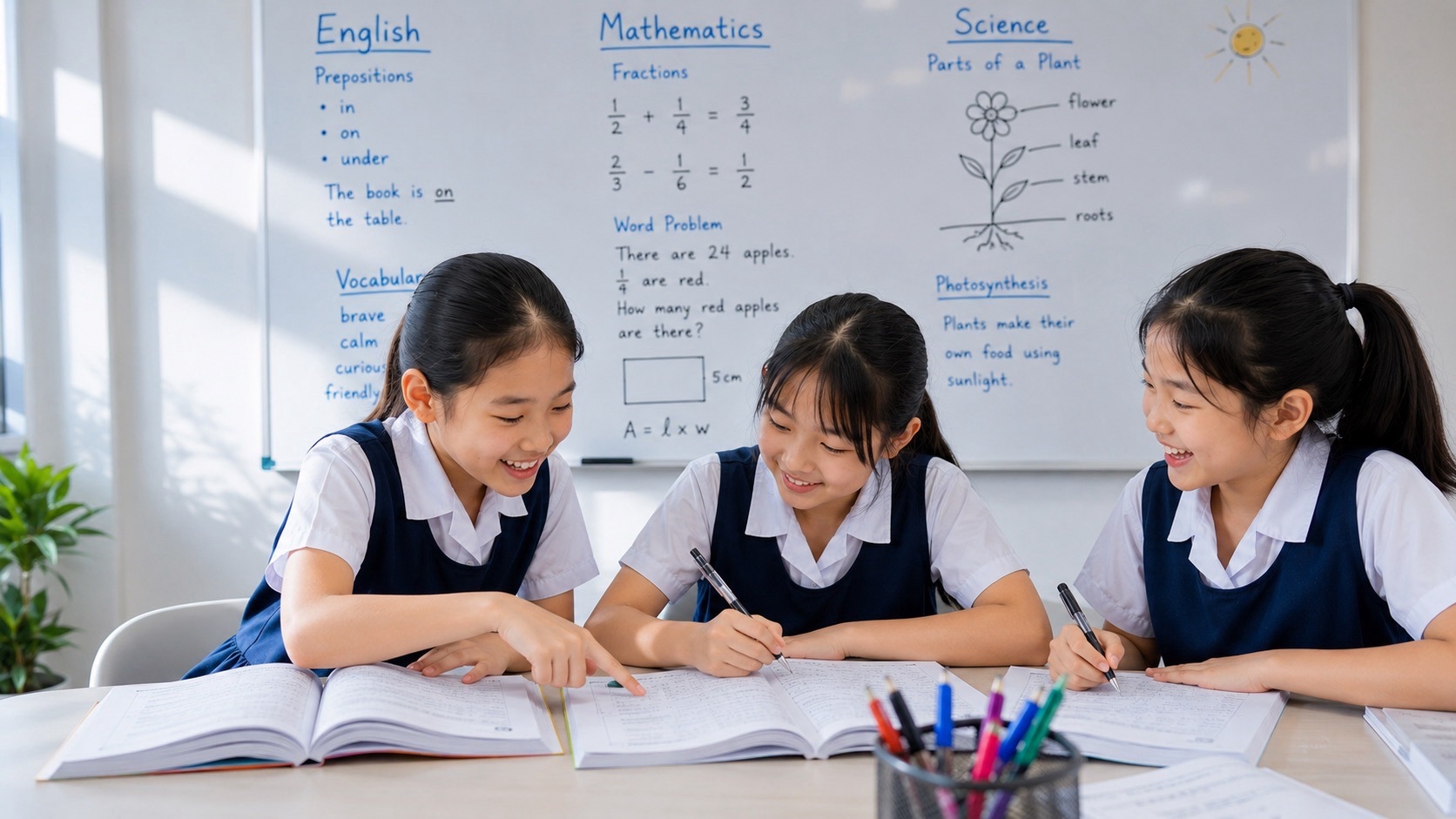
Primary 2 English Tutor: turning spoken language into clear written sentences
Families searching for a Primary 2 English tutor, P2 English tuition, reading, grammar, vocabulary, comprehension, writing or oral communication support often notice a familiar gap. The child can explain an idea aloud, but the written sentence becomes shorter, less precise or grammatically unstable. Primary 2 is an ideal year to close that gap.
Spoken language and written language support one another, but they are not identical. Speech allows gesture, repetition, correction and immediate feedback from a listener. Writing has to carry meaning on the page. The pupil must choose words, organise sentence order, control grammar and make the relationship between ideas clear without the reader standing beside them.
This legacy article keeps its original title and historical URL. The rewritten body does not treat old location, staffing, class-size or promotional claims as current facts. Its distinct educational job is oral-to-written transfer: helping Primary 2 pupils turn ideas they can say into sentences and short paragraphs they can write independently.
Begin with what the child can already say
A pupil who freezes at a blank page may still have a perfectly good idea. Ask the child to explain it aloud first. Once the thought is clear in speech, the tutor can help the pupil hear the sentence boundaries and transfer the idea into writing.
Oral rehearsal should not become dictation
The spoken sentence should belong to the child. The tutor can ask questions such as “Who did what?” or “What happened next?” but should avoid supplying the final sentence. The goal is to support planning, not replace authorship.
Sentence completeness needs to become audible
Young writers often produce fragments because the idea feels complete in their head. Reading the sentence aloud can expose what is missing. Who is the sentence about? What happened? Does the sentence sound finished? This gives grammar a practical purpose.
Subject and action form a useful core
Before adding detail, pupils should be able to write a clear basic sentence with a subject and an action. Once that structure is secure, the sentence can expand with time, place, reason, manner or description.
Sentence expansion should add meaning, not length for its own sake
“The boy ran.” can become more informative by adding useful detail: where he ran, why he ran, how he ran or what happened because he ran. Expansion should answer a meaningful question, not simply make the sentence longer.
Connectors help spoken ideas become written relationships
Because, so, but, when, after and while allow pupils to connect thoughts. These words make relationships visible. One event causes another. Two ideas contrast. One action happens after another. The connector becomes a bridge between thought and sentence structure.
Sequence should become explicit
Primary 2 pupils benefit from telling a short event in order before writing it. First, next, after that and finally can be used temporarily as planning supports. Once the sequence is secure, writing becomes easier.
Picture discussion can become paragraph writing
A picture provides shared content. Begin orally: who is present, what is happening, what might have happened before and what may happen next? Then select two or three connected ideas for writing. The pupil learns that a paragraph is not a list of objects; it is a small sequence of related meaning.
Vocabulary should be retrieved during speaking
New vocabulary often appears more naturally in speech before it appears in writing. If pupils can use a word accurately while discussing a picture or story, the word has a better chance of becoming available during composition.
Near-synonyms can be introduced gently
Primary 2 pupils can begin noticing that “walked”, “hurried” and “strolled” do not mean exactly the same thing. The aim is not advanced vocabulary for its own sake. It is learning that word choice changes meaning.
Grammar should connect directly to the sentence
Tense tells when something happens. Pronouns replace nouns. Conjunctions connect ideas. Subject-verb agreement keeps the sentence structurally correct. When pupils understand the job of the grammar pattern, isolated exercises become easier to transfer into real writing.
Reading aloud can support sentence editing
After writing, the child should read the sentence back. Does it sound complete? Does the time remain consistent? Is the same noun repeated unnecessarily? Is a connector missing? The ear can help detect problems that the eye skips.
Comprehension answers are also writing practice
A short comprehension response teaches pupils to identify the question, select the relevant detail and express it clearly. This is valuable sentence-writing practice because the content is already supplied by the passage.
The question should shape the sentence
If the question asks “Why?”, the answer should include a reason. If it asks “Where?”, the pupil should not retell the whole event. Primary 2 is a good year to connect question type with sentence shape.
Pronoun reference should be made visible
When a passage says “She picked them up,” the pupil should be able to explain who “she” is and what “them” refers to. The same skill improves writing because unclear pronouns can confuse the reader.
Vocabulary in context supports independent reading
When an unfamiliar word appears, pupils can look at the surrounding sentence, picture or event before asking for the meaning. This builds a habit of using clues rather than stopping immediately.
A fictional learner: Leonie and the rich oral answer
Imagine Leonie, a fictional Primary 2 pupil. She can describe a picture in detail but writes only “The girl fell.” The tutor records none of the sentence for her. Instead, Leonie says the idea again slowly: “The girl slipped on the wet floor because she was running.” She then writes her own version. Her written language begins catching up with her spoken language.
A fictional learner: Kai and the sentence list
Kai writes four correct sentences about a picture, but they do not connect. The tutor asks him to explain the event aloud as one story. Kai notices the order and adds connectors between ideas. The paragraph begins to flow because the oral sequence became visible.
A fictional learner: Alicia and the missing reason
Alicia answers a “why” comprehension question with a fact from the passage. The fact is related but does not explain the cause. She practises saying “because…” before writing. This small oral cue helps her build the correct answer shape.
Small groups make oral rehearsal natural
One pupil describes. Another adds a detail. A third notices the sequence. The group gains ideas, but each pupil writes independently. Discussion broadens language while final writing shows individual ownership.
Peer listening can improve clarity
When a pupil explains an idea aloud, classmates can say what they understood. If the listener misunderstands, the speaker can clarify. This teaches an important writing principle: communication is successful only when the reader can follow the intended meaning.
Support should fade gradually
At first the tutor may ask, “Who did what?” Later the pupil uses a tiny prompt card. Later still the pupil silently rehearses the sentence without any prompt. The aim is not permanent oral scaffolding. It is internal planning.
Editing should remain small enough to use
Primary 2 pupils can begin with a short check:
- Does the sentence make sense?
- Does it start correctly?
- Does it end correctly?
- Is the tense right?
- Is there one word I should check?
A short routine performed consistently is more useful than a long checklist ignored.
Reading supports writing indirectly
Regular reading exposes pupils to sentence patterns, vocabulary and ways of connecting ideas. The goal is not to copy sentences. It is to build a larger internal library of language that can later be retrieved while speaking and writing.
Retelling is a bridge between reading and writing
After reading a short passage, ask the pupil to retell the key events in order. Then write two or three sentences from the retelling. This connects comprehension, oral language and writing in one loop.
Retrieval should bring old vocabulary and grammar back
Words and patterns learned one week should return later in fresh contexts. A pupil who can use the old word without seeing the vocabulary list has moved from recognition toward ownership.
Preparing for Primary 3
A strong Primary 2 pupil should enter Primary 3 able to read connected text, explain a paragraph simply, answer basic comprehension questions accurately, speak in developed sentences, write several connected sentences and perform a short self-check. Those foundations make later inference and composition work easier.
What parents can look for
- The child can say the sentence before writing it.
- Written sentences become more complete.
- Connectors are used meaningfully.
- Picture writing becomes a short event rather than a list.
- Vocabulary moves from speech into writing.
- Comprehension answers match the question type more closely.
- The child checks simple errors independently.
What this legacy article no longer claims
The original page contained historical Yishun location, tutor, programme and promotional claims. The rewritten body does not treat those details as current facts or guarantee a particular result.
The durable Primary 2 English goal
Primary 2 English should help a child turn thought into language that survives on the page. Speak the idea, shape the sentence, connect it to the next sentence, reread and check. For families searching for a Primary 2 English Tutor, that oral-to-written independence is the educational outcome worth comparing.
Related reading
Continue through Primary 2 English: Primary 1–3 article index · Primary English directory · English by area & school · Diagnostics · Examinations · Library
Leave a Reply