
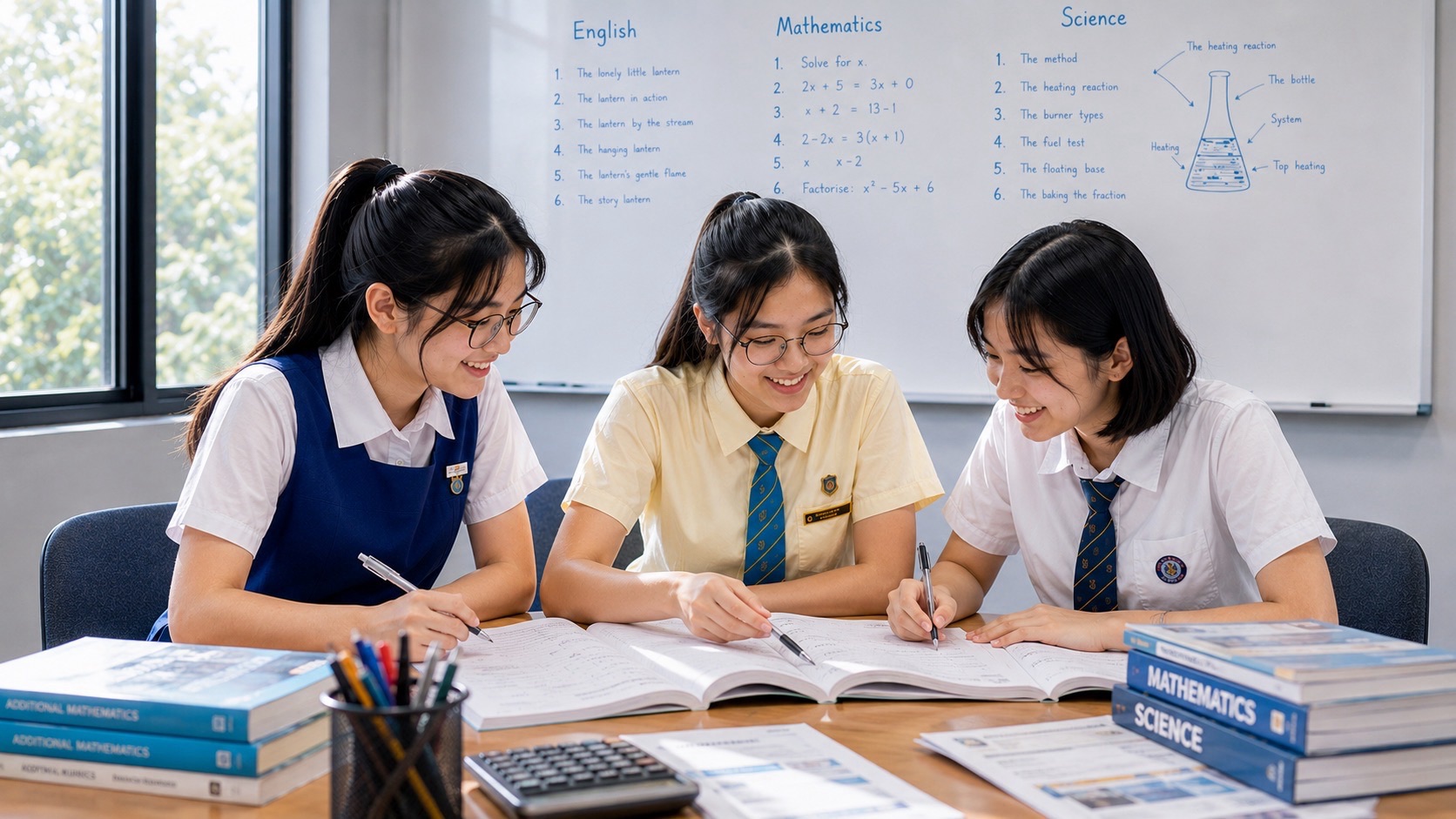
Bukit Timah English Tuition for Pri and Sec is a legacy title, but the learning problem behind the search is current: families comparing English tuition in Bukit Timah, Primary English tuition, Secondary English tuition, small-group English tuition or examination preparation want learners who can move beyond everyday fluency into academic English—reading closely, explaining ideas, organising paragraphs and supporting claims with evidence.
A child can speak English comfortably and still struggle with school English. Academic tasks demand more than conversation. Pupils must understand instructions precisely, follow relationships across paragraphs, interpret tone and implication, distinguish evidence from opinion, and write answers that make the reasoning visible. Those demands begin in Primary school and become much more explicit in Secondary English.
This guide gives this legacy page one distinct job: build the chain read → identify the claim → find evidence → explain the relationship → organise the response → qualify and revise. The goal is not to make a Primary pupil sound like a university essayist. It is to build the academic habits that make Secondary comprehension and writing feel like a progression rather than a sudden change of language.
Everyday English and academic English overlap, but they are not identical
Everyday conversation can rely on shared context.
A speaker can say:
You know what I mean.
Academic writing cannot depend on that assumption.
The reader needs:
- clear nouns;
- explicit relationships;
- relevant evidence;
- logical paragraph order;
- appropriate register.
Primary English already contains academic habits
When a Primary pupil explains why a character behaved in a certain way, they are already practising:
- claim;
- evidence;
- reasoning.
The language is simpler, but the intellectual structure is real.
Secondary English makes the structure more visible
Secondary learners increasingly need to explain:
- tone;
- attitude;
- purpose;
- effect;
- comparison;
- argument.
The student must not only understand the text. They must show how they understand it.
Teach claim, evidence and explanation early
Consider a fictional passage in which a character repeatedly checks the time, refuses help and insists on finishing alone.
A weak answer might say:
He is stubborn.
A stronger answer connects evidence:
He appears stubborn because he repeatedly rejects help and insists on completing the task by himself.
The claim is now supported.
Evidence should be relevant, not merely nearby
A sentence can come from the correct paragraph and still fail to support the answer.
Teach the learner to ask:
- What exactly does this detail prove?
- Does it support my claim?
- Is there stronger evidence?
Evidence quality matters.
Explanation is the bridge
Many pupils can identify a clue but do not explain why it matters.
Use the structure:
evidence → what it shows → why that answers the question.
This simple bridge supports comprehension, oral English and later argumentative writing.
Academic vocabulary is often relational vocabulary
Words such as:
- however;
- therefore;
- consequently;
- in contrast;
- similarly;
- despite;
- whereas;
help readers and writers show relationships between ideas.
They are more useful than collecting rare adjectives without purpose.
Cause and correlation should not be confused
As learners mature, they should notice that two things occurring together does not automatically mean one caused the other.
This habit supports:
- Science reading;
- argument;
- media literacy;
- general reasoning.
English becomes a tool for careful thought.
Paragraph purpose should be explicit
A strong paragraph should do one main job.
That job may be to:
- make a claim;
- give evidence;
- explain a cause;
- present a contrast;
- qualify an earlier point;
- conclude a line of reasoning.
Paragraphs are units of thought, not merely blocks of text.
Primary pupils can learn paragraph logic without jargon overload
Ask:
- What is this paragraph about?
- What does it tell the reader?
- Why does the next paragraph come after it?
This builds the same organisational awareness later used in Secondary writing.
Secondary pupils need stronger paragraph architecture
A useful discursive paragraph may include:
- clear claim;
- explanation;
- specific example;
- link back to the question;
- qualification where appropriate.
The structure should support reasoning, not become a mechanical template.
Summary teaches importance
Ask the learner to reduce a paragraph to one sentence.
Then ask:
- What was essential?
- What could be removed?
- Did the meaning survive?
Summary trains hierarchy of information.
Paraphrasing is a core academic skill
Good paraphrasing requires:
- understanding the original;
- preserving meaning;
- changing expression;
- choosing appropriate vocabulary;
- checking for distortion.
It is not a synonym-replacement game.
Register matters more as pupils mature
Language appropriate for a friend may not suit a teacher, formal email or discursive response.
Teach learners to consider:
- audience;
- purpose;
- relationship;
- level of formality.
Register is a decision, not a list of “fancy” phrases.
Reading across subjects strengthens English
Academic English grows through:
- Science explanations;
- History narratives;
- Geography cause-and-effect texts;
- Mathematics word problems;
- news and informational reading.
English tuition can help pupils recognise how language carries ideas across subjects.
Informational texts deserve regular attention
Do not build English only through stories.
Use age-appropriate informational texts requiring:
- main idea;
- supporting detail;
- cause and effect;
- comparison;
- sequence;
- evaluation of evidence.
This supports later Secondary comprehension.
Teach the difference between fact, inference and opinion
A useful reading routine asks:
- What does the text state?
- What can I reasonably infer?
- What is my own judgement?
These categories should not be blurred.
Argument begins with a defensible claim
A claim should be clear enough to support and limited enough to defend.
Compare:
Technology is bad.
with:
Excessive unsupervised screen use can reduce the time available for sleep, reading and face-to-face interaction.
The second claim is more precise and easier to discuss responsibly.
Examples should do evidence work
An example should illustrate the claim, not merely decorate the paragraph.
Ask:
- What does this example prove?
- Does it really match the claim?
- Is it specific enough?
Examples need a job.
Teach qualification instead of absolute language
Words such as:
- often;
- may;
- can;
- in some cases;
- depending on;
can make a claim more accurate when evidence does not justify certainty.
Careful language is not weakness. It is precision.
Counterarguments should improve reasoning
Older learners can ask:
- What would someone who disagrees say?
- What part of that objection is valid?
- How should my claim be adjusted?
Argument becomes thoughtful rather than combative.
Grammar supports logic
Grammar choices carry relationships.
Because signals cause.
Although signals contrast.
Unless sets a condition.
Therefore signals consequence.
Grammar is part of reasoning.
Sentence structure can control emphasis
Compare:
Although the proposal was popular, it was expensive.
with:
The proposal was expensive, although it was popular.
Both express contrast, but the final position gives different emphasis.
Older learners can begin noticing such choices.
A fictional learner: Alicia understands but cannot explain effect
Alicia recognises that a writer sounds critical.
Her answer says:
The writer is critical because the words are negative.
The tutor asks her to identify the actual words and explain what attitude they create.
Her analysis becomes evidence-based.
A fictional learner: Kai writes strong sentences but weak paragraphs
Kai’s individual sentences are sophisticated.
His paragraph contains three different claims.
The tutor asks:
What is the one job of this paragraph?
Organisation becomes the new target.
A fictional learner: Beatrice overstates every claim
Beatrice writes:
Everyone uses social media badly.
The tutor asks what evidence would justify everyone.
She revises to a more defensible claim.
Language becomes more accurate.
A fictional learner: Denise uses examples without explanation
Denise provides a relevant example but moves immediately to the next point.
The tutor asks:
What does this example show?
She adds the missing reasoning bridge.
Small groups can compare interpretations
Give two plausible readings of the same passage.
Ask:
- Which evidence supports each?
- Which interpretation fits more details?
- What would weaken one reading?
Discussion teaches intellectual flexibility.
Small groups can compare paragraph quality
One paragraph may have a clear claim but weak example.
Another may have excellent detail but no clear point.
Ask pupils to diagnose the difference.
Quality becomes visible.
Independent work should follow every discussion
Group analysis can be excellent.
Then each learner should write a fresh response alone.
Shared insight should become individual competence.
Model answers should be reverse-engineered
Do not simply admire the model.
Ask:
- What claim did it make?
- What evidence did it choose?
- How did it explain the evidence?
- How did it organise the paragraph?
- What could transfer to another topic?
Study the mechanism.
Reading and writing should feed each other
A learner who reads strong paragraphs can notice:
- how claims are introduced;
- how evidence is embedded;
- how contrast is signalled;
- how conclusions are qualified.
Then the learner can practise those moves with original content.
Academic vocabulary should be revisited
Words such as consequence, contrast, significant, relevant, evidence and imply become useful across multiple subjects.
Revisit them in new contexts so they become part of the learner’s working language.
Timing should come after structure
If a pupil does not know how to organise a paragraph, timing simply produces a rushed weak paragraph.
Build:
- clear method;
- accurate execution;
- varied practice;
- then timing.
Speed should compress a reliable process.
A four-week academic-English cycle
Week 1: diagnose
Identify whether the main issue is evidence, explanation, paragraph structure, vocabulary or register.
Week 2: isolate one mechanism
Practise claim-evidence-explanation or paragraph control.
Week 3: vary the text
Use a different genre or topic requiring the same reasoning.
Week 4: remove support
Use fresh reading and writing without the original scaffold.
What progress can look like
- claims become more precise;
- evidence becomes more relevant;
- explanations make the relationship visible;
- paragraphs have clearer jobs;
- register improves;
- absolute claims become better qualified;
- models are needed less often.
These are signs of stronger academic English.
What parents can bring to a tuition discussion
- a recent comprehension;
- a writing sample;
- teacher comments;
- one strong paragraph;
- one answer the learner found difficult.
The tutor can compare reasoning as well as language accuracy.
Questions worth asking an English tutor
- How do you teach evidence-based reading?
- How do you teach paragraph architecture?
- How do Primary pupils prepare naturally for Secondary interpretation?
- How do you teach academic vocabulary without forcing jargon?
- How do you reduce dependence on model answers?
- How do you teach qualification and counterargument at the appropriate age?
The answers should describe a progression in thinking, not simply harder worksheets.
The durable academic-English goal
A learner should increasingly be able to:
- read closely;
- identify claims and evidence;
- explain relationships;
- organise paragraphs;
- choose appropriate register;
- qualify claims;
- revise independently.
That is the language of learning.
About the Bukit Timah wording in this legacy title
The location wording is retained as historical search context. This page does not imply a current Bukit Timah venue or any affiliation with external schools or organisations.
The educational framework applies to learners generally and should be matched to the child’s actual school level and needs.
Continue reading
For a broader Primary-to-Secondary continuity guide, see Yishun English Tuition Centre for Pri and Sec. For the site-wide English route, use the English Tuition & Learning Hub.
Part II · The Primary-to-Secondary English Progression, Translation and Recovery Manual
This extended manual keeps the original page identity intact while deepening its educational job. The governing sequence is Strategy → Defence → Consolidate → Convert → Recover → Metamorphose → Rebuild. Strategy identifies the real learning job. Defence protects what is already strong. Consolidation stabilises high-transfer foundations. Conversion turns understanding into independent action. Recovery repairs the first broken mechanism. Metamorphosis is the point where new habits begin to feel natural. Rebuilding creates a stronger version of the learner rather than simply restoring the old one.
This is also the wider rehabilitation direction of eduKateYishun. Falling marks, weak confidence or a difficult transition are treated as states that can be changed through evidence and design. The learner is not reduced to the result that triggered the search for help. The work is to understand the current system, change the right mechanism, prove transfer and then reduce support.
1. English as one system
Core proposition. Bukit Timah English tuition improves when the learner can see how reading, vocabulary, grammar, writing, oral and listening reinforce one another. A strong programme does not confuse explanation with learning. It makes the decision visible, gives the student a way to practise it, then changes the surface so the learner has to recognise the principle again without being handed the answer.
Common breakdown. A recurring problem is treating each component as a separate tuition product. This is useful evidence. It tells us where the learner’s current system becomes unstable and therefore what should be repaired first. More volume is not automatically more learning if the same mechanism keeps failing.
Diagnostic move. trace how one weak reading habit appears in writing and oral work. Ask the learner to explain what they intended before supplying the correction. The same wrong answer can come from weak knowledge, poor representation, slow recognition, fragile language or weak checking, and each cause requires a different response.
Practice architecture. build weekly links between components. Begin with the smallest version that makes the relationship visible, then add variation, mixed context, delay and reduced prompting. Practice becomes deliberate when the student knows what decision is being trained.
Recovery and rebuilding. Keep the earlier attempt beside the revised one. Name the changed mechanism. The learner should be able to say what was different and why the new process is stronger. This turns improvement into an understandable transformation rather than a mysterious jump in marks.
Transfer. transfer language control across Primary and Secondary. The final test is whether the learner can use the repaired capability under changed conditions without waiting for a tutor to announce which method, rule or framework applies.
2. Primary-to-Secondary transition
Core proposition. Bukit Timah English tuition improves when the learner can see how English becomes more inferential, argumentative and independent. A strong programme does not confuse explanation with learning. It makes the decision visible, gives the student a way to practise it, then changes the surface so the learner has to recognise the principle again without being handed the answer.
Common breakdown. A recurring problem is assuming Primary fluency automatically transfers. This is useful evidence. It tells us where the learner’s current system becomes unstable and therefore what should be repaired first. More volume is not automatically more learning if the same mechanism keeps failing.
Diagnostic move. compare familiar Primary tasks with Secondary demands. Ask the learner to explain what they intended before supplying the correction. The same wrong answer can come from weak knowledge, poor representation, slow recognition, fragile language or weak checking, and each cause requires a different response.
Practice architecture. teach evidence and explanation before workload expands. Begin with the smallest version that makes the relationship visible, then add variation, mixed context, delay and reduced prompting. Practice becomes deliberate when the student knows what decision is being trained.
Recovery and rebuilding. Keep the earlier attempt beside the revised one. Name the changed mechanism. The learner should be able to say what was different and why the new process is stronger. This turns improvement into an understandable transformation rather than a mysterious jump in marks.
Transfer. transfer strong foundations into new genres. The final test is whether the learner can use the repaired capability under changed conditions without waiting for a tutor to announce which method, rule or framework applies.
3. Reading for structure
Core proposition. Bukit Timah English tuition improves when the learner can see how paragraphs organise claims, examples, contrast and cause. A strong programme does not confuse explanation with learning. It makes the decision visible, gives the student a way to practise it, then changes the surface so the learner has to recognise the principle again without being handed the answer.
Common breakdown. A recurring problem is reading sentence by sentence without seeing the whole. This is useful evidence. It tells us where the learner’s current system becomes unstable and therefore what should be repaired first. More volume is not automatically more learning if the same mechanism keeps failing.
Diagnostic move. label paragraph function and turning points. Ask the learner to explain what they intended before supplying the correction. The same wrong answer can come from weak knowledge, poor representation, slow recognition, fragile language or weak checking, and each cause requires a different response.
Practice architecture. reconstruct a passage map from headings or notes. Begin with the smallest version that makes the relationship visible, then add variation, mixed context, delay and reduced prompting. Practice becomes deliberate when the student knows what decision is being trained.
Recovery and rebuilding. Keep the earlier attempt beside the revised one. Name the changed mechanism. The learner should be able to say what was different and why the new process is stronger. This turns improvement into an understandable transformation rather than a mysterious jump in marks.
Transfer. transfer structure into summary and writing. The final test is whether the learner can use the repaired capability under changed conditions without waiting for a tutor to announce which method, rule or framework applies.
4. Inference
Core proposition. Bukit Timah English tuition improves when the learner can see how evidence supports unstated meaning. A strong programme does not confuse explanation with learning. It makes the decision visible, gives the student a way to practise it, then changes the surface so the learner has to recognise the principle again without being handed the answer.
Common breakdown. A recurring problem is guessing from personal experience. This is useful evidence. It tells us where the learner’s current system becomes unstable and therefore what should be repaired first. More volume is not automatically more learning if the same mechanism keeps failing.
Diagnostic move. underline the phrase that justifies the inference. Ask the learner to explain what they intended before supplying the correction. The same wrong answer can come from weak knowledge, poor representation, slow recognition, fragile language or weak checking, and each cause requires a different response.
Practice architecture. compare plausible, weak and overreaching answers. Begin with the smallest version that makes the relationship visible, then add variation, mixed context, delay and reduced prompting. Practice becomes deliberate when the student knows what decision is being trained.
Recovery and rebuilding. Keep the earlier attempt beside the revised one. Name the changed mechanism. The learner should be able to say what was different and why the new process is stronger. This turns improvement into an understandable transformation rather than a mysterious jump in marks.
Transfer. transfer evidence discipline into oral and argument. The final test is whether the learner can use the repaired capability under changed conditions without waiting for a tutor to announce which method, rule or framework applies.
5. Vocabulary in context
Core proposition. Bukit Timah English tuition improves when the learner can see how syntax, collocation and semantic relationships reveal meaning. A strong programme does not confuse explanation with learning. It makes the decision visible, gives the student a way to practise it, then changes the surface so the learner has to recognise the principle again without being handed the answer.
Common breakdown. A recurring problem is using a dictionary meaning that does not fit the sentence. This is useful evidence. It tells us where the learner’s current system becomes unstable and therefore what should be repaired first. More volume is not automatically more learning if the same mechanism keeps failing.
Diagnostic move. identify grammatical role and nearby clues. Ask the learner to explain what they intended before supplying the correction. The same wrong answer can come from weak knowledge, poor representation, slow recognition, fragile language or weak checking, and each cause requires a different response.
Practice architecture. test several candidate meanings. Begin with the smallest version that makes the relationship visible, then add variation, mixed context, delay and reduced prompting. Practice becomes deliberate when the student knows what decision is being trained.
Recovery and rebuilding. Keep the earlier attempt beside the revised one. Name the changed mechanism. The learner should be able to say what was different and why the new process is stronger. This turns improvement into an understandable transformation rather than a mysterious jump in marks.
Transfer. transfer contextual vocabulary into reading. The final test is whether the learner can use the repaired capability under changed conditions without waiting for a tutor to announce which method, rule or framework applies.
6. Academic vocabulary
Core proposition. Bukit Timah English tuition improves when the learner can see how word families and collocations support explanation. A strong programme does not confuse explanation with learning. It makes the decision visible, gives the student a way to practise it, then changes the surface so the learner has to recognise the principle again without being handed the answer.
Common breakdown. A recurring problem is collecting rare words with little usable context. This is useful evidence. It tells us where the learner’s current system becomes unstable and therefore what should be repaired first. More volume is not automatically more learning if the same mechanism keeps failing.
Diagnostic move. organise words by concept, register and common partners. Ask the learner to explain what they intended before supplying the correction. The same wrong answer can come from weak knowledge, poor representation, slow recognition, fragile language or weak checking, and each cause requires a different response.
Practice architecture. use one family in reading, oral and writing. Begin with the smallest version that makes the relationship visible, then add variation, mixed context, delay and reduced prompting. Practice becomes deliberate when the student knows what decision is being trained.
Recovery and rebuilding. Keep the earlier attempt beside the revised one. Name the changed mechanism. The learner should be able to say what was different and why the new process is stronger. This turns improvement into an understandable transformation rather than a mysterious jump in marks.
Transfer. transfer vocabulary into thought. The final test is whether the learner can use the repaired capability under changed conditions without waiting for a tutor to announce which method, rule or framework applies.
7. Grammar as meaning
Core proposition. Bukit Timah English tuition improves when the learner can see how tense, agreement, reference and clause structure carry relationships. A strong programme does not confuse explanation with learning. It makes the decision visible, gives the student a way to practise it, then changes the surface so the learner has to recognise the principle again without being handed the answer.
Common breakdown. A recurring problem is memorising rules without seeing their communicative job. This is useful evidence. It tells us where the learner’s current system becomes unstable and therefore what should be repaired first. More volume is not automatically more learning if the same mechanism keeps failing.
Diagnostic move. ask what time, number or reference the form expresses. Ask the learner to explain what they intended before supplying the correction. The same wrong answer can come from weak knowledge, poor representation, slow recognition, fragile language or weak checking, and each cause requires a different response.
Practice architecture. edit by category. Begin with the smallest version that makes the relationship visible, then add variation, mixed context, delay and reduced prompting. Practice becomes deliberate when the student knows what decision is being trained.
Recovery and rebuilding. Keep the earlier attempt beside the revised one. Name the changed mechanism. The learner should be able to say what was different and why the new process is stronger. This turns improvement into an understandable transformation rather than a mysterious jump in marks.
Transfer. transfer grammar into composition. The final test is whether the learner can use the repaired capability under changed conditions without waiting for a tutor to announce which method, rule or framework applies.
8. Sentence architecture
Core proposition. Bukit Timah English tuition improves when the learner can see how clauses create emphasis and clarity. A strong programme does not confuse explanation with learning. It makes the decision visible, gives the student a way to practise it, then changes the surface so the learner has to recognise the principle again without being handed the answer.
Common breakdown. A recurring problem is writing long sentences because they sound advanced. This is useful evidence. It tells us where the learner’s current system becomes unstable and therefore what should be repaired first. More volume is not automatically more learning if the same mechanism keeps failing.
Diagnostic move. identify the main clause and intended emphasis. Ask the learner to explain what they intended before supplying the correction. The same wrong answer can come from weak knowledge, poor representation, slow recognition, fragile language or weak checking, and each cause requires a different response.
Practice architecture. combine and split deliberately. Begin with the smallest version that makes the relationship visible, then add variation, mixed context, delay and reduced prompting. Practice becomes deliberate when the student knows what decision is being trained.
Recovery and rebuilding. Keep the earlier attempt beside the revised one. Name the changed mechanism. The learner should be able to say what was different and why the new process is stronger. This turns improvement into an understandable transformation rather than a mysterious jump in marks.
Transfer. transfer sentence control into editing. The final test is whether the learner can use the repaired capability under changed conditions without waiting for a tutor to announce which method, rule or framework applies.
9. Paragraph purpose
Core proposition. Bukit Timah English tuition improves when the learner can see how each paragraph changes what the reader understands. A strong programme does not confuse explanation with learning. It makes the decision visible, gives the student a way to practise it, then changes the surface so the learner has to recognise the principle again without being handed the answer.
Common breakdown. A recurring problem is repeating the same idea in new wording. This is useful evidence. It tells us where the learner’s current system becomes unstable and therefore what should be repaired first. More volume is not automatically more learning if the same mechanism keeps failing.
Diagnostic move. label the job of each paragraph in the margin. Ask the learner to explain what they intended before supplying the correction. The same wrong answer can come from weak knowledge, poor representation, slow recognition, fragile language or weak checking, and each cause requires a different response.
Practice architecture. reorder scrambled paragraphs. Begin with the smallest version that makes the relationship visible, then add variation, mixed context, delay and reduced prompting. Practice becomes deliberate when the student knows what decision is being trained.
Recovery and rebuilding. Keep the earlier attempt beside the revised one. Name the changed mechanism. The learner should be able to say what was different and why the new process is stronger. This turns improvement into an understandable transformation rather than a mysterious jump in marks.
Transfer. transfer paragraph control into essays. The final test is whether the learner can use the repaired capability under changed conditions without waiting for a tutor to announce which method, rule or framework applies.
10. Narrative writing
Core proposition. Bukit Timah English tuition improves when the learner can see how cause, choice and consequence create story movement. A strong programme does not confuse explanation with learning. It makes the decision visible, gives the student a way to practise it, then changes the surface so the learner has to recognise the principle again without being handed the answer.
Common breakdown. A recurring problem is stacking events without a causal spine. This is useful evidence. It tells us where the learner’s current system becomes unstable and therefore what should be repaired first. More volume is not automatically more learning if the same mechanism keeps failing.
Diagnostic move. map what changes because of each paragraph. Ask the learner to explain what they intended before supplying the correction. The same wrong answer can come from weak knowledge, poor representation, slow recognition, fragile language or weak checking, and each cause requires a different response.
Practice architecture. rewrite coincidence as consequence. Begin with the smallest version that makes the relationship visible, then add variation, mixed context, delay and reduced prompting. Practice becomes deliberate when the student knows what decision is being trained.
Recovery and rebuilding. Keep the earlier attempt beside the revised one. Name the changed mechanism. The learner should be able to say what was different and why the new process is stronger. This turns improvement into an understandable transformation rather than a mysterious jump in marks.
Transfer. transfer story logic into reflection. The final test is whether the learner can use the repaired capability under changed conditions without waiting for a tutor to announce which method, rule or framework applies.
11. Expository writing
Core proposition. Bukit Timah English tuition improves when the learner can see how explanation moves from point to reason to example and implication. A strong programme does not confuse explanation with learning. It makes the decision visible, gives the student a way to practise it, then changes the surface so the learner has to recognise the principle again without being handed the answer.
Common breakdown. A recurring problem is listing information without connection. This is useful evidence. It tells us where the learner’s current system becomes unstable and therefore what should be repaired first. More volume is not automatically more learning if the same mechanism keeps failing.
Diagnostic move. use a claim-reason-example-so-what skeleton. Ask the learner to explain what they intended before supplying the correction. The same wrong answer can come from weak knowledge, poor representation, slow recognition, fragile language or weak checking, and each cause requires a different response.
Practice architecture. revise for logical links. Begin with the smallest version that makes the relationship visible, then add variation, mixed context, delay and reduced prompting. Practice becomes deliberate when the student knows what decision is being trained.
Recovery and rebuilding. Keep the earlier attempt beside the revised one. Name the changed mechanism. The learner should be able to say what was different and why the new process is stronger. This turns improvement into an understandable transformation rather than a mysterious jump in marks.
Transfer. transfer explanation into oral. The final test is whether the learner can use the repaired capability under changed conditions without waiting for a tutor to announce which method, rule or framework applies.
12. Argumentative writing
Core proposition. Bukit Timah English tuition improves when the learner can see how claims survive challenge through evidence and qualification. A strong programme does not confuse explanation with learning. It makes the decision visible, gives the student a way to practise it, then changes the surface so the learner has to recognise the principle again without being handed the answer.
Common breakdown. A recurring problem is stating opinions as conclusions. This is useful evidence. It tells us where the learner’s current system becomes unstable and therefore what should be repaired first. More volume is not automatically more learning if the same mechanism keeps failing.
Diagnostic move. build counterargument before final judgement. Ask the learner to explain what they intended before supplying the correction. The same wrong answer can come from weak knowledge, poor representation, slow recognition, fragile language or weak checking, and each cause requires a different response.
Practice architecture. compare evidence quality. Begin with the smallest version that makes the relationship visible, then add variation, mixed context, delay and reduced prompting. Practice becomes deliberate when the student knows what decision is being trained.
Recovery and rebuilding. Keep the earlier attempt beside the revised one. Name the changed mechanism. The learner should be able to say what was different and why the new process is stronger. This turns improvement into an understandable transformation rather than a mysterious jump in marks.
Transfer. transfer critical reasoning into discussion. The final test is whether the learner can use the repaired capability under changed conditions without waiting for a tutor to announce which method, rule or framework applies.
13. Situational writing
Core proposition. Bukit Timah English tuition improves when the learner can see how audience and purpose shape content and tone. A strong programme does not confuse explanation with learning. It makes the decision visible, gives the student a way to practise it, then changes the surface so the learner has to recognise the principle again without being handed the answer.
Common breakdown. A recurring problem is writing the same way for every reader. This is useful evidence. It tells us where the learner’s current system becomes unstable and therefore what should be repaired first. More volume is not automatically more learning if the same mechanism keeps failing.
Diagnostic move. identify role, reader, purpose and required action. Ask the learner to explain what they intended before supplying the correction. The same wrong answer can come from weak knowledge, poor representation, slow recognition, fragile language or weak checking, and each cause requires a different response.
Practice architecture. rewrite one message for several audiences. Begin with the smallest version that makes the relationship visible, then add variation, mixed context, delay and reduced prompting. Practice becomes deliberate when the student knows what decision is being trained.
Recovery and rebuilding. Keep the earlier attempt beside the revised one. Name the changed mechanism. The learner should be able to say what was different and why the new process is stronger. This turns improvement into an understandable transformation rather than a mysterious jump in marks.
Transfer. transfer register control into real communication. The final test is whether the learner can use the repaired capability under changed conditions without waiting for a tutor to announce which method, rule or framework applies.
14. Summary
Core proposition. Bukit Timah English tuition improves when the learner can see how essential ideas can be compressed without distortion. A strong programme does not confuse explanation with learning. It makes the decision visible, gives the student a way to practise it, then changes the surface so the learner has to recognise the principle again without being handed the answer.
Common breakdown. A recurring problem is copying too much or deleting relationships. This is useful evidence. It tells us where the learner’s current system becomes unstable and therefore what should be repaired first. More volume is not automatically more learning if the same mechanism keeps failing.
Diagnostic move. identify idea units before shortening. Ask the learner to explain what they intended before supplying the correction. The same wrong answer can come from weak knowledge, poor representation, slow recognition, fragile language or weak checking, and each cause requires a different response.
Practice architecture. compress in stages. Begin with the smallest version that makes the relationship visible, then add variation, mixed context, delay and reduced prompting. Practice becomes deliberate when the student knows what decision is being trained.
Recovery and rebuilding. Keep the earlier attempt beside the revised one. Name the changed mechanism. The learner should be able to say what was different and why the new process is stronger. This turns improvement into an understandable transformation rather than a mysterious jump in marks.
Transfer. transfer economy into writing. The final test is whether the learner can use the repaired capability under changed conditions without waiting for a tutor to announce which method, rule or framework applies.
15. Editing
Core proposition. Bukit Timah English tuition improves when the learner can see how recurring error families can be diagnosed and reduced. A strong programme does not confuse explanation with learning. It makes the decision visible, gives the student a way to practise it, then changes the surface so the learner has to recognise the principle again without being handed the answer.
Common breakdown. A recurring problem is correcting only after the tutor points to the exact word. This is useful evidence. It tells us where the learner’s current system becomes unstable and therefore what should be repaired first. More volume is not automatically more learning if the same mechanism keeps failing.
Diagnostic move. classify tense, agreement, pronoun, word form, punctuation and logic. Ask the learner to explain what they intended before supplying the correction. The same wrong answer can come from weak knowledge, poor representation, slow recognition, fragile language or weak checking, and each cause requires a different response.
Practice architecture. fade cues over time. Begin with the smallest version that makes the relationship visible, then add variation, mixed context, delay and reduced prompting. Practice becomes deliberate when the student knows what decision is being trained.
Recovery and rebuilding. Keep the earlier attempt beside the revised one. Name the changed mechanism. The learner should be able to say what was different and why the new process is stronger. This turns improvement into an understandable transformation rather than a mysterious jump in marks.
Transfer. transfer self-editing into examination work. The final test is whether the learner can use the repaired capability under changed conditions without waiting for a tutor to announce which method, rule or framework applies.
16. Oral communication
Core proposition. Bukit Timah English tuition improves when the learner can see how spoken reasoning uses position, reason, example and reflection. A strong programme does not confuse explanation with learning. It makes the decision visible, gives the student a way to practise it, then changes the surface so the learner has to recognise the principle again without being handed the answer.
Common breakdown. A recurring problem is giving one-sentence opinions or long anecdotes without a point. This is useful evidence. It tells us where the learner’s current system becomes unstable and therefore what should be repaired first. More volume is not automatically more learning if the same mechanism keeps failing.
Diagnostic move. use a four-part spoken structure. Ask the learner to explain what they intended before supplying the correction. The same wrong answer can come from weak knowledge, poor representation, slow recognition, fragile language or weak checking, and each cause requires a different response.
Practice architecture. practise several time lengths. Begin with the smallest version that makes the relationship visible, then add variation, mixed context, delay and reduced prompting. Practice becomes deliberate when the student knows what decision is being trained.
Recovery and rebuilding. Keep the earlier attempt beside the revised one. Name the changed mechanism. The learner should be able to say what was different and why the new process is stronger. This turns improvement into an understandable transformation rather than a mysterious jump in marks.
Transfer. transfer oral organisation into writing. The final test is whether the learner can use the repaired capability under changed conditions without waiting for a tutor to announce which method, rule or framework applies.
17. Listening
Core proposition. Bukit Timah English tuition improves when the learner can see how meaning is built through sequence, contrast and intention. A strong programme does not confuse explanation with learning. It makes the decision visible, gives the student a way to practise it, then changes the surface so the learner has to recognise the principle again without being handed the answer.
Common breakdown. A recurring problem is trying to remember every word. This is useful evidence. It tells us where the learner’s current system becomes unstable and therefore what should be repaired first. More volume is not automatically more learning if the same mechanism keeps failing.
Diagnostic move. note turning points and relationships. Ask the learner to explain what they intended before supplying the correction. The same wrong answer can come from weak knowledge, poor representation, slow recognition, fragile language or weak checking, and each cause requires a different response.
Practice architecture. reconstruct the message from key connectors. Begin with the smallest version that makes the relationship visible, then add variation, mixed context, delay and reduced prompting. Practice becomes deliberate when the student knows what decision is being trained.
Recovery and rebuilding. Keep the earlier attempt beside the revised one. Name the changed mechanism. The learner should be able to say what was different and why the new process is stronger. This turns improvement into an understandable transformation rather than a mysterious jump in marks.
Transfer. transfer listening structure into note-taking. The final test is whether the learner can use the repaired capability under changed conditions without waiting for a tutor to announce which method, rule or framework applies.
18. Translation
Core proposition. Bukit Timah English tuition improves when the learner can see how meaning can move across form, register and language. A strong programme does not confuse explanation with learning. It makes the decision visible, gives the student a way to practise it, then changes the surface so the learner has to recognise the principle again without being handed the answer.
Common breakdown. A recurring problem is translating word by word and losing intent. This is useful evidence. It tells us where the learner’s current system becomes unstable and therefore what should be repaired first. More volume is not automatically more learning if the same mechanism keeps failing.
Diagnostic move. identify proposition, tone and audience first. Ask the learner to explain what they intended before supplying the correction. The same wrong answer can come from weak knowledge, poor representation, slow recognition, fragile language or weak checking, and each cause requires a different response.
Practice architecture. rewrite informal into formal and back again. Begin with the smallest version that makes the relationship visible, then add variation, mixed context, delay and reduced prompting. Practice becomes deliberate when the student knows what decision is being trained.
Recovery and rebuilding. Keep the earlier attempt beside the revised one. Name the changed mechanism. The learner should be able to say what was different and why the new process is stronger. This turns improvement into an understandable transformation rather than a mysterious jump in marks.
Transfer. transfer deep comprehension into communication. The final test is whether the learner can use the repaired capability under changed conditions without waiting for a tutor to announce which method, rule or framework applies.
19. Recovery after falling marks
Core proposition. Bukit Timah English tuition improves when the learner can see how a weak result becomes a component map. A strong programme does not confuse explanation with learning. It makes the decision visible, gives the student a way to practise it, then changes the surface so the learner has to recognise the principle again without being handed the answer.
Common breakdown. A recurring problem is doing more of every component. This is useful evidence. It tells us where the learner’s current system becomes unstable and therefore what should be repaired first. More volume is not automatically more learning if the same mechanism keeps failing.
Diagnostic move. separate reading, vocabulary, grammar, writing, oral and timing losses. Ask the learner to explain what they intended before supplying the correction. The same wrong answer can come from weak knowledge, poor representation, slow recognition, fragile language or weak checking, and each cause requires a different response.
Practice architecture. repair the highest-cost mechanism first. Begin with the smallest version that makes the relationship visible, then add variation, mixed context, delay and reduced prompting. Practice becomes deliberate when the student knows what decision is being trained.
Recovery and rebuilding. Keep the earlier attempt beside the revised one. Name the changed mechanism. The learner should be able to say what was different and why the new process is stronger. This turns improvement into an understandable transformation rather than a mysterious jump in marks.
Transfer. turn the fall into a bounded plan. The final test is whether the learner can use the repaired capability under changed conditions without waiting for a tutor to announce which method, rule or framework applies.
20. Independent editorial judgement
Core proposition. Bukit Timah English tuition improves when the learner can see how the learner becomes their own first reader and editor. A strong programme does not confuse explanation with learning. It makes the decision visible, gives the student a way to practise it, then changes the surface so the learner has to recognise the principle again without being handed the answer.
Common breakdown. A recurring problem is waiting for a model answer. This is useful evidence. It tells us where the learner’s current system becomes unstable and therefore what should be repaired first. More volume is not automatically more learning if the same mechanism keeps failing.
Diagnostic move. use a self-review sequence for meaning, evidence, structure, language and task fit. Ask the learner to explain what they intended before supplying the correction. The same wrong answer can come from weak knowledge, poor representation, slow recognition, fragile language or weak checking, and each cause requires a different response.
Practice architecture. fade comments from detailed to category cue to silence. Begin with the smallest version that makes the relationship visible, then add variation, mixed context, delay and reduced prompting. Practice becomes deliberate when the student knows what decision is being trained.
Recovery and rebuilding. Keep the earlier attempt beside the revised one. Name the changed mechanism. The learner should be able to say what was different and why the new process is stronger. This turns improvement into an understandable transformation rather than a mysterious jump in marks.
Transfer. make revision ownership the final goal. The final test is whether the learner can use the repaired capability under changed conditions without waiting for a tutor to announce which method, rule or framework applies.
Practice Bank · Transfer laboratories
These laboratories are designed for small-group tutorials, independent practice and parent-visible progress checks. Each one moves through attempt, diagnosis, repair, changed context and delayed retesting so the learner has to reconstruct the principle rather than remember the page.
Application Lab 1: literal versus inferential reading
Start with a cold attempt. Ask the learner to identify the task, the available evidence or quantities, and the first defensible move before receiving any hint. After the first attempt, diagnose the earliest weak link and repair only that mechanism. Then create a fresh version by changing the surface while preserving the underlying structure.
Finish with a transfer check after the original model is hidden. The learner should explain the choice, complete the task and perform an appropriate check. If the improvement disappears, return to the mechanism rather than adding more unrelated practice. The aim is durable independence.
Application Lab 2: paragraph mapping
Start with a cold attempt. Ask the learner to identify the task, the available evidence or quantities, and the first defensible move before receiving any hint. After the first attempt, diagnose the earliest weak link and repair only that mechanism. Then create a fresh version by changing the surface while preserving the underlying structure.
Finish with a transfer check after the original model is hidden. The learner should explain the choice, complete the task and perform an appropriate check. If the improvement disappears, return to the mechanism rather than adding more unrelated practice. The aim is durable independence.
Application Lab 3: vocabulary from context
Start with a cold attempt. Ask the learner to identify the task, the available evidence or quantities, and the first defensible move before receiving any hint. After the first attempt, diagnose the earliest weak link and repair only that mechanism. Then create a fresh version by changing the surface while preserving the underlying structure.
Finish with a transfer check after the original model is hidden. The learner should explain the choice, complete the task and perform an appropriate check. If the improvement disappears, return to the mechanism rather than adding more unrelated practice. The aim is durable independence.
Application Lab 4: building a word family
Start with a cold attempt. Ask the learner to identify the task, the available evidence or quantities, and the first defensible move before receiving any hint. After the first attempt, diagnose the earliest weak link and repair only that mechanism. Then create a fresh version by changing the surface while preserving the underlying structure.
Finish with a transfer check after the original model is hidden. The learner should explain the choice, complete the task and perform an appropriate check. If the improvement disappears, return to the mechanism rather than adding more unrelated practice. The aim is durable independence.
Application Lab 5: editing tense consistency
Start with a cold attempt. Ask the learner to identify the task, the available evidence or quantities, and the first defensible move before receiving any hint. After the first attempt, diagnose the earliest weak link and repair only that mechanism. Then create a fresh version by changing the surface while preserving the underlying structure.
Finish with a transfer check after the original model is hidden. The learner should explain the choice, complete the task and perform an appropriate check. If the improvement disappears, return to the mechanism rather than adding more unrelated practice. The aim is durable independence.
Application Lab 6: repairing pronoun reference
Start with a cold attempt. Ask the learner to identify the task, the available evidence or quantities, and the first defensible move before receiving any hint. After the first attempt, diagnose the earliest weak link and repair only that mechanism. Then create a fresh version by changing the surface while preserving the underlying structure.
Finish with a transfer check after the original model is hidden. The learner should explain the choice, complete the task and perform an appropriate check. If the improvement disappears, return to the mechanism rather than adding more unrelated practice. The aim is durable independence.
Application Lab 7: splitting an overloaded sentence
Start with a cold attempt. Ask the learner to identify the task, the available evidence or quantities, and the first defensible move before receiving any hint. After the first attempt, diagnose the earliest weak link and repair only that mechanism. Then create a fresh version by changing the surface while preserving the underlying structure.
Finish with a transfer check after the original model is hidden. The learner should explain the choice, complete the task and perform an appropriate check. If the improvement disappears, return to the mechanism rather than adding more unrelated practice. The aim is durable independence.
Application Lab 8: combining choppy sentences
Start with a cold attempt. Ask the learner to identify the task, the available evidence or quantities, and the first defensible move before receiving any hint. After the first attempt, diagnose the earliest weak link and repair only that mechanism. Then create a fresh version by changing the surface while preserving the underlying structure.
Finish with a transfer check after the original model is hidden. The learner should explain the choice, complete the task and perform an appropriate check. If the improvement disappears, return to the mechanism rather than adding more unrelated practice. The aim is durable independence.
Application Lab 9: labelling paragraph purpose
Start with a cold attempt. Ask the learner to identify the task, the available evidence or quantities, and the first defensible move before receiving any hint. After the first attempt, diagnose the earliest weak link and repair only that mechanism. Then create a fresh version by changing the surface while preserving the underlying structure.
Finish with a transfer check after the original model is hidden. The learner should explain the choice, complete the task and perform an appropriate check. If the improvement disappears, return to the mechanism rather than adding more unrelated practice. The aim is durable independence.
Application Lab 10: building a causal story spine
Start with a cold attempt. Ask the learner to identify the task, the available evidence or quantities, and the first defensible move before receiving any hint. After the first attempt, diagnose the earliest weak link and repair only that mechanism. Then create a fresh version by changing the surface while preserving the underlying structure.
Finish with a transfer check after the original model is hidden. The learner should explain the choice, complete the task and perform an appropriate check. If the improvement disappears, return to the mechanism rather than adding more unrelated practice. The aim is durable independence.
Application Lab 11: writing an explanatory paragraph
Start with a cold attempt. Ask the learner to identify the task, the available evidence or quantities, and the first defensible move before receiving any hint. After the first attempt, diagnose the earliest weak link and repair only that mechanism. Then create a fresh version by changing the surface while preserving the underlying structure.
Finish with a transfer check after the original model is hidden. The learner should explain the choice, complete the task and perform an appropriate check. If the improvement disappears, return to the mechanism rather than adding more unrelated practice. The aim is durable independence.
Application Lab 12: constructing a counterargument
Start with a cold attempt. Ask the learner to identify the task, the available evidence or quantities, and the first defensible move before receiving any hint. After the first attempt, diagnose the earliest weak link and repair only that mechanism. Then create a fresh version by changing the surface while preserving the underlying structure.
Finish with a transfer check after the original model is hidden. The learner should explain the choice, complete the task and perform an appropriate check. If the improvement disappears, return to the mechanism rather than adding more unrelated practice. The aim is durable independence.
Application Lab 13: rewriting for a formal audience
Start with a cold attempt. Ask the learner to identify the task, the available evidence or quantities, and the first defensible move before receiving any hint. After the first attempt, diagnose the earliest weak link and repair only that mechanism. Then create a fresh version by changing the surface while preserving the underlying structure.
Finish with a transfer check after the original model is hidden. The learner should explain the choice, complete the task and perform an appropriate check. If the improvement disappears, return to the mechanism rather than adding more unrelated practice. The aim is durable independence.
Application Lab 14: compressing a summary
Start with a cold attempt. Ask the learner to identify the task, the available evidence or quantities, and the first defensible move before receiving any hint. After the first attempt, diagnose the earliest weak link and repair only that mechanism. Then create a fresh version by changing the surface while preserving the underlying structure.
Finish with a transfer check after the original model is hidden. The learner should explain the choice, complete the task and perform an appropriate check. If the improvement disappears, return to the mechanism rather than adding more unrelated practice. The aim is durable independence.
Application Lab 15: self-editing by category
Start with a cold attempt. Ask the learner to identify the task, the available evidence or quantities, and the first defensible move before receiving any hint. After the first attempt, diagnose the earliest weak link and repair only that mechanism. Then create a fresh version by changing the surface while preserving the underlying structure.
Finish with a transfer check after the original model is hidden. The learner should explain the choice, complete the task and perform an appropriate check. If the improvement disappears, return to the mechanism rather than adding more unrelated practice. The aim is durable independence.
Application Lab 16: one-minute oral response
Start with a cold attempt. Ask the learner to identify the task, the available evidence or quantities, and the first defensible move before receiving any hint. After the first attempt, diagnose the earliest weak link and repair only that mechanism. Then create a fresh version by changing the surface while preserving the underlying structure.
Finish with a transfer check after the original model is hidden. The learner should explain the choice, complete the task and perform an appropriate check. If the improvement disappears, return to the mechanism rather than adding more unrelated practice. The aim is durable independence.
Application Lab 17: listening for contrast
Start with a cold attempt. Ask the learner to identify the task, the available evidence or quantities, and the first defensible move before receiving any hint. After the first attempt, diagnose the earliest weak link and repair only that mechanism. Then create a fresh version by changing the surface while preserving the underlying structure.
Finish with a transfer check after the original model is hidden. The learner should explain the choice, complete the task and perform an appropriate check. If the improvement disappears, return to the mechanism rather than adding more unrelated practice. The aim is durable independence.
Application Lab 18: informal-to-formal translation
Start with a cold attempt. Ask the learner to identify the task, the available evidence or quantities, and the first defensible move before receiving any hint. After the first attempt, diagnose the earliest weak link and repair only that mechanism. Then create a fresh version by changing the surface while preserving the underlying structure.
Finish with a transfer check after the original model is hidden. The learner should explain the choice, complete the task and perform an appropriate check. If the improvement disappears, return to the mechanism rather than adding more unrelated practice. The aim is durable independence.
Application Lab 19: diagnosing a weak English paper
Start with a cold attempt. Ask the learner to identify the task, the available evidence or quantities, and the first defensible move before receiving any hint. After the first attempt, diagnose the earliest weak link and repair only that mechanism. Then create a fresh version by changing the surface while preserving the underlying structure.
Finish with a transfer check after the original model is hidden. The learner should explain the choice, complete the task and perform an appropriate check. If the improvement disappears, return to the mechanism rather than adding more unrelated practice. The aim is durable independence.
Application Lab 20: revising after a delayed retest
Start with a cold attempt. Ask the learner to identify the task, the available evidence or quantities, and the first defensible move before receiving any hint. After the first attempt, diagnose the earliest weak link and repair only that mechanism. Then create a fresh version by changing the surface while preserving the underlying structure.
Finish with a transfer check after the original model is hidden. The learner should explain the choice, complete the task and perform an appropriate check. If the improvement disappears, return to the mechanism rather than adding more unrelated practice. The aim is durable independence.
Application Lab 21: cross-component vocabulary transfer
Start with a cold attempt. Ask the learner to identify the task, the available evidence or quantities, and the first defensible move before receiving any hint. After the first attempt, diagnose the earliest weak link and repair only that mechanism. Then create a fresh version by changing the surface while preserving the underlying structure.
Finish with a transfer check after the original model is hidden. The learner should explain the choice, complete the task and perform an appropriate check. If the improvement disappears, return to the mechanism rather than adding more unrelated practice. The aim is durable independence.
Application Lab 22: independent editorial review
Start with a cold attempt. Ask the learner to identify the task, the available evidence or quantities, and the first defensible move before receiving any hint. After the first attempt, diagnose the earliest weak link and repair only that mechanism. Then create a fresh version by changing the surface while preserving the underlying structure.
Finish with a transfer check after the original model is hidden. The learner should explain the choice, complete the task and perform an appropriate check. If the improvement disappears, return to the mechanism rather than adding more unrelated practice. The aim is durable independence.
The English progression and recovery architecture
Bukit Timah English Tuition for Pri and Sec now functions as a complete progression manual: Primary English builds vocabulary, reading, grammar and organised expression; Secondary English asks for more independent interpretation, argument, register and editorial control. The system is continuous even when the examination components change.
When performance falls, the learner does not need a new identity. The programme protects secure strengths, identifies the specific language mechanism that has failed, rebuilds it, tests it in another form and then reduces support. That process helps turn tuition from supervised practice into durable language ownership.
Independent reconstruction audit 1
Select one old piece of work and hide every correction. Reconstruct the task from first principles. State what the learner is being asked to do, identify the key relationship or evidence, choose a representation or structure, complete the task and explain one suitable check. Then create a fresh version with the same underlying mechanism and attempt it after a delay. Compare the old and new processes and name the exact change. This audit turns revision into a portable learning habit rather than a memory of one model answer.
Independent reconstruction audit 2
Select one old piece of work and hide every correction. Reconstruct the task from first principles. State what the learner is being asked to do, identify the key relationship or evidence, choose a representation or structure, complete the task and explain one suitable check. Then create a fresh version with the same underlying mechanism and attempt it after a delay. Compare the old and new processes and name the exact change. This audit turns revision into a portable learning habit rather than a memory of one model answer.
Independent reconstruction audit 3
Select one old piece of work and hide every correction. Reconstruct the task from first principles. State what the learner is being asked to do, identify the key relationship or evidence, choose a representation or structure, complete the task and explain one suitable check. Then create a fresh version with the same underlying mechanism and attempt it after a delay. Compare the old and new processes and name the exact change. This audit turns revision into a portable learning habit rather than a memory of one model answer.
Independent reconstruction audit 4
Select one old piece of work and hide every correction. Reconstruct the task from first principles. State what the learner is being asked to do, identify the key relationship or evidence, choose a representation or structure, complete the task and explain one suitable check. Then create a fresh version with the same underlying mechanism and attempt it after a delay. Compare the old and new processes and name the exact change. This audit turns revision into a portable learning habit rather than a memory of one model answer.
Independent reconstruction audit 5
Select one old piece of work and hide every correction. Reconstruct the task from first principles. State what the learner is being asked to do, identify the key relationship or evidence, choose a representation or structure, complete the task and explain one suitable check. Then create a fresh version with the same underlying mechanism and attempt it after a delay. Compare the old and new processes and name the exact change. This audit turns revision into a portable learning habit rather than a memory of one model answer.
Independent reconstruction audit 6
Select one old piece of work and hide every correction. Reconstruct the task from first principles. State what the learner is being asked to do, identify the key relationship or evidence, choose a representation or structure, complete the task and explain one suitable check. Then create a fresh version with the same underlying mechanism and attempt it after a delay. Compare the old and new processes and name the exact change. This audit turns revision into a portable learning habit rather than a memory of one model answer.
Independent reconstruction audit 7
Select one old piece of work and hide every correction. Reconstruct the task from first principles. State what the learner is being asked to do, identify the key relationship or evidence, choose a representation or structure, complete the task and explain one suitable check. Then create a fresh version with the same underlying mechanism and attempt it after a delay. Compare the old and new processes and name the exact change. This audit turns revision into a portable learning habit rather than a memory of one model answer.
Independent reconstruction audit 8
Select one old piece of work and hide every correction. Reconstruct the task from first principles. State what the learner is being asked to do, identify the key relationship or evidence, choose a representation or structure, complete the task and explain one suitable check. Then create a fresh version with the same underlying mechanism and attempt it after a delay. Compare the old and new processes and name the exact change. This audit turns revision into a portable learning habit rather than a memory of one model answer.
Independent reconstruction audit 9
Select one old piece of work and hide every correction. Reconstruct the task from first principles. State what the learner is being asked to do, identify the key relationship or evidence, choose a representation or structure, complete the task and explain one suitable check. Then create a fresh version with the same underlying mechanism and attempt it after a delay. Compare the old and new processes and name the exact change. This audit turns revision into a portable learning habit rather than a memory of one model answer.
Independent reconstruction audit 10
Select one old piece of work and hide every correction. Reconstruct the task from first principles. State what the learner is being asked to do, identify the key relationship or evidence, choose a representation or structure, complete the task and explain one suitable check. Then create a fresh version with the same underlying mechanism and attempt it after a delay. Compare the old and new processes and name the exact change. This audit turns revision into a portable learning habit rather than a memory of one model answer.
Independent reconstruction audit 11
Select one old piece of work and hide every correction. Reconstruct the task from first principles. State what the learner is being asked to do, identify the key relationship or evidence, choose a representation or structure, complete the task and explain one suitable check. Then create a fresh version with the same underlying mechanism and attempt it after a delay. Compare the old and new processes and name the exact change. This audit turns revision into a portable learning habit rather than a memory of one model answer.
Independent reconstruction audit 12
Select one old piece of work and hide every correction. Reconstruct the task from first principles. State what the learner is being asked to do, identify the key relationship or evidence, choose a representation or structure, complete the task and explain one suitable check. Then create a fresh version with the same underlying mechanism and attempt it after a delay. Compare the old and new processes and name the exact change. This audit turns revision into a portable learning habit rather than a memory of one model answer.
Independent reconstruction audit 13
Select one old piece of work and hide every correction. Reconstruct the task from first principles. State what the learner is being asked to do, identify the key relationship or evidence, choose a representation or structure, complete the task and explain one suitable check. Then create a fresh version with the same underlying mechanism and attempt it after a delay. Compare the old and new processes and name the exact change. This audit turns revision into a portable learning habit rather than a memory of one model answer.
Independent reconstruction audit 14
Select one old piece of work and hide every correction. Reconstruct the task from first principles. State what the learner is being asked to do, identify the key relationship or evidence, choose a representation or structure, complete the task and explain one suitable check. Then create a fresh version with the same underlying mechanism and attempt it after a delay. Compare the old and new processes and name the exact change. This audit turns revision into a portable learning habit rather than a memory of one model answer.
Independent reconstruction audit 15
Select one old piece of work and hide every correction. Reconstruct the task from first principles. State what the learner is being asked to do, identify the key relationship or evidence, choose a representation or structure, complete the task and explain one suitable check. Then create a fresh version with the same underlying mechanism and attempt it after a delay. Compare the old and new processes and name the exact change. This audit turns revision into a portable learning habit rather than a memory of one model answer.
Independent reconstruction audit 16
Select one old piece of work and hide every correction. Reconstruct the task from first principles. State what the learner is being asked to do, identify the key relationship or evidence, choose a representation or structure, complete the task and explain one suitable check. Then create a fresh version with the same underlying mechanism and attempt it after a delay. Compare the old and new processes and name the exact change. This audit turns revision into a portable learning habit rather than a memory of one model answer.
Independent reconstruction audit 17
Select one old piece of work and hide every correction. Reconstruct the task from first principles. State what the learner is being asked to do, identify the key relationship or evidence, choose a representation or structure, complete the task and explain one suitable check. Then create a fresh version with the same underlying mechanism and attempt it after a delay. Compare the old and new processes and name the exact change. This audit turns revision into a portable learning habit rather than a memory of one model answer.
Independent reconstruction audit 18
Select one old piece of work and hide every correction. Reconstruct the task from first principles. State what the learner is being asked to do, identify the key relationship or evidence, choose a representation or structure, complete the task and explain one suitable check. Then create a fresh version with the same underlying mechanism and attempt it after a delay. Compare the old and new processes and name the exact change. This audit turns revision into a portable learning habit rather than a memory of one model answer.
Independent reconstruction audit 19
Select one old piece of work and hide every correction. Reconstruct the task from first principles. State what the learner is being asked to do, identify the key relationship or evidence, choose a representation or structure, complete the task and explain one suitable check. Then create a fresh version with the same underlying mechanism and attempt it after a delay. Compare the old and new processes and name the exact change. This audit turns revision into a portable learning habit rather than a memory of one model answer.
Independent reconstruction audit 20
Select one old piece of work and hide every correction. Reconstruct the task from first principles. State what the learner is being asked to do, identify the key relationship or evidence, choose a representation or structure, complete the task and explain one suitable check. Then create a fresh version with the same underlying mechanism and attempt it after a delay. Compare the old and new processes and name the exact change. This audit turns revision into a portable learning habit rather than a memory of one model answer.
Independent reconstruction audit 21
Select one old piece of work and hide every correction. Reconstruct the task from first principles. State what the learner is being asked to do, identify the key relationship or evidence, choose a representation or structure, complete the task and explain one suitable check. Then create a fresh version with the same underlying mechanism and attempt it after a delay. Compare the old and new processes and name the exact change. This audit turns revision into a portable learning habit rather than a memory of one model answer.
Independent reconstruction audit 22
Select one old piece of work and hide every correction. Reconstruct the task from first principles. State what the learner is being asked to do, identify the key relationship or evidence, choose a representation or structure, complete the task and explain one suitable check. Then create a fresh version with the same underlying mechanism and attempt it after a delay. Compare the old and new processes and name the exact change. This audit turns revision into a portable learning habit rather than a memory of one model answer.
Independent reconstruction audit 23
Select one old piece of work and hide every correction. Reconstruct the task from first principles. State what the learner is being asked to do, identify the key relationship or evidence, choose a representation or structure, complete the task and explain one suitable check. Then create a fresh version with the same underlying mechanism and attempt it after a delay. Compare the old and new processes and name the exact change. This audit turns revision into a portable learning habit rather than a memory of one model answer.
Independent reconstruction audit 24
Select one old piece of work and hide every correction. Reconstruct the task from first principles. State what the learner is being asked to do, identify the key relationship or evidence, choose a representation or structure, complete the task and explain one suitable check. Then create a fresh version with the same underlying mechanism and attempt it after a delay. Compare the old and new processes and name the exact change. This audit turns revision into a portable learning habit rather than a memory of one model answer.
Independent reconstruction audit 25
Select one old piece of work and hide every correction. Reconstruct the task from first principles. State what the learner is being asked to do, identify the key relationship or evidence, choose a representation or structure, complete the task and explain one suitable check. Then create a fresh version with the same underlying mechanism and attempt it after a delay. Compare the old and new processes and name the exact change. This audit turns revision into a portable learning habit rather than a memory of one model answer.
Independent reconstruction audit 26
Select one old piece of work and hide every correction. Reconstruct the task from first principles. State what the learner is being asked to do, identify the key relationship or evidence, choose a representation or structure, complete the task and explain one suitable check. Then create a fresh version with the same underlying mechanism and attempt it after a delay. Compare the old and new processes and name the exact change. This audit turns revision into a portable learning habit rather than a memory of one model answer.
Independent reconstruction audit 27
Select one old piece of work and hide every correction. Reconstruct the task from first principles. State what the learner is being asked to do, identify the key relationship or evidence, choose a representation or structure, complete the task and explain one suitable check. Then create a fresh version with the same underlying mechanism and attempt it after a delay. Compare the old and new processes and name the exact change. This audit turns revision into a portable learning habit rather than a memory of one model answer.
Independent reconstruction audit 28
Select one old piece of work and hide every correction. Reconstruct the task from first principles. State what the learner is being asked to do, identify the key relationship or evidence, choose a representation or structure, complete the task and explain one suitable check. Then create a fresh version with the same underlying mechanism and attempt it after a delay. Compare the old and new processes and name the exact change. This audit turns revision into a portable learning habit rather than a memory of one model answer.
Independent reconstruction audit 29
Select one old piece of work and hide every correction. Reconstruct the task from first principles. State what the learner is being asked to do, identify the key relationship or evidence, choose a representation or structure, complete the task and explain one suitable check. Then create a fresh version with the same underlying mechanism and attempt it after a delay. Compare the old and new processes and name the exact change. This audit turns revision into a portable learning habit rather than a memory of one model answer.
Independent reconstruction audit 30
Select one old piece of work and hide every correction. Reconstruct the task from first principles. State what the learner is being asked to do, identify the key relationship or evidence, choose a representation or structure, complete the task and explain one suitable check. Then create a fresh version with the same underlying mechanism and attempt it after a delay. Compare the old and new processes and name the exact change. This audit turns revision into a portable learning habit rather than a memory of one model answer.
Independent reconstruction audit 31
Select one old piece of work and hide every correction. Reconstruct the task from first principles. State what the learner is being asked to do, identify the key relationship or evidence, choose a representation or structure, complete the task and explain one suitable check. Then create a fresh version with the same underlying mechanism and attempt it after a delay. Compare the old and new processes and name the exact change. This audit turns revision into a portable learning habit rather than a memory of one model answer.
Independent reconstruction audit 32
Select one old piece of work and hide every correction. Reconstruct the task from first principles. State what the learner is being asked to do, identify the key relationship or evidence, choose a representation or structure, complete the task and explain one suitable check. Then create a fresh version with the same underlying mechanism and attempt it after a delay. Compare the old and new processes and name the exact change. This audit turns revision into a portable learning habit rather than a memory of one model answer.
Independent reconstruction audit 33
Select one old piece of work and hide every correction. Reconstruct the task from first principles. State what the learner is being asked to do, identify the key relationship or evidence, choose a representation or structure, complete the task and explain one suitable check. Then create a fresh version with the same underlying mechanism and attempt it after a delay. Compare the old and new processes and name the exact change. This audit turns revision into a portable learning habit rather than a memory of one model answer.
Independent reconstruction audit 34
Select one old piece of work and hide every correction. Reconstruct the task from first principles. State what the learner is being asked to do, identify the key relationship or evidence, choose a representation or structure, complete the task and explain one suitable check. Then create a fresh version with the same underlying mechanism and attempt it after a delay. Compare the old and new processes and name the exact change. This audit turns revision into a portable learning habit rather than a memory of one model answer.
Independent reconstruction audit 35
Select one old piece of work and hide every correction. Reconstruct the task from first principles. State what the learner is being asked to do, identify the key relationship or evidence, choose a representation or structure, complete the task and explain one suitable check. Then create a fresh version with the same underlying mechanism and attempt it after a delay. Compare the old and new processes and name the exact change. This audit turns revision into a portable learning habit rather than a memory of one model answer.
Independent reconstruction audit 36
Select one old piece of work and hide every correction. Reconstruct the task from first principles. State what the learner is being asked to do, identify the key relationship or evidence, choose a representation or structure, complete the task and explain one suitable check. Then create a fresh version with the same underlying mechanism and attempt it after a delay. Compare the old and new processes and name the exact change. This audit turns revision into a portable learning habit rather than a memory of one model answer.
Independent reconstruction audit 37
Select one old piece of work and hide every correction. Reconstruct the task from first principles. State what the learner is being asked to do, identify the key relationship or evidence, choose a representation or structure, complete the task and explain one suitable check. Then create a fresh version with the same underlying mechanism and attempt it after a delay. Compare the old and new processes and name the exact change. This audit turns revision into a portable learning habit rather than a memory of one model answer.
Independent reconstruction audit 38
Select one old piece of work and hide every correction. Reconstruct the task from first principles. State what the learner is being asked to do, identify the key relationship or evidence, choose a representation or structure, complete the task and explain one suitable check. Then create a fresh version with the same underlying mechanism and attempt it after a delay. Compare the old and new processes and name the exact change. This audit turns revision into a portable learning habit rather than a memory of one model answer.
Independent reconstruction audit 39
Select one old piece of work and hide every correction. Reconstruct the task from first principles. State what the learner is being asked to do, identify the key relationship or evidence, choose a representation or structure, complete the task and explain one suitable check. Then create a fresh version with the same underlying mechanism and attempt it after a delay. Compare the old and new processes and name the exact change. This audit turns revision into a portable learning habit rather than a memory of one model answer.
Independent reconstruction audit 40
Select one old piece of work and hide every correction. Reconstruct the task from first principles. State what the learner is being asked to do, identify the key relationship or evidence, choose a representation or structure, complete the task and explain one suitable check. Then create a fresh version with the same underlying mechanism and attempt it after a delay. Compare the old and new processes and name the exact change. This audit turns revision into a portable learning habit rather than a memory of one model answer.
Independent reconstruction audit 41
Select one old piece of work and hide every correction. Reconstruct the task from first principles. State what the learner is being asked to do, identify the key relationship or evidence, choose a representation or structure, complete the task and explain one suitable check. Then create a fresh version with the same underlying mechanism and attempt it after a delay. Compare the old and new processes and name the exact change. This audit turns revision into a portable learning habit rather than a memory of one model answer.
Independent reconstruction audit 42
Select one old piece of work and hide every correction. Reconstruct the task from first principles. State what the learner is being asked to do, identify the key relationship or evidence, choose a representation or structure, complete the task and explain one suitable check. Then create a fresh version with the same underlying mechanism and attempt it after a delay. Compare the old and new processes and name the exact change. This audit turns revision into a portable learning habit rather than a memory of one model answer.
Independent reconstruction audit 43
Select one old piece of work and hide every correction. Reconstruct the task from first principles. State what the learner is being asked to do, identify the key relationship or evidence, choose a representation or structure, complete the task and explain one suitable check. Then create a fresh version with the same underlying mechanism and attempt it after a delay. Compare the old and new processes and name the exact change. This audit turns revision into a portable learning habit rather than a memory of one model answer.
Independent reconstruction audit 44
Select one old piece of work and hide every correction. Reconstruct the task from first principles. State what the learner is being asked to do, identify the key relationship or evidence, choose a representation or structure, complete the task and explain one suitable check. Then create a fresh version with the same underlying mechanism and attempt it after a delay. Compare the old and new processes and name the exact change. This audit turns revision into a portable learning habit rather than a memory of one model answer.
Independent reconstruction audit 45
Select one old piece of work and hide every correction. Reconstruct the task from first principles. State what the learner is being asked to do, identify the key relationship or evidence, choose a representation or structure, complete the task and explain one suitable check. Then create a fresh version with the same underlying mechanism and attempt it after a delay. Compare the old and new processes and name the exact change. This audit turns revision into a portable learning habit rather than a memory of one model answer.
Independent reconstruction audit 46
Select one old piece of work and hide every correction. Reconstruct the task from first principles. State what the learner is being asked to do, identify the key relationship or evidence, choose a representation or structure, complete the task and explain one suitable check. Then create a fresh version with the same underlying mechanism and attempt it after a delay. Compare the old and new processes and name the exact change. This audit turns revision into a portable learning habit rather than a memory of one model answer.
Independent reconstruction audit 47
Select one old piece of work and hide every correction. Reconstruct the task from first principles. State what the learner is being asked to do, identify the key relationship or evidence, choose a representation or structure, complete the task and explain one suitable check. Then create a fresh version with the same underlying mechanism and attempt it after a delay. Compare the old and new processes and name the exact change. This audit turns revision into a portable learning habit rather than a memory of one model answer.
Independent reconstruction audit 48
Select one old piece of work and hide every correction. Reconstruct the task from first principles. State what the learner is being asked to do, identify the key relationship or evidence, choose a representation or structure, complete the task and explain one suitable check. Then create a fresh version with the same underlying mechanism and attempt it after a delay. Compare the old and new processes and name the exact change. This audit turns revision into a portable learning habit rather than a memory of one model answer.
Independent reconstruction audit 49
Select one old piece of work and hide every correction. Reconstruct the task from first principles. State what the learner is being asked to do, identify the key relationship or evidence, choose a representation or structure, complete the task and explain one suitable check. Then create a fresh version with the same underlying mechanism and attempt it after a delay. Compare the old and new processes and name the exact change. This audit turns revision into a portable learning habit rather than a memory of one model answer.
Independent reconstruction audit 50
Select one old piece of work and hide every correction. Reconstruct the task from first principles. State what the learner is being asked to do, identify the key relationship or evidence, choose a representation or structure, complete the task and explain one suitable check. Then create a fresh version with the same underlying mechanism and attempt it after a delay. Compare the old and new processes and name the exact change. This audit turns revision into a portable learning habit rather than a memory of one model answer.
Independent reconstruction audit 51
Select one old piece of work and hide every correction. Reconstruct the task from first principles. State what the learner is being asked to do, identify the key relationship or evidence, choose a representation or structure, complete the task and explain one suitable check. Then create a fresh version with the same underlying mechanism and attempt it after a delay. Compare the old and new processes and name the exact change. This audit turns revision into a portable learning habit rather than a memory of one model answer.
Independent reconstruction audit 52
Select one old piece of work and hide every correction. Reconstruct the task from first principles. State what the learner is being asked to do, identify the key relationship or evidence, choose a representation or structure, complete the task and explain one suitable check. Then create a fresh version with the same underlying mechanism and attempt it after a delay. Compare the old and new processes and name the exact change. This audit turns revision into a portable learning habit rather than a memory of one model answer.
Independent reconstruction audit 53
Select one old piece of work and hide every correction. Reconstruct the task from first principles. State what the learner is being asked to do, identify the key relationship or evidence, choose a representation or structure, complete the task and explain one suitable check. Then create a fresh version with the same underlying mechanism and attempt it after a delay. Compare the old and new processes and name the exact change. This audit turns revision into a portable learning habit rather than a memory of one model answer.
Independent reconstruction audit 54
Select one old piece of work and hide every correction. Reconstruct the task from first principles. State what the learner is being asked to do, identify the key relationship or evidence, choose a representation or structure, complete the task and explain one suitable check. Then create a fresh version with the same underlying mechanism and attempt it after a delay. Compare the old and new processes and name the exact change. This audit turns revision into a portable learning habit rather than a memory of one model answer.
Independent reconstruction audit 55
Select one old piece of work and hide every correction. Reconstruct the task from first principles. State what the learner is being asked to do, identify the key relationship or evidence, choose a representation or structure, complete the task and explain one suitable check. Then create a fresh version with the same underlying mechanism and attempt it after a delay. Compare the old and new processes and name the exact change. This audit turns revision into a portable learning habit rather than a memory of one model answer.
Independent reconstruction audit 56
Select one old piece of work and hide every correction. Reconstruct the task from first principles. State what the learner is being asked to do, identify the key relationship or evidence, choose a representation or structure, complete the task and explain one suitable check. Then create a fresh version with the same underlying mechanism and attempt it after a delay. Compare the old and new processes and name the exact change. This audit turns revision into a portable learning habit rather than a memory of one model answer.
Independent reconstruction audit 57
Select one old piece of work and hide every correction. Reconstruct the task from first principles. State what the learner is being asked to do, identify the key relationship or evidence, choose a representation or structure, complete the task and explain one suitable check. Then create a fresh version with the same underlying mechanism and attempt it after a delay. Compare the old and new processes and name the exact change. This audit turns revision into a portable learning habit rather than a memory of one model answer.
Independent reconstruction audit 58
Select one old piece of work and hide every correction. Reconstruct the task from first principles. State what the learner is being asked to do, identify the key relationship or evidence, choose a representation or structure, complete the task and explain one suitable check. Then create a fresh version with the same underlying mechanism and attempt it after a delay. Compare the old and new processes and name the exact change. This audit turns revision into a portable learning habit rather than a memory of one model answer.
Independent reconstruction audit 59
Select one old piece of work and hide every correction. Reconstruct the task from first principles. State what the learner is being asked to do, identify the key relationship or evidence, choose a representation or structure, complete the task and explain one suitable check. Then create a fresh version with the same underlying mechanism and attempt it after a delay. Compare the old and new processes and name the exact change. This audit turns revision into a portable learning habit rather than a memory of one model answer.
Independent reconstruction audit 60
Select one old piece of work and hide every correction. Reconstruct the task from first principles. State what the learner is being asked to do, identify the key relationship or evidence, choose a representation or structure, complete the task and explain one suitable check. Then create a fresh version with the same underlying mechanism and attempt it after a delay. Compare the old and new processes and name the exact change. This audit turns revision into a portable learning habit rather than a memory of one model answer.
Independent reconstruction audit 61
Select one old piece of work and hide every correction. Reconstruct the task from first principles. State what the learner is being asked to do, identify the key relationship or evidence, choose a representation or structure, complete the task and explain one suitable check. Then create a fresh version with the same underlying mechanism and attempt it after a delay. Compare the old and new processes and name the exact change. This audit turns revision into a portable learning habit rather than a memory of one model answer.
Independent reconstruction audit 62
Select one old piece of work and hide every correction. Reconstruct the task from first principles. State what the learner is being asked to do, identify the key relationship or evidence, choose a representation or structure, complete the task and explain one suitable check. Then create a fresh version with the same underlying mechanism and attempt it after a delay. Compare the old and new processes and name the exact change. This audit turns revision into a portable learning habit rather than a memory of one model answer.
Independent reconstruction audit 63
Select one old piece of work and hide every correction. Reconstruct the task from first principles. State what the learner is being asked to do, identify the key relationship or evidence, choose a representation or structure, complete the task and explain one suitable check. Then create a fresh version with the same underlying mechanism and attempt it after a delay. Compare the old and new processes and name the exact change. This audit turns revision into a portable learning habit rather than a memory of one model answer.
Independent reconstruction audit 64
Select one old piece of work and hide every correction. Reconstruct the task from first principles. State what the learner is being asked to do, identify the key relationship or evidence, choose a representation or structure, complete the task and explain one suitable check. Then create a fresh version with the same underlying mechanism and attempt it after a delay. Compare the old and new processes and name the exact change. This audit turns revision into a portable learning habit rather than a memory of one model answer.
Independent reconstruction audit 65
Select one old piece of work and hide every correction. Reconstruct the task from first principles. State what the learner is being asked to do, identify the key relationship or evidence, choose a representation or structure, complete the task and explain one suitable check. Then create a fresh version with the same underlying mechanism and attempt it after a delay. Compare the old and new processes and name the exact change. This audit turns revision into a portable learning habit rather than a memory of one model answer.
Independent reconstruction audit 66
Select one old piece of work and hide every correction. Reconstruct the task from first principles. State what the learner is being asked to do, identify the key relationship or evidence, choose a representation or structure, complete the task and explain one suitable check. Then create a fresh version with the same underlying mechanism and attempt it after a delay. Compare the old and new processes and name the exact change. This audit turns revision into a portable learning habit rather than a memory of one model answer.
Independent reconstruction audit 67
Select one old piece of work and hide every correction. Reconstruct the task from first principles. State what the learner is being asked to do, identify the key relationship or evidence, choose a representation or structure, complete the task and explain one suitable check. Then create a fresh version with the same underlying mechanism and attempt it after a delay. Compare the old and new processes and name the exact change. This audit turns revision into a portable learning habit rather than a memory of one model answer.
Independent reconstruction audit 68
Select one old piece of work and hide every correction. Reconstruct the task from first principles. State what the learner is being asked to do, identify the key relationship or evidence, choose a representation or structure, complete the task and explain one suitable check. Then create a fresh version with the same underlying mechanism and attempt it after a delay. Compare the old and new processes and name the exact change. This audit turns revision into a portable learning habit rather than a memory of one model answer.
Independent reconstruction audit 69
Select one old piece of work and hide every correction. Reconstruct the task from first principles. State what the learner is being asked to do, identify the key relationship or evidence, choose a representation or structure, complete the task and explain one suitable check. Then create a fresh version with the same underlying mechanism and attempt it after a delay. Compare the old and new processes and name the exact change. This audit turns revision into a portable learning habit rather than a memory of one model answer.
Independent reconstruction audit 70
Select one old piece of work and hide every correction. Reconstruct the task from first principles. State what the learner is being asked to do, identify the key relationship or evidence, choose a representation or structure, complete the task and explain one suitable check. Then create a fresh version with the same underlying mechanism and attempt it after a delay. Compare the old and new processes and name the exact change. This audit turns revision into a portable learning habit rather than a memory of one model answer.
Independent reconstruction audit 71
Select one old piece of work and hide every correction. Reconstruct the task from first principles. State what the learner is being asked to do, identify the key relationship or evidence, choose a representation or structure, complete the task and explain one suitable check. Then create a fresh version with the same underlying mechanism and attempt it after a delay. Compare the old and new processes and name the exact change. This audit turns revision into a portable learning habit rather than a memory of one model answer.
Independent reconstruction audit 72
Select one old piece of work and hide every correction. Reconstruct the task from first principles. State what the learner is being asked to do, identify the key relationship or evidence, choose a representation or structure, complete the task and explain one suitable check. Then create a fresh version with the same underlying mechanism and attempt it after a delay. Compare the old and new processes and name the exact change. This audit turns revision into a portable learning habit rather than a memory of one model answer.
Independent reconstruction audit 73
Select one old piece of work and hide every correction. Reconstruct the task from first principles. State what the learner is being asked to do, identify the key relationship or evidence, choose a representation or structure, complete the task and explain one suitable check. Then create a fresh version with the same underlying mechanism and attempt it after a delay. Compare the old and new processes and name the exact change. This audit turns revision into a portable learning habit rather than a memory of one model answer.
Independent reconstruction audit 74
Select one old piece of work and hide every correction. Reconstruct the task from first principles. State what the learner is being asked to do, identify the key relationship or evidence, choose a representation or structure, complete the task and explain one suitable check. Then create a fresh version with the same underlying mechanism and attempt it after a delay. Compare the old and new processes and name the exact change. This audit turns revision into a portable learning habit rather than a memory of one model answer.
Independent reconstruction audit 75
Select one old piece of work and hide every correction. Reconstruct the task from first principles. State what the learner is being asked to do, identify the key relationship or evidence, choose a representation or structure, complete the task and explain one suitable check. Then create a fresh version with the same underlying mechanism and attempt it after a delay. Compare the old and new processes and name the exact change. This audit turns revision into a portable learning habit rather than a memory of one model answer.
Independent reconstruction audit 76
Select one old piece of work and hide every correction. Reconstruct the task from first principles. State what the learner is being asked to do, identify the key relationship or evidence, choose a representation or structure, complete the task and explain one suitable check. Then create a fresh version with the same underlying mechanism and attempt it after a delay. Compare the old and new processes and name the exact change. This audit turns revision into a portable learning habit rather than a memory of one model answer.
Independent reconstruction audit 77
Select one old piece of work and hide every correction. Reconstruct the task from first principles. State what the learner is being asked to do, identify the key relationship or evidence, choose a representation or structure, complete the task and explain one suitable check. Then create a fresh version with the same underlying mechanism and attempt it after a delay. Compare the old and new processes and name the exact change. This audit turns revision into a portable learning habit rather than a memory of one model answer.
Independent reconstruction audit 78
Select one old piece of work and hide every correction. Reconstruct the task from first principles. State what the learner is being asked to do, identify the key relationship or evidence, choose a representation or structure, complete the task and explain one suitable check. Then create a fresh version with the same underlying mechanism and attempt it after a delay. Compare the old and new processes and name the exact change. This audit turns revision into a portable learning habit rather than a memory of one model answer.
Independent reconstruction audit 79
Select one old piece of work and hide every correction. Reconstruct the task from first principles. State what the learner is being asked to do, identify the key relationship or evidence, choose a representation or structure, complete the task and explain one suitable check. Then create a fresh version with the same underlying mechanism and attempt it after a delay. Compare the old and new processes and name the exact change. This audit turns revision into a portable learning habit rather than a memory of one model answer.
Independent reconstruction audit 80
Select one old piece of work and hide every correction. Reconstruct the task from first principles. State what the learner is being asked to do, identify the key relationship or evidence, choose a representation or structure, complete the task and explain one suitable check. Then create a fresh version with the same underlying mechanism and attempt it after a delay. Compare the old and new processes and name the exact change. This audit turns revision into a portable learning habit rather than a memory of one model answer.
Independent reconstruction audit 81
Select one old piece of work and hide every correction. Reconstruct the task from first principles. State what the learner is being asked to do, identify the key relationship or evidence, choose a representation or structure, complete the task and explain one suitable check. Then create a fresh version with the same underlying mechanism and attempt it after a delay. Compare the old and new processes and name the exact change. This audit turns revision into a portable learning habit rather than a memory of one model answer.
Independent reconstruction audit 82
Select one old piece of work and hide every correction. Reconstruct the task from first principles. State what the learner is being asked to do, identify the key relationship or evidence, choose a representation or structure, complete the task and explain one suitable check. Then create a fresh version with the same underlying mechanism and attempt it after a delay. Compare the old and new processes and name the exact change. This audit turns revision into a portable learning habit rather than a memory of one model answer.
Independent reconstruction audit 83
Select one old piece of work and hide every correction. Reconstruct the task from first principles. State what the learner is being asked to do, identify the key relationship or evidence, choose a representation or structure, complete the task and explain one suitable check. Then create a fresh version with the same underlying mechanism and attempt it after a delay. Compare the old and new processes and name the exact change. This audit turns revision into a portable learning habit rather than a memory of one model answer.
Independent reconstruction audit 84
Select one old piece of work and hide every correction. Reconstruct the task from first principles. State what the learner is being asked to do, identify the key relationship or evidence, choose a representation or structure, complete the task and explain one suitable check. Then create a fresh version with the same underlying mechanism and attempt it after a delay. Compare the old and new processes and name the exact change. This audit turns revision into a portable learning habit rather than a memory of one model answer.
Independent reconstruction audit 85
Select one old piece of work and hide every correction. Reconstruct the task from first principles. State what the learner is being asked to do, identify the key relationship or evidence, choose a representation or structure, complete the task and explain one suitable check. Then create a fresh version with the same underlying mechanism and attempt it after a delay. Compare the old and new processes and name the exact change. This audit turns revision into a portable learning habit rather than a memory of one model answer.
Independent reconstruction audit 86
Select one old piece of work and hide every correction. Reconstruct the task from first principles. State what the learner is being asked to do, identify the key relationship or evidence, choose a representation or structure, complete the task and explain one suitable check. Then create a fresh version with the same underlying mechanism and attempt it after a delay. Compare the old and new processes and name the exact change. This audit turns revision into a portable learning habit rather than a memory of one model answer.
Independent reconstruction audit 87
Select one old piece of work and hide every correction. Reconstruct the task from first principles. State what the learner is being asked to do, identify the key relationship or evidence, choose a representation or structure, complete the task and explain one suitable check. Then create a fresh version with the same underlying mechanism and attempt it after a delay. Compare the old and new processes and name the exact change. This audit turns revision into a portable learning habit rather than a memory of one model answer.
Independent reconstruction audit 88
Select one old piece of work and hide every correction. Reconstruct the task from first principles. State what the learner is being asked to do, identify the key relationship or evidence, choose a representation or structure, complete the task and explain one suitable check. Then create a fresh version with the same underlying mechanism and attempt it after a delay. Compare the old and new processes and name the exact change. This audit turns revision into a portable learning habit rather than a memory of one model answer.
Independent reconstruction audit 89
Select one old piece of work and hide every correction. Reconstruct the task from first principles. State what the learner is being asked to do, identify the key relationship or evidence, choose a representation or structure, complete the task and explain one suitable check. Then create a fresh version with the same underlying mechanism and attempt it after a delay. Compare the old and new processes and name the exact change. This audit turns revision into a portable learning habit rather than a memory of one model answer.
Independent reconstruction audit 90
Select one old piece of work and hide every correction. Reconstruct the task from first principles. State what the learner is being asked to do, identify the key relationship or evidence, choose a representation or structure, complete the task and explain one suitable check. Then create a fresh version with the same underlying mechanism and attempt it after a delay. Compare the old and new processes and name the exact change. This audit turns revision into a portable learning habit rather than a memory of one model answer.
Independent reconstruction audit 91
Select one old piece of work and hide every correction. Reconstruct the task from first principles. State what the learner is being asked to do, identify the key relationship or evidence, choose a representation or structure, complete the task and explain one suitable check. Then create a fresh version with the same underlying mechanism and attempt it after a delay. Compare the old and new processes and name the exact change. This audit turns revision into a portable learning habit rather than a memory of one model answer.
Independent reconstruction audit 92
Select one old piece of work and hide every correction. Reconstruct the task from first principles. State what the learner is being asked to do, identify the key relationship or evidence, choose a representation or structure, complete the task and explain one suitable check. Then create a fresh version with the same underlying mechanism and attempt it after a delay. Compare the old and new processes and name the exact change. This audit turns revision into a portable learning habit rather than a memory of one model answer.
Independent reconstruction audit 93
Select one old piece of work and hide every correction. Reconstruct the task from first principles. State what the learner is being asked to do, identify the key relationship or evidence, choose a representation or structure, complete the task and explain one suitable check. Then create a fresh version with the same underlying mechanism and attempt it after a delay. Compare the old and new processes and name the exact change. This audit turns revision into a portable learning habit rather than a memory of one model answer.
Independent reconstruction audit 94
Select one old piece of work and hide every correction. Reconstruct the task from first principles. State what the learner is being asked to do, identify the key relationship or evidence, choose a representation or structure, complete the task and explain one suitable check. Then create a fresh version with the same underlying mechanism and attempt it after a delay. Compare the old and new processes and name the exact change. This audit turns revision into a portable learning habit rather than a memory of one model answer.
Independent reconstruction audit 95
Select one old piece of work and hide every correction. Reconstruct the task from first principles. State what the learner is being asked to do, identify the key relationship or evidence, choose a representation or structure, complete the task and explain one suitable check. Then create a fresh version with the same underlying mechanism and attempt it after a delay. Compare the old and new processes and name the exact change. This audit turns revision into a portable learning habit rather than a memory of one model answer.
Independent reconstruction audit 96
Select one old piece of work and hide every correction. Reconstruct the task from first principles. State what the learner is being asked to do, identify the key relationship or evidence, choose a representation or structure, complete the task and explain one suitable check. Then create a fresh version with the same underlying mechanism and attempt it after a delay. Compare the old and new processes and name the exact change. This audit turns revision into a portable learning habit rather than a memory of one model answer.
Independent reconstruction audit 97
Select one old piece of work and hide every correction. Reconstruct the task from first principles. State what the learner is being asked to do, identify the key relationship or evidence, choose a representation or structure, complete the task and explain one suitable check. Then create a fresh version with the same underlying mechanism and attempt it after a delay. Compare the old and new processes and name the exact change. This audit turns revision into a portable learning habit rather than a memory of one model answer.
Independent reconstruction audit 98
Select one old piece of work and hide every correction. Reconstruct the task from first principles. State what the learner is being asked to do, identify the key relationship or evidence, choose a representation or structure, complete the task and explain one suitable check. Then create a fresh version with the same underlying mechanism and attempt it after a delay. Compare the old and new processes and name the exact change. This audit turns revision into a portable learning habit rather than a memory of one model answer.
Independent reconstruction audit 99
Select one old piece of work and hide every correction. Reconstruct the task from first principles. State what the learner is being asked to do, identify the key relationship or evidence, choose a representation or structure, complete the task and explain one suitable check. Then create a fresh version with the same underlying mechanism and attempt it after a delay. Compare the old and new processes and name the exact change. This audit turns revision into a portable learning habit rather than a memory of one model answer.
Independent reconstruction audit 100
Select one old piece of work and hide every correction. Reconstruct the task from first principles. State what the learner is being asked to do, identify the key relationship or evidence, choose a representation or structure, complete the task and explain one suitable check. Then create a fresh version with the same underlying mechanism and attempt it after a delay. Compare the old and new processes and name the exact change. This audit turns revision into a portable learning habit rather than a memory of one model answer.
Independent reconstruction audit 101
Select one old piece of work and hide every correction. Reconstruct the task from first principles. State what the learner is being asked to do, identify the key relationship or evidence, choose a representation or structure, complete the task and explain one suitable check. Then create a fresh version with the same underlying mechanism and attempt it after a delay. Compare the old and new processes and name the exact change. This audit turns revision into a portable learning habit rather than a memory of one model answer.
Independent reconstruction audit 102
Select one old piece of work and hide every correction. Reconstruct the task from first principles. State what the learner is being asked to do, identify the key relationship or evidence, choose a representation or structure, complete the task and explain one suitable check. Then create a fresh version with the same underlying mechanism and attempt it after a delay. Compare the old and new processes and name the exact change. This audit turns revision into a portable learning habit rather than a memory of one model answer.
Independent reconstruction audit 103
Select one old piece of work and hide every correction. Reconstruct the task from first principles. State what the learner is being asked to do, identify the key relationship or evidence, choose a representation or structure, complete the task and explain one suitable check. Then create a fresh version with the same underlying mechanism and attempt it after a delay. Compare the old and new processes and name the exact change. This audit turns revision into a portable learning habit rather than a memory of one model answer.
Independent reconstruction audit 104
Select one old piece of work and hide every correction. Reconstruct the task from first principles. State what the learner is being asked to do, identify the key relationship or evidence, choose a representation or structure, complete the task and explain one suitable check. Then create a fresh version with the same underlying mechanism and attempt it after a delay. Compare the old and new processes and name the exact change. This audit turns revision into a portable learning habit rather than a memory of one model answer.
Independent reconstruction audit 105
Select one old piece of work and hide every correction. Reconstruct the task from first principles. State what the learner is being asked to do, identify the key relationship or evidence, choose a representation or structure, complete the task and explain one suitable check. Then create a fresh version with the same underlying mechanism and attempt it after a delay. Compare the old and new processes and name the exact change. This audit turns revision into a portable learning habit rather than a memory of one model answer.
Independent reconstruction audit 106
Select one old piece of work and hide every correction. Reconstruct the task from first principles. State what the learner is being asked to do, identify the key relationship or evidence, choose a representation or structure, complete the task and explain one suitable check. Then create a fresh version with the same underlying mechanism and attempt it after a delay. Compare the old and new processes and name the exact change. This audit turns revision into a portable learning habit rather than a memory of one model answer.
Independent reconstruction audit 107
Select one old piece of work and hide every correction. Reconstruct the task from first principles. State what the learner is being asked to do, identify the key relationship or evidence, choose a representation or structure, complete the task and explain one suitable check. Then create a fresh version with the same underlying mechanism and attempt it after a delay. Compare the old and new processes and name the exact change. This audit turns revision into a portable learning habit rather than a memory of one model answer.
Independent reconstruction audit 108
Select one old piece of work and hide every correction. Reconstruct the task from first principles. State what the learner is being asked to do, identify the key relationship or evidence, choose a representation or structure, complete the task and explain one suitable check. Then create a fresh version with the same underlying mechanism and attempt it after a delay. Compare the old and new processes and name the exact change. This audit turns revision into a portable learning habit rather than a memory of one model answer.
Independent reconstruction audit 109
Select one old piece of work and hide every correction. Reconstruct the task from first principles. State what the learner is being asked to do, identify the key relationship or evidence, choose a representation or structure, complete the task and explain one suitable check. Then create a fresh version with the same underlying mechanism and attempt it after a delay. Compare the old and new processes and name the exact change. This audit turns revision into a portable learning habit rather than a memory of one model answer.
Independent reconstruction audit 110
Select one old piece of work and hide every correction. Reconstruct the task from first principles. State what the learner is being asked to do, identify the key relationship or evidence, choose a representation or structure, complete the task and explain one suitable check. Then create a fresh version with the same underlying mechanism and attempt it after a delay. Compare the old and new processes and name the exact change. This audit turns revision into a portable learning habit rather than a memory of one model answer.
Independent reconstruction audit 111
Select one old piece of work and hide every correction. Reconstruct the task from first principles. State what the learner is being asked to do, identify the key relationship or evidence, choose a representation or structure, complete the task and explain one suitable check. Then create a fresh version with the same underlying mechanism and attempt it after a delay. Compare the old and new processes and name the exact change. This audit turns revision into a portable learning habit rather than a memory of one model answer.
Independent reconstruction audit 112
Select one old piece of work and hide every correction. Reconstruct the task from first principles. State what the learner is being asked to do, identify the key relationship or evidence, choose a representation or structure, complete the task and explain one suitable check. Then create a fresh version with the same underlying mechanism and attempt it after a delay. Compare the old and new processes and name the exact change. This audit turns revision into a portable learning habit rather than a memory of one model answer.
Independent reconstruction audit 113
Select one old piece of work and hide every correction. Reconstruct the task from first principles. State what the learner is being asked to do, identify the key relationship or evidence, choose a representation or structure, complete the task and explain one suitable check. Then create a fresh version with the same underlying mechanism and attempt it after a delay. Compare the old and new processes and name the exact change. This audit turns revision into a portable learning habit rather than a memory of one model answer.
Independent reconstruction audit 114
Select one old piece of work and hide every correction. Reconstruct the task from first principles. State what the learner is being asked to do, identify the key relationship or evidence, choose a representation or structure, complete the task and explain one suitable check. Then create a fresh version with the same underlying mechanism and attempt it after a delay. Compare the old and new processes and name the exact change. This audit turns revision into a portable learning habit rather than a memory of one model answer.
Independent reconstruction audit 115
Select one old piece of work and hide every correction. Reconstruct the task from first principles. State what the learner is being asked to do, identify the key relationship or evidence, choose a representation or structure, complete the task and explain one suitable check. Then create a fresh version with the same underlying mechanism and attempt it after a delay. Compare the old and new processes and name the exact change. This audit turns revision into a portable learning habit rather than a memory of one model answer.
Independent reconstruction audit 116
Select one old piece of work and hide every correction. Reconstruct the task from first principles. State what the learner is being asked to do, identify the key relationship or evidence, choose a representation or structure, complete the task and explain one suitable check. Then create a fresh version with the same underlying mechanism and attempt it after a delay. Compare the old and new processes and name the exact change. This audit turns revision into a portable learning habit rather than a memory of one model answer.
Comprehensive Rehabilitation Learning Route
21. Learning, recovery and transfer 1
This section develops the article as a rehabilitation and rebuilding route. Begin by identifying what the learner can already do independently, then locate the first recurring weakness. Preserve secure knowledge while repairing the specific gap through a clear model, worked example and carefully varied practice.
Use examples that make thinking visible. Ask the learner to explain the relationship, evidence, language choice, scientific idea or problem-solving decision in a concise form. Change one important feature after the first success so the learner must transfer the idea rather than copy the immediately preceding example.
When an error occurs, diagnose it precisely. Separate knowledge gaps from reading errors, vocabulary problems, representation problems, reasoning gaps, execution slips and weak checking. Repair the earliest broken layer, then test a fresh example after support has faded.
Build retrieval across time. A corrected idea should return after several days and later appear among mixed tasks. Progress is visible when prompts reduce, explanations become clearer and the learner can recover independently when a new surface creates uncertainty.
22. Learning, recovery and transfer 2
This section develops the article as a rehabilitation and rebuilding route. Begin by identifying what the learner can already do independently, then locate the first recurring weakness. Preserve secure knowledge while repairing the specific gap through a clear model, worked example and carefully varied practice.
Use examples that make thinking visible. Ask the learner to explain the relationship, evidence, language choice, scientific idea or problem-solving decision in a concise form. Change one important feature after the first success so the learner must transfer the idea rather than copy the immediately preceding example.
When an error occurs, diagnose it precisely. Separate knowledge gaps from reading errors, vocabulary problems, representation problems, reasoning gaps, execution slips and weak checking. Repair the earliest broken layer, then test a fresh example after support has faded.
Build retrieval across time. A corrected idea should return after several days and later appear among mixed tasks. Progress is visible when prompts reduce, explanations become clearer and the learner can recover independently when a new surface creates uncertainty.
23. Learning, recovery and transfer 3
This section develops the article as a rehabilitation and rebuilding route. Begin by identifying what the learner can already do independently, then locate the first recurring weakness. Preserve secure knowledge while repairing the specific gap through a clear model, worked example and carefully varied practice.
Use examples that make thinking visible. Ask the learner to explain the relationship, evidence, language choice, scientific idea or problem-solving decision in a concise form. Change one important feature after the first success so the learner must transfer the idea rather than copy the immediately preceding example.
When an error occurs, diagnose it precisely. Separate knowledge gaps from reading errors, vocabulary problems, representation problems, reasoning gaps, execution slips and weak checking. Repair the earliest broken layer, then test a fresh example after support has faded.
Build retrieval across time. A corrected idea should return after several days and later appear among mixed tasks. Progress is visible when prompts reduce, explanations become clearer and the learner can recover independently when a new surface creates uncertainty.
24. Learning, recovery and transfer 4
This section develops the article as a rehabilitation and rebuilding route. Begin by identifying what the learner can already do independently, then locate the first recurring weakness. Preserve secure knowledge while repairing the specific gap through a clear model, worked example and carefully varied practice.
Use examples that make thinking visible. Ask the learner to explain the relationship, evidence, language choice, scientific idea or problem-solving decision in a concise form. Change one important feature after the first success so the learner must transfer the idea rather than copy the immediately preceding example.
When an error occurs, diagnose it precisely. Separate knowledge gaps from reading errors, vocabulary problems, representation problems, reasoning gaps, execution slips and weak checking. Repair the earliest broken layer, then test a fresh example after support has faded.
Build retrieval across time. A corrected idea should return after several days and later appear among mixed tasks. Progress is visible when prompts reduce, explanations become clearer and the learner can recover independently when a new surface creates uncertainty.
25. Learning, recovery and transfer 5
This section develops the article as a rehabilitation and rebuilding route. Begin by identifying what the learner can already do independently, then locate the first recurring weakness. Preserve secure knowledge while repairing the specific gap through a clear model, worked example and carefully varied practice.
Use examples that make thinking visible. Ask the learner to explain the relationship, evidence, language choice, scientific idea or problem-solving decision in a concise form. Change one important feature after the first success so the learner must transfer the idea rather than copy the immediately preceding example.
When an error occurs, diagnose it precisely. Separate knowledge gaps from reading errors, vocabulary problems, representation problems, reasoning gaps, execution slips and weak checking. Repair the earliest broken layer, then test a fresh example after support has faded.
Build retrieval across time. A corrected idea should return after several days and later appear among mixed tasks. Progress is visible when prompts reduce, explanations become clearer and the learner can recover independently when a new surface creates uncertainty.
26. Learning, recovery and transfer 6
This section develops the article as a rehabilitation and rebuilding route. Begin by identifying what the learner can already do independently, then locate the first recurring weakness. Preserve secure knowledge while repairing the specific gap through a clear model, worked example and carefully varied practice.
Use examples that make thinking visible. Ask the learner to explain the relationship, evidence, language choice, scientific idea or problem-solving decision in a concise form. Change one important feature after the first success so the learner must transfer the idea rather than copy the immediately preceding example.
When an error occurs, diagnose it precisely. Separate knowledge gaps from reading errors, vocabulary problems, representation problems, reasoning gaps, execution slips and weak checking. Repair the earliest broken layer, then test a fresh example after support has faded.
Build retrieval across time. A corrected idea should return after several days and later appear among mixed tasks. Progress is visible when prompts reduce, explanations become clearer and the learner can recover independently when a new surface creates uncertainty.
27. Learning, recovery and transfer 7
This section develops the article as a rehabilitation and rebuilding route. Begin by identifying what the learner can already do independently, then locate the first recurring weakness. Preserve secure knowledge while repairing the specific gap through a clear model, worked example and carefully varied practice.
Use examples that make thinking visible. Ask the learner to explain the relationship, evidence, language choice, scientific idea or problem-solving decision in a concise form. Change one important feature after the first success so the learner must transfer the idea rather than copy the immediately preceding example.
When an error occurs, diagnose it precisely. Separate knowledge gaps from reading errors, vocabulary problems, representation problems, reasoning gaps, execution slips and weak checking. Repair the earliest broken layer, then test a fresh example after support has faded.
Build retrieval across time. A corrected idea should return after several days and later appear among mixed tasks. Progress is visible when prompts reduce, explanations become clearer and the learner can recover independently when a new surface creates uncertainty.
28. Learning, recovery and transfer 8
This section develops the article as a rehabilitation and rebuilding route. Begin by identifying what the learner can already do independently, then locate the first recurring weakness. Preserve secure knowledge while repairing the specific gap through a clear model, worked example and carefully varied practice.
Use examples that make thinking visible. Ask the learner to explain the relationship, evidence, language choice, scientific idea or problem-solving decision in a concise form. Change one important feature after the first success so the learner must transfer the idea rather than copy the immediately preceding example.
When an error occurs, diagnose it precisely. Separate knowledge gaps from reading errors, vocabulary problems, representation problems, reasoning gaps, execution slips and weak checking. Repair the earliest broken layer, then test a fresh example after support has faded.
Build retrieval across time. A corrected idea should return after several days and later appear among mixed tasks. Progress is visible when prompts reduce, explanations become clearer and the learner can recover independently when a new surface creates uncertainty.
29. Learning, recovery and transfer 9
This section develops the article as a rehabilitation and rebuilding route. Begin by identifying what the learner can already do independently, then locate the first recurring weakness. Preserve secure knowledge while repairing the specific gap through a clear model, worked example and carefully varied practice.
Use examples that make thinking visible. Ask the learner to explain the relationship, evidence, language choice, scientific idea or problem-solving decision in a concise form. Change one important feature after the first success so the learner must transfer the idea rather than copy the immediately preceding example.
When an error occurs, diagnose it precisely. Separate knowledge gaps from reading errors, vocabulary problems, representation problems, reasoning gaps, execution slips and weak checking. Repair the earliest broken layer, then test a fresh example after support has faded.
Build retrieval across time. A corrected idea should return after several days and later appear among mixed tasks. Progress is visible when prompts reduce, explanations become clearer and the learner can recover independently when a new surface creates uncertainty.
30. Learning, recovery and transfer 10
This section develops the article as a rehabilitation and rebuilding route. Begin by identifying what the learner can already do independently, then locate the first recurring weakness. Preserve secure knowledge while repairing the specific gap through a clear model, worked example and carefully varied practice.
Use examples that make thinking visible. Ask the learner to explain the relationship, evidence, language choice, scientific idea or problem-solving decision in a concise form. Change one important feature after the first success so the learner must transfer the idea rather than copy the immediately preceding example.
When an error occurs, diagnose it precisely. Separate knowledge gaps from reading errors, vocabulary problems, representation problems, reasoning gaps, execution slips and weak checking. Repair the earliest broken layer, then test a fresh example after support has faded.
Build retrieval across time. A corrected idea should return after several days and later appear among mixed tasks. Progress is visible when prompts reduce, explanations become clearer and the learner can recover independently when a new surface creates uncertainty.
31. Learning, recovery and transfer 11
This section develops the article as a rehabilitation and rebuilding route. Begin by identifying what the learner can already do independently, then locate the first recurring weakness. Preserve secure knowledge while repairing the specific gap through a clear model, worked example and carefully varied practice.
Use examples that make thinking visible. Ask the learner to explain the relationship, evidence, language choice, scientific idea or problem-solving decision in a concise form. Change one important feature after the first success so the learner must transfer the idea rather than copy the immediately preceding example.
When an error occurs, diagnose it precisely. Separate knowledge gaps from reading errors, vocabulary problems, representation problems, reasoning gaps, execution slips and weak checking. Repair the earliest broken layer, then test a fresh example after support has faded.
Build retrieval across time. A corrected idea should return after several days and later appear among mixed tasks. Progress is visible when prompts reduce, explanations become clearer and the learner can recover independently when a new surface creates uncertainty.
32. Learning, recovery and transfer 12
This section develops the article as a rehabilitation and rebuilding route. Begin by identifying what the learner can already do independently, then locate the first recurring weakness. Preserve secure knowledge while repairing the specific gap through a clear model, worked example and carefully varied practice.
Use examples that make thinking visible. Ask the learner to explain the relationship, evidence, language choice, scientific idea or problem-solving decision in a concise form. Change one important feature after the first success so the learner must transfer the idea rather than copy the immediately preceding example.
When an error occurs, diagnose it precisely. Separate knowledge gaps from reading errors, vocabulary problems, representation problems, reasoning gaps, execution slips and weak checking. Repair the earliest broken layer, then test a fresh example after support has faded.
Build retrieval across time. A corrected idea should return after several days and later appear among mixed tasks. Progress is visible when prompts reduce, explanations become clearer and the learner can recover independently when a new surface creates uncertainty.
33. Learning, recovery and transfer 13
This section develops the article as a rehabilitation and rebuilding route. Begin by identifying what the learner can already do independently, then locate the first recurring weakness. Preserve secure knowledge while repairing the specific gap through a clear model, worked example and carefully varied practice.
Use examples that make thinking visible. Ask the learner to explain the relationship, evidence, language choice, scientific idea or problem-solving decision in a concise form. Change one important feature after the first success so the learner must transfer the idea rather than copy the immediately preceding example.
When an error occurs, diagnose it precisely. Separate knowledge gaps from reading errors, vocabulary problems, representation problems, reasoning gaps, execution slips and weak checking. Repair the earliest broken layer, then test a fresh example after support has faded.
Build retrieval across time. A corrected idea should return after several days and later appear among mixed tasks. Progress is visible when prompts reduce, explanations become clearer and the learner can recover independently when a new surface creates uncertainty.
34. Learning, recovery and transfer 14
This section develops the article as a rehabilitation and rebuilding route. Begin by identifying what the learner can already do independently, then locate the first recurring weakness. Preserve secure knowledge while repairing the specific gap through a clear model, worked example and carefully varied practice.
Use examples that make thinking visible. Ask the learner to explain the relationship, evidence, language choice, scientific idea or problem-solving decision in a concise form. Change one important feature after the first success so the learner must transfer the idea rather than copy the immediately preceding example.
When an error occurs, diagnose it precisely. Separate knowledge gaps from reading errors, vocabulary problems, representation problems, reasoning gaps, execution slips and weak checking. Repair the earliest broken layer, then test a fresh example after support has faded.
Build retrieval across time. A corrected idea should return after several days and later appear among mixed tasks. Progress is visible when prompts reduce, explanations become clearer and the learner can recover independently when a new surface creates uncertainty.
35. Learning, recovery and transfer 15
This section develops the article as a rehabilitation and rebuilding route. Begin by identifying what the learner can already do independently, then locate the first recurring weakness. Preserve secure knowledge while repairing the specific gap through a clear model, worked example and carefully varied practice.
Use examples that make thinking visible. Ask the learner to explain the relationship, evidence, language choice, scientific idea or problem-solving decision in a concise form. Change one important feature after the first success so the learner must transfer the idea rather than copy the immediately preceding example.
When an error occurs, diagnose it precisely. Separate knowledge gaps from reading errors, vocabulary problems, representation problems, reasoning gaps, execution slips and weak checking. Repair the earliest broken layer, then test a fresh example after support has faded.
Build retrieval across time. A corrected idea should return after several days and later appear among mixed tasks. Progress is visible when prompts reduce, explanations become clearer and the learner can recover independently when a new surface creates uncertainty.
36. Learning, recovery and transfer 16
This section develops the article as a rehabilitation and rebuilding route. Begin by identifying what the learner can already do independently, then locate the first recurring weakness. Preserve secure knowledge while repairing the specific gap through a clear model, worked example and carefully varied practice.
Use examples that make thinking visible. Ask the learner to explain the relationship, evidence, language choice, scientific idea or problem-solving decision in a concise form. Change one important feature after the first success so the learner must transfer the idea rather than copy the immediately preceding example.
When an error occurs, diagnose it precisely. Separate knowledge gaps from reading errors, vocabulary problems, representation problems, reasoning gaps, execution slips and weak checking. Repair the earliest broken layer, then test a fresh example after support has faded.
Build retrieval across time. A corrected idea should return after several days and later appear among mixed tasks. Progress is visible when prompts reduce, explanations become clearer and the learner can recover independently when a new surface creates uncertainty.
37. Learning, recovery and transfer 17
This section develops the article as a rehabilitation and rebuilding route. Begin by identifying what the learner can already do independently, then locate the first recurring weakness. Preserve secure knowledge while repairing the specific gap through a clear model, worked example and carefully varied practice.
Use examples that make thinking visible. Ask the learner to explain the relationship, evidence, language choice, scientific idea or problem-solving decision in a concise form. Change one important feature after the first success so the learner must transfer the idea rather than copy the immediately preceding example.
When an error occurs, diagnose it precisely. Separate knowledge gaps from reading errors, vocabulary problems, representation problems, reasoning gaps, execution slips and weak checking. Repair the earliest broken layer, then test a fresh example after support has faded.
Build retrieval across time. A corrected idea should return after several days and later appear among mixed tasks. Progress is visible when prompts reduce, explanations become clearer and the learner can recover independently when a new surface creates uncertainty.
38. Learning, recovery and transfer 18
This section develops the article as a rehabilitation and rebuilding route. Begin by identifying what the learner can already do independently, then locate the first recurring weakness. Preserve secure knowledge while repairing the specific gap through a clear model, worked example and carefully varied practice.
Use examples that make thinking visible. Ask the learner to explain the relationship, evidence, language choice, scientific idea or problem-solving decision in a concise form. Change one important feature after the first success so the learner must transfer the idea rather than copy the immediately preceding example.
When an error occurs, diagnose it precisely. Separate knowledge gaps from reading errors, vocabulary problems, representation problems, reasoning gaps, execution slips and weak checking. Repair the earliest broken layer, then test a fresh example after support has faded.
Build retrieval across time. A corrected idea should return after several days and later appear among mixed tasks. Progress is visible when prompts reduce, explanations become clearer and the learner can recover independently when a new surface creates uncertainty.
39. Learning, recovery and transfer 19
This section develops the article as a rehabilitation and rebuilding route. Begin by identifying what the learner can already do independently, then locate the first recurring weakness. Preserve secure knowledge while repairing the specific gap through a clear model, worked example and carefully varied practice.
Use examples that make thinking visible. Ask the learner to explain the relationship, evidence, language choice, scientific idea or problem-solving decision in a concise form. Change one important feature after the first success so the learner must transfer the idea rather than copy the immediately preceding example.
When an error occurs, diagnose it precisely. Separate knowledge gaps from reading errors, vocabulary problems, representation problems, reasoning gaps, execution slips and weak checking. Repair the earliest broken layer, then test a fresh example after support has faded.
Build retrieval across time. A corrected idea should return after several days and later appear among mixed tasks. Progress is visible when prompts reduce, explanations become clearer and the learner can recover independently when a new surface creates uncertainty.
40. Learning, recovery and transfer 20
This section develops the article as a rehabilitation and rebuilding route. Begin by identifying what the learner can already do independently, then locate the first recurring weakness. Preserve secure knowledge while repairing the specific gap through a clear model, worked example and carefully varied practice.
Use examples that make thinking visible. Ask the learner to explain the relationship, evidence, language choice, scientific idea or problem-solving decision in a concise form. Change one important feature after the first success so the learner must transfer the idea rather than copy the immediately preceding example.
When an error occurs, diagnose it precisely. Separate knowledge gaps from reading errors, vocabulary problems, representation problems, reasoning gaps, execution slips and weak checking. Repair the earliest broken layer, then test a fresh example after support has faded.
Build retrieval across time. A corrected idea should return after several days and later appear among mixed tasks. Progress is visible when prompts reduce, explanations become clearer and the learner can recover independently when a new surface creates uncertainty.
41. Learning, recovery and transfer 21
This section develops the article as a rehabilitation and rebuilding route. Begin by identifying what the learner can already do independently, then locate the first recurring weakness. Preserve secure knowledge while repairing the specific gap through a clear model, worked example and carefully varied practice.
Use examples that make thinking visible. Ask the learner to explain the relationship, evidence, language choice, scientific idea or problem-solving decision in a concise form. Change one important feature after the first success so the learner must transfer the idea rather than copy the immediately preceding example.
When an error occurs, diagnose it precisely. Separate knowledge gaps from reading errors, vocabulary problems, representation problems, reasoning gaps, execution slips and weak checking. Repair the earliest broken layer, then test a fresh example after support has faded.
Build retrieval across time. A corrected idea should return after several days and later appear among mixed tasks. Progress is visible when prompts reduce, explanations become clearer and the learner can recover independently when a new surface creates uncertainty.
42. Learning, recovery and transfer 22
This section develops the article as a rehabilitation and rebuilding route. Begin by identifying what the learner can already do independently, then locate the first recurring weakness. Preserve secure knowledge while repairing the specific gap through a clear model, worked example and carefully varied practice.
Use examples that make thinking visible. Ask the learner to explain the relationship, evidence, language choice, scientific idea or problem-solving decision in a concise form. Change one important feature after the first success so the learner must transfer the idea rather than copy the immediately preceding example.
When an error occurs, diagnose it precisely. Separate knowledge gaps from reading errors, vocabulary problems, representation problems, reasoning gaps, execution slips and weak checking. Repair the earliest broken layer, then test a fresh example after support has faded.
Build retrieval across time. A corrected idea should return after several days and later appear among mixed tasks. Progress is visible when prompts reduce, explanations become clearer and the learner can recover independently when a new surface creates uncertainty.
43. Learning, recovery and transfer 23
This section develops the article as a rehabilitation and rebuilding route. Begin by identifying what the learner can already do independently, then locate the first recurring weakness. Preserve secure knowledge while repairing the specific gap through a clear model, worked example and carefully varied practice.
Use examples that make thinking visible. Ask the learner to explain the relationship, evidence, language choice, scientific idea or problem-solving decision in a concise form. Change one important feature after the first success so the learner must transfer the idea rather than copy the immediately preceding example.
When an error occurs, diagnose it precisely. Separate knowledge gaps from reading errors, vocabulary problems, representation problems, reasoning gaps, execution slips and weak checking. Repair the earliest broken layer, then test a fresh example after support has faded.
Build retrieval across time. A corrected idea should return after several days and later appear among mixed tasks. Progress is visible when prompts reduce, explanations become clearer and the learner can recover independently when a new surface creates uncertainty.
44. Learning, recovery and transfer 24
This section develops the article as a rehabilitation and rebuilding route. Begin by identifying what the learner can already do independently, then locate the first recurring weakness. Preserve secure knowledge while repairing the specific gap through a clear model, worked example and carefully varied practice.
Use examples that make thinking visible. Ask the learner to explain the relationship, evidence, language choice, scientific idea or problem-solving decision in a concise form. Change one important feature after the first success so the learner must transfer the idea rather than copy the immediately preceding example.
When an error occurs, diagnose it precisely. Separate knowledge gaps from reading errors, vocabulary problems, representation problems, reasoning gaps, execution slips and weak checking. Repair the earliest broken layer, then test a fresh example after support has faded.
Build retrieval across time. A corrected idea should return after several days and later appear among mixed tasks. Progress is visible when prompts reduce, explanations become clearer and the learner can recover independently when a new surface creates uncertainty.
45. Learning, recovery and transfer 25
This section develops the article as a rehabilitation and rebuilding route. Begin by identifying what the learner can already do independently, then locate the first recurring weakness. Preserve secure knowledge while repairing the specific gap through a clear model, worked example and carefully varied practice.
Use examples that make thinking visible. Ask the learner to explain the relationship, evidence, language choice, scientific idea or problem-solving decision in a concise form. Change one important feature after the first success so the learner must transfer the idea rather than copy the immediately preceding example.
When an error occurs, diagnose it precisely. Separate knowledge gaps from reading errors, vocabulary problems, representation problems, reasoning gaps, execution slips and weak checking. Repair the earliest broken layer, then test a fresh example after support has faded.
Build retrieval across time. A corrected idea should return after several days and later appear among mixed tasks. Progress is visible when prompts reduce, explanations become clearer and the learner can recover independently when a new surface creates uncertainty.
46. Learning, recovery and transfer 26
This section develops the article as a rehabilitation and rebuilding route. Begin by identifying what the learner can already do independently, then locate the first recurring weakness. Preserve secure knowledge while repairing the specific gap through a clear model, worked example and carefully varied practice.
Use examples that make thinking visible. Ask the learner to explain the relationship, evidence, language choice, scientific idea or problem-solving decision in a concise form. Change one important feature after the first success so the learner must transfer the idea rather than copy the immediately preceding example.
When an error occurs, diagnose it precisely. Separate knowledge gaps from reading errors, vocabulary problems, representation problems, reasoning gaps, execution slips and weak checking. Repair the earliest broken layer, then test a fresh example after support has faded.
Build retrieval across time. A corrected idea should return after several days and later appear among mixed tasks. Progress is visible when prompts reduce, explanations become clearer and the learner can recover independently when a new surface creates uncertainty.
47. Learning, recovery and transfer 27
This section develops the article as a rehabilitation and rebuilding route. Begin by identifying what the learner can already do independently, then locate the first recurring weakness. Preserve secure knowledge while repairing the specific gap through a clear model, worked example and carefully varied practice.
Use examples that make thinking visible. Ask the learner to explain the relationship, evidence, language choice, scientific idea or problem-solving decision in a concise form. Change one important feature after the first success so the learner must transfer the idea rather than copy the immediately preceding example.
When an error occurs, diagnose it precisely. Separate knowledge gaps from reading errors, vocabulary problems, representation problems, reasoning gaps, execution slips and weak checking. Repair the earliest broken layer, then test a fresh example after support has faded.
Build retrieval across time. A corrected idea should return after several days and later appear among mixed tasks. Progress is visible when prompts reduce, explanations become clearer and the learner can recover independently when a new surface creates uncertainty.
48. Learning, recovery and transfer 28
This section develops the article as a rehabilitation and rebuilding route. Begin by identifying what the learner can already do independently, then locate the first recurring weakness. Preserve secure knowledge while repairing the specific gap through a clear model, worked example and carefully varied practice.
Use examples that make thinking visible. Ask the learner to explain the relationship, evidence, language choice, scientific idea or problem-solving decision in a concise form. Change one important feature after the first success so the learner must transfer the idea rather than copy the immediately preceding example.
When an error occurs, diagnose it precisely. Separate knowledge gaps from reading errors, vocabulary problems, representation problems, reasoning gaps, execution slips and weak checking. Repair the earliest broken layer, then test a fresh example after support has faded.
Build retrieval across time. A corrected idea should return after several days and later appear among mixed tasks. Progress is visible when prompts reduce, explanations become clearer and the learner can recover independently when a new surface creates uncertainty.
49. Learning, recovery and transfer 29
This section develops the article as a rehabilitation and rebuilding route. Begin by identifying what the learner can already do independently, then locate the first recurring weakness. Preserve secure knowledge while repairing the specific gap through a clear model, worked example and carefully varied practice.
Use examples that make thinking visible. Ask the learner to explain the relationship, evidence, language choice, scientific idea or problem-solving decision in a concise form. Change one important feature after the first success so the learner must transfer the idea rather than copy the immediately preceding example.
When an error occurs, diagnose it precisely. Separate knowledge gaps from reading errors, vocabulary problems, representation problems, reasoning gaps, execution slips and weak checking. Repair the earliest broken layer, then test a fresh example after support has faded.
Build retrieval across time. A corrected idea should return after several days and later appear among mixed tasks. Progress is visible when prompts reduce, explanations become clearer and the learner can recover independently when a new surface creates uncertainty.
50. Learning, recovery and transfer 30
This section develops the article as a rehabilitation and rebuilding route. Begin by identifying what the learner can already do independently, then locate the first recurring weakness. Preserve secure knowledge while repairing the specific gap through a clear model, worked example and carefully varied practice.
Use examples that make thinking visible. Ask the learner to explain the relationship, evidence, language choice, scientific idea or problem-solving decision in a concise form. Change one important feature after the first success so the learner must transfer the idea rather than copy the immediately preceding example.
When an error occurs, diagnose it precisely. Separate knowledge gaps from reading errors, vocabulary problems, representation problems, reasoning gaps, execution slips and weak checking. Repair the earliest broken layer, then test a fresh example after support has faded.
Build retrieval across time. A corrected idea should return after several days and later appear among mixed tasks. Progress is visible when prompts reduce, explanations become clearer and the learner can recover independently when a new surface creates uncertainty.
51. Learning, recovery and transfer 31
This section develops the article as a rehabilitation and rebuilding route. Begin by identifying what the learner can already do independently, then locate the first recurring weakness. Preserve secure knowledge while repairing the specific gap through a clear model, worked example and carefully varied practice.
Use examples that make thinking visible. Ask the learner to explain the relationship, evidence, language choice, scientific idea or problem-solving decision in a concise form. Change one important feature after the first success so the learner must transfer the idea rather than copy the immediately preceding example.
When an error occurs, diagnose it precisely. Separate knowledge gaps from reading errors, vocabulary problems, representation problems, reasoning gaps, execution slips and weak checking. Repair the earliest broken layer, then test a fresh example after support has faded.
Build retrieval across time. A corrected idea should return after several days and later appear among mixed tasks. Progress is visible when prompts reduce, explanations become clearer and the learner can recover independently when a new surface creates uncertainty.
52. Learning, recovery and transfer 32
This section develops the article as a rehabilitation and rebuilding route. Begin by identifying what the learner can already do independently, then locate the first recurring weakness. Preserve secure knowledge while repairing the specific gap through a clear model, worked example and carefully varied practice.
Use examples that make thinking visible. Ask the learner to explain the relationship, evidence, language choice, scientific idea or problem-solving decision in a concise form. Change one important feature after the first success so the learner must transfer the idea rather than copy the immediately preceding example.
When an error occurs, diagnose it precisely. Separate knowledge gaps from reading errors, vocabulary problems, representation problems, reasoning gaps, execution slips and weak checking. Repair the earliest broken layer, then test a fresh example after support has faded.
Build retrieval across time. A corrected idea should return after several days and later appear among mixed tasks. Progress is visible when prompts reduce, explanations become clearer and the learner can recover independently when a new surface creates uncertainty.
53. Learning, recovery and transfer 33
This section develops the article as a rehabilitation and rebuilding route. Begin by identifying what the learner can already do independently, then locate the first recurring weakness. Preserve secure knowledge while repairing the specific gap through a clear model, worked example and carefully varied practice.
Use examples that make thinking visible. Ask the learner to explain the relationship, evidence, language choice, scientific idea or problem-solving decision in a concise form. Change one important feature after the first success so the learner must transfer the idea rather than copy the immediately preceding example.
When an error occurs, diagnose it precisely. Separate knowledge gaps from reading errors, vocabulary problems, representation problems, reasoning gaps, execution slips and weak checking. Repair the earliest broken layer, then test a fresh example after support has faded.
Build retrieval across time. A corrected idea should return after several days and later appear among mixed tasks. Progress is visible when prompts reduce, explanations become clearer and the learner can recover independently when a new surface creates uncertainty.
54. Learning, recovery and transfer 34
This section develops the article as a rehabilitation and rebuilding route. Begin by identifying what the learner can already do independently, then locate the first recurring weakness. Preserve secure knowledge while repairing the specific gap through a clear model, worked example and carefully varied practice.
Use examples that make thinking visible. Ask the learner to explain the relationship, evidence, language choice, scientific idea or problem-solving decision in a concise form. Change one important feature after the first success so the learner must transfer the idea rather than copy the immediately preceding example.
When an error occurs, diagnose it precisely. Separate knowledge gaps from reading errors, vocabulary problems, representation problems, reasoning gaps, execution slips and weak checking. Repair the earliest broken layer, then test a fresh example after support has faded.
Build retrieval across time. A corrected idea should return after several days and later appear among mixed tasks. Progress is visible when prompts reduce, explanations become clearer and the learner can recover independently when a new surface creates uncertainty.
55. Learning, recovery and transfer 35
This section develops the article as a rehabilitation and rebuilding route. Begin by identifying what the learner can already do independently, then locate the first recurring weakness. Preserve secure knowledge while repairing the specific gap through a clear model, worked example and carefully varied practice.
Use examples that make thinking visible. Ask the learner to explain the relationship, evidence, language choice, scientific idea or problem-solving decision in a concise form. Change one important feature after the first success so the learner must transfer the idea rather than copy the immediately preceding example.
When an error occurs, diagnose it precisely. Separate knowledge gaps from reading errors, vocabulary problems, representation problems, reasoning gaps, execution slips and weak checking. Repair the earliest broken layer, then test a fresh example after support has faded.
Build retrieval across time. A corrected idea should return after several days and later appear among mixed tasks. Progress is visible when prompts reduce, explanations become clearer and the learner can recover independently when a new surface creates uncertainty.
56. Learning, recovery and transfer 36
This section develops the article as a rehabilitation and rebuilding route. Begin by identifying what the learner can already do independently, then locate the first recurring weakness. Preserve secure knowledge while repairing the specific gap through a clear model, worked example and carefully varied practice.
Use examples that make thinking visible. Ask the learner to explain the relationship, evidence, language choice, scientific idea or problem-solving decision in a concise form. Change one important feature after the first success so the learner must transfer the idea rather than copy the immediately preceding example.
When an error occurs, diagnose it precisely. Separate knowledge gaps from reading errors, vocabulary problems, representation problems, reasoning gaps, execution slips and weak checking. Repair the earliest broken layer, then test a fresh example after support has faded.
Build retrieval across time. A corrected idea should return after several days and later appear among mixed tasks. Progress is visible when prompts reduce, explanations become clearer and the learner can recover independently when a new surface creates uncertainty.
57. Learning, recovery and transfer 37
This section develops the article as a rehabilitation and rebuilding route. Begin by identifying what the learner can already do independently, then locate the first recurring weakness. Preserve secure knowledge while repairing the specific gap through a clear model, worked example and carefully varied practice.
Use examples that make thinking visible. Ask the learner to explain the relationship, evidence, language choice, scientific idea or problem-solving decision in a concise form. Change one important feature after the first success so the learner must transfer the idea rather than copy the immediately preceding example.
When an error occurs, diagnose it precisely. Separate knowledge gaps from reading errors, vocabulary problems, representation problems, reasoning gaps, execution slips and weak checking. Repair the earliest broken layer, then test a fresh example after support has faded.
Build retrieval across time. A corrected idea should return after several days and later appear among mixed tasks. Progress is visible when prompts reduce, explanations become clearer and the learner can recover independently when a new surface creates uncertainty.
58. Learning, recovery and transfer 38
This section develops the article as a rehabilitation and rebuilding route. Begin by identifying what the learner can already do independently, then locate the first recurring weakness. Preserve secure knowledge while repairing the specific gap through a clear model, worked example and carefully varied practice.
Use examples that make thinking visible. Ask the learner to explain the relationship, evidence, language choice, scientific idea or problem-solving decision in a concise form. Change one important feature after the first success so the learner must transfer the idea rather than copy the immediately preceding example.
When an error occurs, diagnose it precisely. Separate knowledge gaps from reading errors, vocabulary problems, representation problems, reasoning gaps, execution slips and weak checking. Repair the earliest broken layer, then test a fresh example after support has faded.
Build retrieval across time. A corrected idea should return after several days and later appear among mixed tasks. Progress is visible when prompts reduce, explanations become clearer and the learner can recover independently when a new surface creates uncertainty.
59. Learning, recovery and transfer 39
This section develops the article as a rehabilitation and rebuilding route. Begin by identifying what the learner can already do independently, then locate the first recurring weakness. Preserve secure knowledge while repairing the specific gap through a clear model, worked example and carefully varied practice.
Use examples that make thinking visible. Ask the learner to explain the relationship, evidence, language choice, scientific idea or problem-solving decision in a concise form. Change one important feature after the first success so the learner must transfer the idea rather than copy the immediately preceding example.
When an error occurs, diagnose it precisely. Separate knowledge gaps from reading errors, vocabulary problems, representation problems, reasoning gaps, execution slips and weak checking. Repair the earliest broken layer, then test a fresh example after support has faded.
Build retrieval across time. A corrected idea should return after several days and later appear among mixed tasks. Progress is visible when prompts reduce, explanations become clearer and the learner can recover independently when a new surface creates uncertainty.
60. Learning, recovery and transfer 40
This section develops the article as a rehabilitation and rebuilding route. Begin by identifying what the learner can already do independently, then locate the first recurring weakness. Preserve secure knowledge while repairing the specific gap through a clear model, worked example and carefully varied practice.
Use examples that make thinking visible. Ask the learner to explain the relationship, evidence, language choice, scientific idea or problem-solving decision in a concise form. Change one important feature after the first success so the learner must transfer the idea rather than copy the immediately preceding example.
When an error occurs, diagnose it precisely. Separate knowledge gaps from reading errors, vocabulary problems, representation problems, reasoning gaps, execution slips and weak checking. Repair the earliest broken layer, then test a fresh example after support has faded.
Build retrieval across time. A corrected idea should return after several days and later appear among mixed tasks. Progress is visible when prompts reduce, explanations become clearer and the learner can recover independently when a new surface creates uncertainty.
61. Learning, recovery and transfer 41
This section develops the article as a rehabilitation and rebuilding route. Begin by identifying what the learner can already do independently, then locate the first recurring weakness. Preserve secure knowledge while repairing the specific gap through a clear model, worked example and carefully varied practice.
Use examples that make thinking visible. Ask the learner to explain the relationship, evidence, language choice, scientific idea or problem-solving decision in a concise form. Change one important feature after the first success so the learner must transfer the idea rather than copy the immediately preceding example.
When an error occurs, diagnose it precisely. Separate knowledge gaps from reading errors, vocabulary problems, representation problems, reasoning gaps, execution slips and weak checking. Repair the earliest broken layer, then test a fresh example after support has faded.
Build retrieval across time. A corrected idea should return after several days and later appear among mixed tasks. Progress is visible when prompts reduce, explanations become clearer and the learner can recover independently when a new surface creates uncertainty.
62. Learning, recovery and transfer 42
This section develops the article as a rehabilitation and rebuilding route. Begin by identifying what the learner can already do independently, then locate the first recurring weakness. Preserve secure knowledge while repairing the specific gap through a clear model, worked example and carefully varied practice.
Use examples that make thinking visible. Ask the learner to explain the relationship, evidence, language choice, scientific idea or problem-solving decision in a concise form. Change one important feature after the first success so the learner must transfer the idea rather than copy the immediately preceding example.
When an error occurs, diagnose it precisely. Separate knowledge gaps from reading errors, vocabulary problems, representation problems, reasoning gaps, execution slips and weak checking. Repair the earliest broken layer, then test a fresh example after support has faded.
Build retrieval across time. A corrected idea should return after several days and later appear among mixed tasks. Progress is visible when prompts reduce, explanations become clearer and the learner can recover independently when a new surface creates uncertainty.
63. Learning, recovery and transfer 43
This section develops the article as a rehabilitation and rebuilding route. Begin by identifying what the learner can already do independently, then locate the first recurring weakness. Preserve secure knowledge while repairing the specific gap through a clear model, worked example and carefully varied practice.
Use examples that make thinking visible. Ask the learner to explain the relationship, evidence, language choice, scientific idea or problem-solving decision in a concise form. Change one important feature after the first success so the learner must transfer the idea rather than copy the immediately preceding example.
When an error occurs, diagnose it precisely. Separate knowledge gaps from reading errors, vocabulary problems, representation problems, reasoning gaps, execution slips and weak checking. Repair the earliest broken layer, then test a fresh example after support has faded.
Build retrieval across time. A corrected idea should return after several days and later appear among mixed tasks. Progress is visible when prompts reduce, explanations become clearer and the learner can recover independently when a new surface creates uncertainty.
64. Learning, recovery and transfer 44
This section develops the article as a rehabilitation and rebuilding route. Begin by identifying what the learner can already do independently, then locate the first recurring weakness. Preserve secure knowledge while repairing the specific gap through a clear model, worked example and carefully varied practice.
Use examples that make thinking visible. Ask the learner to explain the relationship, evidence, language choice, scientific idea or problem-solving decision in a concise form. Change one important feature after the first success so the learner must transfer the idea rather than copy the immediately preceding example.
When an error occurs, diagnose it precisely. Separate knowledge gaps from reading errors, vocabulary problems, representation problems, reasoning gaps, execution slips and weak checking. Repair the earliest broken layer, then test a fresh example after support has faded.
Build retrieval across time. A corrected idea should return after several days and later appear among mixed tasks. Progress is visible when prompts reduce, explanations become clearer and the learner can recover independently when a new surface creates uncertainty.
65. Learning, recovery and transfer 45
This section develops the article as a rehabilitation and rebuilding route. Begin by identifying what the learner can already do independently, then locate the first recurring weakness. Preserve secure knowledge while repairing the specific gap through a clear model, worked example and carefully varied practice.
Use examples that make thinking visible. Ask the learner to explain the relationship, evidence, language choice, scientific idea or problem-solving decision in a concise form. Change one important feature after the first success so the learner must transfer the idea rather than copy the immediately preceding example.
When an error occurs, diagnose it precisely. Separate knowledge gaps from reading errors, vocabulary problems, representation problems, reasoning gaps, execution slips and weak checking. Repair the earliest broken layer, then test a fresh example after support has faded.
Build retrieval across time. A corrected idea should return after several days and later appear among mixed tasks. Progress is visible when prompts reduce, explanations become clearer and the learner can recover independently when a new surface creates uncertainty.
66. Learning, recovery and transfer 46
This section develops the article as a rehabilitation and rebuilding route. Begin by identifying what the learner can already do independently, then locate the first recurring weakness. Preserve secure knowledge while repairing the specific gap through a clear model, worked example and carefully varied practice.
Use examples that make thinking visible. Ask the learner to explain the relationship, evidence, language choice, scientific idea or problem-solving decision in a concise form. Change one important feature after the first success so the learner must transfer the idea rather than copy the immediately preceding example.
When an error occurs, diagnose it precisely. Separate knowledge gaps from reading errors, vocabulary problems, representation problems, reasoning gaps, execution slips and weak checking. Repair the earliest broken layer, then test a fresh example after support has faded.
Build retrieval across time. A corrected idea should return after several days and later appear among mixed tasks. Progress is visible when prompts reduce, explanations become clearer and the learner can recover independently when a new surface creates uncertainty.
67. Learning, recovery and transfer 47
This section develops the article as a rehabilitation and rebuilding route. Begin by identifying what the learner can already do independently, then locate the first recurring weakness. Preserve secure knowledge while repairing the specific gap through a clear model, worked example and carefully varied practice.
Use examples that make thinking visible. Ask the learner to explain the relationship, evidence, language choice, scientific idea or problem-solving decision in a concise form. Change one important feature after the first success so the learner must transfer the idea rather than copy the immediately preceding example.
When an error occurs, diagnose it precisely. Separate knowledge gaps from reading errors, vocabulary problems, representation problems, reasoning gaps, execution slips and weak checking. Repair the earliest broken layer, then test a fresh example after support has faded.
Build retrieval across time. A corrected idea should return after several days and later appear among mixed tasks. Progress is visible when prompts reduce, explanations become clearer and the learner can recover independently when a new surface creates uncertainty.
68. Learning, recovery and transfer 48
This section develops the article as a rehabilitation and rebuilding route. Begin by identifying what the learner can already do independently, then locate the first recurring weakness. Preserve secure knowledge while repairing the specific gap through a clear model, worked example and carefully varied practice.
Use examples that make thinking visible. Ask the learner to explain the relationship, evidence, language choice, scientific idea or problem-solving decision in a concise form. Change one important feature after the first success so the learner must transfer the idea rather than copy the immediately preceding example.
When an error occurs, diagnose it precisely. Separate knowledge gaps from reading errors, vocabulary problems, representation problems, reasoning gaps, execution slips and weak checking. Repair the earliest broken layer, then test a fresh example after support has faded.
Build retrieval across time. A corrected idea should return after several days and later appear among mixed tasks. Progress is visible when prompts reduce, explanations become clearer and the learner can recover independently when a new surface creates uncertainty.
69. Learning, recovery and transfer 49
This section develops the article as a rehabilitation and rebuilding route. Begin by identifying what the learner can already do independently, then locate the first recurring weakness. Preserve secure knowledge while repairing the specific gap through a clear model, worked example and carefully varied practice.
Use examples that make thinking visible. Ask the learner to explain the relationship, evidence, language choice, scientific idea or problem-solving decision in a concise form. Change one important feature after the first success so the learner must transfer the idea rather than copy the immediately preceding example.
When an error occurs, diagnose it precisely. Separate knowledge gaps from reading errors, vocabulary problems, representation problems, reasoning gaps, execution slips and weak checking. Repair the earliest broken layer, then test a fresh example after support has faded.
Build retrieval across time. A corrected idea should return after several days and later appear among mixed tasks. Progress is visible when prompts reduce, explanations become clearer and the learner can recover independently when a new surface creates uncertainty.
70. Learning, recovery and transfer 50
This section develops the article as a rehabilitation and rebuilding route. Begin by identifying what the learner can already do independently, then locate the first recurring weakness. Preserve secure knowledge while repairing the specific gap through a clear model, worked example and carefully varied practice.
Use examples that make thinking visible. Ask the learner to explain the relationship, evidence, language choice, scientific idea or problem-solving decision in a concise form. Change one important feature after the first success so the learner must transfer the idea rather than copy the immediately preceding example.
When an error occurs, diagnose it precisely. Separate knowledge gaps from reading errors, vocabulary problems, representation problems, reasoning gaps, execution slips and weak checking. Repair the earliest broken layer, then test a fresh example after support has faded.
Build retrieval across time. A corrected idea should return after several days and later appear among mixed tasks. Progress is visible when prompts reduce, explanations become clearer and the learner can recover independently when a new surface creates uncertainty.
71. Learning, recovery and transfer 51
This section develops the article as a rehabilitation and rebuilding route. Begin by identifying what the learner can already do independently, then locate the first recurring weakness. Preserve secure knowledge while repairing the specific gap through a clear model, worked example and carefully varied practice.
Use examples that make thinking visible. Ask the learner to explain the relationship, evidence, language choice, scientific idea or problem-solving decision in a concise form. Change one important feature after the first success so the learner must transfer the idea rather than copy the immediately preceding example.
When an error occurs, diagnose it precisely. Separate knowledge gaps from reading errors, vocabulary problems, representation problems, reasoning gaps, execution slips and weak checking. Repair the earliest broken layer, then test a fresh example after support has faded.
Build retrieval across time. A corrected idea should return after several days and later appear among mixed tasks. Progress is visible when prompts reduce, explanations become clearer and the learner can recover independently when a new surface creates uncertainty.
72. Learning, recovery and transfer 52
This section develops the article as a rehabilitation and rebuilding route. Begin by identifying what the learner can already do independently, then locate the first recurring weakness. Preserve secure knowledge while repairing the specific gap through a clear model, worked example and carefully varied practice.
Use examples that make thinking visible. Ask the learner to explain the relationship, evidence, language choice, scientific idea or problem-solving decision in a concise form. Change one important feature after the first success so the learner must transfer the idea rather than copy the immediately preceding example.
When an error occurs, diagnose it precisely. Separate knowledge gaps from reading errors, vocabulary problems, representation problems, reasoning gaps, execution slips and weak checking. Repair the earliest broken layer, then test a fresh example after support has faded.
Build retrieval across time. A corrected idea should return after several days and later appear among mixed tasks. Progress is visible when prompts reduce, explanations become clearer and the learner can recover independently when a new surface creates uncertainty.
73. Learning, recovery and transfer 53
This section develops the article as a rehabilitation and rebuilding route. Begin by identifying what the learner can already do independently, then locate the first recurring weakness. Preserve secure knowledge while repairing the specific gap through a clear model, worked example and carefully varied practice.
Use examples that make thinking visible. Ask the learner to explain the relationship, evidence, language choice, scientific idea or problem-solving decision in a concise form. Change one important feature after the first success so the learner must transfer the idea rather than copy the immediately preceding example.
When an error occurs, diagnose it precisely. Separate knowledge gaps from reading errors, vocabulary problems, representation problems, reasoning gaps, execution slips and weak checking. Repair the earliest broken layer, then test a fresh example after support has faded.
Build retrieval across time. A corrected idea should return after several days and later appear among mixed tasks. Progress is visible when prompts reduce, explanations become clearer and the learner can recover independently when a new surface creates uncertainty.
74. Learning, recovery and transfer 54
This section develops the article as a rehabilitation and rebuilding route. Begin by identifying what the learner can already do independently, then locate the first recurring weakness. Preserve secure knowledge while repairing the specific gap through a clear model, worked example and carefully varied practice.
Use examples that make thinking visible. Ask the learner to explain the relationship, evidence, language choice, scientific idea or problem-solving decision in a concise form. Change one important feature after the first success so the learner must transfer the idea rather than copy the immediately preceding example.
When an error occurs, diagnose it precisely. Separate knowledge gaps from reading errors, vocabulary problems, representation problems, reasoning gaps, execution slips and weak checking. Repair the earliest broken layer, then test a fresh example after support has faded.
Build retrieval across time. A corrected idea should return after several days and later appear among mixed tasks. Progress is visible when prompts reduce, explanations become clearer and the learner can recover independently when a new surface creates uncertainty.
75. Learning, recovery and transfer 55
This section develops the article as a rehabilitation and rebuilding route. Begin by identifying what the learner can already do independently, then locate the first recurring weakness. Preserve secure knowledge while repairing the specific gap through a clear model, worked example and carefully varied practice.
Use examples that make thinking visible. Ask the learner to explain the relationship, evidence, language choice, scientific idea or problem-solving decision in a concise form. Change one important feature after the first success so the learner must transfer the idea rather than copy the immediately preceding example.
When an error occurs, diagnose it precisely. Separate knowledge gaps from reading errors, vocabulary problems, representation problems, reasoning gaps, execution slips and weak checking. Repair the earliest broken layer, then test a fresh example after support has faded.
Build retrieval across time. A corrected idea should return after several days and later appear among mixed tasks. Progress is visible when prompts reduce, explanations become clearer and the learner can recover independently when a new surface creates uncertainty.
76. Learning, recovery and transfer 56
This section develops the article as a rehabilitation and rebuilding route. Begin by identifying what the learner can already do independently, then locate the first recurring weakness. Preserve secure knowledge while repairing the specific gap through a clear model, worked example and carefully varied practice.
Use examples that make thinking visible. Ask the learner to explain the relationship, evidence, language choice, scientific idea or problem-solving decision in a concise form. Change one important feature after the first success so the learner must transfer the idea rather than copy the immediately preceding example.
When an error occurs, diagnose it precisely. Separate knowledge gaps from reading errors, vocabulary problems, representation problems, reasoning gaps, execution slips and weak checking. Repair the earliest broken layer, then test a fresh example after support has faded.
Build retrieval across time. A corrected idea should return after several days and later appear among mixed tasks. Progress is visible when prompts reduce, explanations become clearer and the learner can recover independently when a new surface creates uncertainty.
77. Learning, recovery and transfer 57
This section develops the article as a rehabilitation and rebuilding route. Begin by identifying what the learner can already do independently, then locate the first recurring weakness. Preserve secure knowledge while repairing the specific gap through a clear model, worked example and carefully varied practice.
Use examples that make thinking visible. Ask the learner to explain the relationship, evidence, language choice, scientific idea or problem-solving decision in a concise form. Change one important feature after the first success so the learner must transfer the idea rather than copy the immediately preceding example.
When an error occurs, diagnose it precisely. Separate knowledge gaps from reading errors, vocabulary problems, representation problems, reasoning gaps, execution slips and weak checking. Repair the earliest broken layer, then test a fresh example after support has faded.
Build retrieval across time. A corrected idea should return after several days and later appear among mixed tasks. Progress is visible when prompts reduce, explanations become clearer and the learner can recover independently when a new surface creates uncertainty.
78. Learning, recovery and transfer 58
This section develops the article as a rehabilitation and rebuilding route. Begin by identifying what the learner can already do independently, then locate the first recurring weakness. Preserve secure knowledge while repairing the specific gap through a clear model, worked example and carefully varied practice.
Use examples that make thinking visible. Ask the learner to explain the relationship, evidence, language choice, scientific idea or problem-solving decision in a concise form. Change one important feature after the first success so the learner must transfer the idea rather than copy the immediately preceding example.
When an error occurs, diagnose it precisely. Separate knowledge gaps from reading errors, vocabulary problems, representation problems, reasoning gaps, execution slips and weak checking. Repair the earliest broken layer, then test a fresh example after support has faded.
Build retrieval across time. A corrected idea should return after several days and later appear among mixed tasks. Progress is visible when prompts reduce, explanations become clearer and the learner can recover independently when a new surface creates uncertainty.
79. Learning, recovery and transfer 59
This section develops the article as a rehabilitation and rebuilding route. Begin by identifying what the learner can already do independently, then locate the first recurring weakness. Preserve secure knowledge while repairing the specific gap through a clear model, worked example and carefully varied practice.
Use examples that make thinking visible. Ask the learner to explain the relationship, evidence, language choice, scientific idea or problem-solving decision in a concise form. Change one important feature after the first success so the learner must transfer the idea rather than copy the immediately preceding example.
When an error occurs, diagnose it precisely. Separate knowledge gaps from reading errors, vocabulary problems, representation problems, reasoning gaps, execution slips and weak checking. Repair the earliest broken layer, then test a fresh example after support has faded.
Build retrieval across time. A corrected idea should return after several days and later appear among mixed tasks. Progress is visible when prompts reduce, explanations become clearer and the learner can recover independently when a new surface creates uncertainty.
80. Learning, recovery and transfer 60
This section develops the article as a rehabilitation and rebuilding route. Begin by identifying what the learner can already do independently, then locate the first recurring weakness. Preserve secure knowledge while repairing the specific gap through a clear model, worked example and carefully varied practice.
Use examples that make thinking visible. Ask the learner to explain the relationship, evidence, language choice, scientific idea or problem-solving decision in a concise form. Change one important feature after the first success so the learner must transfer the idea rather than copy the immediately preceding example.
When an error occurs, diagnose it precisely. Separate knowledge gaps from reading errors, vocabulary problems, representation problems, reasoning gaps, execution slips and weak checking. Repair the earliest broken layer, then test a fresh example after support has faded.
Build retrieval across time. A corrected idea should return after several days and later appear among mixed tasks. Progress is visible when prompts reduce, explanations become clearer and the learner can recover independently when a new surface creates uncertainty.
81. Learning, recovery and transfer 61
This section develops the article as a rehabilitation and rebuilding route. Begin by identifying what the learner can already do independently, then locate the first recurring weakness. Preserve secure knowledge while repairing the specific gap through a clear model, worked example and carefully varied practice.
Use examples that make thinking visible. Ask the learner to explain the relationship, evidence, language choice, scientific idea or problem-solving decision in a concise form. Change one important feature after the first success so the learner must transfer the idea rather than copy the immediately preceding example.
When an error occurs, diagnose it precisely. Separate knowledge gaps from reading errors, vocabulary problems, representation problems, reasoning gaps, execution slips and weak checking. Repair the earliest broken layer, then test a fresh example after support has faded.
Build retrieval across time. A corrected idea should return after several days and later appear among mixed tasks. Progress is visible when prompts reduce, explanations become clearer and the learner can recover independently when a new surface creates uncertainty.
82. Learning, recovery and transfer 62
This section develops the article as a rehabilitation and rebuilding route. Begin by identifying what the learner can already do independently, then locate the first recurring weakness. Preserve secure knowledge while repairing the specific gap through a clear model, worked example and carefully varied practice.
Use examples that make thinking visible. Ask the learner to explain the relationship, evidence, language choice, scientific idea or problem-solving decision in a concise form. Change one important feature after the first success so the learner must transfer the idea rather than copy the immediately preceding example.
When an error occurs, diagnose it precisely. Separate knowledge gaps from reading errors, vocabulary problems, representation problems, reasoning gaps, execution slips and weak checking. Repair the earliest broken layer, then test a fresh example after support has faded.
Build retrieval across time. A corrected idea should return after several days and later appear among mixed tasks. Progress is visible when prompts reduce, explanations become clearer and the learner can recover independently when a new surface creates uncertainty.
83. Learning, recovery and transfer 63
This section develops the article as a rehabilitation and rebuilding route. Begin by identifying what the learner can already do independently, then locate the first recurring weakness. Preserve secure knowledge while repairing the specific gap through a clear model, worked example and carefully varied practice.
Use examples that make thinking visible. Ask the learner to explain the relationship, evidence, language choice, scientific idea or problem-solving decision in a concise form. Change one important feature after the first success so the learner must transfer the idea rather than copy the immediately preceding example.
When an error occurs, diagnose it precisely. Separate knowledge gaps from reading errors, vocabulary problems, representation problems, reasoning gaps, execution slips and weak checking. Repair the earliest broken layer, then test a fresh example after support has faded.
Build retrieval across time. A corrected idea should return after several days and later appear among mixed tasks. Progress is visible when prompts reduce, explanations become clearer and the learner can recover independently when a new surface creates uncertainty.
84. Learning, recovery and transfer 64
This section develops the article as a rehabilitation and rebuilding route. Begin by identifying what the learner can already do independently, then locate the first recurring weakness. Preserve secure knowledge while repairing the specific gap through a clear model, worked example and carefully varied practice.
Use examples that make thinking visible. Ask the learner to explain the relationship, evidence, language choice, scientific idea or problem-solving decision in a concise form. Change one important feature after the first success so the learner must transfer the idea rather than copy the immediately preceding example.
When an error occurs, diagnose it precisely. Separate knowledge gaps from reading errors, vocabulary problems, representation problems, reasoning gaps, execution slips and weak checking. Repair the earliest broken layer, then test a fresh example after support has faded.
Build retrieval across time. A corrected idea should return after several days and later appear among mixed tasks. Progress is visible when prompts reduce, explanations become clearer and the learner can recover independently when a new surface creates uncertainty.
85. Learning, recovery and transfer 65
This section develops the article as a rehabilitation and rebuilding route. Begin by identifying what the learner can already do independently, then locate the first recurring weakness. Preserve secure knowledge while repairing the specific gap through a clear model, worked example and carefully varied practice.
Use examples that make thinking visible. Ask the learner to explain the relationship, evidence, language choice, scientific idea or problem-solving decision in a concise form. Change one important feature after the first success so the learner must transfer the idea rather than copy the immediately preceding example.
When an error occurs, diagnose it precisely. Separate knowledge gaps from reading errors, vocabulary problems, representation problems, reasoning gaps, execution slips and weak checking. Repair the earliest broken layer, then test a fresh example after support has faded.
Build retrieval across time. A corrected idea should return after several days and later appear among mixed tasks. Progress is visible when prompts reduce, explanations become clearer and the learner can recover independently when a new surface creates uncertainty.
86. Learning, recovery and transfer 66
This section develops the article as a rehabilitation and rebuilding route. Begin by identifying what the learner can already do independently, then locate the first recurring weakness. Preserve secure knowledge while repairing the specific gap through a clear model, worked example and carefully varied practice.
Use examples that make thinking visible. Ask the learner to explain the relationship, evidence, language choice, scientific idea or problem-solving decision in a concise form. Change one important feature after the first success so the learner must transfer the idea rather than copy the immediately preceding example.
When an error occurs, diagnose it precisely. Separate knowledge gaps from reading errors, vocabulary problems, representation problems, reasoning gaps, execution slips and weak checking. Repair the earliest broken layer, then test a fresh example after support has faded.
Build retrieval across time. A corrected idea should return after several days and later appear among mixed tasks. Progress is visible when prompts reduce, explanations become clearer and the learner can recover independently when a new surface creates uncertainty.
87. Learning, recovery and transfer 67
This section develops the article as a rehabilitation and rebuilding route. Begin by identifying what the learner can already do independently, then locate the first recurring weakness. Preserve secure knowledge while repairing the specific gap through a clear model, worked example and carefully varied practice.
Use examples that make thinking visible. Ask the learner to explain the relationship, evidence, language choice, scientific idea or problem-solving decision in a concise form. Change one important feature after the first success so the learner must transfer the idea rather than copy the immediately preceding example.
When an error occurs, diagnose it precisely. Separate knowledge gaps from reading errors, vocabulary problems, representation problems, reasoning gaps, execution slips and weak checking. Repair the earliest broken layer, then test a fresh example after support has faded.
Build retrieval across time. A corrected idea should return after several days and later appear among mixed tasks. Progress is visible when prompts reduce, explanations become clearer and the learner can recover independently when a new surface creates uncertainty.
88. Learning, recovery and transfer 68
This section develops the article as a rehabilitation and rebuilding route. Begin by identifying what the learner can already do independently, then locate the first recurring weakness. Preserve secure knowledge while repairing the specific gap through a clear model, worked example and carefully varied practice.
Use examples that make thinking visible. Ask the learner to explain the relationship, evidence, language choice, scientific idea or problem-solving decision in a concise form. Change one important feature after the first success so the learner must transfer the idea rather than copy the immediately preceding example.
When an error occurs, diagnose it precisely. Separate knowledge gaps from reading errors, vocabulary problems, representation problems, reasoning gaps, execution slips and weak checking. Repair the earliest broken layer, then test a fresh example after support has faded.
Build retrieval across time. A corrected idea should return after several days and later appear among mixed tasks. Progress is visible when prompts reduce, explanations become clearer and the learner can recover independently when a new surface creates uncertainty.
89. Learning, recovery and transfer 69
This section develops the article as a rehabilitation and rebuilding route. Begin by identifying what the learner can already do independently, then locate the first recurring weakness. Preserve secure knowledge while repairing the specific gap through a clear model, worked example and carefully varied practice.
Use examples that make thinking visible. Ask the learner to explain the relationship, evidence, language choice, scientific idea or problem-solving decision in a concise form. Change one important feature after the first success so the learner must transfer the idea rather than copy the immediately preceding example.
When an error occurs, diagnose it precisely. Separate knowledge gaps from reading errors, vocabulary problems, representation problems, reasoning gaps, execution slips and weak checking. Repair the earliest broken layer, then test a fresh example after support has faded.
Build retrieval across time. A corrected idea should return after several days and later appear among mixed tasks. Progress is visible when prompts reduce, explanations become clearer and the learner can recover independently when a new surface creates uncertainty.
90. Learning, recovery and transfer 70
This section develops the article as a rehabilitation and rebuilding route. Begin by identifying what the learner can already do independently, then locate the first recurring weakness. Preserve secure knowledge while repairing the specific gap through a clear model, worked example and carefully varied practice.
Use examples that make thinking visible. Ask the learner to explain the relationship, evidence, language choice, scientific idea or problem-solving decision in a concise form. Change one important feature after the first success so the learner must transfer the idea rather than copy the immediately preceding example.
When an error occurs, diagnose it precisely. Separate knowledge gaps from reading errors, vocabulary problems, representation problems, reasoning gaps, execution slips and weak checking. Repair the earliest broken layer, then test a fresh example after support has faded.
Build retrieval across time. A corrected idea should return after several days and later appear among mixed tasks. Progress is visible when prompts reduce, explanations become clearer and the learner can recover independently when a new surface creates uncertainty.
Continue through The Library for connected eduKateYishun learning, recovery, consolidation and rebuilding routes.
Leave a Reply