
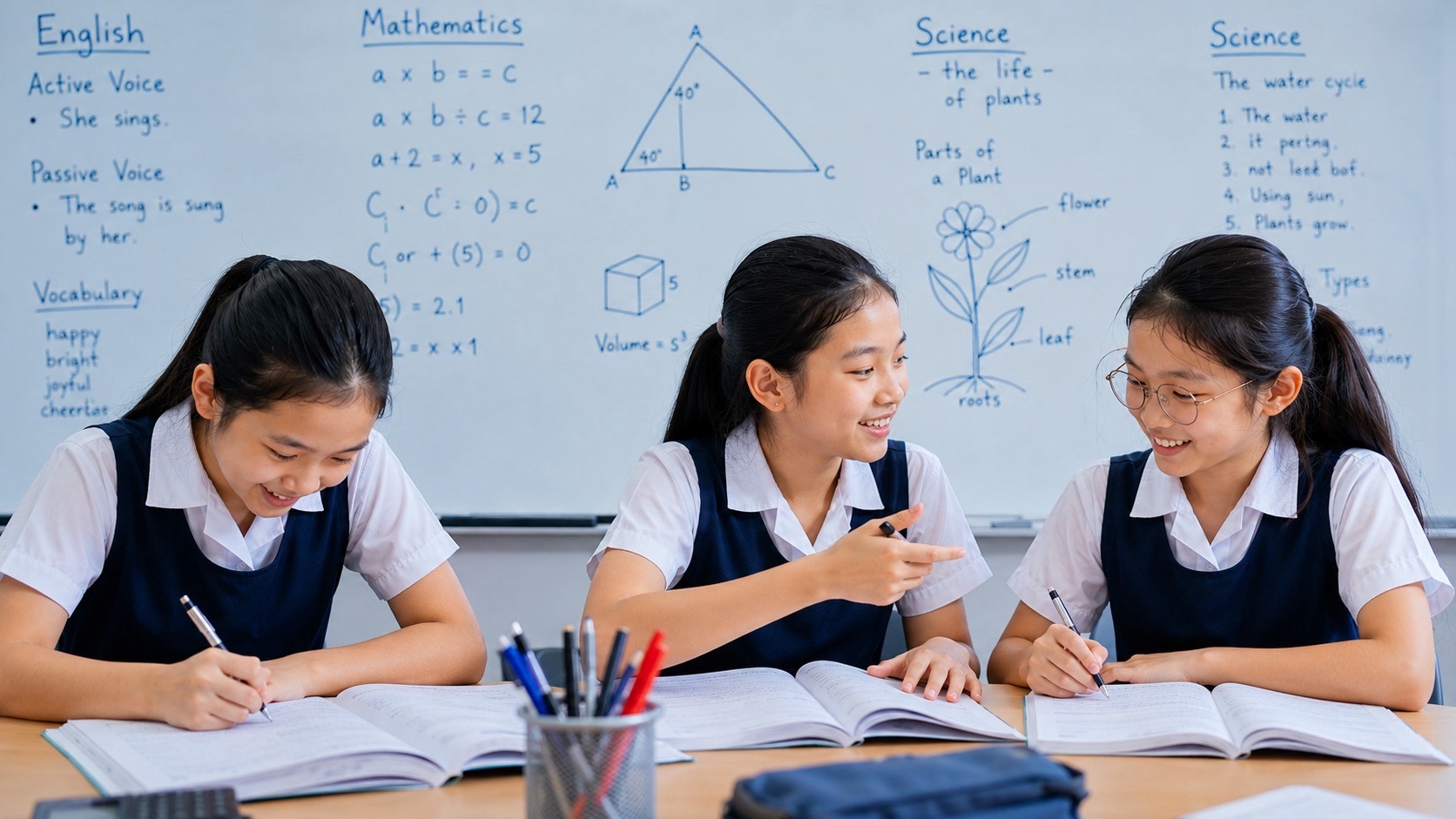
Families searching for a Primary Maths tuition centre in Yishun are often looking for one programme that can support a child from early number sense to upper-primary problem solving and PSLE preparation. The challenge is that “Primary Mathematics” changes substantially from Primary 1 to Primary 6. A lower-primary pupil may need help understanding number bonds and place value, while an upper-primary pupil may understand arithmetic but struggle with fractions, percentage, ratio, bar models or multi-step problem sums. Good Primary Maths tuition in Yishun should therefore diagnose the mathematical stage before deciding what to practise.
Strong Primary Mathematics programmes in Singapore commonly emphasise number sense, multiplication and division, fractions, decimals, percentage, ratio, geometry, model drawing, heuristics and problem solving. These topics are connected by a common process: understand the concept → represent the relationship → calculate accurately → check the result. A child can lose marks at any of those four stages. The total score alone does not reveal which stage needs teaching.
In a three-student, 90-minute tutorial, the tutor can observe how each pupil starts a problem, what representation is chosen, where the working changes direction and whether the final answer actually responds to the question. One child may need place-value repair, another may need a clearer bar model, and a third may simply need a more disciplined checking routine. Small-group tuition becomes useful when the lesson is organised around the failure mechanism rather than the worksheet chapter.
Primary Mathematics Is a Six-Year Developmental System
The six primary years are not six copies of the same subject with larger numbers. Each stage adds new ways of representing quantity and new expectations for independence.
- Primary 1: number sense, number bonds, place value, addition and subtraction.
- Primary 2: multiplication, division, larger place values, early fractions and two-step problems.
- Primary 3: bar models, multiplication and division fluency, fractions and more structured problem sums.
- Primary 4: factors, multiples, fractions, decimals, area, perimeter, angles and stronger multi-step reasoning.
- Primary 5: percentage, rate, richer fraction work, geometry, volume and PSLE-style integration.
- Primary 6: ratio, algebraic representation, advanced multi-step problems and reliable examination execution.
A pupil can be officially in Primary 5 while carrying a Primary 3 representation gap. Tuition should support current schoolwork while repairing the earliest unstable prerequisite.
Primary 1: Number Sense Before Speed
Primary 1 pupils need to see numbers as quantities that can be split, combined and compared. Eight is not only a symbol; it can be five and three, six and two, or two less than ten.
We use counters, ten-frames, number lines and drawings where useful. The aim is to move from concrete objects to pictorial representation and finally to symbols without losing meaning.
Speed develops more safely when number relationships are understood. A child who sees 9 + 4 as 10 + 3 has begun using number structure rather than counting every object from one.
Primary 2: Equal Groups and the Multiplication–Division Connection
Primary 2 introduces a major conceptual shift: equal groups. Multiplication and division should be understood as related descriptions of the same structure.
If 4 × 5 = 20, the pupil should also see 20 ÷ 4 = 5 and 20 ÷ 5 = 4. Arrays, grouped objects and fact families help these relationships become visible before tables are treated only as facts to memorise.
This understanding later supports fractions, ratio and upper-primary problem solving.
Primary 3: Translate the Story Into a Model
By Primary 3, the difficulty in a problem sum is often no longer the arithmetic. It is understanding how the quantities are related.
We teach a four-step route:
- Identify the known quantities.
- Identify the relationship between them.
- Represent the relationship with a bar model, diagram or equation.
- Calculate only after the representation makes sense.
The model is not decoration. Every bar or segment must represent something in the story.
Primary 4: One Number System, Several Representations
Primary 4 pupils increasingly move between fractions, decimals and larger whole numbers while also reasoning about geometry and measurement.
We ask pupils to preserve structure when the form changes. Three quarters and 0.75 are two representations of the same quantity. Area and perimeter both involve a shape but measure different properties. A factor and a multiple are related but point in different directions.
Connections reduce the feeling that every new chapter is an unrelated collection of procedures.
Primary 5: Build the PSLE Bridge
Primary 5 is an important year because problems begin combining topics more aggressively. Fractions, percentage, rate, geometry and multi-step reasoning may appear together.
We repeatedly ask:
- What is the whole?
- What does one unit represent?
- What quantity is changing?
- What remains unchanged?
- What did the previous step find?
These questions make upper-primary problem solving more systematic without turning every question into a memorised template.
Primary 6: Reliable Reasoning Under Examination Conditions
Primary 6 Mathematics is a reliability year. Pupils need to recognise relationships quickly, choose efficient models, calculate accurately, manage time and check intelligently.
We distinguish concept weakness from execution weakness. A pupil who cannot identify the whole in a percentage question needs concept repair. A pupil who models correctly but omits the final unit needs an execution routine.
Those pupils should not receive identical homework simply because both lost two marks.
The Four-Layer Mathematics Diagnosis
1. Concept
Does the pupil understand the mathematical idea? Can fractions be explained as parts of a whole? Can ratio be explained through units? Can area be distinguished from perimeter?
2. Representation
Can the pupil convert language into a bar model, diagram, table or equation that preserves the relationship?
3. Calculation
Can the required arithmetic be performed accurately and efficiently?
4. Execution
Can the pupil finish, label intermediate results, include units, manage time and check high-risk steps?
This framework prevents “careless” from becoming a catch-all explanation.
The Bar Model Is a Thinking Tool
The model method is powerful because it translates relationships into space. A comparison can be seen. A missing part can be located. Equal units can be counted. Before-and-after changes can be separated.
We ask pupils three questions about every model:
- What does each bar represent?
- What relationship does the model show?
- How does the unknown appear in the model?
If the pupil cannot answer, the model should be repaired before calculation begins.
Heuristics Should Reduce the Problem
Useful heuristics include drawing a model, working backwards, making a systematic list, spotting a pattern, simplifying the problem and finding what remains unchanged.
We teach pupils to ask why the heuristic helps. Working backwards is useful when the final state is known and earlier changes need to be reversed. Making a list is useful when all possible cases must be considered systematically.
A heuristic is not a password attached to a familiar question type.
Calculation Fluency Frees Attention for Reasoning
Strong arithmetic matters because working memory is limited. A pupil who struggles to recall multiplication facts has less attention available for a multi-step model problem.
We use short retrieval practice for number bonds, multiplication facts, fraction relationships and common percentage benchmarks after the concept is understood.
Fluency is a support for reasoning, not a replacement for it.
Checking Should Be Targeted
“Check everything” is inefficient. We teach specific checks:
- Does the final answer answer the final question?
- Is the unit correct?
- Is the answer approximately the right size?
- Can an inverse operation check the arithmetic?
- Did the model use every important condition?
- Was a number copied incorrectly from the question?
Targeted checking turns examination time into a deliberate resource.
Worked Case 1: The Pupil Who Is Fast but Misreads Problems
The arithmetic is accurate, but operations are selected by keywords.
We remove the numbers and ask the pupil to explain the relationship first. Once the story is represented correctly, the numbers return. The repair targets translation rather than speed.
Worked Case 2: The Pupil Who Draws Models but Cannot Use Them
The child draws bars mechanically because “model method” is expected.
We ask what each bar means and which quantity is unknown. If the pupil cannot explain the drawing, the model is rebuilt from the story. A simple accurate model is better than an elaborate meaningless one.
Worked Case 3: The Pupil Who Loses Marks Through Execution
The method is correct, but units are omitted and the final question is sometimes left unanswered.
We add a final-line routine: reread the question, state the requested quantity, include the unit and estimate whether the result is reasonable.
A 90-Minute Small-Group Primary Mathematics Lesson
- Retrieval: important facts and earlier concepts return.
- Diagnostic: one fresh question reveals the current constraint.
- Concept: the mathematical relationship is clarified.
- Representation: pupils use a model, diagram or equation.
- Calculation: efficient working is completed.
- Transfer: the same concept appears in changed wording.
- Independent attempt: prompts are removed.
- Error review: concept, representation, calculation and execution are classified.
Repair, Stabilise, Extend
Repair
Find the earliest unstable concept and rebuild it with an appropriate concrete, pictorial or symbolic representation.
Stabilise
Use spaced retrieval and mixed problems so the pupil recognises relationships after chapter labels disappear.
Extend
Use unfamiliar structures, alternative methods and non-routine problems to increase mathematical flexibility.
What Parents Can Bring to a Mathematics Review
- one recent school paper;
- one piece of ordinary homework;
- one difficult problem the child could not start;
- one example of a repeated error;
- the child’s own explanation of what feels difficult.
The most useful sample may not be the lowest score. A repeated model error can reveal more than an isolated hard question.
The Yishun Primary Maths Goal Is a Connected Six-Year System
Primary Mathematics works best when each year strengthens the next. Number bonds support arithmetic. Equal groups support multiplication, division, fractions and ratio. Place value supports decimals and algorithms. Bar models connect language to quantity. Heuristics help pupils reorganise unfamiliar problems.
For pupils who are behind, we repair the earliest unstable point. For pupils who are inconsistent, we stabilise representation and calculation. For pupils who are ready, we deepen non-routine problem solving.
The result we want is a pupil who does not merely recognise a familiar worksheet, but can understand an unfamiliar mathematical situation, represent it clearly and work towards a solution with confidence and control. Properly taught kids shine a bright light into the future.
Leave a Reply