
Families searching for Maths tuition in Punggol, Primary Mathematics tuition or a small-group Math tutor often begin with a score: 62, 78, 91. The score matters, but it does not tell us what to teach next. A pupil can lose marks because the concept is weak, the representation is wrong, the arithmetic is inaccurate, the working is unclear or the examination process breaks under time. Good Mathematics tuition should identify which layer is failing before adding more worksheets.
Strong Primary Mathematics programmes in Singapore commonly emphasise number sense, model drawing, problem sums, heuristics, fractions, decimals, percentage, ratio, geometry and PSLE preparation. These topics are important, but the more useful parent question is whether the child can move through four stages reliably: understand → represent → calculate → check. A weakness in any one stage can make the entire subject look difficult.
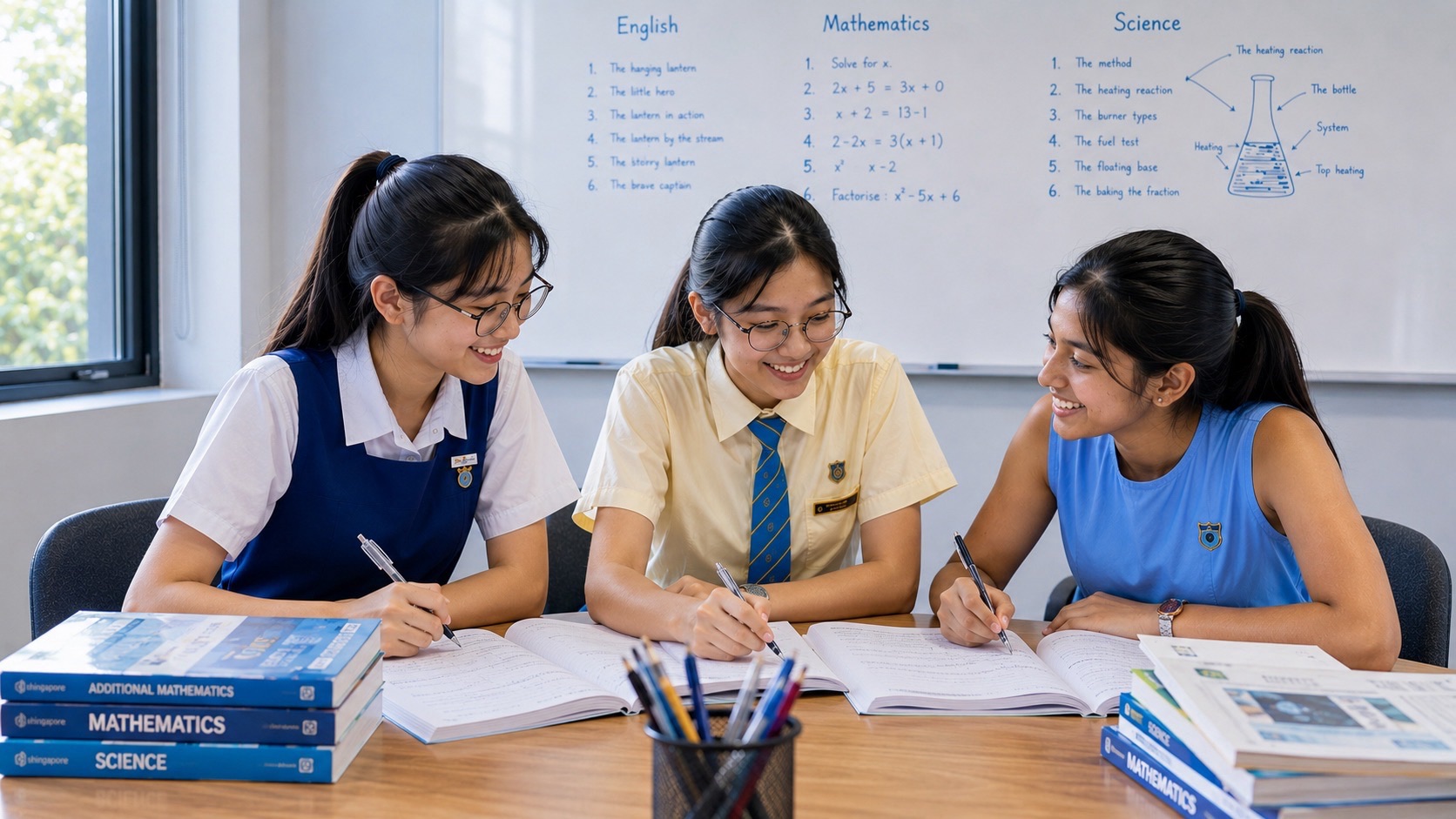
In a three-student, 90-minute tutorial, the tutor can see the pupil’s mathematical process rather than only the answer. Does the child understand what each number means? Can the relationship be shown using a model or diagram? Is the arithmetic method appropriate? Does the final answer respond to the question and include the correct unit? Small-group tuition becomes valuable when these questions produce a precise teaching plan.
Mathematics Problems Usually Fail in One of Four Places
- Concept failure: the mathematical idea is not understood.
- Representation failure: the pupil cannot convert the situation into a useful model, diagram, table or equation.
- Calculation failure: the relationship is correct but arithmetic breaks.
- Execution failure: time, copying, units, incomplete working or poor checking causes avoidable loss.
These categories help parents and tutors avoid the vague diagnosis of “careless” or “weak in Maths”.
Primary 1: Build Number Sense Before Speed
Primary 1 Mathematics should make numbers meaningful. Pupils learn number bonds, place value, addition, subtraction and simple problem solving.
The key questions are:
- Can the child see 8 as 5 + 3 or 10 – 2?
- Can tens and ones be explained?
- Can an addition or subtraction story be shown with objects or a drawing?
- Does the child know when to count on rather than recount from one?
Number sense is the foundation that later algorithms depend on.
Primary 2: Equal Groups, Multiplication and Division
Primary 2 introduces a larger grouping world. Multiplication and division should be understood through equal groups, arrays, sharing and grouping.
We check whether the pupil sees multiplication and division as related operations rather than unrelated chapters. A times-table fact should support the matching division facts.
Word problems then become a translation exercise: which relationship is being described?
Primary 3: Represent the Problem
Primary 3 often makes problem solving more visible through bar models, fractions and multi-step questions.
The pupil should be able to identify the quantities, state how they are related and draw a model that reveals the unknown. A neat model is not automatically a correct model.
At this stage, representation becomes a major part of mathematical maturity.
Primary 4: Connect Fractions, Decimals and Geometry
Primary 4 pupils begin seeing the same quantity in multiple forms. Fractions and decimals describe one number system. Area and perimeter describe different properties of shapes. Factors and multiples describe number relationships.
We look for whether the learner can change representation without losing meaning.
Primary 5: Build the PSLE Bridge
Primary 5 adds greater demand through fractions, percentage, rate, geometry and increasingly complex multi-step problems.
This is an important year for finding hidden gaps. A pupil may have survived earlier fraction work through memorised procedures but struggle when fractions appear inside a changing-quantity problem.
P5 tuition should therefore combine concept repair with examination-style transfer rather than jump immediately to endless full papers.
Primary 6: Make Mathematics Reliable Under Time
Primary 6 requires the learner to combine the full primary system. Fractions, percentage, ratio, algebra, geometry, measurement and heuristics may appear inside unfamiliar multi-step questions.
The key job becomes reliability:
- recognise the relationship quickly;
- choose an efficient representation;
- calculate accurately;
- show enough working;
- manage time;
- check high-risk steps.
PSLE Mathematics is not a new subject. It is the full primary mathematical system operating under examination conditions.
The Bar Model: A Language-to-Mathematics Bridge
Bar models are useful because they translate verbal relationships into visible quantities.
We use models for:
- part-whole relationships;
- comparison;
- equal groups;
- fractions;
- ratio;
- before-and-after changes;
- multi-step problems.
The model is only useful when every segment has a clear meaning.
Heuristics: Choose the Strategy From the Structure
Heuristics include model drawing, working backwards, making a systematic list, spotting a pattern, simplifying, guess-and-check and finding an invariant.
We avoid teaching them as magical tricks tied to memorised question types. Pupils should understand why a heuristic makes the problem smaller or more visible.
Word Problems: Translate Before Calculating
A strong word-problem routine is:
- What quantities are given?
- What relationship connects them?
- What is unknown?
- What representation will make the relationship visible?
- Which operation follows from that representation?
The calculation should be the consequence of understanding, not the first move.
Do Not Over-Rely on Keywords
Words such as more, fewer, altogether, each and left can be clues, but they are not reliable formulas.
“Ali has 12 more stickers than Ben” may require addition or subtraction depending on which quantity is known and what the question asks.
The relationship is more dependable than the keyword.
Calculation Fluency: Free Attention for Reasoning
Fast and accurate arithmetic matters because working memory is limited. A pupil who spends too much attention recalling basic facts has less attention available for representation and checking.
We therefore use short, spaced retrieval for multiplication facts, number bonds, fraction relationships and common percentage benchmarks after the concepts are understood.
Checking: Use a Reason, Not Anxiety
Checking should target high-risk points:
- Did I answer the final question?
- Is the unit correct?
- Does the answer have a reasonable size?
- Did I copy the numbers correctly?
- Can the relationship be checked through an inverse operation or alternate method?
Repeatedly redoing every line is slow. Targeted checking is more efficient.
The Mathematics Error Ledger
We record recurring patterns rather than every isolated mistake.
- number bond or fact retrieval;
- place-value misunderstanding;
- wrong operation chosen;
- bar model does not match the story;
- fraction whole misidentified;
- percentage base quantity wrong;
- unit omitted;
- intermediate step unlabeled;
- time lost on one difficult question.
The ledger tells us what the next lesson should repair.
Worked Case 1: Same Score, Different Problems
Two pupils score 70. One loses marks because arithmetic is inaccurate. The other calculates perfectly but models word problems incorrectly.
Giving both pupils the same worksheet wastes the diagnostic opportunity. The first needs fluency and checking; the second needs representation and problem translation.
Worked Case 2: Child Says “I Understand” but Cannot Start
The pupil follows the tutor’s explanation but freezes on a fresh question.
We reduce prompting and use a start routine: name the known quantities, state the unknown and draw one relationship. Startability is a skill that can be taught.
Worked Case 3: Correct Method, Repeated Careless Errors
We avoid the label “careless” and classify the error. Is the pupil copying digits wrongly? Omitting units? Changing correct answers? Rushing the final calculation?
A specific execution problem can be repaired with a specific checking routine.
A 90-Minute Small-Group Mathematics Lesson
- Retrieval: core facts and prior concepts return.
- Diagnostic: one short fresh problem reveals the current constraint.
- Concept: the mathematical relationship is clarified.
- Representation: pupils model or diagram the relationship.
- Calculation: efficient working is completed.
- Problem transfer: the same concept appears in changed wording.
- Independent attempt: prompts are removed.
- Error review: concept, representation, calculation and execution are separated.
Repair, Stabilise, Extend
Repair
Find the earliest unstable mathematical idea and rebuild it using concrete, pictorial or symbolic representations as appropriate.
Stabilise
Use spaced retrieval and mixed problems so the pupil can recognise the same relationship when the chapter label disappears.
Extend
Use unfamiliar structures, multiple methods and non-routine problems to deepen flexibility rather than simply moving ahead.
What Parents Can Look For
- The child can explain what each number represents.
- Models increasingly match the story.
- Repeated errors become less frequent.
- The pupil starts difficult problems with a routine instead of freezing.
- Working becomes clearer and easier to check.
- Units and final answers are handled deliberately.
- Practice papers reveal fewer execution losses.
The Punggol Maths Tuition Goal Is Better Mathematical Decisions
Mathematics tuition is most useful when it improves the decisions a pupil makes before, during and after calculation.
For pupils who are behind, we repair the concept. For pupils who know the topic but struggle with word problems, we repair representation. For pupils who are inconsistent, we stabilise calculation and execution. For pupils who are ready, we extend flexibility.
The result we want is a learner who can look at an unfamiliar problem, understand the quantities, represent the relationship, calculate accurately and explain why the answer makes sense. Properly taught kids shine a bright light into the future.
Leave a Reply