
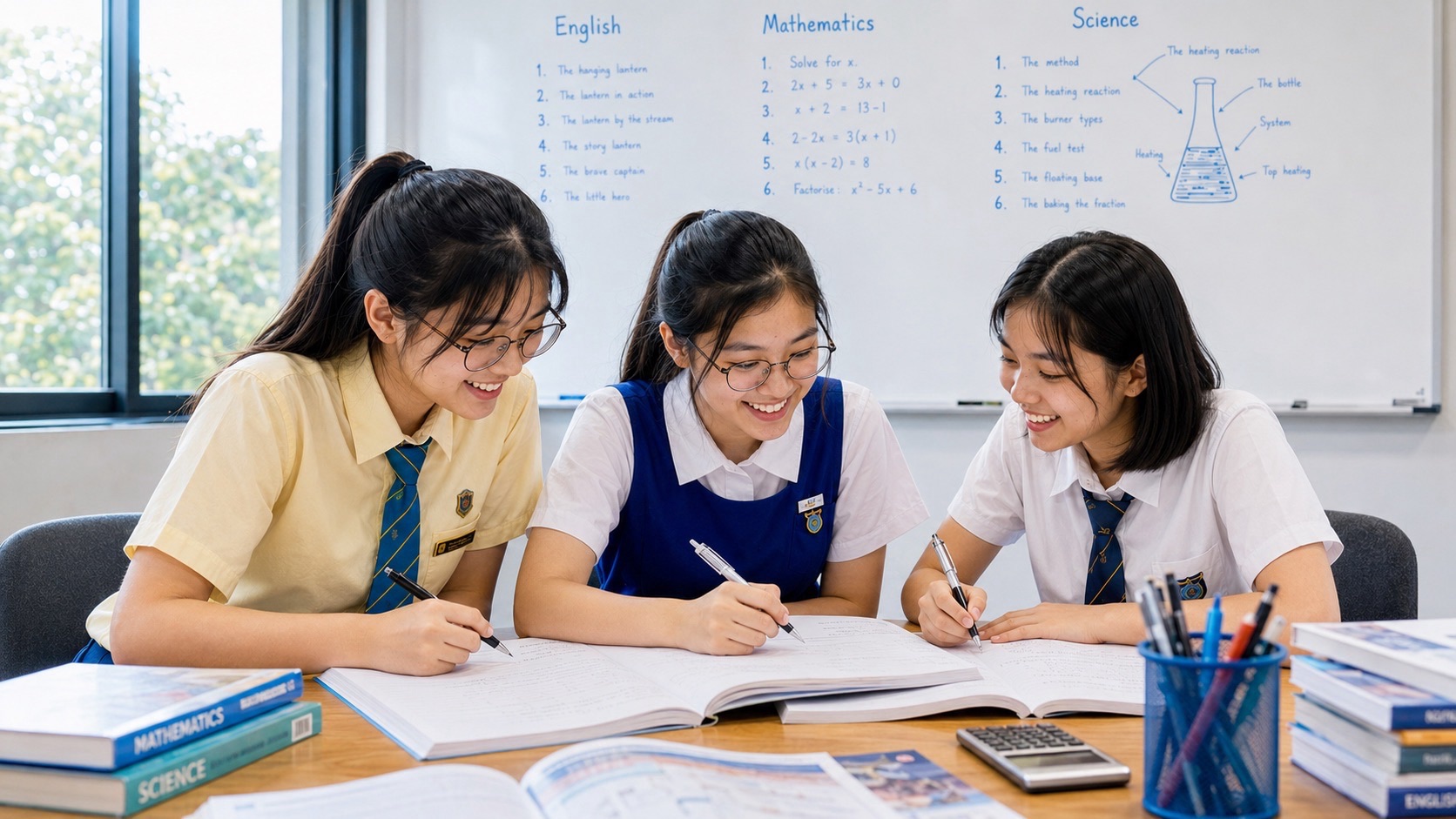
Families searching for English tuition for Punggol schools, Primary English tuition in Punggol or small-group English tuition often compare programmes by school name, level and examination stage. The more useful comparison is the learning stage the child is actually in. A Primary 1 learner who is still becoming independent with print needs a different lesson from a Primary 3 pupil struggling with mixed grammar and inference, while a Primary 6 pupil preparing for PSLE needs transfer, timing and answer precision on top of the same language foundations.
Strong Primary English programmes in Singapore typically cover reading, grammar, vocabulary, comprehension, writing and oral communication, with PSLE preparation becoming more explicit in the upper-primary years. Those labels remain consistent across schools; what changes is the depth and independence expected. Good tuition therefore should not simply mirror a school worksheet by worksheet. It should help the pupil understand the language mechanism beneath the worksheet and carry that mechanism into the next class test, composition, oral task or school year.
In a three-student, 90-minute tutorial, schoolwork becomes useful evidence. We can examine marked comprehension, grammar exercises, composition scripts, spelling patterns, oral notes and teacher comments to identify the stage that is unstable. The goal is not to compete with school. School establishes the curriculum and assessment context; tuition should diagnose, repair, stabilise and extend the individual learner inside that context.
One English Language, Different Primary-School Jobs
The subject name stays “English”, but the learning job changes as pupils move through primary school.
- Primary 1: move from supported spoken language into increasingly independent reading and sentence writing.
- Primary 2: connect sentences into paragraphs and maintain meaning across longer reading.
- Primary 3: transfer grammar, vocabulary and comprehension skills into mixed and less predictable tasks.
- Primary 4: deepen inference, paragraph control, editing and independent explanation.
- Primary 5: bridge into PSLE-style demands while repairing any foundation still leaking marks.
- Primary 6: stabilise examination performance across writing, language use, comprehension, listening and oral communication.
A child can be officially in Primary 5 while still carrying a Primary 3 reading bottleneck. Tuition should respect the current school level but teach the earliest unstable prerequisite when necessary.
Primary 1: From Adult Support to Learner Strategy
The central Primary 1 question is not merely whether the child can complete the page. It is whether the child knows what to do when the page becomes difficult.
We look for reading accuracy, basic fluency, high-frequency vocabulary, simple grammar patterns, complete sentence construction and the beginnings of evidence-based comprehension. A strong sign of progress is reduced prompting: the pupil attempts an unfamiliar word, rereads a sentence or checks punctuation before waiting for an adult.
At this stage, help should leave behind a strategy. “Look at the first sound”, “read the whole sentence again” and “point to the picture clue” are more useful than supplying the answer immediately.
Primary 2: Make Sentences Cooperate
Primary 2 increasingly asks pupils to hold meaning across several sentences. Pronouns need clear referents. Events need sequence. Tense should remain stable. Picture writing begins moving from description towards connected events.
We teach cohesion through simple questions: Who does he refer to? What happened before this? Why did this event cause the next one? Which connector shows the relationship? These reading habits later become writing habits.
A pupil ready to leave Primary 2 should increasingly be able to read a short paragraph without losing the thread and write several sentences without losing the reader.
Primary 3: English Stops Telling You Which Rule to Use
Primary 3 often feels like a jump because exercises become less isolated. Grammar cloze mixes rules. Vocabulary depends more heavily on context. Comprehension includes more inference. Composition requires a stronger story line.
The new skill is classification. The pupil must recognise which tool applies before using the tool.
- Is this a tense problem or an agreement problem?
- Is this answer stated or inferred?
- Does this vocabulary option fit only the sentence or the whole paragraph?
- Is this composition event part of the causal story line or just an interesting addition?
Transfer becomes the main teaching job.
Primary 4: Deepen Meaning and Independence
By Primary 4, pupils benefit from stronger inferential reading, more independent editing and clearer paragraph organisation.
We ask pupils to distinguish what the text states, what it supports and what would be speculation. In writing, we ask what each paragraph is doing, whether pronouns remain clear and whether sentence relationships carry cause, contrast, time or condition accurately.
The learner should increasingly be able to explain why an answer is correct rather than simply recognise it after a teacher reveals the key.
Primary 5: Bridge to PSLE Without Abandoning Foundations
Primary 5 often introduces more explicit examination-style demands. Pupils need stronger situational writing, continuous writing, cloze, comprehension and oral performance while the language underneath continues developing.
The danger is treating PSLE preparation as a reason to stop teaching fundamentals. If reference tracking is weak, more Paper 2 practice may reproduce the same errors. If sentence structure is unstable, more composition volume may increase fatigue without improving control.
We use examination tasks to expose gaps, then repair the underlying mechanism and return to the examination format.
Primary 6: Make Good English Dependable Under Time
Primary 6 adds execution. Pupils must retrieve language knowledge, interpret unfamiliar material, write under time, listen accurately and respond orally without prolonged support.
We therefore track not only correctness but process:
- where time is lost;
- which answers are changed during checking;
- whether composition planning is brief and usable;
- which comprehension question types repeatedly fail;
- whether grammar rules survive mixed contexts;
- whether oral answers remain organised when follow-up questions change direction.
PSLE readiness means the system is reliable enough to operate when the tutor is not beside the pupil.
What Schoolwork Tells Us
A marked school paper is valuable because it records the pupil’s decisions under authentic conditions. We do not look only at the total score.
- Which question types are repeatedly wrong?
- Are errors clustered around vocabulary, grammar, reference or inference?
- Is writing relevant but thin, or imaginative but structurally weak?
- Do mistakes increase near the end of a timed paper?
- Which corrections can the child explain?
- Which mistakes return after being taught before?
Patterns matter more than isolated mistakes.
School-to-Tuition Transfer: The Three-Step Bridge
- Bring the evidence: recent marked work, current topics and difficult homework.
- Identify the mechanism: determine whether the problem is knowledge, interpretation, retrieval, expression or execution.
- Return the repaired skill: use a fresh task similar enough to schoolwork that the pupil can carry the improvement back.
Tuition should not become a parallel universe of worksheets that never reconnects with school performance.
Reading Across the Primary Years
Reading changes from decoding to fluency, from fluency to connected comprehension, and from connected comprehension to inference and evaluation.
We use both narrative and informational texts because pupils need vocabulary and world knowledge across many contexts. A student who reads only examination passages may become skilled at question formats without building the broader language base that makes difficult passages easier.
Regular reading is therefore not separate from examination preparation. It supplies vocabulary, syntax, knowledge and examples that later support writing and oral communication.
Vocabulary Across the Primary Years
Young learners need strong everyday vocabulary and high-frequency academic words. Older pupils need greater nuance, morphology, collocation and context sensitivity.
We move pupils from “I know the definition” towards:
- I recognise the word in a new passage;
- I know which nearby word is more precise;
- I can identify the correct word form;
- I know a natural phrase that uses it;
- I can retrieve it while speaking or writing.
Vocabulary becomes useful when it survives outside the list.
Grammar Across the Primary Years
Grammar begins as visible patterns and gradually becomes structural reasoning. Pupils move from simple subject-verb relationships towards clause control, synthesis, reference, word form and mixed contextual use.
We repeatedly ask what the grammar is doing to meaning. A conjunction shows cause, contrast, time, condition or purpose. Tense locates events in time. Pronouns preserve cohesion. Word forms determine the job a vocabulary item performs in the sentence.
This meaning-first approach helps grammar transfer into comprehension and writing.
Writing Across the Primary Years
Writing grows from the sentence to the paragraph and from the paragraph to whole-task control.
- Lower primary: complete sentences, sequence, clear reference.
- Middle primary: paragraphs, causal links, prompt relevance, sentence variety.
- Upper primary: audience and purpose, story architecture, pacing, editing and timed execution.
The foundation is always meaning. Sophisticated vocabulary cannot rescue a response that the reader cannot follow.
Oral Communication Across the Primary Years
Oral work progresses from complete responses and retelling towards reasoned discussion, examples and responsive follow-up.
We treat oral communication as thinking made audible. Pupils should listen to the exact question, organise a point and respond in language another person can follow.
This supports writing because a pupil who can organise an idea aloud often has a clearer route into written expression.
Why a Three-Student Class Can Fit Different Schools
Pupils from different schools may be working on different chapters or assessment schedules. A small group can still share a language mechanism.
Three pupils might read the same passage while receiving different questions: one tracks pronouns, another works on inference and the third analyses writer’s craft. They may plan from one composition prompt while receiving different constraints: faster planning, stronger causal development or more precise editing.
The curriculum remains aligned at the level of English skills while the teaching adjusts to the individual learner.
A Typical 90-Minute Small-Group English Lesson
- Retrieval: earlier vocabulary, grammar or reading patterns return.
- Reading: a connected text supplies language in context.
- Comprehension: pupils locate evidence and reason about meaning.
- Language focus: one grammar or vocabulary mechanism is isolated.
- Transfer: the same mechanism moves into sentence or paragraph work.
- Independent task: prompts are reduced.
- Error review: the tutor records recurring patterns.
- School reconnection: the repaired skill is linked back to current school demands.
Worked Case 1: School Score Falls, but Reading Looks Fine
A pupil reads fluently at home, yet comprehension marks fall. We inspect the paper and discover repeated inference and question-scope errors. The repair is not more fluency work. The pupil practises evidence-based inference and learns to classify question demands.
Worked Case 2: Grammar Worksheets Are Strong, Composition Is Not
The pupil knows the rules in isolation but loses tense and pronoun control while generating ideas. We move grammar into authentic writing, using targeted editing passes after short paragraphs. The rule is practised where it fails.
Worked Case 3: Marks Are Stable, but the Child Depends on Adults
A pupil produces good homework with heavy parental support. In tuition, we reduce prompts and record how much help is required. Progress is measured by increasingly independent starts, evidence location and self-correction, not only the final page.
Worked Case 4: Strong Student Needs Extension, Not More Repetition
A pupil performs accurately on familiar school formats. We alter the conditions: unfamiliar text type, subtler inference, changed writing perspective or mixed grammar. Extension increases flexibility rather than merely moving ahead in the textbook.
Repair, Stabilise, Extend
Repair
Find the earliest unstable skill still affecting current schoolwork. Rebuild it directly and reconnect it to the current level.
Stabilise
Use spaced retrieval, mixed tasks and reduced prompting so a known skill becomes reliable across days and formats.
Extend
Increase ambiguity, depth, craft and transfer rather than repeat comfortable material or race ahead for appearance.
What Parents Can Bring to a First Review
- recent school English papers;
- composition scripts;
- grammar or cloze worksheets with repeated errors;
- teacher comments where available;
- the current school topics;
- homework that regularly creates difficulty;
- a short note about what the child says is hard.
We are looking for patterns, not blame. The most revealing item may be a repeated small error rather than the lowest score.
Frequently Asked Questions
Should tuition follow exactly what the school is teaching that week?
It should remain coordinated with school, but an unstable prerequisite may need repair first. Tuition is most useful when it supports current work while solving the reason the pupil is struggling with it.
Do pupils from different Punggol schools need completely different English programmes?
School pacing and assessment can differ, but core English mechanisms—reading, vocabulary, grammar, comprehension, writing and oral communication—remain transferable. Small-group teaching can adjust emphasis without creating unrelated programmes.
When should PSLE preparation begin?
The best preparation begins with strong lower- and middle-primary language foundations. Explicit PSLE-format practice becomes increasingly useful in upper primary, but examination drilling should not replace unresolved reading, vocabulary or writing skills.
How can parents tell whether tuition is helping?
Look for fewer repeated errors, clearer explanations, more independent starts, better self-correction and stronger transfer into schoolwork. Marks matter, but these are useful leading indicators.
How quickly should English improve?
Specific routines can improve within several lesson cycles. Reading depth, vocabulary, grammar automaticity and writing craft develop over longer periods. We track the learner’s actual bottleneck rather than promise a fixed grade or timetable.
The School Name Is the Context; the Learning Problem Is the Job
Pupils arrive from different schools, classes and teachers, but tuition becomes useful only when it answers a precise learning question. What can this child not yet do independently and reliably?
For a pupil who is behind, we repair the first unstable point. For a pupil who is inconsistent, we stabilise transfer. For a pupil who is already strong, we extend depth and flexibility.
The aim is to help the pupil return to school with a stronger language system: able to read more closely, explain more clearly, write with greater control and understand why the work succeeds. Properly taught kids shine a bright light into the future.
Leave a Reply