
Primary and Secondary Tuition for 2019: a historical tuition page, rebuilt as a useful learning guide
This page keeps its original 2018 title because it belongs to eduKateYishun’s historical archive. Families who now find it while searching for Primary tuition, Secondary tuition, small-group tuition in Singapore, English tuition, Mathematics tuition, Science tuition or Additional Mathematics tuition should not treat the 2019 schedules, locations, staff descriptions, subject codes, class arrangements or examination terminology as current.
What remains useful is the educational problem underneath the old registration page. Primary and Secondary students still need the same broad things: strong foundations, accurate diagnosis, explicit teaching, purposeful practice, clear feedback, correction of recurring mistakes, examination readiness and a gradual move from guided work to independent performance.
This rewritten article therefore turns a dated 2019 class notice into something more durable: a parent-facing guide to how Primary and Secondary tuition can be organised intelligently across English, Mathematics and Science, while also explaining why families should always check today’s MOE and SEAB syllabuses rather than rely on a historical tuition page.
What this page was in 2019
The original article was a registration notice.
It listed Primary and Secondary levels, subjects, old examination codes and then-current class arrangements.
That information belonged to a specific moment.
Some of the broad subject labels remain familiar.
The examination system and codes have continued to evolve.
Schedules and teaching arrangements are inherently time-sensitive.
A responsible historical page should preserve context without pretending that old logistics are still live.
What a useful tuition page should explain instead
Parents rarely need more advertising vocabulary.
They need a map.
What exactly is the child struggling with?
What should be taught next?
How will practice be structured?
How will the tutor know whether the repair worked?
When will support be removed?
How does the programme connect to school and examination demands?
These questions are more durable than a timetable.
The common mechanism across subjects
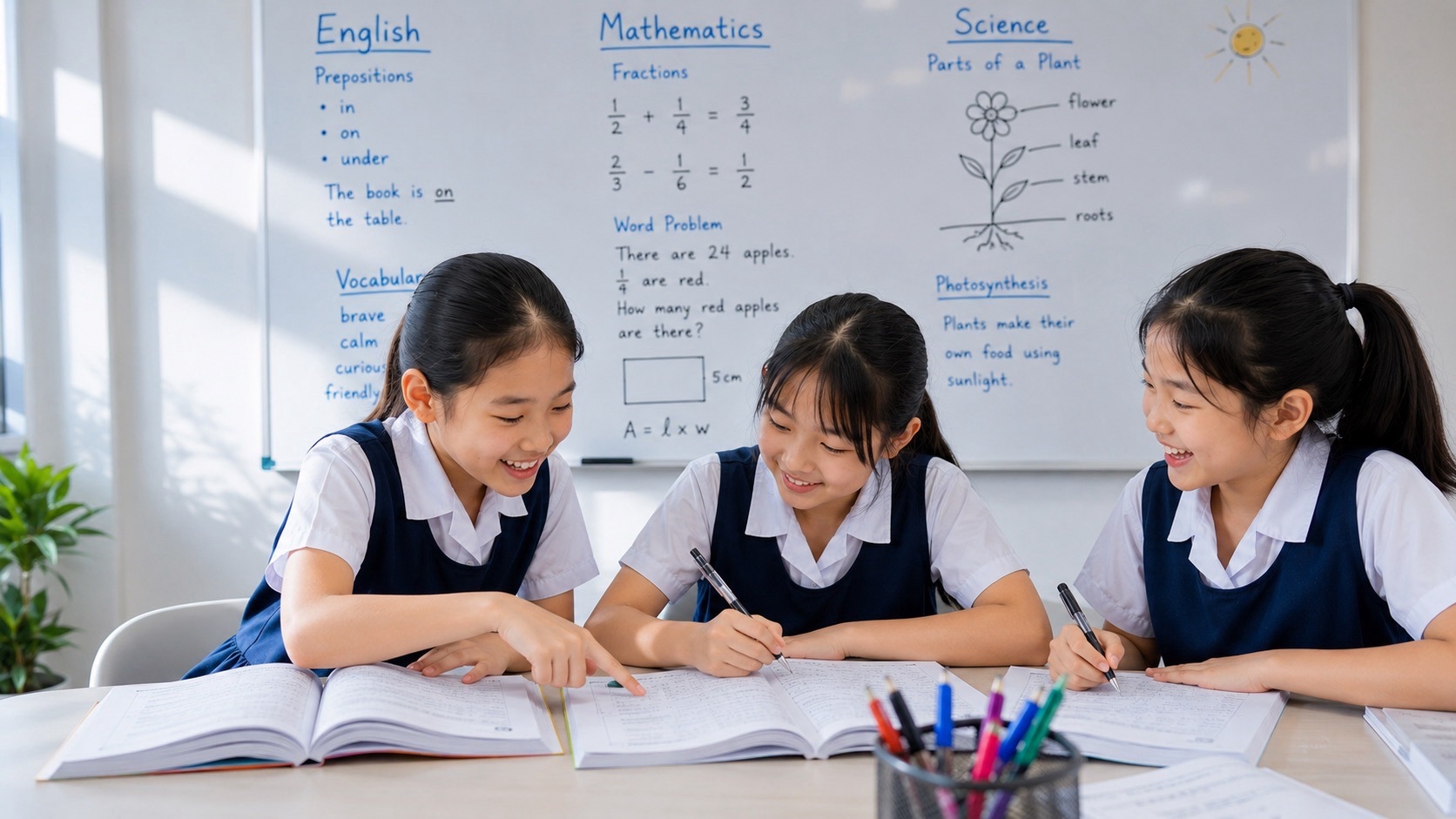
English, Mathematics and Science look different on the timetable.
The learning process has common stages.
- observe current performance;
- diagnose the failure;
- teach the missing mechanism;
- practise with support;
- reduce support;
- test in a fresh context;
- correct recurring errors;
- retrieve later;
- perform under realistic conditions.
This sequence can be adapted to almost any subject.
What changes is the content of the diagnosis.
Primary English: one language system, many components
Primary English can look fragmented.
Vocabulary.
Grammar.
Comprehension.
Oral.
Situational Writing.
Continuous Writing.
Yet the learner uses one connected language system.
Reading develops vocabulary and sentence patterns.
Vocabulary helps comprehension and writing.
Grammar supports clarity.
Comprehension teaches evidence and answer scope.
Writing turns language into purposeful expression.
Oral communication makes thinking audible.
Strong tuition connects these jobs rather than treating them as separate weekly packets.
Primary English diagnosis
A low mark may come from different causes.
The pupil may misread questions.
Inference may be weak.
Vocabulary may be shallow.
Grammar may collapse during writing.
The child may plan too slowly.
Compositions may drift away from the topic.
Oral responses may be brief because ideas are not organised.
The tutor should identify the mechanism before prescribing practice.
“Do more English” is too broad.
Primary Mathematics: representation before calculation
Primary Mathematics is often difficult not because the child cannot calculate, but because the child cannot see the relationship hidden inside the words.
Representation helps.
Bar models, diagrams, tables, number lines and simple sketches can expose quantities and relationships.
The pupil slows down long enough to decide what each number means.
This reduces operation guessing.
A strong Mathematics programme should make the child’s thinking visible before demanding speed.
Primary Mathematics: concepts, heuristics and checking
Concepts explain why Mathematics works.
Procedures explain how to carry out a method.
Heuristics help when a problem is non-routine.
Checking protects against avoidable loss.
A pupil should know more than the name of a heuristic.
The child should recognise the feature of the problem that suggests working backwards, model drawing, guess and check, systematic listing or identifying what stays the same.
Strategy selection is a skill in its own right.
Primary Science: knowledge must become usable
Science exposes the difference between memorisation and application very clearly.
A pupil may know the chapter and still struggle when a familiar concept appears in an unfamiliar experiment, graph, diagram or real-world situation.
Strong Science tuition should teach pupils to identify the task word, locate evidence, choose the relevant concept and build the causal explanation.
Observation and explanation are not the same.
Prediction is not guessing.
Keywords are not a substitute for correct relationships.
These distinctions matter.
Secondary English: the judgement load increases
Secondary English asks students to make more decisions.
Read denser texts.
Infer tone.
Paraphrase accurately.
Summarise information.
Write for audience and purpose.
Develop arguments.
Select examples.
Respond orally under follow-up questioning.
Editing also becomes more demanding because grammar knowledge must survive longer writing.
The tuition programme should therefore teach judgement, not merely model answers.
Secondary Mathematics: abstraction becomes visible
Secondary Mathematics begins to ask students to operate with more abstract relationships.
Algebra becomes a language rather than a chapter.
Graphs represent relationships.
Geometry becomes more formal.
Students need to move between equations, diagrams, tables and verbal conditions.
A weak foundation in algebraic manipulation can quietly damage many later topics.
Good tuition identifies the bottleneck early.
Additional Mathematics: method selection under abstraction
Additional Mathematics intensifies the need for symbolic control.
Students encounter advanced algebra, functions, trigonometry and calculus.
Knowing a formula is not enough.
The student must recognise when the formula is relevant, transform expressions accurately and preserve logical working across several lines.
This is why A-Math errors should be classified carefully.
Is the concept wrong?
Is the algebra unstable?
Was the method unsuitable?
Was the answer not checked?
Each failure suggests a different repair.
Secondary Science: explanation becomes more formal
As students move into Secondary Science, scientific language becomes more precise and models become more formal.
Variables, evidence, cause, mechanism and mathematical relationships become increasingly important.
The same learning principle still applies.
Do not memorise an answer shape without understanding why it works.
A correct explanation should survive when the context changes.
Why a small group can help across subjects
Small groups are useful when they create visibility and comparison.
In English, pupils can compare interpretations.
In Mathematics, they can compare solution methods.
In Science, they can compare explanations and identify missing causal links.
The tutor can hear reasoning rather than seeing only final answers.
The danger is passive participation.
Every pupil still needs an individual attempt.
The group should expand thinking, not allow one strong student to carry everyone else.
Homework should have a learning job
More homework is not automatically better tuition.
Practice should have a reason.
One task may build fluency.
Another may expose transfer.
A third may retrieve old learning.
A timed paper may test performance.
A correction task may repair one recurring error.
When homework is purposeful, quantity can be judged intelligently.
Feedback should change future work
A marked script is useful only when the next script changes.
Feedback should therefore be specific enough to practise.
“Improve English” is not useful.
“Your inference answers contain the correct idea but no textual evidence” is useful.
“Be more careful in Math” is vague.
“You are calculating before representing the relationship and choosing the wrong operation” is teachable.
“Improve Science answers” is broad.
“You are repeating the observation instead of explaining the mechanism” identifies the repair.
Specific feedback creates the next lesson.
Why retrieval matters
Students forget.
That is normal.
Retrieval brings earlier learning back without showing the answer first.
A class can begin with five minutes of old errors.
An English grammar pattern.
A Math heuristic.
A Science explanation structure.
Repeated return turns correction into memory.
This is more useful than moving endlessly forward through new material.
Primary to Secondary is a transition in independence
Primary school can support students with more visible scaffolds.
Secondary school expects greater self-management.
Students must keep track of more subjects, longer assignments, denser texts and more complicated examination demands.
Tuition should not simply add another dependency.
It should teach routines.
How to revise.
How to analyse errors.
How to start a difficult task.
How to organise notes.
How to check work.
How to recognise when a method is failing.
The examination system does not stand still
This is one reason a 2019 tuition page must be read historically.
Singapore’s examination terminology continues to evolve.
SEAB’s 2026 pages still list GCE O-Level syllabuses for that examination year.
From 2027, the Singapore-Cambridge Secondary Education Certificate combines the earlier N(T), N(A) and O-Level certificates under Full Subject-Based Banding.
Subjects are offered at G1, G2 and G3.
Families should therefore check the official syllabus for the student’s actual cohort and subject level.
Historical subject codes should not be used as current guidance.
A fictional family: one timetable, three different learning jobs
Imagine a family with three children.
Alicia is in Primary 4 and struggles with English comprehension.
Ben is in Primary 6 and performs inconsistently in Mathematics word problems.
Clara is in Secondary 3 and finds Additional Mathematics intimidating.
All three can attend tuition.
The learning jobs are completely different.
Alicia needs question-scope and inference work.
Ben needs representation and heuristic selection.
Clara needs algebraic foundations and method recognition.
The timetable is not the programme.
The diagnosis is.
What parents should ask instead of “How many worksheets?”
What has been diagnosed?
Which two or three weaknesses are receiving priority?
How are old errors revisited?
When is the student tested without support?
How is examination timing introduced?
What should improvement look like over the next six weeks?
How will we know when a skill is stable?
These questions produce better conversations about tuition quality.
What responsible tuition should not promise
No responsible teacher can guarantee a particular grade for every student.
Results depend on starting point, attendance, school demands, health, practice, motivation, time available and the difficulty of the eventual assessment.
What teaching can promise is a process.
Observe.
Diagnose.
Teach.
Practise.
Correct.
Retrieve.
Test independence.
Adjust.
That process is less dramatic than a guarantee and more educationally useful.
Why preserving old pages can still help readers
A historical page shows how tuition language changes over time.
Old subject codes change.
Examination labels change.
Locations change.
Schedules change.
What should survive is the explanation of learning.
When a legacy article is rewritten around mechanisms rather than old logistics, it becomes useful again without pretending that 2019 is still now.
The durable standard
Good tuition should make the learner more capable, not merely more occupied.
English should become more precise.
Mathematics should become more intelligible.
Science should become more evidence-driven.
Secondary subjects should become more manageable through stronger foundations and better routines.
The tutor should gradually become less necessary for each individual task because the student has internalised the process.
That is the useful lesson to keep from a page titled Primary and Secondary Tuition for 2019.
Related reading
- Yishun Tuition Centre Hub
- Small Group English tuition in Punggol NIE/MOE teacher
- Primary School English Tuition for 2019 Small Group Waterway Point
- Primary Math Tuition Punggol 2019
- Punggol Additional Mathematics Tuition for 2019 Small Group
Official references
Singapore Examinations and Assessment Board: Singapore-Cambridge Secondary Education Certificate.
Leave a Reply