
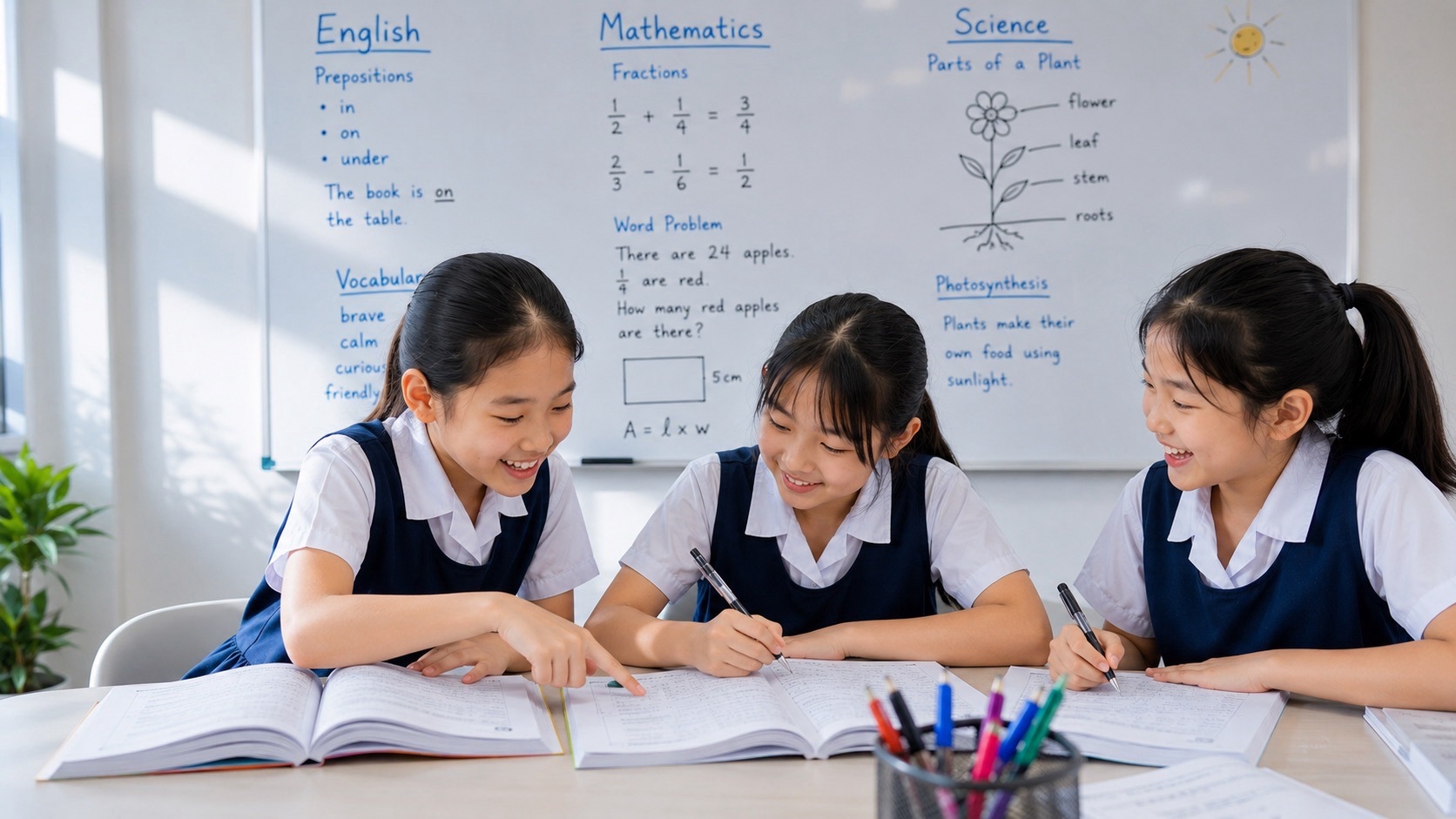
Yishun English Tuition for Springdale Primary School should help Primary pupils turn a PSLE Continuous Writing topic and three pictures into one coherent story rather than three disconnected ideas. Families searching for Primary English tuition, Springdale Primary School English tuition, Yishun English tuition, PSLE English, composition writing, Continuous Writing, picture composition, story planning, vocabulary, grammar, creative writing and small-group English tuition are often looking at a child who can write individual scenes but freezes at the beginning because there are too many possible directions.
Current Singapore English programmes commonly emphasise composition planning, PSLE Continuous Writing, story development, vocabulary, grammar, creative writing, comprehension, oral communication, structured feedback and exam techniques. Those labels are useful, but the central problem is choice. In the 2026 PSLE English format, pupils receive a topic and three pictures offering different angles of interpretation, and the composition must be based on at least one picture. The task is therefore not “use every picture”. It is “choose a story mechanism that remains relevant to the topic and can be completed under time”.
This 2017 legacy page keeps its historical title and URL; no school affiliation or endorsement is implied. Its modern educational job is specific: how Primary pupils plan Continuous Writing from picture prompt to complete narrative. The focus is topic interpretation, picture selection, story mechanism, character goal, conflict, cause and consequence, paragraph architecture, vocabulary fit, pacing, ending design, revision and the gradual move from tutor-generated plots to independent planning.
The topic comes before the pictures
Pupils sometimes see an exciting picture and begin planning immediately. The safer order is to interpret the topic first.
- What does the topic actually mean?
- What kinds of events would genuinely fit it?
- What would make the story drift away from it?
The pictures should serve the topic, not replace it.
topic → picture choice → story mechanism → character decision → consequence
One picture can be enough
The 2026 PSLE syllabus requires the composition to be based on at least one of the three pictures. Pupils do not receive extra merit simply for forcing all three into the story.
A single picture used deeply can be stronger than three pictures used as cameos.
Ask what job the picture can perform
A picture can function as:
- the trigger that starts the story;
- an object the character needs;
- the source of conflict;
- evidence that changes a decision;
- a setting where the central event occurs;
- a symbol or detail that returns at the end.
If the pupil cannot explain the picture’s function, it may not yet belong in the plot.
Primary 3–4: begin with one clear problem
Younger writers benefit from a simple causal spine.
normal situation → problem → attempt → consequence → resolution
This prevents the story from becoming a parade of unrelated events.
Primary 5–6: build around a meaningful choice
Upper Primary stories become stronger when the main character has to decide something under pressure.
- tell the truth or hide the mistake;
- help someone or protect personal advantage;
- follow instructions or take a risk;
- admit responsibility or allow another person to be blamed.
The choice creates consequence, and consequence creates an ending that feels earned.
A story mechanism is more useful than a theme bank
Pupils often prepare “honesty stories”, “kindness stories” or “accident stories”. That can help idea generation, but rigid story banks become fragile when the topic changes.
A mechanism travels better.
- temptation creates a difficult choice;
- misunderstanding creates conflict;
- delay creates urgency;
- lost information creates investigation;
- a promise creates responsibility;
- competition creates pressure.
The surface story can change while the causal structure remains useful.
The five-question planning card
- What does the main character want?
- What changes?
- Why does the change matter?
- What difficult choice appears?
- What consequence ends the story?
If those five answers are clear, the pupil usually has enough structure to begin drafting.
Do not plan every sentence
A plan should reduce uncertainty, not become a second composition.
Useful notes can be brief:
school fair → find wallet → wants new game → friend watching → chooses to return → owner relieved → lesson shown through action
The pupil now has a route without using precious time writing full sentences twice.
The opening should begin near the first meaningful change
If the real story begins when the wallet is found, the composition does not need waking up, breakfast, transport and assembly unless those details create consequence.
Start close enough to the event that the reader quickly understands why the story matters.
Paragraphs should carry different jobs
| Paragraph | Possible job |
|---|---|
| 1 | orient reader and introduce first change |
| 2 | develop problem or temptation |
| 3 | increase pressure |
| 4 | turning point / decision |
| 5 | consequence and resolution |
This is not a compulsory five-paragraph formula. It is a way to stop paragraphs from repeating the same narrative function.
Cause should connect the middle
Weak stories often rely on “and then”. Stronger stories use “because of that”.
After every major event, ask:
- What does this change?
- What becomes harder?
- What new decision becomes necessary?
Causality creates movement.
Dialogue should change something
Dialogue is useful when it reveals information, creates conflict, applies pressure or changes a decision.
“Hi, how are you?” rarely earns its space unless that ordinary greeting hides something important.
Ask what becomes different after the line is spoken.
Description should follow viewpoint
A frightened character notices exits. An impatient character notices the clock. A guilty character notices who is watching.
Selective description is stronger than a paragraph listing everything visible.
Vocabulary should fit the scene before it impresses the reader
Composition vocabulary is useful when it creates precision. A rare word used inaccurately weakens the piece.
Teach pupils to ask:
- Does this word express the exact action or feeling?
- Does it collocate naturally?
- Is the intensity believable?
- Does it sound like the character or narrator?
The picture should remain important after it appears
If a picture of a wallet appears only once and has no consequence, it may be decorative. If the wallet triggers temptation, conflict, choice and resolution, the picture is integrated.
The same principle applies to people, places and objects in the prompt.
Plan the ending before drafting the middle
Many pupils rush endings because they discover the ending only after the middle has expanded too far.
Before writing, know:
- what central problem is resolved;
- what choice creates the outcome;
- what consequence remains visible;
- where the story should stop.
The exact final sentence can wait. The destination should not.
The turning-point checkpoint protects the ending
Under time, pupils should know roughly when the major decision needs to occur. If the turning point is still far away late in the task, compress minor scenes.
“Watch the time” becomes useful only when linked to a narrative milestone.
The picture-prompt planning errors
| Error | What happens | Repair |
|---|---|---|
| uses all pictures mechanically | plot becomes crowded | choose only pictures with real story jobs |
| topic drift | story interesting but irrelevant | restate topic before planning |
| too many events | middle expands, ending rushes | protect one central causal spine |
| no character goal | events feel random | state what the character wants |
| ending pasted on | moral replaces consequence | plan resolution from earlier choice |
The composition planning ledger
| Recurring pattern | Future rule |
|---|---|
| starts too early | begin near first meaningful change |
| plot drifts | make every paragraph serve topic and central problem |
| dialogue too long | keep only speech that changes scene |
| vocabulary forced | precision before rarity |
| rushed resolution | set turning-point checkpoint |
The three-plan drill
Give one topic and the three pictures. Ask the pupil to design three different story mechanisms in five minutes.
Then compare:
- Which is most relevant?
- Which can be completed under time?
- Which gives the main character a meaningful choice?
- Which picture has the strongest function?
Planning becomes selection, not waiting for one perfect idea.
The one-picture drill
Force the pupil to use only one picture and build a complete story around it. This develops depth and reduces the habit of treating all visual prompts as compulsory.
The backwards-plan drill
Start with the final consequence. Ask what choice creates it, what pressure makes the choice difficult and what earlier event creates the pressure.
ending → consequence → choice → pressure → trigger
This is especially useful for pupils who habitually rush conclusions.
The reverse-outline check
After writing, label each paragraph in five words. Does the sequence resemble the plan? Did one scene expand unexpectedly? Did two paragraphs perform the same job?
The reverse outline reveals whether the story’s architecture survived drafting.
Small-group composition can compare plans without creating one model story
Three pupils can design different valid stories from the same prompt. Compare the mechanisms rather than voting for the “best” plot.
- Which starts closest to the change?
- Which uses the picture most meaningfully?
- Which has the clearest choice?
- Which ending grows most naturally from the middle?
The discussion widens possibilities while protecting individual authorship.
A 90-minute picture-prompt writing lesson
| Time | Learning job |
|---|---|
| 10 min | interpret topic and pictures |
| 10 min | generate three mechanisms |
| 10 min | select and plan one causal spine |
| 30 min | draft independently |
| 10 min | reverse-outline paragraphs |
| 10 min | revise relevance and consequence |
| 5 min | personal grammar check |
| 5 min | record one planning rule |
Home composition practice can focus on planning alone
Pupils do not need to write a full composition every time they practise. Five fresh topics can produce five short plans. This builds selection speed and reduces the cognitive load of whole-task practice.
Parents can ask structural questions without writing the story
- What does the topic actually ask?
- Which picture has the clearest job?
- What does the character want?
- What changes?
- What choice creates the ending?
- Could one scene be removed?
The child should make the narrative decisions.
When extra English tuition may not be necessary
A pupil who can interpret fresh composition topics, plan independently, write coherent stories, use feedback and continue progressing may not need additional formal tuition.
Reading widely and writing regularly for real purposes can continue strengthening narrative judgement.
Questions parents can ask an English tutor
- How do you teach pupils to interpret the PSLE topic before using the pictures?
- How do pupils learn to choose rather than force all three pictures?
- How is cause and consequence taught?
- How do you prevent memorised story-bank dependence?
- How are endings planned?
- How is vocabulary kept natural?
- How are planning prompts reduced?
- How is transfer tested on fresh topics?
Frequently asked questions
Must a pupil use all three PSLE pictures?
No. The 2026 syllabus states that the composition must be based on at least one of the three pictures. The more important issue is whether the selected picture is genuinely integrated into a relevant story.
How much planning is enough?
Enough to stabilise the topic, character goal, central problem, turning point and ending. The plan should reduce uncertainty without becoming a second draft.
What if my child has no ideas?
Use mechanisms rather than waiting for inspiration. Ask what the character wants, what could change and what decision would create consequence. Ideas often emerge from relationships rather than isolated “creative” events.
What is the best sign composition planning is becoming independent?
The pupil can face an unfamiliar topic, choose a useful picture, build a causal spine and reach a complete ending without needing the tutor to supply the plot.
Yishun English Tuition for Springdale Primary School: the larger lesson
A picture prompt does not contain a story. It contains possibilities.
What does the topic mean?
Which picture can perform a real job?
What does the character want?
What choice creates consequence?
Where should the story end?
When pupils can answer those questions quickly and independently, Continuous Writing becomes less about waiting for a brilliant idea and more about building a coherent narrative from available evidence. That is the modern learning job of Yishun English Tuition for Springdale Primary School. No school affiliation or endorsement is implied.
Current routes
- SEAB — 2026 PSLE English Language syllabus
- eduKateYishun — Writing & Vocabulary Directory
- eduKateYishun — English Tuition & Learning Hub
Leave a Reply