
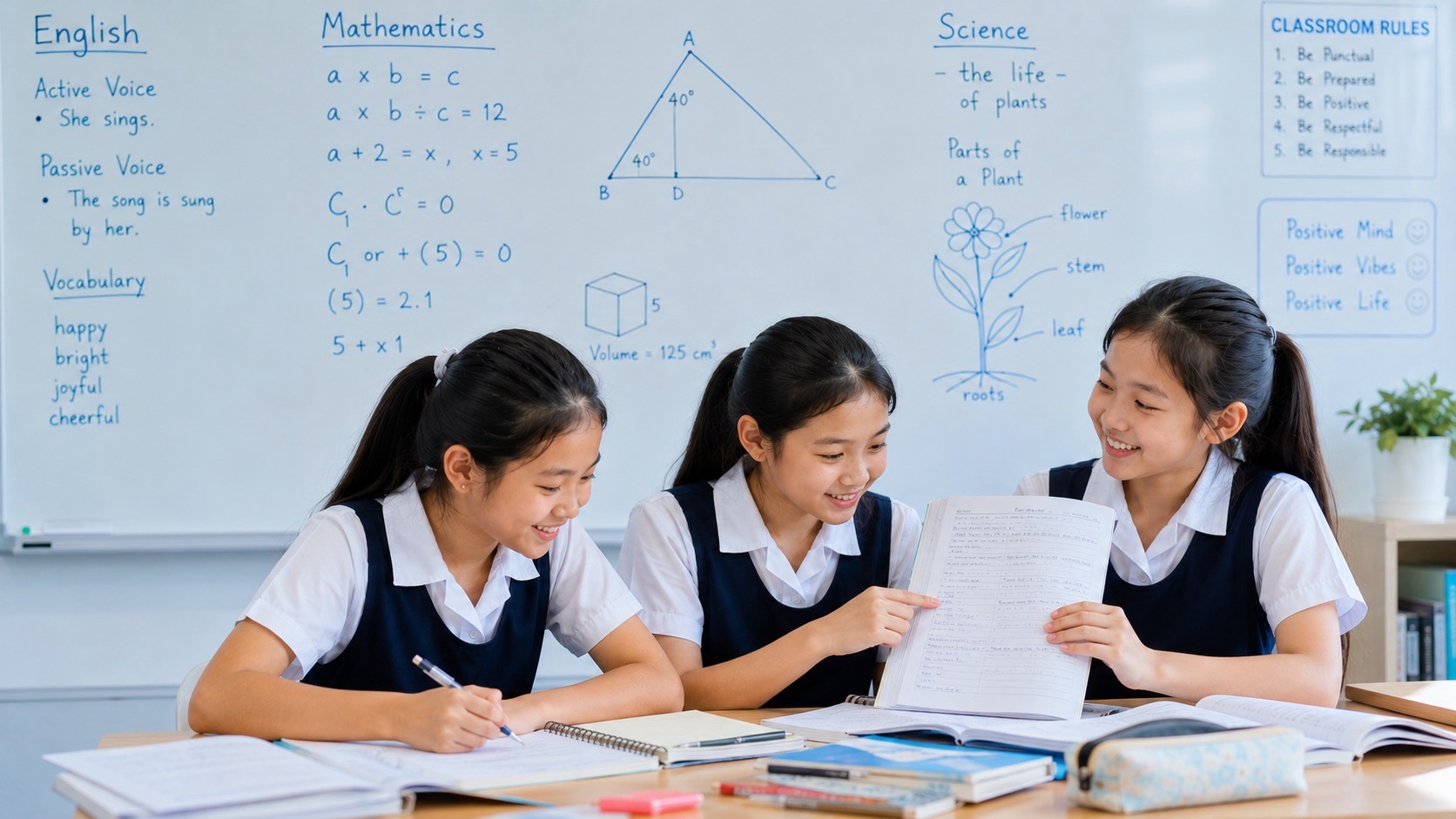
English Tuition for Fernvale Primary School should help Primary pupils solve a writing problem that is easy to misdiagnose. A child may know many vocabulary words, write grammatically acceptable sentences and still produce composition paragraphs that feel choppy, repetitive or disconnected. Families searching for Primary English tuition, Fernvale Primary School English tuition, composition writing, sentence construction, paragraph writing, grammar, vocabulary, comprehension, PSLE English and small-group English tuition are often looking for a way to turn individual sentences into coherent writing.
Current Singapore Primary English programmes commonly emphasise composition planning, paragraph organisation, sentence variety, grammar, vocabulary, comprehension, oral communication and writing feedback. The deeper skill connecting those areas is cohesion. A paragraph is not simply five correct sentences placed together. The sentences need to belong to the same job, refer clearly to one another and move the reader through an idea, event or explanation in a controlled order.
This 2017 legacy page keeps its historical title and URL; no school affiliation or endorsement is implied. Its modern educational job is specific: how Primary pupils build sentence-to-paragraph cohesion from P1 to P6. The focus is sentence purpose, paragraph jobs, reference, connectors, sequencing, cause and effect, repeated ideas, topic control, revision and the gradual move from tutor-supplied frames to independent composition architecture.
A paragraph is one unit of work
A strong paragraph usually performs one main job.
In narrative writing, the job may be:
- introduce the setting;
- create the problem;
- increase pressure;
- show a decision;
- show a consequence;
- resolve the story.
In expository writing, the job may be:
- explain one reason;
- develop one example;
- compare two ideas;
- show cause and effect;
- present one solution.
When a paragraph has no clear job, sentences often compete instead of cooperate.
Primary 1–2: build complete sentences before building elaborate paragraphs
Lower Primary pupils need stable sentence meaning first.
- Who or what is the sentence about?
- What happened?
- When did it happen?
- Where did it happen?
- Why did it happen?
Oral rehearsal helps. Ask the child to say the sentence before writing it. If the spoken idea is incomplete, the written sentence is unlikely to repair itself.
Sentence order should follow meaning
Young writers often produce several relevant sentences in an order that makes the reader work too hard.
Use simple sequencing questions:
- What happened first?
- What caused the next event?
- Which sentence explains the previous one?
- Which sentence should come last because it shows the result?
Sentence order is the earliest form of paragraph architecture.
Primary 3–4: paragraph jobs become visible
Middle Primary pupils can begin labelling paragraphs by function.
setup → disturbance → pressure → choice → consequence → resolution
This does not mean every story must contain exactly six paragraphs. The labels help pupils understand that each paragraph should move the story somewhere.
If two paragraphs perform the same job, they may need to merge or become more distinct.
Topic control prevents paragraph drift
Ask the pupil to complete:
This paragraph is mainly showing ______.
Then test every sentence against that job.
If a sentence is interesting but unrelated, move it, revise it or remove it.
Cohesion often improves through subtraction rather than addition.
Pronouns create cohesion when references remain clear
Repeating every noun makes writing clumsy. Replacing every noun with a pronoun makes writing confusing.
The reader should always know who or what each pronoun refers to.
When two characters of the same gender appear, repeating a name may be clearer than writing “she” three times.
Cohesion is not about maximum variation. It is about clear continuity.
Connectors should describe real relationships
Students sometimes insert linking words because teachers asked for more connectors.
The relationship must come first.
- because shows cause;
- therefore shows result;
- however shows contrast;
- although shows concession;
- meanwhile shows simultaneous or parallel action;
- later shows sequence.
A wrong connector damages cohesion because it tells the reader to expect the wrong relationship.
Repetition can be useful or wasteful
Repeating a key word can maintain topic continuity.
Repeating the same idea in slightly different wording can make the paragraph feel stuck.
Use the test:
Does this sentence add a new step, reason, example, detail or consequence?
If not, the sentence may be redundant.
Paragraph cohesion depends on causal movement
Weak narrative writing often becomes an event list:
This happened. Then this happened. Then something else happened.
Stronger narrative writing asks:
- What caused this?
- How did it create pressure?
- What decision followed?
- What consequence came from that decision?
Causality makes the paragraph feel inevitable rather than random.
The paragraph should enter late and leave early
Young writers often spend too long before the important event and continue too long after it.
Ask:
- What is the first sentence the reader actually needs?
- What is the last sentence that completes this paragraph’s job?
Trimming the edges often makes writing more energetic.
Primary 5–6: paragraph cohesion must survive longer compositions
Upper Primary writers need to coordinate:
- topic relevance;
- plot structure;
- paragraph jobs;
- sentence clarity;
- tense;
- reference;
- vocabulary;
- time management.
The solution is not to make the plan larger. It is to make the plan more useful.
A short plan should preserve paragraph architecture
Under time, five or six compact planning notes may be enough:
school fair → wallet found → temptation → friend asks → choice to return → consequence
The notes are not sentences. They preserve the causal spine so drafting does not need to invent the whole story again.
Topic relevance should be visible in the paragraph
A beautifully written paragraph can still be weak if it does not serve the composition topic.
Ask:
How does this paragraph help answer the topic?
If the connection is difficult to explain, the paragraph may be drifting.
Dialogue should change the paragraph
Dialogue is cohesive when it performs a job:
- reveal information;
- create conflict;
- force a decision;
- show misunderstanding;
- repair a relationship;
- change what happens next.
If the conversation changes nothing, it may be decorative.
Description should support viewpoint and movement
Do not describe everything visible.
A frightened character notices exits.
An impatient character notices the clock.
A guilty character notices who is watching.
Selective detail strengthens cohesion because description now belongs to the character’s situation.
Sentence variety should follow paragraph purpose
Longer sentences can accumulate detail.
Short sentences can mark a turn.
A fragment may occasionally work stylistically in advanced writing, but Primary pupils should first master complete sentence control.
Variation should support meaning, not satisfy a checklist.
The reverse-outline test reveals paragraph drift
After writing, summarise every paragraph in five words.
Example:
- arrive at school fair;
- find wallet near stall;
- temptation and friend pressure;
- decide to return wallet;
- owner appears, consequence;
- reflect on choice.
If two paragraph summaries are almost identical, the draft may be repeating rather than progressing.
The “one sentence too many” editing drill
Give pupils a paragraph containing one unnecessary sentence.
Ask which sentence should be removed and why.
This teaches cohesion through editing rather than only through drafting.
The “missing bridge” editing drill
Give two sentences where the logical connection is unclear.
The child must decide whether the paragraph needs:
- a connector;
- a cause;
- an explanation;
- a reference noun;
- a reordered sentence.
This shows that cohesion problems have different causes.
Grammar correction should not destroy paragraph flow
When pupils edit grammar, they can become so focused on individual sentences that they forget the paragraph.
Edit in passes:
- Does the paragraph have one job?
- Is the order logical?
- Are references clear?
- Are sentences grammatically stable?
- Is vocabulary precise?
Large structure comes before small polish.
Reading can teach paragraph cohesion
Choose one strong paragraph from age-appropriate reading and ask:
- What is this paragraph doing?
- How does sentence two connect to sentence one?
- Where does the writer use reference?
- Which word signals contrast or cause?
- What would happen if one sentence moved?
Reading becomes a source of writing architecture.
Small-group composition should compare architecture
Three pupils can plan the same topic differently.
Compare:
- where each story begins;
- where pressure appears;
- which paragraph contains the decision;
- how the ending grows from the choice;
- which plan contains unnecessary scenes.
The group learns structural judgement without copying one model story.
A 90-minute cohesion lesson
| Time | Learning job |
|---|---|
| 10 min | sentence-combining retrieval |
| 15 min | analyse one model paragraph |
| 15 min | cold composition plan |
| 20 min | draft one or two paragraphs |
| 15 min | reverse outline + cohesion edit |
| 10 min | fresh paragraph on changed topic |
| 5 min | future writing rule |
The paragraph error ledger
| Recurring problem | Future rule |
|---|---|
| paragraph drifts | state its job before drafting |
| repetition | each sentence must add a new function |
| pronouns unclear | repeat the noun when references compete |
| events feel random | link cause → pressure → choice → consequence |
| dialogue too long | keep only speech that changes the scene |
| ending unrelated | resolve the central problem, not a new one |
Retesting should change the topic
If a child learned paragraph cohesion through a story about honesty, do not test only another honesty story.
Use a new setting, different conflict or expository task.
The paragraph job should remain clear even when the subject changes.
Parents can ask structural questions without rewriting the composition
- What is this paragraph trying to do?
- Which sentence is most important?
- Does every sentence belong?
- What changed because of this paragraph?
- Does the next paragraph follow logically?
- What problem does the ending resolve?
These questions preserve the child’s authorship.
When extra English tuition may not be necessary
A pupil who reads widely, writes regularly, organises paragraphs independently, uses school feedback and continues improving may not need additional formal tuition.
Reading, journalling and ordinary writing for real purposes can provide valuable practice.
Questions parents can ask an English tutor
- How do you teach paragraph purpose?
- How do you move from sentence frames to independent writing?
- How do you teach reference and cohesion?
- How do pupils learn cause-and-effect story structure?
- How are model texts used without encouraging imitation?
- How are revisions transferred to new topics?
- How do prompts reduce?
- How do you distinguish grammar problems from structure problems?
Frequently asked questions
Why does my child write grammatically correct paragraphs that still feel weak?
The paragraph may lack one clear purpose, logical sentence order, reference continuity or causal movement. Grammar can be correct while cohesion remains weak.
Should every paragraph begin with a topic sentence?
Not in exactly the same formulaic way. The paragraph should have a clear job, but narrative and expository paragraphs may signal that job differently.
How can composition become less repetitive?
Give each paragraph a different function and require each sentence to add new information, pressure, explanation or consequence rather than restating the same point.
What is the best sign cohesion is improving?
The pupil can explain each paragraph’s job, remove irrelevant sentences, maintain clear references and produce a draft whose events or ideas progress without the tutor having to reorganise it.
English Tuition for Fernvale Primary School: the larger lesson
Writing does not become coherent because every sentence is correct.
It becomes coherent because every sentence knows why it is there.
What is this paragraph doing?
What does this sentence add?
Who does this pronoun refer to?
What caused the next event?
Does the ending resolve the same problem the story created?
When those questions move from tutor prompts into the learner’s own revision process, composition stops being a sequence of sentences and becomes controlled communication. That is the modern learning job of English Tuition for Fernvale Primary School. No school affiliation or endorsement is implied.
Current routes
- MOE — Primary English Language Syllabus
- SEAB — 2026 PSLE English Language
- eduKateYishun — English Tuition & Learning Hub
Leave a Reply