
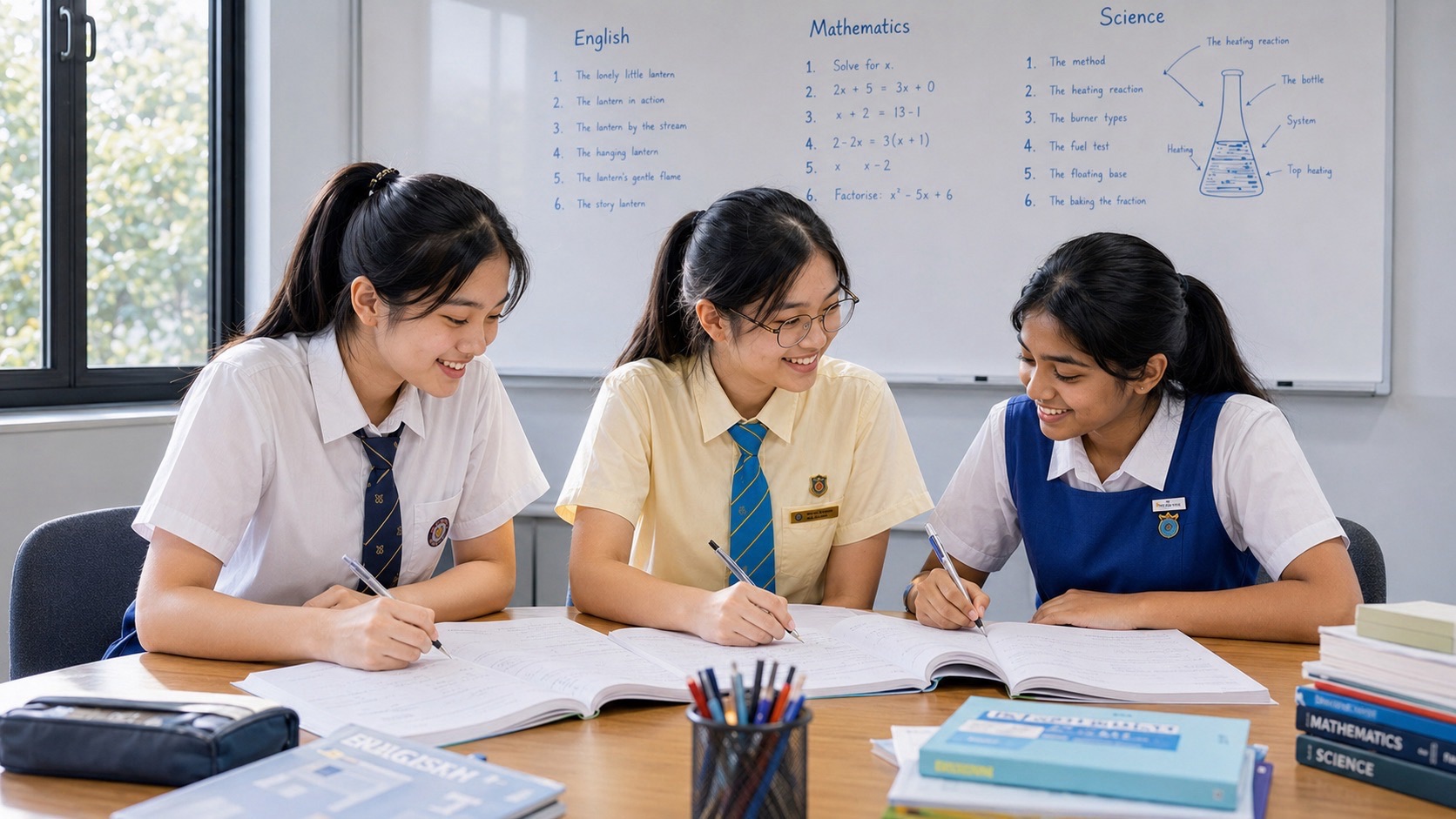
Punggol Tutor Secondary Maths Tuition Center should help families understand what a strong Secondary Mathematics tutor actually does when a student moves from Primary arithmetic into algebra, graphs, geometry, trigonometry, problem solving and eventually examination performance. Parents searching for Secondary Maths tuition Punggol, Sec 1 Maths tuition, Sec 2 Maths tuition, Sec 3 Maths tuition, Sec 4 Maths tuition, G2 Mathematics, G3 Mathematics, Additional Mathematics, algebra tuition and small-group Maths tuition are often looking at the visible symptom—falling marks—when the real problem may be one unstable mathematical dependency.
Current Singapore Secondary Mathematics tuition pages repeatedly emphasise algebra foundations, problem solving, clear working, method selection, small-group attention and examination preparation. Those phrases matter because Secondary Mathematics is not simply Primary Mathematics with larger numbers. The subject becomes more symbolic, more interconnected and less forgiving of weak fractions, negative-number control, algebraic manipulation or unclear working. A tutor should therefore diagnose the first weak link before prescribing more practice.
The wider Singapore examination landscape is also changing. SEAB states that from 2027, the former GCE N(T), N(A) and O-Level qualifications are combined as the Singapore-Cambridge Secondary Education Certificate (SEC), with subjects taken at G1, G2 or G3 levels under Full Subject-Based Banding. For 2027 school candidates, SEAB lists G2 Mathematics K210, G3 Mathematics K310, G2 Additional Mathematics K232 and G3 Additional Mathematics K341. This article therefore keeps the historical title while teaching the modern job: build mathematical understanding that survives subject-level pathways, syllabus changes and unfamiliar questions. Current official information should be checked with SEAB’s SEC page, 2027 G2 syllabuses and 2027 G3 syllabuses.
Secondary Mathematics changes the language before it changes the difficulty
A Primary student may see:
3 × 7 = 21
A Secondary student may see:
3x = 21
The arithmetic relationship has not disappeared. But now the pupil must understand a variable, an equation, balance, inverse operations and symbolic convention.
That is the central transition:
arithmetic procedure → mathematical structure → symbolic reasoning
A tutor should inspect the first wrong mathematical move
The final wrong answer is only the visible end of the error.
The first invalid line may be:
- a negative sign applied incorrectly;
- unlike terms combined;
- a bracket expanded only partly;
- a fraction simplified illegally;
- an equation treated like an expression;
- a graph scale read wrongly;
- a formula used with the wrong measurement;
- a unit omitted;
- the correct method presented so unclearly that the student cannot inspect it.
Good Secondary Maths tuition traces upward until the first unstable decision appears. That decision becomes the teaching target.
The dependency map matters more than the chapter label
| Current difficulty | Possible earlier dependency |
|---|---|
| Algebraic fractions | ordinary fractions, factorisation, sign control |
| Linear equations | inverse operations, negatives, equality |
| Graphs | coordinates, scale, substitution, equation meaning |
| Trigonometry | ratio, geometry, algebra, calculator control |
| Quadratics | expansion, factorisation, equation structure |
| Additional Mathematics | symbolic fluency, functions, algebraic accuracy |
A student who says “I cannot do trigonometry” may actually understand the trigonometric ratio and then fail while rearranging the equation. Another may perform the algebra perfectly but choose the wrong relationship from the diagram.
Same chapter. Different repair.
Secondary 1: algebra should be taught as a language
Before manipulating symbols quickly, pupils need to know what the symbols mean.
- variable: a quantity represented by a symbol;
- coefficient: the numerical factor attached to a term;
- term: one part of an expression separated by addition or subtraction;
- expression: a mathematical phrase without an equality statement;
- equation: a statement that two expressions are equal.
These are not vocabulary decorations. They tell pupils what operations are legal.
“Move it to the other side” is not a mathematical principle
The phrase can appear to work on simple equations. It becomes dangerous when pupils stop thinking about equality.
A stronger idea is balance:
perform the same valid operation to both sides so equality is preserved.
Once this principle is understood, changing a sign is no longer magic. It is the visible result of an inverse operation applied consistently.
Negative numbers are an early stress test
Weak negative-number control spreads quickly through Secondary Mathematics.
It affects:
- algebraic simplification;
- equations;
- coordinates;
- graphs;
- expansion;
- factorisation;
- substitution.
Do not dismiss repeated sign losses as “carelessness”. If the same representation habit creates the same error, the system needs repair.
Fractions do not disappear when algebra begins
They become more expensive.
A pupil who is shaky with ordinary numerical fractions often becomes much less stable when numerators and denominators contain letters.
Before teaching an algebraic fraction shortcut, test whether the child still understands:
- common denominators;
- factor cancellation;
- multiplication versus addition;
- signs;
- equivalent forms.
Symbolic difficulty often exposes an older numerical dependency.
Secondary 2: method selection becomes more important
By Secondary 2, pupils usually face a wider network of topics. The question is increasingly not “Can you repeat the demonstrated method?” but “Can you recognise which method belongs here?”
Topical practice is still useful when a concept is new. It should gradually give way to mixed work.
learn → practise → delay → mix → transfer
The chapter title is a clue. Examination questions eventually remove that clue.
Secondary 3: dependency debt becomes visible
Upper-secondary Mathematics can feel suddenly steep because several earlier skills are now required at once.
A question may require the pupil to:
- interpret a diagram;
- select a formula;
- substitute accurately;
- rearrange algebra;
- use a calculator correctly;
- state the final answer with suitable units or accuracy.
One weak dependency can break a five-step solution. This is why Secondary 3 tuition should audit foundations while teaching current content.
Additional Mathematics amplifies algebraic habits
Additional Mathematics is not simply “harder E-Math”. It expects stronger symbolic fluency and uses algebra as the operating language for functions, trigonometry, quadratics and, at the relevant subject level, calculus.
SEAB’s 2027 G3 Additional Mathematics K341 syllabus explicitly assumes knowledge of the G3 Mathematics syllabus. That dependency matters pedagogically. A tutor should not treat weak G3 Mathematics algebra as someone else’s problem while pushing ahead with Additional Mathematics chapters.
Repair the floor that the new topic stands on.
Secondary 4: the job changes from chapter learning to paper control
By the final year, the student increasingly needs to integrate.
- retrieve without notes;
- identify the method from mixed questions;
- organise longer working;
- manage time;
- skip strategically;
- return to incomplete work;
- check personal error risks.
A tutor who continues teaching every lesson as an isolated chapter may miss the actual final-year problem.
Separate knowledge failure from performance failure
| Failure family | What it means | Likely repair |
|---|---|---|
| Knowledge | Concept or formula unavailable | Rebuild and retrieve |
| Recognition | Method known but not selected | Mixed comparison practice |
| Representation | Problem translated wrongly | Diagram/equation modelling |
| Execution | Correct route, algebra/arithmetic fails | Targeted fluency repair |
| Communication | Working unclear or incomplete | Line-by-line mathematical presentation |
| Timing | Reachable marks left unfinished | Pacing and move-on rules |
| Checking | Known errors not caught | Personal verification routine |
Clear working is a mathematical tool
Working is not written merely because an examiner wants to see something.
Good working allows the pupil to:
- see the logical sequence;
- spot the first wrong line;
- check a substituted value;
- preserve units;
- recover without restarting;
- communicate enough method to be understood.
Compressed working is not automatically sophisticated. If compression creates repeated sign or transcription errors, slow the representation until control returns.
One transformation per line can be a powerful temporary repair
Students who lose signs, brackets or denominators may benefit from writing one algebraic transformation per line.
This makes illegal jumps visible.
Later, when the process becomes stable, the student may compress safely. The temporary goal is not beautiful handwriting. It is reliable reasoning.
Graphs should be interpreted, not merely plotted
A student should ask:
- what each axis represents;
- what the scale is;
- what an intercept means;
- what gradient means in context where relevant;
- where values rise, fall or remain constant;
- which values are meaningful within the problem.
Graph literacy connects algebra, geometry, data and real-world interpretation.
Geometry diagrams should be treated as evidence
Do not assume a line is perpendicular because it looks perpendicular. Do not assume lengths are equal because the drawing looks symmetrical.
Mark what is given. Use known properties. Separate visual impression from mathematical fact.
This is the same disciplined reasoning students use in Science: claim only what the evidence allows.
Trigonometry errors should be classified
- wrong ratio or relationship;
- diagram misread;
- angle/side correspondence confused;
- calculator mode error;
- algebra after substitution fails;
- final condition or accuracy mishandled.
“Do more trigonometry questions” is a blunt response. Target the mechanism that is actually failing.
Functions should move across representations
Students should move among:
- equations;
- tables;
- graphs;
- verbal descriptions;
- specific numerical inputs and outputs.
A pupil who can translate between representations understands more than a pupil who recognises one worksheet format.
Mixed practice should begin before examination season
Topical work teaches the method. Mixed work teaches selection.
A short mixed set can combine:
- one algebra item;
- one graph;
- one geometry or mensuration problem;
- one ratio/percentage application;
- one older retrieval question.
The pupil has to decide which mathematical system applies.
Interleaving may initially reduce scores—and still improve learning
When pupils first move from blocked worksheets to mixed sets, performance can feel less fluent. That is expected. The task has become harder because the method is no longer announced.
The useful question is not “Did the score dip today?”
It is “Is the student becoming better at choosing methods without cues?”
Delayed retrieval prevents chapter amnesia
Return to important skills after several days, two weeks and a month.
Do not keep old Mathematics alive only by rereading notes. Use short problems that force reconstruction.
Secondary Mathematics compounds. A concept forgotten after the test may be needed inside another chapter later.
The Secondary Mathematics error ledger
| Error | Cause | Future rule | Retest |
|---|---|---|---|
| sign error | too many transformations in one line | one change per line | fresh algebra set |
| wrong method | depends on chapter cue | compare competing methods | mixed set |
| graph value wrong | scale ignored | read axes and interval first | new graph |
| trig answer incomplete | condition forgotten | record required condition before final line | new trig item |
| paper unfinished | hard-question trap | use move-on threshold | timed section |
The ledger should be short enough to use and dynamic enough to shrink.
Immediate correction is not proof of retention
Once the tutor shows the missing step, the original question often becomes easy.
Retest with:
- different numbers;
- changed wording;
- a different diagram;
- a reversed unknown;
- a delay of several days;
- a mixed set containing competing methods.
The skill is promoted only when it survives without the original explanation beside it.
Small-group Maths should preserve independent starts
Before group discussion, every student should attempt.
The tutor needs to observe:
- how the pupil reads the question;
- what representation is chosen;
- where the first hesitation appears;
- whether the child asks for help too quickly;
- whether the working remains inspectable.
If the strongest pupil speaks first every time, the class may look lively while hiding individual dependency.
Method comparison is one of the best uses of three students
After individual attempts, compare two valid routes.
- Which is shorter?
- Which is easier to check?
- Which depends on a special property?
- Which is more general?
- Which would be safer under time?
Students learn mathematical judgement rather than worshipping one “teacher method”.
A useful 90-minute Secondary Maths tutorial
| Time | Learning job |
|---|---|
| 10 min | Retrieval of earlier dependency |
| 15 min | Cold attempt / school-paper diagnosis |
| 20 min | Explicit concept teaching |
| 20 min | Guided then independent practice |
| 15 min | Mixed transfer / method comparison |
| 10 min | Fresh retest and error rule |
The architecture should change with the learner. Sec 4 near prelims needs more timed integration than Sec 1 learning algebra for the first time.
A tutor should use prompts in levels
- Wait.
- Ask the pupil to reread the target.
- Ask what is known.
- Ask what representation might help.
- Point to a relevant relationship.
- Model one step only if necessary.
Record the lightest prompt that restores progress.
One sign of genuine improvement is prompt reduction.
Homework should have a mathematical job
Homework may target:
- fluency;
- retrieval;
- one error repair;
- mixed method selection;
- transfer;
- timing;
- extension.
Thirty repetitive questions are not automatically more rigorous than eight well-chosen questions that expose the actual weakness.
Strong students need depth, not decorative difficulty
A strong learner can be extended through:
- alternative methods;
- proof-like explanations;
- counterexamples;
- changed assumptions;
- unfamiliar representations;
- generalisation;
- questions where more than one route is valid.
Harder numbers are not the only form of mathematical challenge.
When marks fall despite effort
Do not assume the student needs more hours immediately.
Audit:
- foundation knowledge;
- method selection;
- working clarity;
- accuracy;
- timing;
- question interpretation;
- checking.
More practice helps only when it attacks the limiting factor.
When marks stay high, inspect independence anyway
A student can score well on familiar school worksheets while depending heavily on hints, chapter cues or memorised models.
Ask whether the pupil can:
- start an unfamiliar problem;
- choose a representation;
- explain why a method works;
- recover after a failed attempt;
- check independently.
High marks and strong independence are related but not identical.
Sec 3 to Sec 4 runway
Sec 3 early year: audit dependencies
Check algebra, fractions, graphs and core lower-secondary knowledge before new topics compound.
Sec 3 middle year: build concepts and retrieval
Learn current topics while deliberately bringing back older ones.
Sec 3 end year: increase mixed selection
Remove chapter cues and compare competing methods.
Sec 4 early year: consolidate the system
Repair remaining gaps and increase integrated practice.
Prelim runway: train performance
Use realistic timing, error-ledger repair, paper triage and checking routines.
Final examination runway: stabilise
Retest high-frequency errors, maintain old topics and avoid replacing a working system with last-minute novelty.
Questions parents can ask a Secondary Maths tutor
- What is my child’s first unstable mathematical dependency?
- How do you distinguish concept errors from execution errors?
- How is algebra taught from meaning rather than shortcuts?
- How are G1, G2 and G3 subject levels handled?
- How do you judge Additional Mathematics readiness?
- When does mixed practice begin?
- How are old topics retrieved after a delay?
- How are corrections retested?
- How is paper timing trained?
- How do you reduce prompts?
Red flags
- guaranteed grade jumps;
- instant-improvement promises;
- old stream labels presented as if nothing changed;
- one worksheet path for every student;
- constant tutor rescue;
- full papers before foundational repair;
- no delayed retrieval;
- no plan for independence.
Frequently asked questions
What happens to O-Level Mathematics from 2027?
SEAB states that the former GCE N(T), N(A) and O-Level qualifications are combined under the Singapore-Cambridge Secondary Education Certificate from 2027. Students sit subjects at G1, G2 or G3 levels. Check the current SEAB syllabus for the student’s examination year.
What are the 2027 Mathematics codes?
For school candidates, SEAB lists G2 Mathematics K210, G3 Mathematics K310, G2 Additional Mathematics K232 and G3 Additional Mathematics K341.
Should Secondary 1 students start with difficult exam papers?
Usually the higher-value job is establishing number, algebra, representation and working habits, then introducing mixed assessment-style work progressively.
What should improve before marks improve?
Independent starts, clearer working, fewer repeated errors, stronger retrieval and better method selection often improve before a large score change appears.
Punggol Tutor Secondary Maths Tuition Center: the larger lesson
A Secondary Maths tutor should not become a human answer key.
The tutor should help the learner see mathematical structure earlier, represent it more clearly, choose methods more intelligently, execute them more reliably and inspect the result with less external rescue.
Algebra should become a language the pupil can read.
Working should become a surface the pupil can inspect.
Mixed questions should become decisions rather than surprises.
And examinations should become a performance environment in which an existing mathematical system is operated, not a crisis in which a new one is invented.
That is the durable job of Punggol Tutor Secondary Maths Tuition Center: repair the first weak link, connect the Mathematics, and gradually return control to the student.
Leave a Reply