
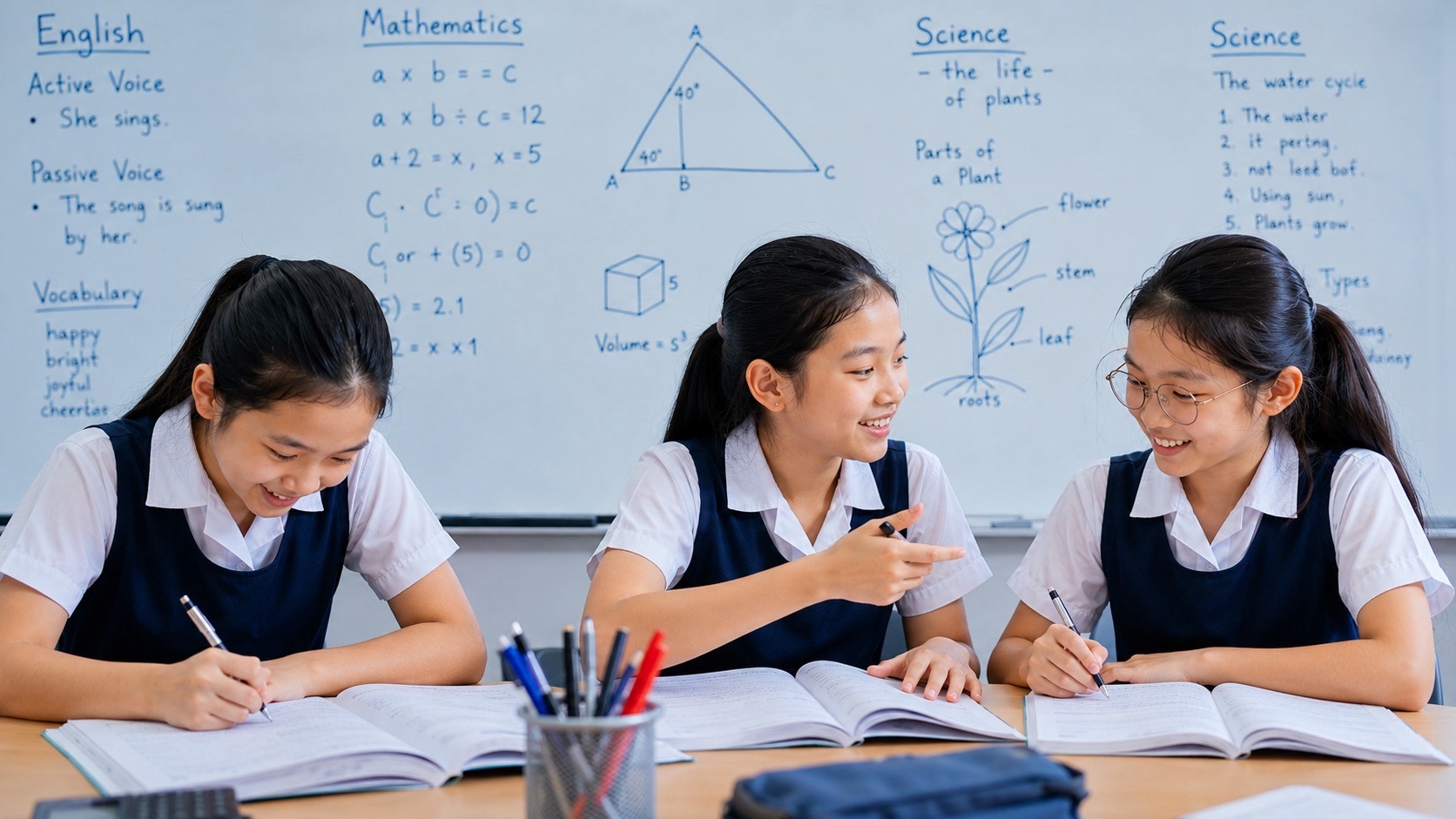
Katong English Enrichment Class is rebuilt as a Primary creative-language guide for families searching for English enrichment classes in Singapore, Katong English tuition, Primary English tuition, creative writing, composition writing, vocabulary, reading comprehension, grammar, oral communication, small-group English classes and PSLE English preparation. Its central learning job is simple to describe and difficult to fake: help pupils notice more, then turn what they notice into precise, meaningful language.
Current English enrichment and creative-writing programmes in Singapore often emphasise composition techniques, vocabulary, comprehension, oral communication, grammar, modelled writing, feedback and small-group learning. Those components are useful, but creativity does not arrive because a worksheet says “be creative”. Creativity grows when a child has knowledge, observation, language and enough structural control to select details that matter. A pupil who notices gesture, movement, contradiction, setting and cause has more material than a pupil who memorises twenty dramatic phrases.
This historical 2017 page keeps its title, URL, publication date and featured image. It does not claim a current eduKate operating location in Katong. Its modern learning job is observation-to-imagination transfer: how Primary 3 to Primary 6 pupils can read the world closely, distinguish useful from decorative detail, infer carefully and transform ordinary observations into stronger creative writing, oral description and comprehension.
1. Creativity needs raw material
Writers do not create from nothing. They recombine what they have seen, heard, read, learned and imagined. A child whose experience of writing consists mainly of model compositions may know how stories look without having enough material to build one independently.
Observation enlarges the raw-material bank.
2. Observation is not listing
“I saw a red chair, a white wall and a brown table” is technically observation but not yet useful writing. Useful observation selects details connected to mood, action, character or meaning.
The writer’s job is not to notice everything. It is to notice what matters.
3. Five observation channels
| Channel | Question | Writing use |
|---|---|---|
| Movement | What is changing or moving? | Action, pacing, tension. |
| Sound | What can be heard? | Atmosphere, distance, interruption. |
| Space | Where are objects and people in relation? | Setting, route, obstacle. |
| Behaviour | What do people repeatedly do? | Character inference. |
| Objects | Which item seems unusually important? | Clue, memory, conflict, connection. |
Smell and touch can also matter, but pupils should select them when relevant rather than force all five senses into every paragraph.
4. Observation before inference
Teach pupils to separate what is visible from what it might mean. “His hands are shaking” is observation. “He is guilty” is an inference. Shaking might also indicate fear, cold or exhaustion.
This distinction improves comprehension and creative writing at the same time.
5. The inference ladder
- State the visible detail.
- List two possible explanations.
- Look for additional evidence.
- Choose the strongest interpretation.
- Keep uncertainty if the evidence remains incomplete.
A writer can then decide whether to reveal the truth immediately or let the reader share the uncertainty.
6. People-watching without inventing facts
In a safe public setting, pupils can observe posture, pace, gesture and interaction without pretending to know strangers’ lives. “The man checked his watch three times” is usable. “He was late for a job interview” is invention.
The writer may later use the behaviour inside a fictional character, but should understand where observation ended and imagination began.
7. Setting as pressure
A setting becomes interesting when it changes what characters can do. A crowded walkway slows movement. Heavy rain changes routes. A quiet library makes one dropped object unusually loud. A closing gate creates a deadline.
This is more useful than a paragraph of generic scenery.
8. Objects with story potential
Give pupils an ordinary object—a receipt, umbrella, key, broken strap, name tag, notebook or photograph—and ask for five different story functions. The object might be evidence, obstacle, connection, memory or choice.
Imagination improves when pupils learn to change function rather than merely change adjective.
9. The ordinary-detail challenge
Write a scene using no dramatic accident, emergency or villain. The pupil must create interest through ordinary pressure: being late, misunderstanding a message, returning an item, keeping a promise, deciding whether to admit something.
This trains story control because the pupil cannot rely on spectacle.
10. Vocabulary from observation
Observation generates a reason for precise language. Instead of memorising ten movement verbs, watch how people actually move: shuffle, stride, edge, weave, hurry, linger, stumble, retrace.
Then connect verbs to context and collocation. Precision becomes functional.
11. Specific nouns
Specific nouns reduce the need for adjective piles. Turnstile, railing, lanyard, trolley, noticeboard, platform create a clearer world than thing, area, object.
Vocabulary breadth therefore supports description by naming reality accurately.
12. Behaviour reveals character
Rather than writing “She was impatient”, show the repeated behaviour: tapping a shoe, checking a queue, interrupting, moving ahead before the person in front has finished. Character adjectives become conclusions drawn from evidence.
This is another bridge between reading inference and writing craft.
13. Contradiction creates interest
A character who says “I’m fine” while folding and refolding a receipt creates subtext. A cheerful poster beside an empty shop creates contrast. An immaculate uniform with muddy shoes suggests a story.
Teach pupils to notice when two details do not fit neatly together. Contradiction is fertile ground for questions.
14. Questions generate story
- Why is that object there?
- What happened just before this moment?
- What does the character want now?
- What might they be hiding?
- What could change their plan?
- What would happen if one assumption were wrong?
A useful creative-writing class teaches pupils to ask such questions themselves.
15. Photograph-to-story workflow
- List only visible details.
- Group details by person, setting and object.
- Make two cautious inferences.
- Choose one story question.
- Give the main character a goal.
- Turn one detail into an obstacle or clue.
- Plan the consequence.
The photograph becomes a springboard rather than a list of things to mention.
16. Reading-to-observation transfer
When reading a strong narrative, ask which details the writer selected and which were omitted. Why did the writer mention the cracked cup but not the colour of every chair? Selection is part of craft.
Pupils can imitate the principle without copying the wording.
17. Oral description
Give pupils thirty seconds to observe an image, then remove it and ask them to describe what mattered. Memory reveals which details felt salient. Compare descriptions among three pupils and discuss why different people noticed different things.
This creates excellent vocabulary and oral practice.
18. From oral description to paragraph
After discussion, pupils write one paragraph using only three selected details. Each detail must contribute to mood, character or action. This forces prioritisation.
More detail is not automatically better detail.
19. Description and pacing
Description slows narrative time. Use it where the reader needs to notice something important. Compress routine travel; slow down at discovery, conflict or decision.
Pupils should understand that description has a cost in time and words.
20. Sensory detail
Sensory writing works when the detail belongs to the viewpoint. A frightened child may notice footsteps and the rattle of a locked handle. A hungry child may notice the smell from a stall. Viewpoint decides what becomes salient.
This is better than forcing one smell, one sound, one touch and one sight into every scene.
21. World knowledge feeds imagination
A pupil can invent more credibly when they know more about places, jobs, weather, transport, animals, sports, technology and daily systems. Knowledge supplies constraints and possibilities.
English enrichment should therefore include substantial reading beyond composition models.
22. Primary 3: concrete noticing
At Primary 3, focus on clear nouns, verbs and one or two meaningful details. Ask pupils to distinguish what they saw from what they guessed. Keep creative transformation simple.
23. Primary 4: observation plus motive
Primary 4 pupils can connect behaviour to possible motive. Why might the character keep looking toward the door? Generate alternatives before choosing one for the story.
This builds richer characterisation without requiring complicated plots.
24. Primary 5: patterns and contradiction
Primary 5 pupils can notice repeated behaviour and conflicting clues. A character says one thing but repeatedly acts another way. The writer can create suspense through the gap.
25. Primary 6: selective detail under time
By Primary 6, pupils should select useful detail quickly. Timed writing rewards judgement: which two details make the scene vivid and relevant? Which paragraph deserves expansion?
Observation becomes an examination skill when it helps the pupil develop rather than decorate.
26. Revision by deleting
A powerful exercise is to delete half the descriptive details and ask whether the scene improves. Pupils learn that strong writing is often created through selection and removal.
If a detail changes nothing about mood, character, action or understanding, it may not be earning its space.
27. Revision by upgrading
Choose three vague words—went, looked, nice, bad, thing—and replace only where a more precise word genuinely improves meaning. Do not turn every ordinary word into a thesaurus challenge.
28. Feedback language
- This detail is accurate but not yet useful—what does it change?
- You inferred too quickly; what else could the action mean?
- Which object could carry the story instead of just decorating the room?
- Your vocabulary is vivid, but which word is most precise?
- Can the reader infer the emotion from the behaviour?
29. A four-week observation cycle
- Week 1: objects, movement and precise nouns.
- Week 2: behaviour, inference and character.
- Week 3: setting as pressure and route.
- Week 4: independent composition using selected observed detail.
Repeat with less scaffolding and unfamiliar images or texts.
30. Small-group advantage
Three pupils rarely notice exactly the same thing. Comparison itself becomes the lesson. One notices sound, another spatial arrangement, another behaviour. The tutor can ask which detail would produce the strongest story and why.
Creativity becomes comparative judgement rather than mystical inspiration.
31. Parent questions
- What did you notice first?
- Which detail matters most?
- What are you inferring rather than observing?
- What else could that behaviour mean?
- How could this object create a problem or connection?
- Which detail would you remove?
32. What parents should look for
- Reading and observation beyond model compositions.
- Vocabulary learned from real contexts.
- Discussion of why details matter.
- Creative writing that grows from knowledge and cause.
- Feedback on selection, not only grammar.
- Independent story decisions rather than teacher-supplied plots.
33. Frequently asked questions
Can observation really be taught?
Yes. Pupils can be trained to slow down, distinguish fact from inference, compare details and ask better questions.
Will realistic observation make stories boring?
No. Reality supplies strong constraints. Interesting stories often come from ordinary details placed under pressure.
How does this help comprehension?
Pupils become better at noticing textual evidence, behaviour and implied meaning.
Does this page advertise a current Katong centre?
No. It is an educational archive page preserving its historical title and URL.
34. The durable principle
Creative language starts with attention. A child who notices accurately, questions thoughtfully and understands more of the world does not need to manufacture “creative” sentences from nothing. The material is already there, waiting to be selected and transformed.
Notice first. Infer carefully. Imagine deliberately. Write what matters.
35. Observation walks as English training
A short observation walk can produce language material without becoming an excursion for its own sake. Give pupils one narrow task: notice movement, collect signs, map sound, watch how people queue, or identify objects that control movement through a space. Back in class, convert the observations into precise nouns and verbs.
The lesson is not “go outside and write creatively”. It is “collect evidence, classify it, then choose what belongs in writing”.
36. The detail ladder
| Level | Example |
|---|---|
| Generic | A man walked quickly. |
| Specific action | A man weaved through the queue. |
| Meaningful detail | He weaved through the queue while checking a folded ticket. |
| Story-bearing detail | He weaved through the queue, checking the same folded ticket after every few steps. |
Each level adds information. The writer should stop when the detail has done enough work.
37. Objects as clues
An object can reveal ownership, memory, urgency or conflict. Give pupils an ordinary item and ask: who owns it, why does it matter now, what changes if it is lost, and what might another character misunderstand about it?
The exercise turns observation into plot architecture.
38. Space and route
Many weak stories have characters teleport conveniently from one place to another. Teach pupils to think spatially. Where is the exit? What blocks the route? Who can see whom? How long would movement take?
A quick sketch can make a scene more believable and prevent impossible action sequences.
39. Sound as information
Sound does more than create atmosphere. A closing announcement creates urgency. Footsteps reveal approach. A repeated vibration signals an ignored phone. A sudden silence can make a character notice something has changed.
Teach pupils to ask what the sound causes, not merely how it sounds.
40. Gesture and subtext
Small gestures can contradict speech. A character says “Take your time” while glancing repeatedly at the clock. A pupil says “It doesn’t matter” while folding the paper into smaller pieces. The reader infers tension without the writer naming it.
This is an age-appropriate entry into subtext.
41. Description from viewpoint
Different characters notice different details. A nervous pupil notices exits and watching faces. A hungry child notices food smells. A competitive athlete notices scores and timing. Viewpoint makes description selective and character-specific.
42. The memory test
Show pupils an image for thirty seconds, then remove it. Ask them to list what they remember. Compare the lists. Salient details reveal attention. Then discuss which remembered details are actually useful for a story.
The exercise demonstrates that noticing and selecting are different skills.
43. The camera test
Ask whether a camera could record the sentence. “She clenched the handle” is observable. “She regretted everything” is internal. Both can belong in writing, but pupils should know the difference and decide when to show behaviour and when to state thought directly.
44. The contradiction bank
- smiling while avoiding eye contact;
- a spotless desk with one torn envelope;
- a cheerful message sent at an unusual hour;
- a crowded place around one empty seat;
- a confident answer followed by repeated erasing.
Contradictions create questions, and questions create story energy.
45. Knowledge before imagination
If pupils want to write about a hospital, competition, airport, museum or animal encounter, build enough real knowledge first. Knowing ordinary procedures and objects makes invented events more convincing.
A few accurate details do more than a large amount of generic excitement.
46. Reading as an observation apprenticeship
When reading fiction, highlight only the details that change interpretation. Ask why the writer selected them. Then remove one detail and discuss what becomes less clear. Pupils discover that description is edited attention.
47. Nonfiction as detail training
Nonfiction teaches precise naming and classification. A pupil who reads about trains, storms, insects or buildings gains nouns and processes that can later enrich both explanation and creative writing.
48. The one-object story
Challenge pupils to build a complete story around one ordinary object. The object must appear in the opening, become important in the middle and carry a changed meaning by the ending. A key can shift from convenience to responsibility; a receipt can shift from rubbish to evidence.
The exercise teaches cohesion.
49. The no-adjective paragraph
Ask pupils to write a vivid paragraph with no adjectives. They must rely on precise nouns, verbs, spatial relationships and action. The restriction reveals how much descriptive work verbs and nouns can do.
Adjectives can return later, but with greater purpose.
50. The no-emotion-word scene
Write a scene without using angry, nervous, sad, happy, scared or similar labels. Emotion must appear through behaviour, speech, thought and physical reaction.
The task trains evidence-based characterisation.
51. The setting swap
Take the same conflict and place it in a library, sports hall, bus interchange and hawker centre. What changes? Noise, visibility, movement, rules, objects and possible interactions. Pupils learn that setting is not a background image; it changes the story’s options.
52. Observation-to-oral transfer
For oral communication, give pupils a photograph and require three stages: objective description, reasonable inference and personal connection. This prevents responses from jumping immediately into unrelated personal anecdotes.
53. Observation-to-comprehension transfer
In comprehension, pupils who notice patterns of gesture, repeated objects and changes in behaviour become stronger at inference. The same attention trained for writing helps them read character evidence more carefully.
54. Observation-to-vocabulary transfer
Instead of teaching a word first, show the action and ask pupils to choose among verbs. Should the person stroll, stride, shuffle, edge or dash? Compare meanings against the observation.
Vocabulary choice becomes evidence-based.
55. A four-stage scene workshop
- Observe or read a source scene.
- Select three important details.
- Infer one plausible tension or goal.
- Write a new scene in which the details cause or reveal something.
The source provides raw material, but the new writing requires independent transformation.
56. Revision by function
After drafting, label descriptive details by function: setting, character, clue, atmosphere, obstacle or connection. If several details have no function, cut or replace them.
This is especially effective for pupils whose compositions are long but underdeveloped.
57. Revision by viewpoint
Underline details the viewpoint character could not reasonably notice or know. First-person stories are especially vulnerable to impossible knowledge. Repairing viewpoint strengthens credibility.
58. Feedback for observational writing
- This is vivid, but what does the detail make the reader understand?
- You named the emotion; can one action show it instead?
- This inference is interesting but needs one more clue.
- The setting is clear; now let it affect the character’s options.
- Your object appears twice—can its meaning change by the ending?
59. A five-week observation curriculum
- Week 1: precise nouns and verbs.
- Week 2: behaviour and inference.
- Week 3: setting, route and constraint.
- Week 4: objects, contradiction and subtext.
- Week 5: independent composition using observed material.
Repeat with more complex sources and less teacher prompting.
60. Parent observation prompts
- What did you notice that I did not?
- Which detail is factual and which is your inference?
- What could that object do in a story?
- How would another person describe the same place?
- Which detail would you remove because it adds nothing?
61. A final observation checklist
- I separated observation from inference.
- I chose details that matter.
- My setting changes what can happen.
- My verbs and nouns are precise.
- My character behaviour provides evidence.
- My viewpoint controls what is noticed.
- I removed decorative details that slow the scene.
- At least one observed detail affects the plot.
62. The long-term outcome
A child who learns to observe does not only become a better descriptive writer. The pupil becomes a better reader of behaviour, a more precise speaker, a stronger inference-maker and a more independent generator of ideas. Creativity becomes less dependent on memorised phrases because the learner has learned how to gather material from the world.
63. The observation portfolio
Across a term, keep one photograph analysis, one setting sketch, one object-based story, one behaviour-inference task and one revised descriptive paragraph. The pupil can see whether details are becoming more selective and whether observation is turning into better story decisions.
64. The five-minute detail harvest
Before a composition, give pupils five minutes to harvest possible material: three precise nouns, three movement verbs, one sound, one spatial constraint and one behaviour clue. They do not have to use everything. The exercise separates gathering from selecting.
65. Observation and emotional control
When a pupil writes strong emotion, ask what an observer could notice. Fast breathing, unfinished sentences, avoidance, repeated checking or stillness can carry emotion more convincingly than a long list of adjectives. The child learns to show without becoming melodramatic.
66. Observation and suspense
Suspense often comes from noticing something before understanding it. A repeated sound, object out of place or unusual behaviour can be planted early. Later information changes its meaning. The detail earns its place twice.
67. The precision challenge
- Replace one vague verb.
- Replace one generic noun.
- Remove one decorative adjective.
- Add one spatial relationship.
- Add one behaviour clue.
Five small revisions can sharpen a paragraph without rewriting the whole scene.
68. Final independence test
Give a new image or real setting and ask the pupil to collect observations, separate inference, choose one story-bearing detail and write a short scene without teacher suggestions. The ability to generate useful material independently is the real creative-writing outcome.
69. Final principle
Creative pupils are not those who permanently wait for inspiration. They are those who know how to look, question, select and transform.
70. Observation in nonfiction
Observation is not only for narrative writing. In nonfiction, pupils can learn to notice patterns in diagrams, photographs, maps and demonstrations before explaining them. This strengthens descriptive accuracy and reduces the habit of jumping straight to a conclusion.
71. The before-and-after scene
Ask pupils to describe the same place before and after one meaningful change: rain begins, a crowd arrives, a light fails, a notice is posted, an object disappears. The physical setting may be similar, but attention shifts. Pupils learn that description is dynamic.
72. The viewpoint swap
Write the same thirty-second event from two viewpoints. A teacher notices rule-breaking; a pupil notices embarrassment. A younger sibling notices fear; an older sibling notices responsibility. The exercise shows that observation is filtered by knowledge and goals.
73. The object-history drill
Choose one ordinary object and invent three plausible histories for how it arrived in the scene. Then choose the history that best fits the available evidence. The task connects observation, inference and creative plausibility.
74. The selective-sensory drill
Give pupils six sensory details and allow only two in the final paragraph. They must justify which two affect mood, action or understanding. Selection becomes conscious rather than automatic.
75. The setting-constraint drill
Change one physical condition—locked gate, heavy rain, crowded corridor, broken lift—and ask pupils how the character’s options change. Setting becomes a mechanism rather than wallpaper.
76. Final longform principle
Observation training gives young writers an endless renewable source of material. Instead of waiting for a model phrase or spectacular idea, they can build stories from what people do, what spaces allow, what objects imply and what changes under pressure.
77. Observation under time pressure
Timed writing does not remove the need to observe; it changes the selection problem. Pupils cannot describe everything, so they should rapidly choose one spatial detail, one behaviour clue and one object or sound that matters. A small set of high-value details is easier to control and more effective than a long catalogue.
Practise this with sixty-second image scans followed by a short scene. The pupil learns that observation can become fast without becoming careless.
78. Observation and revision under time
During final checking, ask whether any descriptive sentence can be removed without affecting meaning. If yes, consider cutting it. The saved attention can be spent clarifying the turning point or ending.
79. Closing checkpoint
Before leaving an observation task, the pupil should be able to identify which details are facts, which are inferences and which were invented for the story. The child should also be able to explain why one selected detail matters more than another. That explanation is the clearest evidence that observation has become deliberate craft.
80. Final writer standard
A strong young writer should be able to gather more details than they need, then deliberately choose only the ones that support viewpoint, action or meaning. Selection—not decorative accumulation—is the mature target of this page.
When that habit becomes automatic, descriptions become shorter, clearer and more memorable.
81. Final application
Use a fresh place, photograph or everyday scene and ask the pupil to identify three observations, one cautious inference and one story-bearing detail. Then write a short scene in which that detail changes what a character notices or does. This final transfer task shows that observation has become usable rather than teacher-dependent.