
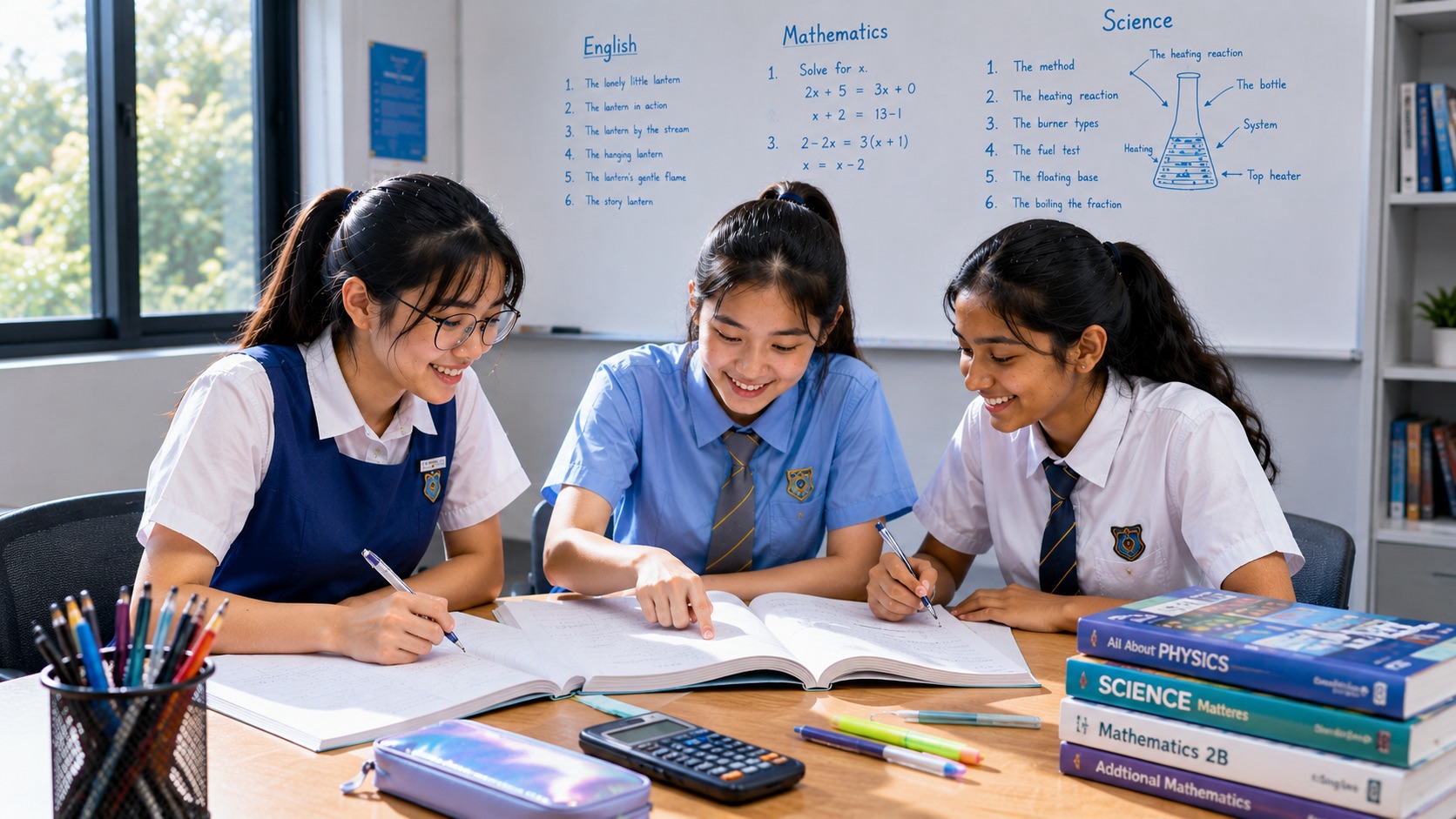
Parkway Parade Additional A Mathematics Tuition should help a Secondary student understand why Additional Mathematics, A-Math tuition, Sec 3 A-Math, Sec 4 A-Math, algebra, functions, logarithms, trigonometry, coordinate geometry and calculus can feel difficult even when individual formulas seem familiar. Families searching for A-Math tuition in Parkway Parade, small-group Additional Mathematics tuition, G3 Additional Mathematics, structured working, exam technique and past-paper support often see the visible chapter but not the dependency underneath it. A calculus question may fail because factorisation is weak. A trigonometric equation may fail because algebraic manipulation collapses. A logarithm question may fail because index laws were never secure.
For students preparing under Singapore’s current examination pathways, the exact syllabus and cohort still matter. In the 2026 GCE O-Level framework, Additional Mathematics is examined under syllabus 4049; from the 2027 Singapore-Cambridge Secondary Education Certificate transition, G3 Additional Mathematics uses K341. The administrative code changes, but the learning architecture remains recognisable: algebraic fluency supports functions; functions support graphs; trigonometric relationships demand symbolic control; calculus depends on functions, algebra and interpretation.
This rebuilt 2017 legacy page preserves its title, URL, publication date and featured image while removing old phone numbers, fixed-package pricing, obsolete 4047-era marketing, score promises and unrelated travel galleries. Its new reader job is the A-Math dependency and curriculum architecture: how Additional Mathematics grows from ordinary Secondary algebra into functions, trigonometry and calculus; how to find the first broken prerequisite; how to build depth without racing ahead; and how a small-group programme should move from explanation to independent transfer.
Additional Mathematics Is a Connected System, Not a Stack of Chapters
A-Math becomes intimidating when every topic is treated as a separate body of tricks.
The subject is much easier to organise when students see the dependency chain:
- number sense supports algebra;
- algebra supports equations and functions;
- functions support graphs and transformations;
- factorisation supports polynomial work and equation solving;
- indices support logarithms;
- geometry and algebra support coordinate geometry;
- trigonometric ratios grow into trigonometric functions and identities;
- functions and algebra support differentiation and integration.
When one dependency is weak, several later chapters can appear weak at once.
The First Diagnostic: Is the A-Math Floor Ready?
Before adding advanced questions, audit the mathematical floor.
A student should increasingly be able to handle:
- signed numbers;
- fractions;
- indices;
- expansion;
- factorisation;
- linear and quadratic equations;
- formula rearrangement;
- substitution;
- coordinate relationships;
- graph reading.
If these remain expensive, A-Math will repeatedly feel harder than it actually is because the new concept is carrying old friction.
Do Not Confuse a New-Topic Error With an Algebra Error
Suppose a student differentiates correctly and then simplifies the derivative incorrectly.
The calculus concept may be secure.
The first broken link is algebra.
Or suppose a learner knows the trigonometric identity but cannot solve the resulting quadratic in sine.
Again, the topic label says trigonometry while the repair point says algebra.
Good tuition preserves the part that worked and repairs only the mechanism that failed.
Algebra Is the Operating Language of A-Math
Additional Mathematics is not simply “more algebra”, but algebra is the language through which much of the subject is expressed.
Students need to manipulate expressions without losing the meaning of the relationship.
A useful standard is not merely:
Can you perform expansion?
but:
Can you recognise when expansion helps, when factorisation helps and when leaving an expression untouched is better?
That shift from procedure to judgement is one of the main A-Math transitions.
Expansion: Distribution Must Be Complete
A recurring error such as:
3(x + 4) = 3x + 4
is not a one-question mistake. It is a distribution misconception.
Repair it once at the structural level:
3(x + 4) = 3x + 12
Then vary signs, coefficients and nested expressions so the student must reconstruct the rule rather than copy a pattern.
Factorisation: Reveal the Multiplicative Structure
Factorisation rewrites an expression to expose a useful product.
The ability matters in:
- quadratic equations;
- polynomials;
- algebraic fractions;
- trigonometric equations;
- calculus simplification;
- finding roots or critical values.
A student who treats factorisation as one early chapter will keep rediscovering its importance later.
Quadratics: One Object, Several Useful Forms
A quadratic can be written in expanded, factorised or completed-square form.
Each form reveals different information.
- Expanded form exposes coefficients.
- Factorised form exposes roots where factorisation is available.
- Completed-square form exposes the vertex structure.
The student should learn to ask which form serves the current question.
This is an early lesson in representation choice.
The Discriminant Is Information About the Graph
For a quadratic equation, the discriminant does more than sit inside the quadratic formula.
Its sign tells us how the graph relates to the horizontal axis.
- positive: two distinct real roots;
- zero: one repeated real root;
- negative: no real roots.
Connecting symbolic and graphical meaning reduces memorisation.
Functions: The Organising Idea
Function notation is one of the points where students often become procedurally competent before becoming conceptually comfortable.
A function is a rule mapping allowable inputs to outputs.
That viewpoint makes several later ideas easier:
- evaluation;
- composite functions;
- inverse functions;
- domain and range;
- graph transformations;
- calculus of functions.
The notation should compress an idea the student understands, not replace understanding.
Composite Functions: Order Matters
Applying f after g is not generally the same as applying g after f.
Students should read the order explicitly and, while learning, write the intermediate mapping.
This prevents function composition from becoming a bracket-substitution ritual.
Later, the notation can become compact once the mapping logic is stable.
Inverse Functions: Reverse a Suitable Mapping
An inverse function reverses an appropriate one-to-one relationship.
Students need to consider:
- whether an inverse exists over the relevant domain;
- how input and output roles switch;
- how the graph relates to the line y = x;
- how domain and range correspond.
Mechanical swapping of x and y is only part of the story.
Indices and Logarithms Should Be Taught Together
Logarithm laws are easier to reconstruct when students understand their connection to index laws.
Multiplication of powers relates to adding exponents.
Division relates to subtraction of exponents.
Raising a power to a power relates to multiplying exponents.
Logarithmic laws record the same multiplicative structure in another representation.
Why Logarithm Questions Become Fragile
Several layers may fail:
- the logarithm law is forgotten;
- the law is applied to addition where it does not belong;
- algebra after the logarithm step is wrong;
- restrictions on values are ignored;
- calculator use replaces exact reasoning too early.
Classify the first failed layer before prescribing more logarithm worksheets.
Coordinate Geometry Connects Shape and Algebra
Lines, gradients, midpoints, distances and circles show students that algebra can encode geometric relationships.
A point on a line satisfies the line equation.
Parallel or perpendicular relationships constrain gradients.
A circle equation represents a geometric locus.
Moving between diagram and equation trains representation flexibility.
Linearisation: Transform the Relationship Before Reading the Graph
When a nonlinear relationship can be transformed into straight-line form, the student must know what now plays the role of:
- horizontal variable;
- vertical variable;
- gradient;
- intercept.
Memorising a transformation template is fragile.
Rearranging into a clear straight-line structure makes the method reconstructable.
Trigonometry Grows Beyond the Right Triangle
In A-Math, sine, cosine and tangent become functions with graphs, periodicity, identities and equations.
The student needs to move between:
- geometric interpretation;
- function value;
- graph;
- identity;
- equation solutions over an interval.
Students who understand only the right-triangle mnemonic often experience this as a sudden discontinuity.
Trigonometric Identities Need a Target
Randomly substituting identities is inefficient.
Before transforming, ask:
- What form am I trying to create?
- Would a common denominator help?
- Would writing everything in sine and cosine help?
- Is a Pythagorean identity relevant?
- Can the expression be factorised?
Each line should move deliberately toward a purpose.
Trigonometric Equations: The Interval Is Part of the Mathematics
Solving the algebraic form is not enough.
Students must consider:
- the stated interval;
- periodicity;
- all valid solutions;
- extraneous or invalid values where relevant.
Interval discipline should be visible early in the working rather than remembered at the final line.
Calculus Is the Next Representation of Change
Differentiation describes local change.
Integration describes reverse differentiation and accumulation in appropriate contexts.
The rules matter, but students are more reliable when they can answer:
What does this derivative or integral represent here?
Interpretation helps select the procedure and check the result.
Differentiation: Procedure and Meaning Must Grow Together
Power rules and other techniques need fluency.
At the same time, students should connect the derivative to:
- gradient;
- rate of change;
- stationary points;
- optimisation;
- kinematics.
This makes application questions feel like extensions of the idea rather than unrelated templates.
Stationary Points: dy/dx = 0 Is Only the Beginning
A stationary point must still be interpreted.
Ask:
- where it occurs;
- what type of stationary point it is;
- whether it lies in the relevant domain;
- what it means in the problem context.
A correct derivative can still lead to an incomplete solution.
Optimisation: The Modelling Comes Before the Calculus
Many optimisation questions are won or lost before differentiation begins.
The student must:
- define the variable;
- build the required quantity as a function;
- respect constraints;
- differentiate;
- identify the relevant stationary point;
- interpret the result.
Perfect calculus cannot rescue a wrong model.
Integration: The Constant Matters
For indefinite integration, the constant of integration represents a family of functions sharing the same derivative.
If additional information is supplied, use it to determine the constant.
This small detail reveals whether the student understands what integration is reconstructing.
Kinematics Connects Calculus to Motion
Under the relevant model, displacement, velocity and acceleration are connected through differentiation and integration.
The Mathematics must remain attached to interpretation.
A negative velocity represents direction, not “negative distance”.
Total distance may require splitting the motion into intervals.
Students need both calculus fluency and contextual reading.
A-Math Needs an Error Taxonomy
Useful categories include:
- prerequisite algebra;
- concept;
- recognition;
- strategy selection;
- sign/notation;
- function domain/range;
- trigonometric interval;
- calculus interpretation;
- calculator input;
- time;
- checking.
“Careless” is too broad to guide the next lesson.
The First-Broken-Line Rule
When a solution is wrong, locate the earliest invalid move.
If the first six lines are sound and the seventh contains a sign error, protect the six.
Repair the seventh line’s mechanism.
This teaches debugging and prevents a wrong final answer from being interpreted as total mathematical failure.
Corrections Need Fresh Transfer
After explaining a correction, give a fresh question whose surface changes but whose underlying structure remains.
Then remove support.
Return again after several days.
A correction that survives fresh and delayed transfer is much stronger evidence than a perfect redo of the remembered original.
Retrieval Keeps the Subject Alive
A-Math topics should not disappear when the class moves on.
A brief weekly retrieval set might include:
- one factorisation;
- one logarithm relationship;
- one function item;
- one trigonometric equation;
- one derivative or integral.
The aim is not volume.
It is availability.
Blocked Practice First, Mixed Practice Later
When a technique is new, several similar examples help establish accuracy.
Once stable, remove the chapter heading and mix competing methods.
The student now has to recognise the structure before executing the method.
This is one of the most important transitions from class competence to examination competence.
Small-Group A-Math: Shared Topic, Individual Diagnosis
Three students can study the same topic and need different next steps.
For a trigonometric equation:
- Student A forgets the identity.
- Student B uses the identity correctly but loses a sign.
- Student C solves correctly but misses a valid interval solution.
The discussion can be shared. The repair should differ.
Peer Comparison Can Develop Mathematical Judgement
When two valid methods exist, ask:
- Which is shorter?
- Which is easier to verify?
- Which depends on a special feature?
- Which generalises better?
Students learn criteria for choosing methods rather than assuming Mathematics is one teacher-approved script.
A 90-Minute A-Math Dependency Lesson
10 minutes — retrieval
Older algebra and one recently repaired mechanism.
20 minutes — dependency check
Identify whether the current problem is concept, algebra, recognition or execution.
20 minutes — explicit teaching
Rebuild the relevant relationship with the clearest representation.
20 minutes — changed-surface transfer
Student works independently on variations.
10 minutes — mixed recognition
Place the method among competing topics.
10 minutes — error and delayed-retest plan
Record the active mechanism and schedule its return.
Homework Should Follow the Mechanism
A student with concept weakness needs different work from a student with slow execution.
Useful homework jobs include:
- algebra repair;
- function recognition;
- trigonometric interval practice;
- calculus fluency;
- mixed method selection;
- timed sections;
- delayed error-family retest.
Equal page count is not equal personalisation.
Sec 3: Build the A-Math Language
Sec 3 should focus on constructing the dependency system.
Priorities include:
- repairing algebra immediately;
- understanding functions;
- building quadratic flexibility;
- connecting indices and logarithms;
- developing coordinate geometry;
- building trigonometric-function thinking;
- keeping an error ledger.
Do not wait until the final examination year to discover that foundational manipulation is fragile.
Sec 4: Convert Knowledge Into Mixed Performance
Sec 4 increasingly shifts toward:
- calculus completion;
- mixed retrieval;
- past-paper integration;
- time management;
- personal checking;
- repair of recurring error families.
The subject should begin feeling smaller as secure mechanisms move to maintenance.
Past Papers Should Test a Changing System
A useful cycle is:
paper → classify → repair → fresh transfer → delayed retest → paper
If the same error repeats paper after paper, another paper alone is not the solution.
Pause and repair the dependency.
Timed Work Comes After Accuracy
Do not use speed to hide an unstable method.
Layer timing:
- accurate untimed;
- timed routine questions;
- timed mixed sets;
- timed sections;
- full papers.
At each stage, identify what degrades under pressure.
Checking Should Be Personal
Build a short checklist from the learner’s actual history.
Examples:
- sign after expansion;
- domain or interval restrictions;
- degree/radian mode;
- exact versus approximate form;
- stationary-point interpretation;
- unanswered subparts.
Risk-based checking is more efficient than rereading everything equally.
Questions Parents Can Ask About Parkway Parade Additional A Mathematics Tuition
- How do you audit algebra before teaching advanced A-Math?
- How do you distinguish a calculus concept error from an algebra error?
- How are functions taught beyond notation?
- How do you connect index laws and logarithm laws?
- How do students learn to choose identities purposefully?
- How are corrections retested on changed questions?
- How are three students differentiated in a small group?
- When does mixed practice begin?
- How are past papers used?
- How do you know tutor dependence is reducing?
Frequently Asked Questions
Why does A-Math feel much harder than E-Math?
A-Math increases symbolic density and depends heavily on algebraic fluency. New concepts are often embedded inside manipulation that must already be reliable.
Should a student start calculus early?
Only when the relevant algebra and functions are stable enough. Racing ahead can make calculus appear weak when the real problem is prerequisite manipulation.
Are hard questions the best practice?
Not automatically. Difficult questions are useful when they stretch stable concepts and create transferable reasoning. They are less useful when the prerequisite method is still missing.
How important are past papers?
Very useful once enough content is secure. They should generate targeted repair between attempts rather than become an end in themselves.
What is the clearest sign A-Math tuition is working?
The student recognises structures faster, manipulates algebra more reliably, retrieves older methods, solves changed questions with less prompting and can explain why a method applies.
The A-Math Architecture End-State
Additional Mathematics becomes much more manageable when the student can see the dependencies instead of experiencing each chapter as a surprise.
Algebra supports functions. Functions support graphs. Indices support logarithms. Geometry and algebra meet in coordinate geometry. Trigonometry becomes a family of functions and identities. Calculus describes change and accumulation.
That is the durable job of Parkway Parade Additional A Mathematics Tuition: make the internal architecture of A-Math visible, repair the earliest weak dependency, and move the student from explained procedures toward independent mathematical control.
Current Routes
- SEAB — 2026 GCE O-Level syllabuses
- SEAB — 2027 SEC G3 syllabuses
- Additional Mathematics Hub
- Mathematics Tuition & Learning Hub
- Student Diagnostics Hub
Properly taught kids shine a bright light into the future.
Leave a Reply