
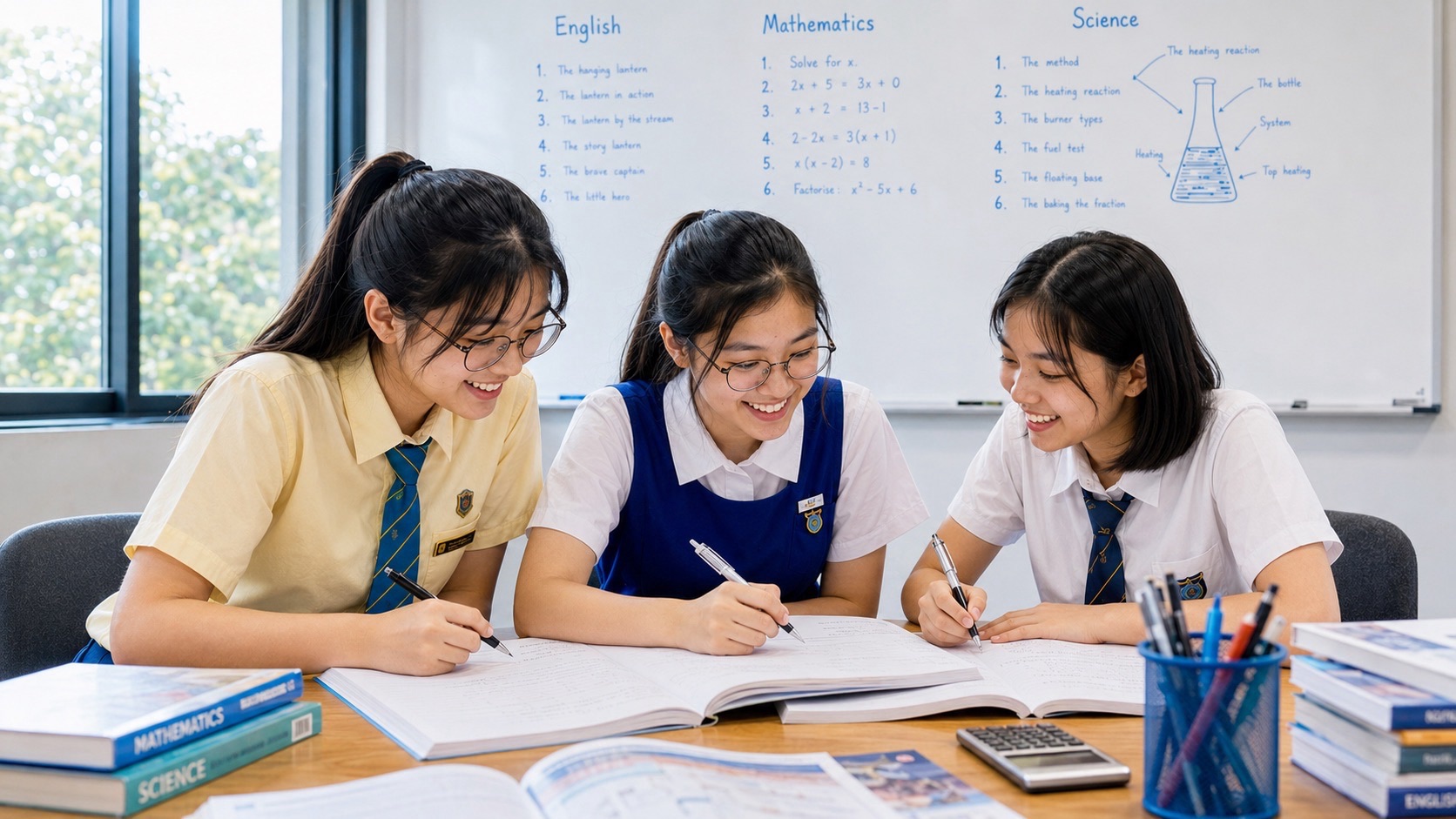
Holland Village Science Tuition Centre is a legacy title that can serve a much more useful job today: explain what advanced Primary Science tuition, high-progress PSLE Science support, deeper conceptual understanding, transfer and precision should look like for students who are already doing reasonably well. Strong students do not always need more questions. They often need better questions.
Parents searching for Science tuition in Holland Village, Primary Science tuition, PSLE Science tuition or small-group Science support may have a child who already scores well but remains fragile in unfamiliar application questions, experimental design, open-ended precision or cross-topic transfer. High marks can hide lucky MCQ choices, memorised answer patterns and topics that have never been stress-tested.
For these learners, strong tuition should move beyond repetition into depth, comparison, counterexamples, variable control, evidence quality, explanation efficiency and changed-context transfer. The aim is not to accelerate blindly into the next level. It is to make current understanding more robust.
A high score does not automatically mean deep understanding
A student can score well for several different reasons. Some are durable; some are not.
- The student genuinely understands the mechanism.
- The school paper closely resembles practised worksheets.
- The student has strong memory but weak transfer.
- The student is excellent at eliminating MCQ options.
- The student writes model-answer phrases accurately but cannot vary them.
- The student has one narrow weakness that the latest paper did not expose.
Advanced tuition should discover which version of “strong” is actually present.
The first advanced move: change the surface
After the student solves a familiar question, change the context without changing the underlying mechanism.
- Change the object.
- Change the diagram.
- Change the wording.
- Change the order of information.
- Change the measured variable.
- Combine the concept with another topic.
If performance collapses when the surface changes, the original mastery was narrower than it appeared.
Advanced Science should ask “under what conditions?”
Many school-level statements are useful simplifications. Strong students should learn that scientific relationships usually depend on conditions.
Instead of memorising “X causes Y”, the student learns to ask:
- Under what conditions does this relationship hold?
- What other variables matter?
- What evidence would weaken the conclusion?
- What would happen if the condition were reversed?
- Is the relationship direct, indirect or conditional?
This makes the student less vulnerable to tricky distractors and unfamiliar application questions.
Counterexamples deepen understanding
One powerful way to test a strong student is to present a case that looks similar but behaves differently.
The tutor can ask: “Why does the usual explanation not apply here?” This forces the learner to identify the exact condition that matters rather than rely on visual similarity.
Counterexamples are especially useful in classification, forces, energy, systems and experimental reasoning because they expose overgeneralisation.
High-progress MCQ should analyse distractor design
For a strong student, simply getting the correct MCQ option is not enough. The tutor should ask why the other options were tempting.
| Distractor pattern | What it may reveal |
|---|---|
| Correct keyword, wrong relationship | Surface recognition |
| Correct relationship, wrong direction | Weak causal control |
| Ignores one condition | Incomplete reading |
| Uses everyday intuition | Scientific model not dominant |
| Overgeneralises from one example | Transfer too broad |
When students can explain why a distractor fails, their understanding becomes more discriminating.
Open-ended answers: precision becomes the challenge
Stronger students often know enough Science to over-answer. They include three correct ideas when the question needs one, then add an inaccurate fourth sentence.
Advanced answering should train selectivity:
- identify the exact demand;
- choose the minimum complete causal chain;
- use the evidence supplied;
- avoid unrelated truths;
- stop when the mechanism is complete.
Precision is a higher-level skill because it requires the student to know not only what is true, but what is relevant.
Advanced experiment questions should test design quality
Once a student can identify variables reliably, the next step is to judge the experiment.
- Is the measurement method appropriate?
- Are important variables controlled?
- Would repeated readings improve reliability?
- Does the conclusion go beyond the evidence?
- Could a different design test the same idea better?
This moves the student from following experiments to evaluating them.
Graphs: move beyond reading values
Strong students should be able to describe the shape of a graph, identify where the relationship changes and explain what that pattern means scientifically.
Useful questions include:
- Where is the change fastest?
- Where does the trend level off?
- Which region supports the claim most strongly?
- What can be inferred, and what cannot?
- What additional data would help?
The student learns to treat data as evidence rather than decoration.
Primary 5 strong students need depth before acceleration
A high-performing Primary 5 student may be ready for harder work, but harder should not automatically mean Primary 6 content.
Useful stretch can come from:
- unfamiliar applications;
- mixed-topic reasoning;
- counterexamples;
- experiment critique;
- data-rich questions;
- requiring two different explanations to be compared;
- explaining why a tempting answer is wrong.
Depth builds a stronger runway for Primary 6 than shallow acceleration.
Primary 6 strong students need independence under uncertainty
By Primary 6, high-progress students should practise working without topic labels, hints or familiar sequencing.
They should be able to meet a difficult question and decide:
- what the question is really testing;
- which information matters;
- which concept or mechanism applies;
- what evidence supports the conclusion;
- how much explanation is enough;
- when to move on and return later.
This is where examination performance and genuine scientific reasoning meet.
Strong students still need retrieval
High-performing students can forget old topics too. Their current work may hide the problem because newer chapters dominate attention.
Advanced tuition should therefore include old-topic retrieval without warning. The student should occasionally have to identify the relevant idea from memory before applying it.
Fast retrieval creates more mental capacity for difficult reasoning.
Cross-topic questions reveal the shape of the student’s knowledge
Real Science is not organised into school chapter boundaries. Examination questions can also combine ideas.
A strong student should therefore practise connecting:
- forces with energy;
- plants with systems;
- heat with states of matter;
- organisms with environmental interactions;
- electricity with energy transfer;
- experimental variables with any content topic.
The purpose is not to create artificial complexity. It is to ensure the student can navigate a connected knowledge system.
Teach students to challenge their own answer
One sign of advanced learning is self-critique. After answering, the student can ask:
- Did I use the condition from the question?
- Is my direction of effect correct?
- Does the evidence really support this?
- Did I assume something that was not given?
- Is there a simpler complete answer?
- What would make my conclusion false?
This moves checking from proofreading into scientific evaluation.
The advanced error ledger
- Overgeneralised from one example.
- Missed a hidden condition.
- Correct concept, wrong direction.
- Answer technically true but irrelevant.
- Conclusion stronger than evidence.
- Used model answer without adapting it.
- Could solve familiar form but not changed representation.
- Old concept retrieval too slow.
- Extra sentence introduced an error.
These are sophisticated errors. They deserve sophisticated repair.
Small groups can challenge strong students efficiently
In a small group, strong learners can be asked to defend and compare explanations rather than merely complete more pages.
One student proposes a conclusion. Another must find the evidence. A third must identify a condition under which the conclusion would fail. The tutor then asks the group to refine the model.
This creates depth without requiring an entirely separate syllabus.
World knowledge can be used as advanced transfer
Strong students often enjoy seeing Science in real systems: transport, energy, architecture, food, ecosystems, sports and technology.
The tutor can use these contexts to ask more demanding questions while keeping the scientific model age-appropriate. The goal is not enrichment for its own sake. It is to create more varied places where the concept must work.
What parents should ask for a strong Science student
- How do you diagnose hidden weaknesses in high scorers?
- How do you distinguish depth from worksheet familiarity?
- Do you use unfamiliar transfer questions?
- How do you stretch students without racing ahead?
- Are experiment designs evaluated, not just completed?
- Do students analyse why distractors are wrong?
- How are old topics retrieved?
- How do you train precision and self-critique?
What advanced progress looks like
- The student transfers concepts across unfamiliar contexts.
- Counterexamples are handled without confusion.
- MCQ distractors are analysed accurately.
- Open-ended answers become concise and selective.
- Experimental conclusions respect evidence limits.
- Cross-topic connections become easier.
- Old knowledge remains quickly retrievable.
- The student can critique their own answer before the tutor does.
The deeper purpose of advanced Primary Science tuition
Advanced tuition should not turn a capable child into a faster worksheet machine. Its job is to increase the resolution of thought.
The student learns that scientific ideas have conditions, evidence has limits, explanations can be compared, and a familiar concept may appear inside an unfamiliar story.
That depth is valuable for PSLE Science, but it also prepares the learner for Secondary Science, where models become more formal and shallow memorisation becomes progressively less reliable.
Leave a Reply