
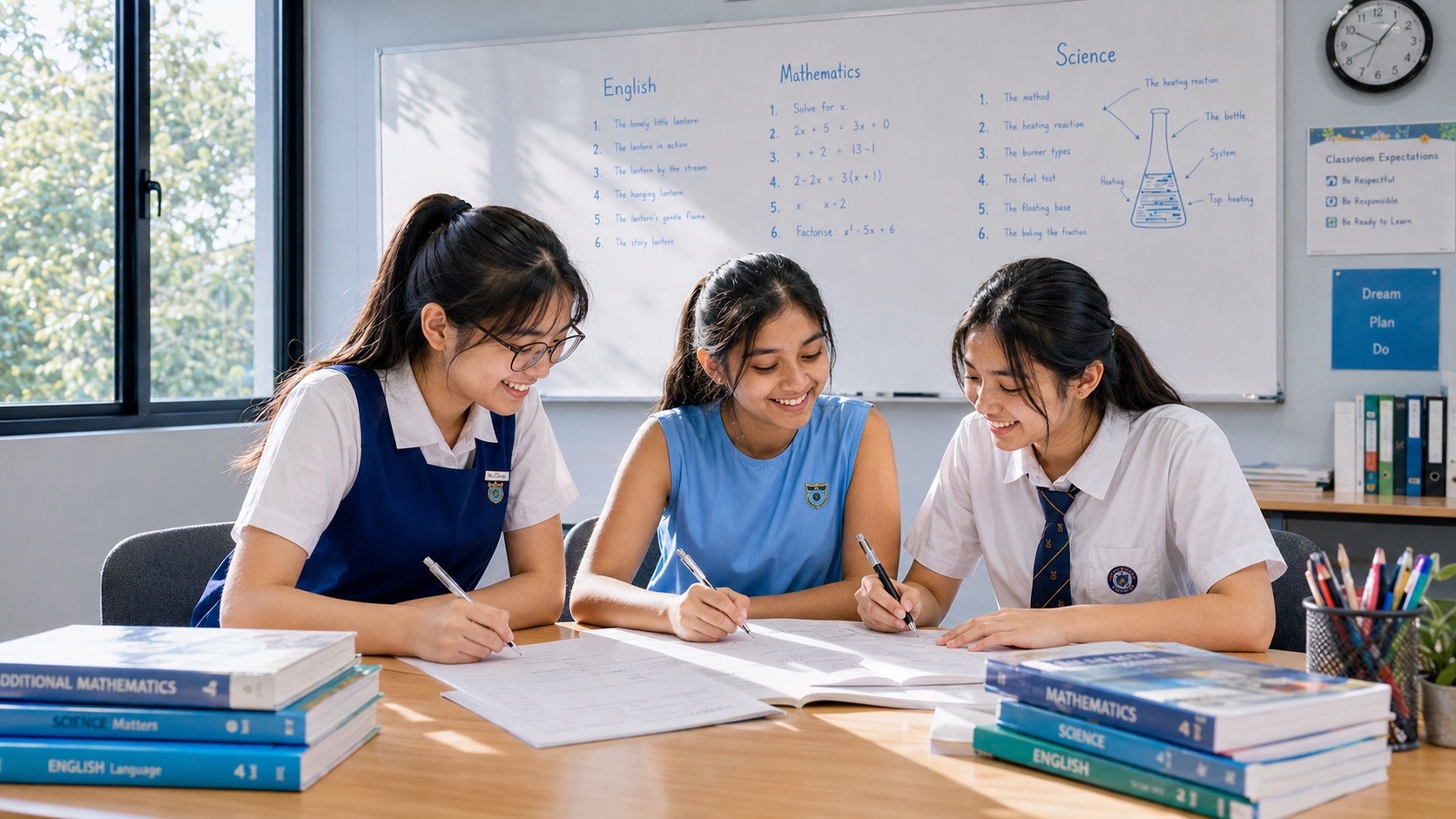
Bishan Science Tuition Centre is a legacy title that can serve a more useful purpose today: explain the transition from Primary Science and PSLE Science to lower-secondary Science, G2/G3 Science pathways and the more formal language of Physics, Chemistry and Biology. Families searching for Science tuition in Bishan, Primary Science tuition, PSLE Science preparation or Secondary Science tuition often need help with the point where familiar Primary-school methods stop being enough.
The transition is not simply “more content”. Students move from broad Primary Science themes into increasingly specialised scientific models. They must read graphs more precisely, work with quantities and variables, use more formal terminology, distinguish evidence from inference and explain mechanisms with greater control. A student who succeeded through memory alone can suddenly feel less secure when the subject asks for deeper transfer.
Strong Science tuition should therefore build a bridge: preserve the Primary habits of observation, evidence and explanation, then extend them into Secondary Physics, Chemistry and Biology reasoning. From 2027, the Singapore-Cambridge Secondary Education Certificate includes current G2 and G3 Science combinations published by SEAB, so modern tuition should work from the student’s actual subject level rather than rely on outdated Express/Normal stream labels.
The Primary-to-Secondary transition is a change in scientific language
Primary Science introduces powerful ideas through accessible contexts: plants, animals, materials, forces, energy, water, heat, light, electricity and ecosystems. Students learn to observe, compare, describe and explain.
Secondary Science keeps those habits but demands greater formal precision. A student may now need to interpret particle models, connect variables quantitatively, use equations, distinguish physical and chemical changes, analyse systems and justify conclusions with more disciplined evidence.
The child is not starting Science again. The language has become denser.
What should survive from Primary Science?
- observe before explaining;
- identify what changed;
- separate evidence from assumption;
- compare conditions carefully;
- explain cause and effect;
- use diagrams as reasoning tools;
- check whether a conclusion is supported;
- retrieve older learning when the topic is mixed.
Students who have these habits enter Secondary Science with a useful operating system even when the content becomes unfamiliar.
What changes in lower-secondary Science?
| Primary emphasis | Secondary extension |
|---|---|
| Describe visible changes | Explain with increasingly formal models |
| Simple variables | More structured experimental design and data analysis |
| Everyday forces and energy | Quantitative and model-based reasoning |
| Materials and states | Particle explanations and chemical ideas |
| Plant and human systems | More detailed biological structures and processes |
| Short data sets | More complex graphs, tables and calculations |
The important point is continuity. The old skill remains, but the resolution becomes higher.
The first Secondary Science problem: students may overestimate what memorisation can do
Memorisation is useful in Science. Terms, formulae, definitions and facts need to be available. The difficulty begins when students assume memory alone will solve application questions.
A student can memorise a definition of diffusion and still fail to apply it. Another can remember a formula but substitute the wrong quantity. Another can recite a biological process but misread the direction of movement in a diagram.
Tuition should therefore pair memory with use. Every important fact should eventually answer the question: “What can you now explain or predict with this?”
Physics: relationships become more quantitative
Primary students already encounter forces, energy, heat, light and electricity. In Secondary Physics, these ideas become more formal and increasingly quantitative.
Students need to read units, interpret diagrams, work with equations where appropriate and understand how one quantity changes when another changes. The formula should be the compact expression of a relationship, not a magic spell.
- What does each quantity mean?
- What unit belongs to it?
- Which quantities are known?
- What relationship connects them?
- Does the calculated answer make physical sense?
This prevents formula substitution from becoming blind arithmetic.
Chemistry: invisible models must explain visible evidence
Chemistry often asks students to explain visible changes using invisible particle models. This can feel like a new kind of thinking.
Students may observe colour change, temperature change, gas production, dissolving or changes of state. The scientific explanation then moves to particles, substances, reactions and energy.
Strong tuition repeatedly connects the two levels: what we observe and what model explains it.
Biology: systems become more detailed
Primary Science gives students an early understanding of plant and human systems. Secondary Biology expands the detail and asks students to connect structures to functions more precisely.
A useful reasoning habit is:
- What structure is present?
- What feature of that structure matters?
- What process occurs?
- How does the structure support the process?
- How does that process contribute to the larger system?
This structure-to-function reasoning is transferable across many biological topics.
Lower Secondary Science still begins with reading
Many Science errors begin before the Science itself. The student misses “except”, overlooks a unit, answers one part of a two-part question or describes a result when the command word asks for an explanation.
Command words should therefore remain visible:
- state: give the required fact;
- describe: say what happens;
- explain: give the mechanism or reason;
- compare: identify relevant similarities or differences;
- calculate: use the correct relationship and units;
- suggest: apply scientific reasoning to a plausible explanation.
Knowing the content is not enough if the student performs the wrong intellectual job.
Graphs become increasingly important
Secondary Science expects students to extract relationships from data with greater precision. A graph is not merely something to read; it is something to reason from.
- What do the axes represent?
- What are the units?
- What trend appears?
- Where does the relationship change?
- Is the relationship linear or not?
- What conclusion is supported?
- What conclusion cannot be made from the data alone?
Students should practise moving from graph to sentence and sentence back to graph.
Experimental design becomes less forgiving
At Primary level, students learn the beginnings of fair testing and variables. Secondary Science asks them to be more precise about controls, measurements, reliability and the meaning of evidence.
Tuition should keep the experimental skeleton visible:
- independent variable;
- dependent variable;
- controlled variables;
- measurement method;
- repeated readings where relevant;
- pattern in results;
- conclusion supported by evidence;
- limitations of the design.
The apparatus may change. The logic remains recognisable.
The G2/G3 pathway should be treated accurately
Legacy Science tuition pages often refer to old streaming terminology. Families entering the 2027 Secondary Education Certificate system should instead check the exact subject level and syllabus their child is taking.
SEAB currently publishes G2 Science combinations such as Physics/Chemistry, Physics/Biology and Chemistry/Biology, and parallel G3 Science combinations under the SEC pathway. The detailed assessment structure belongs to the relevant current syllabus document and should be checked directly rather than assumed from an older O-Level page.
A strong tutor should teach the student in front of them at the correct subject level, not use a generic “Secondary Science” worksheet stack.
What a Secondary 1 Science diagnostic should look for
- Can the student distinguish observation from inference?
- Can they read graphs and units accurately?
- Can they identify variables?
- Can they explain cause and effect?
- Can they use a model rather than a memorised phrase?
- Can they calculate without losing units?
- Can they retrieve Primary foundations?
- Can they read a longer question stem without rushing?
The transition is much easier when these habits are checked early.
Do not throw away Primary knowledge
Students sometimes treat Secondary 1 as a complete reset. That is a mistake. Primary Science contains valuable foundations.
Ideas about forces, energy, matter, living systems and evidence return in more sophisticated forms. The tutor should show the bridge explicitly: “You have seen the basic phenomenon before; now we are giving it a more precise model.”
This reduces cognitive load because the student is extending a known structure rather than building everything from zero.
A good tuition sequence moves from visible to abstract
- Observe a concrete phenomenon or familiar example.
- Represent it with a diagram, table or model.
- Name the relevant scientific relationship.
- Express the relationship more formally.
- Apply it to a less familiar scenario.
- Retrieve it later without prompts.
This progression is particularly useful when students can memorise abstract language but cannot yet use it.
Error analysis should become more disciplinary
By Secondary Science, “careless” is an especially unhelpful label. Error categories can become more precise.
- wrong scientific model;
- right model, wrong variable relationship;
- unit error;
- graph-reading error;
- calculation error;
- particle explanation incomplete;
- structure-function link missing;
- evidence does not support conclusion;
- question demand misread;
- older prerequisite forgotten.
Each error family suggests a different repair.
Small-group Science should use peer reasoning carefully
Secondary students benefit when they hear another learner explain the same evidence differently. The tutor can ask the group to compare explanations and decide which is scientifically supported.
This is especially powerful for graphs, experimental conclusions and mechanism questions because students learn that scientific answers are judged by evidence and logic, not by confidence of delivery.
Retrieval becomes more important as subjects deepen
Physics, Chemistry and Biology build cumulatively. A missing prerequisite can make a later chapter look harder than it really is.
Short retrieval of older topics should remain part of weekly Science tuition. The student should occasionally meet a question without being told which chapter it belongs to.
This trains selection, not just repetition.
Homework should shift from repetition to mixed application
Early Secondary homework may need focused practice while new notation and models become familiar. As control grows, the work should increasingly mix topics and ask students to select the relevant model independently.
The student should not always know which formula, chapter or process is being tested before reading the question.
How parents can tell whether the transition is going well
- The student can explain new terminology in ordinary language.
- Primary concepts are being connected to Secondary models.
- Graphs and units are read more accurately.
- Experimental variables are handled with less prompting.
- Scientific explanations become more formal without becoming memorised scripts.
- Calculations include sensible unit checking.
- The student can distinguish evidence from inference.
- Old learning remains available.
- Unfamiliar questions create less panic.
When should a student seek extra Science support?
Support may be useful when the student says Science “suddenly became hard”, understands lessons but cannot start homework, memorises definitions without applying them, repeatedly loses units, struggles with graphs or experiments, or becomes dependent on model answers.
Early support can be efficient because the tutor can repair the transition before several layers of new content accumulate.
What parents should ask a Bishan Science tutor
- How do you diagnose the Primary-to-Secondary transition?
- How do you teach graphs and experimental reasoning?
- How do you connect Physics, Chemistry and Biology to prior knowledge?
- How do you handle different subject levels?
- How are current SEC syllabuses tracked?
- How do you distinguish memory problems from conceptual problems?
- How is transfer tested?
- How is independence measured?
The goal is not simply to survive Secondary 1
A good Primary-to-Secondary Science transition should create a runway for the years that follow. Students need scientific vocabulary, but also models. They need formulae, but also relationships. They need experimental procedures, but also evidence discipline.
The student should gradually become comfortable moving between four forms of Science: the real phenomenon, the diagram or data, the scientific model and the written or calculated answer.
When those forms connect, Secondary Science stops feeling like a collection of new words. It becomes a more precise version of a habit the child already began in Primary school: look carefully, model what is happening, test the evidence and explain the world.
Leave a Reply