
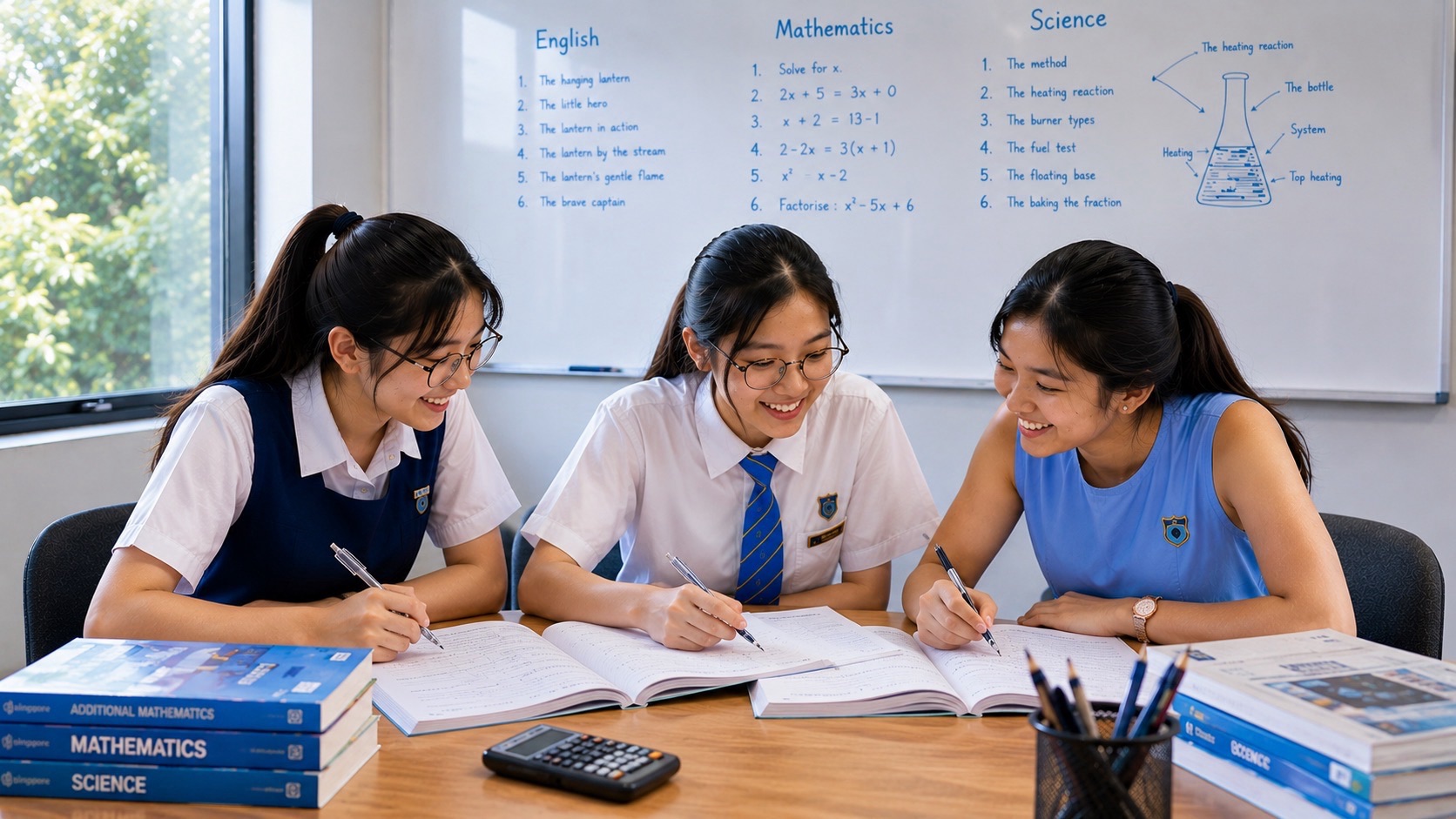
Bedok Science Tuition Centre is a legacy title that can do a much more useful job today: explain how students can improve PSLE Science open-ended answers, answering techniques, scientific keywords, causal explanations, application questions and evidence use. Many Primary Science students know more Science than their written answers reveal. They lose marks not because they have no knowledge, but because the answer is incomplete, vague, overlong or disconnected from the evidence in the question.
Parents searching for Primary Science tuition in Bedok, PSLE Science tuition, Science tutor support or small-group Science tuition often describe the same frustration: “My child understands when we discuss it, but the written answer does not score.” That gap is real. Scientific understanding and scientific expression are related but not identical skills.
Strong Science tuition should therefore teach students to turn understanding into a complete written chain: identify the relevant condition, name the process when useful, explain the direction of effect, connect it to the outcome, and use the question’s evidence precisely. Keywords matter, but the relationship between the keywords is what makes an explanation scientifically meaningful.
Why students know the answer but still lose the mark
Open-ended Science questions require several jobs at once. The student must read the demand, select the correct concept, decide which evidence matters, organise the explanation and write enough—but not too much.
A weak answer can fail at any point:
- the wrong condition is selected;
- the scientific idea is correct but incomplete;
- a keyword is present without a relationship;
- the answer describes what happened but does not explain why;
- the student gives a reason but ignores the evidence in the diagram;
- the causal direction is reversed;
- extra information introduces an error;
- the answer addresses only one part of a multi-part question.
Each failure needs a different repair.
The first rule: answer the intellectual job
Students often focus on topic knowledge and ignore the command word. Yet state, describe, explain, compare, predict and conclude do not ask for the same response.
| Command | Student job |
|---|---|
| State | Give the required fact or answer directly |
| Describe | Say what is observed or what happens |
| Compare | Identify a relevant similarity or difference |
| Explain | Give the scientific reason or mechanism |
| Predict | Use the model to say what should happen |
| Conclude | State what the evidence supports |
A student can know the chapter perfectly and still lose marks by doing the wrong job.
Observation is not explanation
This distinction is one of the most important in Primary Science.
“The water level decreased” is an observation. “Water evaporated” names a process. “The water level decreased because water at the surface gained enough energy to change state and leave as water vapour” is an explanation.
Students should practise labelling their own sentences: observation, process, explanation, conclusion. That makes answer structure visible.
Keywords should live inside a causal chain
Keywords are valuable because they make scientific language precise. They become dangerous when students believe that including the word automatically earns the mark.
A useful causal template is:
- State the condition that matters.
- Name the relevant process or relationship.
- Explain whether the process increases, decreases or changes.
- Connect that change to the required outcome.
- Use the question’s evidence where needed.
The exact wording should change by question. The reasoning architecture remains useful.
Do not teach model answers as scripts
Model answers are useful examples, but students should not treat them as fixed scripts. Examinations vary the scenario, so memorised wording can become awkward or scientifically wrong when copied into the wrong context.
A stronger use of model answers is to ask:
- Which sentence identifies the condition?
- Which word names the process?
- Where is the causal link?
- Which part uses the evidence?
- Which details could change in another question?
Students learn the structure rather than the sentence.
Primary 3–4: build complete scientific sentences
Younger students often have correct ideas but express them vaguely. Tuition should make simple scientific language clear before pushing for sophisticated phrasing.
- “It changed” becomes “The temperature increased.”
- “This is better” becomes “Material A is more flexible than Material B.”
- “It needs water” becomes “The plant needs water for its life processes.”
- “The magnet works” becomes “The magnet attracts the iron object.”
Clarity is the foundation of later open-ended performance.
Primary 5: start training answer architecture explicitly
Primary 5 is a good stage to teach students how to plan a Science answer mentally before writing.
A student can pause for a few seconds and ask:
- What exactly is the question asking?
- Which condition matters?
- Which concept explains it?
- What happens to the process?
- What outcome follows?
- Which evidence should I mention?
This pause is often more valuable than writing immediately.
Primary 6: precision under time pressure
By Primary 6, students need to produce correct explanations efficiently. The goal is not to write as much as possible. It is to include every necessary scientific link and remove unrelated material.
Timed practice should therefore be paired with quality review. A student who writes quickly but incompletely is not yet examination-ready. A student who writes perfectly but takes too long also needs adjustment.
How to repair a weak open-ended answer
Instead of replacing the student’s answer immediately, a tutor can repair it in stages.
- Underline what is already correct.
- Identify the missing relationship.
- Ask the student to say the missing link aloud.
- Rewrite only the necessary part.
- Give a changed question using the same mechanism.
- Return to the same error family later.
This preserves the student’s thinking and makes the repair reusable.
Why saying the answer aloud helps
Students sometimes write unclear sentences because the reasoning itself is still unclear. Asking them to explain the mechanism aloud can expose the gap before grammar becomes involved.
If the student cannot complete the sentence verbally, the tutor knows the issue is deeper than writing style. If the verbal explanation is strong but the written answer is weak, the next job is expression.
Evidence must be connected, not merely copied
Questions often provide a diagram, graph or table. Students may copy a value without explaining why that value matters.
A stronger answer says what the evidence shows and how it supports the conclusion. For example, “Plant A grew taller” is data. “Plant A grew taller under the condition with more light, supporting the conclusion that…” begins the evidence connection.
Comparison questions need both sides
A common open-ended error is to describe only one condition when the question asks for a comparison.
Students should train a quick check: Have I mentioned A and B? Have I stated the relevant difference? Is the comparison scientifically meaningful?
This simple habit can protect marks across many topics.
“More” and “less” need a direction
Science answers often require directional language: increases, decreases, faster, slower, more, less, higher, lower. Students can know the relationship but accidentally reverse it under pressure.
Tuition should therefore ask students to predict the direction before they write the explanation. If the direction is wrong, the rest of the chain will usually be wrong too.
Extra information can reduce answer quality
Students who are unsure often write everything they remember. That strategy feels safe but can introduce scientific errors or contradict the correct part.
Strong answering requires restraint. The student should include what is needed for the question and stop.
Precision is not the same as brevity. A short answer can be incomplete. A long answer can be confused. The goal is complete and relevant.
An open-ended Science error ledger
- Answered observation instead of explanation.
- Keyword present, causal link missing.
- Condition from question not mentioned.
- Evidence copied but not interpreted.
- Compared only one side.
- Direction of effect reversed.
- Stopped one link too early.
- Added irrelevant inaccurate statement.
- Used vague pronoun such as “it” when the subject was unclear.
- Answered only one part of a two-part question.
These categories make revision cumulative because the student can see which writing failures recur across different Science topics.
Small-group tuition can improve scientific expression
In a small group, students can compare two answers to the same question. The tutor can ask which answer is complete, which has unnecessary material and which uses the evidence better.
This helps students understand that Science answering is not about copying one “magic sentence”. Different wording can be correct when the scientific relationship is complete.
Transfer matters after every answer repair
A student who corrects one answer may simply have learned that answer. The tutor should change the surface immediately.
- change the object;
- change the diagram;
- change the numbers;
- change the wording;
- change the topic context while preserving the relationship.
If the same answer architecture still works, the student is learning a transferable skill.
MCQ and open-ended performance should support each other
MCQ can reveal conceptual misconceptions quickly. Open-ended questions reveal whether the student can articulate the mechanism.
When the same topic appears in both formats, the tutor gets a richer diagnosis. A student may select the correct MCQ option but fail to explain the reason. That tells us the knowledge is not yet fully accessible.
A practical weekly answering routine
- Retrieve one older concept.
- Answer one short MCQ and explain the choice.
- Write one open-ended response independently.
- Diagnose the missing or weak link.
- Repair the answer.
- Attempt a changed version.
- Record the error family.
This can be more valuable than completing a large number of unanalysed questions.
What parents should ask a Science tutor about open-ended answers
- How do you teach causal explanations?
- How do you distinguish keywords from complete mechanisms?
- How do you teach command words?
- How do students use evidence from graphs and tables?
- How are recurring answer errors recorded?
- Do students transfer the repaired answer into a changed question?
- How do you reduce over-writing?
- How do you distinguish a Science gap from a language-expression gap?
What progress looks like
- Answers begin with the correct condition.
- Keywords appear inside accurate relationships.
- Students separate observation from explanation.
- Evidence is interpreted rather than copied.
- Comparison questions mention both conditions.
- Directional language becomes more reliable.
- Answers become shorter because unnecessary material disappears.
- The same open-ended error repeats less often.
- Students can explain why their repaired answer is better.
The deeper aim of Science answering technique
Answering technique should not teach students to decorate weak understanding with examination phrases. It should help students express strong understanding precisely.
A well-taught Science student should be able to meet a new question, identify what is being asked, select the relevant scientific relationship and express that relationship clearly enough for another person to follow.
That is useful in PSLE Science, but it is also a much broader intellectual skill: know what you claim, know why you claim it, and connect the evidence to the explanation.
Leave a Reply