
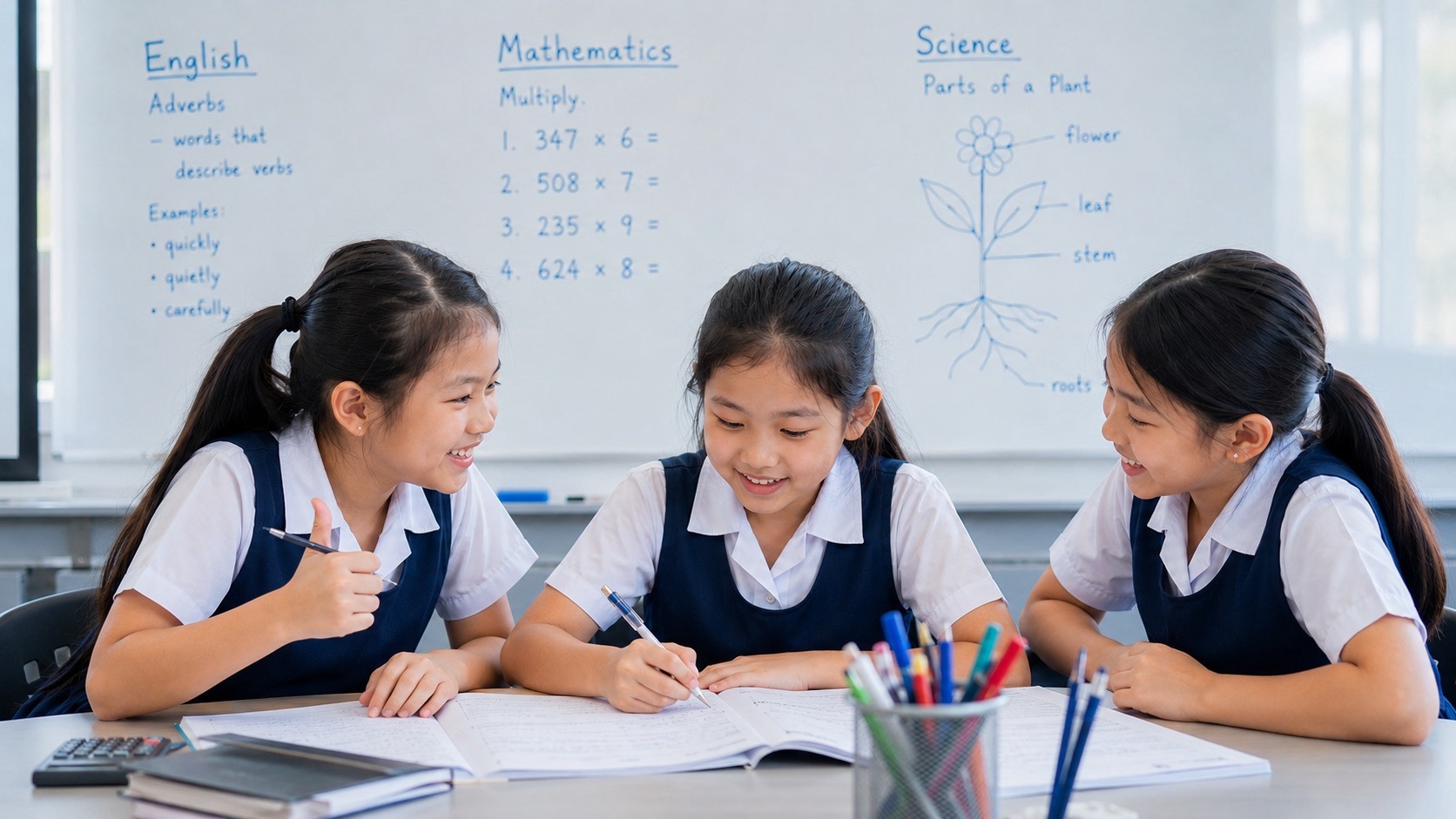
Katong Primary 1 Enrolment for English Maths Tuition is a historical title for a transition that remains very real. Families searching for Primary 1 tuition in Singapore, P1 English tuition, P1 Maths tuition, Katong tuition, phonics, early reading, sentence writing, number sense, word problems, school readiness and small-group tuition are usually not trying to turn a six-year-old into an examination machine. They are trying to help a child enter formal schooling with enough language, number confidence and learning independence to participate without constant rescue.
Current Primary 1 programmes commonly advertise MOE-aligned English and Mathematics, phonics, reading comprehension, grammar, writing, number bonds, problem sums, small classes and personalised support. Those phrases are useful only when they correspond to a sensible learning sequence. A P1 child does not need every upper-primary skill early. The child needs foundations that are accurate, connected and calm enough to carry the heavier work that arrives later.
This rebuilt 2017 page keeps its title and URL but removes the old enrolment promotion, phone numbers, centre-location claims, hashtags and unsupported quality claims. Its modern job is to help parents understand what a strong Primary 1 English and Mathematics transition looks like: what children need before and during P1, how to diagnose genuine gaps, how small-group teaching can support independence, and how to avoid confusing acceleration with readiness.
Primary 1 Is a Systems Transition
A child entering Primary 1 is not merely learning harder English and Mathematics.
The child is learning how school works.
- listen to a multi-step instruction;
- find the correct page;
- begin without an adult sitting beside them;
- copy accurately;
- ask a useful question;
- wait for help;
- finish one task and move to another;
- carry materials between school and home;
- accept correction without treating it as failure.
English and Mathematics sit inside that wider system. A child may know the academic content and still struggle because the self-management load is new.
The First Diagnostic: What Can the Child Do Without Prompting?
Parents often see more ability at home than teachers see in class because home support arrives invisibly.
An adult reads the instruction aloud, points to the first line, reminds the child what happened yesterday and quietly fixes materials. The child then completes the worksheet.
That is useful support, but it can hide the true independent level.
A P1 diagnostic should therefore include a cold attempt: one short reading task, one sentence task, one number task and one simple word problem with as little intervention as reasonably possible.
Observe where the child pauses. The pause is information.
Primary 1 English: Reading Is More Than Saying the Words
Early reading develops through several connected capabilities.
- Decoding: turning print into spoken words.
- Fluency: reading with enough accuracy and pace that meaning remains available.
- Vocabulary: knowing what important words mean in context.
- Sentence meaning: understanding how words relate.
- Comprehension: building a coherent idea from several sentences.
A pupil can sound out every word and still fail to understand the passage. Another child can understand a story when heard aloud but struggle to decode it independently. Those children need different teaching.
Phonics Is a Bridge, Not the Whole Destination
Phonics can help children connect letters and sound patterns, especially when unfamiliar words appear.
But reading eventually requires more than sounding out. Common words need increasing automaticity. Vocabulary grows. Sentences become longer. Punctuation, syntax and background knowledge begin affecting meaning.
Good P1 English teaching therefore moves from sound-pattern support toward fluent, meaningful reading rather than leaving the child permanently dependent on slow decoding.
Vocabulary Should Become Usable
A six-year-old does not need a decorative list of “advanced words”.
The learner needs words that make reading and communication easier.
Teach vocabulary in small semantic neighbourhoods. A lesson about movement might include stroll, hurry, race, creep and stumble. Discuss how the words differ. Act them out. Use them in oral sentences. Find them in a short text. Return to them several days later.
The word becomes useful when the child can recognise it, explain it and choose it appropriately.
From Spoken Sentence to Written Sentence
Many P1 children can tell a lively story and then write three uncertain words.
That gap is normal. Writing asks the child to coordinate idea, vocabulary, grammar, spelling, handwriting, punctuation and working memory at the same time.
A useful sequence is:
- say the sentence;
- repeat it slowly;
- identify the first word;
- write in manageable chunks;
- read the sentence back;
- check capital letter, spacing and full stop;
- ask whether the written sentence still says what the child intended.
Over time, the external sequence becomes internal.
Grammar Should Support Meaning
At Primary 1, grammar is most useful when children see what a form does.
Singular and plural forms change meaning. Pronouns help us avoid repeating a noun. Tense tells the reader when something happened. Sentence boundaries help ideas remain separate.
Short grammar exercises can isolate a pattern. The final test is whether that pattern survives inside the child’s own sentence.
Oral Language Is Part of Academic Language
Conversation builds the material that later writing draws on.
Ask a child to explain why a character made a choice. Ask what might happen next. Ask the child to compare two pictures. Encourage complete answers without turning every conversation into a test.
A pupil who can organise an idea aloud is building a bridge toward organised written language.
Primary 1 Mathematics: Number Sense Before Tricks
The most important early-Mathematics question is not “How fast can the child add?”
It is “What does the number mean?”
Number sense includes:
- counting accurately;
- understanding cardinality—the last count tells how many;
- comparing quantities;
- recognising number bonds;
- seeing tens and ones;
- understanding that addition combines or increases;
- understanding that subtraction can take away or compare;
- estimating whether an answer is plausible.
A child who understands ten as a structure can later use “make ten” strategies rather than recounting from one every time.
Concrete → Pictorial → Symbolic
Young learners often benefit from moving through representations.
For 7 + 5, a tutor might first use counters, then a simple drawing or ten-frame, then the number sentence.
The point is not to keep using manipulatives forever. It is to ensure that the symbol “7 + 5” is attached to a relationship the child understands.
Number Bonds Are More Powerful Than They Look
Number bonds teach composition and decomposition.
If a child knows that 8 is 5 + 3, 6 + 2, 7 + 1 and 4 + 4, the number becomes flexible rather than fixed. That flexibility later supports mental calculation, regrouping, multiplication, fractions and algebraic thinking.
Fluency should therefore grow from structure, not from anxiety about speed.
Primary 1 Word Problems: Language Meets Quantity
A simple word problem can be difficult for a child who calculates accurately because the task combines reading and Mathematics.
Teach a small routine:
- Who or what is the problem about?
- What quantity do we know?
- What changed?
- What are we asked to find?
- Can we show it with objects or a drawing?
- Which operation matches the relationship?
Avoid teaching children to choose operations from isolated keywords such as “altogether” without understanding the situation. Words can be reused in different mathematical relationships.
Do Not Rush Into Model Drawing as a Ritual
Bar models become valuable as problem structures grow more complex, but the foundation is representation itself.
At P1, a child may use counters, simple part-whole drawings, number lines or boxes. The teaching question is always the same: Does the representation preserve the relationship?
Later formal models will be much easier if this habit is already present.
The Hidden P1 Skill: Following a Task Independently
A child may know English and Mathematics but still lose learning time because every task needs adult ignition.
Teach a start routine:
- read or listen to the instruction;
- say what the task is;
- identify the first action;
- start;
- put a small mark beside anything genuinely confusing;
- continue with what can be done;
- ask a specific question later.
This is the beginning of independent learning.
A Small Group Can Teach Waiting, Listening and Explaining
A well-run P1 small group has an advantage beyond tutor attention.
Children learn that not every difficulty receives instant adult rescue. One child explains. Another listens. A third tries. The tutor can see whether a pupil is participating, copying or genuinely understanding.
Smallness should create visibility, not simply a smaller room.
The P1 Help Ladder
When a child is stuck, use the least help necessary.
- Wait for a few seconds.
- Ask the child to repeat the instruction.
- Ask what the first step might be.
- Point to the relevant information.
- Offer one small cue.
- Model one example only if necessary.
- Give a fresh item immediately.
The fresh item matters. It tells us whether the child learned the route or merely followed the adult.
What “School Readiness” Should Not Mean
School readiness does not mean finishing the P1 syllabus before P1 begins.
Over-acceleration can create a strange outcome: the child has seen many topics but owns few of them.
Useful readiness is simpler:
- can attend for a reasonable period;
- can understand ordinary classroom instructions;
- can read or decode at an appropriate developing level;
- can express a simple idea;
- has basic number meaning;
- can begin a short task;
- can tolerate correction;
- can ask for help.
Those capabilities give school learning somewhere to land.
The First Eight Weeks: Observe Before Panicking
Primary 1 contains novelty. A child may come home tired, forget routines, make silly-looking mistakes or temporarily write less than expected.
Look for patterns rather than one difficult afternoon.
- Is the same reading difficulty repeating?
- Does number confusion survive across several weeks?
- Can the child explain schoolwork after rest?
- Is homework dependence decreasing?
- Are instructions becoming easier to follow?
- Does the child recover after correction?
A transition deserves observation before it receives a label.
When P1 Tuition May Be Useful
- reading is so effortful that meaning disappears;
- spoken language is strong but writing cannot begin;
- basic number meaning remains confused;
- the child repeatedly chooses operations without understanding;
- homework requires continuous adult prompting;
- school feedback identifies a persistent gap;
- the child is secure and needs richer—not merely faster—extension.
The reason matters because it determines the intervention.
When P1 Tuition May Not Be Necessary
A child who is adapting steadily, reading and counting at an appropriate developing level, completing schoolwork with increasing independence and remaining curious may not need additional classes.
More scheduled learning is not automatically better learning. Play, sleep, conversation, reading for pleasure and ordinary family life also support development.
A 75–90 Minute P1 Tutorial Should Breathe
Young children need variation in cognitive demand.
- Reading warm-up: familiar text or sound pattern.
- English focus: one reading, vocabulary or sentence idea.
- Short independent attempt: prove the idea without immediate help.
- Movement/reset: brief physical change.
- Mathematics focus: one number or problem-solving concept.
- Hands-on/visual representation: make the relationship visible.
- Independent problem: remove the model.
- Closure: child explains one thing learned and one thing to remember.
Density should come from good selection, not from keeping a six-year-old continuously busy.
Homework: Small Enough to Finish, Important Enough to Matter
P1 continuation work can be short.
- read a short passage aloud once for accuracy and once for meaning;
- retrieve five useful words;
- write two complete sentences;
- practise one number bond family;
- solve two word problems and explain the operation;
- redo one corrected mistake without looking at the answer.
The objective is a closed loop, not a thick file.
Progress Indicators Parents Can See
- The child starts homework faster.
- Reading becomes smoother while comprehension stays intact.
- The child writes longer ideas with less dictation from an adult.
- Number strategies become more flexible.
- Simple mistakes are noticed independently.
- The child can explain what a Mathematics symbol or sentence means.
- Requests for help become more specific.
- Corrections cause less emotional collapse.
Those are meaningful because they describe a learner gaining control.
What Parents Can Ask a P1 Tuition Programme
- How do you distinguish decoding difficulty from comprehension difficulty?
- How do you move children from spoken ideas into written sentences?
- How do you teach number sense before speed?
- How much independent work occurs during a lesson?
- How do you fade prompts?
- How do you prevent advanced children from merely racing ahead?
- What evidence shows that a correction has transferred?
- How much homework is typical, and what is its learning job?
Frequently Asked Questions
Does my child need to read fluently before Primary 1?
Children enter with different levels of reading development. Useful preparation supports sound–print relationships, vocabulary, oral language, attention to meaning and confidence with books without turning readiness into a race.
Should P1 Math tuition teach P2 topics early?
Only when the current foundation is genuinely secure and the extension has a clear learning purpose. Depth in number relationships is often more valuable than premature chapter acceleration.
Is a small group suitable for a shy child?
It can be, if the tutor creates predictable opportunities to answer without public pressure. A small group may help a quiet child learn to speak, wait, listen and explain in manageable steps.
What if homework becomes a nightly battle?
Separate academic difficulty from routine difficulty. The child may not understand the work, may not know how to begin, may be exhausted, or may have learnt that an adult eventually takes over. The repair depends on the cause.
What is the best preparation for Primary 2?
Finish Primary 1 with strong basic reading, increasingly independent sentence writing, secure number meaning, flexible basic addition/subtraction strategies and a reliable habit of beginning and checking short tasks.
Katong Primary 1 Enrolment for English Maths Tuition: The Larger Lesson
The old version of this page was an enrolment notice.
The more durable question is what we are enrolling a child into.
Primary 1 is the beginning of formal academic independence. English teaches the child to turn print into meaning and meaning into language. Mathematics teaches the child to turn quantities into relationships and relationships into symbols. School routines teach the child to carry both without an adult moving every step.
The strongest start is not the child who has raced furthest ahead.
It is the child whose foundations are coherent enough to keep learning when the next unfamiliar thing arrives.
Useful Routes
- eduKateYishun English Tuition & Learning Hub
- eduKateYishun Mathematics Tuition & Learning Hub
- eduKateYishun Library
- MOE Primary Mathematics Syllabus
Properly taught kids shine a bright light into the future.
Leave a Reply