
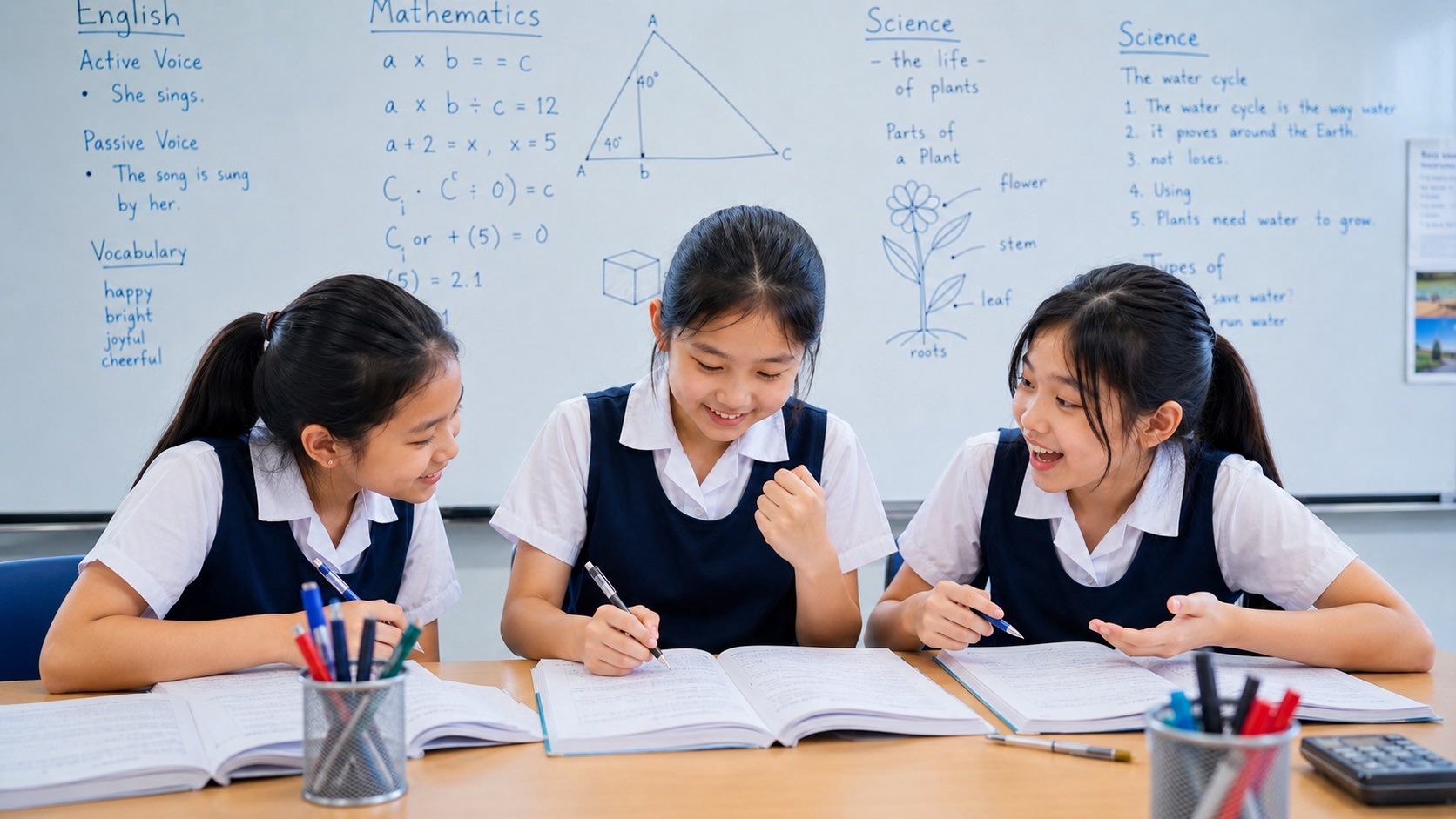
Sentosa Creative Writing Enrichment is now an evergreen longform guide to Primary creative writing, P3 composition, P4 writing, P5 creative writing, P6 Continuous Writing, endings, denouement, aftermath, resolution, emotional landing, character change, final image and revision. The original 2017 page was a promotional location article with grade-improvement claims, phone details, tutor marketing and large galleries. Those elements are removed. The historical title, URL, date and featured image remain. This page now owns one precise craft job: what happens after the climax, when the story must settle rather than simply stop.
Families searching for Sentosa creative writing enrichment, Primary composition tuition, P3–P6 writing classes, composition endings, story resolution or Continuous Writing help often see pupils build pressure effectively and then collapse the ending into one line: “Everything was fine and I learnt a valuable lesson.” Another child solves the practical problem but forgets the damaged relationship. Another writes three pages of aftermath and accidentally starts a second story. These are landing problems. The climax and ending are connected, but they are not the same job.
This page does not claim that eduKate currently operates a Sentosa creative-writing centre. The location title is historical. Its present learning job is portable anywhere: release the main pressure, show the immediate result, account for what remains changed, repair what can reasonably be repaired, and leave the reader with one final state that belongs to the story. A good denouement is neither a moral lecture nor an administrative checklist. It is the story finding its new balance.
1. The climax answers “What will the character do?”
The denouement answers:
- What happened because of that choice?
- What is repaired?
- What remains damaged?
- What is different now?
The climax commits the action.
The denouement reveals the new state.
2. Primary 3: every story needs a place to stop
A P3 story can end simply.
Problem:
borrowed book is missing.
Climax:
character admits leaving it in the hall.
Resolution:
book is found at the office.
Landing:
character returns it and apologises.
That is enough.
3. Primary 3: do not stop at the exact moment of discovery
Weak:
“Then I found the book. The end.”
Better:
“I found the book at the office and returned it before lunch. Mei accepted my apology, although she made me promise not to leave her things unattended again.”
The story shows practical and relational outcome.
4. Resolution is not always complete restoration
The book may be found.
But trust may still be bruised.
The project may be rebuilt.
But time was lost.
Believable endings allow consequences to remain.
5. Primary 3: use one final action
Instead of a moral sentence, end with behaviour.
Example:
“Before leaving the classroom, I clipped the notebook securely inside my bag.”
The small action shows changed care.
6. Final actions can demonstrate learning
Opening habit:
throws materials carelessly.
Ending action:
checks them before leaving.
No lecture is needed.
7. Primary 3: the ending should match the problem
If the story problem is:
lost item,
end with:
- finding;
- replacement;
- accepting loss;
plus relevant relationship effect.
Do not end with an unrelated prize.
8. The central problem creates an ending obligation
If the opening promises:
“Will the character keep the promise?”
the ending should answer it.
The Somerset sibling owns promise/payoff architecture broadly; Sentosa focuses on the period after the answer is known.
9. Primary 4: separate immediate result from aftermath
Immediate result:
missing file restored.
Aftermath:
group must decide how to handle the accusation that happened during the search.
The aftermath is often where emotional meaning becomes visible.
10. Use the three-step landing
result → residual consequence → final state
Example:
Result: file recovered.
Residual consequence: friend remains hurt by false blame.
Final state: apology begins repair.
11. Primary 4: practical resolution and emotional resolution can differ
Practical:
object found.
Emotional:
trust not fully restored.
This difference creates more believable endings.
12. Do not force emotional closure too quickly
Weak:
“She forgave me immediately and everything became perfect.”
Possible:
“She nodded when I apologised, but she did not smile.”
Partial repair can feel more human.
13. Primary 4: use quiet scenes after loud scenes
After an argument, chase or urgent search, reduce intensity.
Possible aftermath setting:
- corridor after everyone leaves;
- walk back to class;
- quiet office.
The quieter environment allows the consequence to land.
14. Pressure should fall after the central turn
The story does not need to stay at maximum intensity.
Think:
rise → peak → release.
Denouement is controlled release.
15. Primary 4: do not add a second climax
Weak:
main problem solved → sudden accident → another rescue → new villain.
The ending becomes a new middle.
After the central climax, resolve rather than expand.
16. “One more surprise” is often an ending failure
Pupils may fear quiet endings.
Teach that satisfaction comes from:
- causal completion;
- character change;
- meaningful image.
Not from constant surprise.
17. Primary 4: use consequence cleanup selectively
Do not list every administrative detail.
Weak:
who packed chairs, who switched lights, who signed form.
Keep only aftermath actions that show:
- repair;
- relationship;
- change.
18. Denouement is not minutes of meeting notes
Compress routine cleanup:
“The group spent the next twenty minutes rebuilding the final slide.”
Then close in:
“When we finished, Lena quietly returned the USB drive to me.”
The handoff matters.
19. Primary 5: identify the story’s residual threads
After climax, ask:
- central problem;
- relationship;
- promise;
- important object;
- misunderstanding.
Which of these still needs updating?
20. Not every thread needs a paragraph
One line can close a minor thread.
The central relationship may deserve more space.
Use hierarchy.
21. Primary 5: resolve the most important thread last
If the story is mainly about trust, the final emphasis should probably be trust rather than whether the chairs were stacked.
The last paragraph tells the reader what mattered most.
22. The final paragraph is an emphasis device
Whatever appears there gains weight.
Choose deliberately:
- relationship;
- changed behaviour;
- important object;
- quiet reflection.
23. Primary 5: denouement can use changed routine
Opening:
character never checks shared files.
Ending:
character checks and messages the group.
Routine demonstrates transfer.
24. Changed behaviour is stronger than generic moral
Weak:
“I learnt to be responsible.”
Stronger:
“The next Friday, I checked the folder before leaving and told everyone where I had saved the backup.”
Action makes learning observable.
25. Primary 5: final images can carry meaning
An object can return:
- repaired;
- returned;
- changed;
Example:
The cracked badge from the opening is now taped carefully inside the notebook.
The image holds consequence and repair.
26. Final images should belong to the story
Do not invent:
sunset, rainbow, bird flying away
unless the image is genuinely connected.
A small story-specific object is often stronger.
27. Primary 5: use echo with changed meaning
Opening:
“I can handle it myself.”
Ending:
“Next time, ask me earlier,” Lena said.
“I will.”
The story shows changed relationship with help.
28. Do not repeat opening word for word just to be circular
A circular ending works when meaning changed.
Mechanical repetition is only a trick.
29. Primary 5: aftermath can reveal who really changed
During crisis, characters may act under pressure.
Afterward, their voluntary behaviour reveals deeper change.
Example:
after teacher leaves, character still chooses to correct the accusation.
That choice has stronger moral weight because external pressure is gone.
30. Aftermath is a test of genuine character change
Ask:
What does the character do when nobody is forcing them?
The answer can create the final beat.
31. Primary 5: apology needs specificity
Weak:
“Sorry for everything.”
Stronger:
“I blamed you before I knew what happened. I’m sorry.”
Specificity shows understanding of harm.
32. Repair action can follow apology
“I’ll tell the group I was wrong.”
Now apology becomes action.
The denouement gains substance.
33. Primary 6: denouement should be planned before the climax is written
Not word for word.
Know:
- main consequence;
- what remains unresolved;
- final changed state.
This prevents the clock from forcing a generic ending.
34. Use the ending-state line
Before drafting:
At the end, ______ is different because ______.
Example:
“At the end, trust is damaged but repair has begun because the protagonist admits the false accusation publicly.”
35. Ending-state planning reduces moralising
If the writer knows the final state, the ending can show it.
No need for abstract lesson paragraphs.
36. Primary 6: protect aftermath time
The Clementi sibling owns timed execution. One key rule applies here:
Do not use every remaining minute reaching the climax.
Reserve enough space for:
- result;
- residual effect;
- landing.
37. A climax without aftermath can feel emotionally unfinished
Character confesses.
Story ends.
Reader still asks:
- What did the group do?
- What happened to the blamed person?
- Was the problem repaired?
Answer the highest-value questions.
38. Use the one-paragraph aftermath when time is short
A compact structure:
- result sentence;
- repair sentence;
- final changed-action sentence.
Three sentences can create a satisfying landing.
39. Example of compact aftermath
“We rebuilt enough of the presentation to finish on time. After class, I told Lena in front of the group that I had blamed her unfairly. The following week, when another file went missing, I asked what had happened before accusing anyone.”
Practical, relational and future effects are all visible.
40. Longer aftermath is justified when relationship is central
If the story’s real heart is:
friendship damaged by mistrust,
the post-climax conversation may deserve a full scene.
Do not compress the central meaning merely because the practical plot is solved.
41. Use scene for the central emotional consequence
Direct dialogue may be useful:
“You could have asked me,” Lena said.
“I know.”
“No. I don’t think you did.”
Not everything repairs immediately.
42. Emotional landing can remain uncomfortable
A satisfying ending does not require happiness.
It requires completion.
Possible endings:
- relationship partly repaired;
- loss accepted;
- responsibility taken;
- uncertainty reduced.
43. Sad endings can still be resolved
The lost item may never be found.
But:
- owner is told honestly;
- replacement is arranged;
- character changes behaviour.
The problem is not magically erased, yet the story reaches a stable end state.
44. Happy endings can still carry cost
File restored.
Presentation completed.
But trust took damage.
Acknowledging cost prevents simplistic reset.
45. Primary 6: distinguish closure from certainty
Closure means the central story feels complete.
It does not mean every future detail is known.
The reader can wonder what happens next without wondering what the story was about.
46. Leave small future space
Example:
“Mei accepted the replacement notebook, but it would be several days before our conversations felt normal again.”
The future remains open, but the current story is complete.
47. Do not explain the rest of the character’s life
Weak:
“Years later, I became a responsible adult, went to university and never made another mistake.”
This usually exceeds the story’s scope.
End near the event unless a time jump has a clear purpose.
48. Use short epilogue jumps carefully
“The following week…”
can demonstrate transfer.
One small later action is enough.
Do not open a second narrative.
49. Denouement can restore routine
Opening:
ordinary routine.
Middle:
routine disrupted.
Ending:
routine returns—but with one difference.
This is a powerful structure.
50. Changed routine shows learning
Before:
character leaves shared materials unchecked.
After:
character checks them.
The world returns to normal, but the character does not return unchanged.
51. Denouement can restore place
Story begins at library.
After multiple scenes, ending returns there.
The same location can feel different because the relationship or object state changed.
52. Return-to-place endings create structural closure
Opening:
bench where promise was made.
Ending:
same bench where apology occurs.
The place connects beginning and ending.
53. Do not force a return if it is inconvenient
Structural echoes are tools, not rules.
End where the central consequence naturally belongs.
54. Denouement can restore object order
Objects may:
- return to owner;
- be repaired;
- be replaced;
- remain lost.
The object’s final state can summarise the plot.
55. Track the important object to the end
If the whole story revolves around a notebook, do not forget it after the apology.
One line can close the object thread.
56. Denouement can restore information order
Misunderstanding story:
different characters hold different beliefs.
Ending:
key facts become shared.
Not everyone must agree emotionally, but the factual confusion can be resolved.
57. Correct public misinformation publicly when relevant
If the protagonist accused someone in front of others, a private apology alone may not repair the public damage.
A believable ending may include public correction.
58. Repair should match the scale and audience of harm
Private mistake → private repair may be enough.
Public accusation → public correction may be needed.
Damaged object → practical repair.
Lost time → help complete work.
59. Denouement can show responsibility through follow-through
Confession is not the end of responsibility.
Follow-through may include:
- repairing;
- replacing;
- informing;
- checking later.
Aftermath shows whether the character follows through.
60. Do not confuse confession with full resolution
“It was me.”
may be the climax.
The denouement answers what happens after truth enters the room.
61. Denouement can reveal secondary-character agency
The harmed character may:
- accept;
- refuse immediate forgiveness;
- set a condition;
- help repair anyway.
Supporting characters should not become automatic forgiveness machines.
62. Secondary-character reactions should fit history
If trust has been damaged repeatedly, one apology may not restore it.
If mistake was minor and unusual, repair may be quicker.
Relationship history shapes landing.
63. Denouement can reveal adult response without moral lecture
A teacher may:
- accept explanation;
- require repair;
- set a boundary.
Do not make authority deliver a page-long moral speech.
Action and consequence can teach.
64. Use realistic authority
Teachers and parents do not need to be:
- perfectly wise;
- unreasonably cruel.
They can respond proportionately to the situation.
65. Denouement can use silence
After an apology:
silence may mean:
- processing;
- hurt;
- uncertainty.
Do not label it automatically.
Let subsequent action clarify.
66. Silence can be the final emotional beat
Example:
“Mei placed the repaired badge beside me. Neither of us said anything, but she did not move away.”
The action suggests cautious repair.
67. Denouement can use ordinary tasks
Packing up, returning books, cleaning a table can become meaningful after conflict.
Ordinary action after extraordinary pressure gives the story a grounded landing.
68. Ordinary tasks should carry changed meaning
Opening:
two friends pack together easily.
Ending:
they pack in careful silence after conflict.
Routine becomes emotional evidence.
69. Denouement can use humour lightly
After tension, a small natural humorous line may restore relationship.
Do not use a joke to erase serious harm.
Tone should respect the consequence.
70. Humour can signal normality returning
When characters can joke again, the reader sees pressure easing.
Use sparingly and only if consistent with relationship.
71. Denouement can use physical distance
After conflict:
characters stand apart.
During repair:
distance changes.
Physical movement can reflect relationship without explicit explanation.
72. Do not turn body position into fixed psychology
Distance may mean:
- anger;
- need for space;
- coincidence.
Context gives meaning.
73. Denouement can use returned objects as peace gestures
A borrowed item returned carefully.
A repaired object placed on desk.
An object can carry apology indirectly.
74. Object gestures should not replace necessary words
If serious harm requires acknowledgement, the character may still need to speak.
Gesture and dialogue can work together.
75. Primary 6: avoid the generic moral paragraph
Weak:
“From that day onwards, I learnt that honesty is the best policy and friendship is very important in life.”
This sounds detached from the actual story.
Replace with specific changed understanding or action.
76. Specific reflection can work
“I had thought keeping quiet would protect me. I had not realised it would leave Lena defending herself for something she had not done.”
This belongs to the story.
77. Reflection should be earned by evidence
Ask:
- What happened that made the character think this?
- What future behaviour might change?
If the reflection has no event support, cut it.
78. Denouement can be reflective without being philosophical
Primary writing does not need broad claims about life.
Stay near:
- this choice;
- this relationship;
- this consequence.
Specificity creates maturity.
79. Use a final question only when natural
An ending may leave a small unresolved question.
But do not end every composition with:
“Would things ever be the same again?”
Use open questions only when they match tone.
80. Avoid cliffhangers in resolved stories
“Then the door opened…”
end.
This may feel unfinished unless the task deliberately calls for continuation.
A composition usually benefits from central closure.
81. Use final image instead of cliffhanger
“The repaired folder sat between us on the desk.”
This image can close without explaining every emotion.
82. Final sentences should not carry too many jobs
Weak:
one giant sentence resolving object, friendship, moral, future and setting.
Use two or three clean sentences if needed.
83. Last sentence can be quiet
It does not need:
- exclamation mark;
- grand lesson;
- dramatic metaphor.
Quiet precision often lands better.
84. Last sentence can return to action
“This time, I checked the folder before leaving.”
Simple, specific, thematic.
85. Last sentence can return to object
“The repaired badge clicked softly against the zipper as I closed my bag.”
Object and changed care combine.
86. Last sentence can return to relationship
“Mei waited for me at the door.”
If earlier she had walked away, the line carries changed meaning.
87. Last sentence can return to place
“The hall was empty now.”
After crowded pressure, emptiness can signal release.
But the line should connect to the story’s emotional state.
88. Revision: identify the exact climax
Underline the moment after which the central story cannot return to its previous state.
Everything after should generally move toward resolution, not renewed escalation.
89. Revision: label aftermath sentences
Mark:
- P = practical;
- R = relationship;
- C = character change;
- O = object.
Which category is central?
Give that one the most attention.
90. Revision: cut post-climax repetition
After resolution, pupils may restate:
- apology;
- lesson;
- emotion
several times.
Say it once through the strongest evidence.
91. Revision: check whether ending solves the right problem
Write:
Central problem = ______.
Ending resolves = ______.
If they do not match, realign.
92. Revision: check residual consequences
Ask:
- What could not realistically disappear immediately?
- What cost remains?
Add one line if needed.
93. Revision: check whether repair matches harm
Public accusation?
Public correction.
Damaged object?
Repair or replacement.
Lost time?
Help with task.
94. Revision: check final image relevance
If final sentence contains:
sunset, rainbow, bird, stars,
ask:
Did this image matter earlier?
If not, choose a story-specific image.
95. Use a denouement error ledger
| Problem | Likely cause | Repair | Retest |
|---|---|---|---|
| ending abrupt | stops at climax | add result + residual consequence | new ending |
| everything perfect | cost erased | keep one realistic residual effect | fresh resolution |
| moral pasted on | change not shown | use changed behaviour | final paragraph |
| ending drags | cleanup overexplained | compress routine aftermath | shortened ending |
| second crisis starts | writer fears quiet ending | resolve, do not expand | new draft |
96. Small groups can compare three endings
Same climax.
Ending A:
abrupt.
Ending B:
overexplained moral.
Ending C:
specific aftermath and changed action.
Ask which questions each ending leaves.
97. Small groups can write different residual consequences
Climax:
truth admitted.
Possible aftermath:
- friend accepts;
- friend needs time;
- group repairs task;
Compare how tone changes.
98. Small groups can cut an overlong denouement
Give a 300-word ending.
Ask pupils to keep:
- one practical result;
- one relational result;
- one final image.
Compression builds hierarchy.
99. A six-week denouement cycle
Week 1: climax versus ending
Identify where one stops and the other begins.
Week 2: immediate result
Show what the key choice causes.
Week 3: residual consequence
Keep one realistic cost.
Week 4: repair
Match repair to harm.
Week 5: final image and changed behaviour
End specifically without moralising.
Week 6: timed transfer
Write a full composition with a protected aftermath section.
100. P3 ending routine
What happened to the problem?
What did the character do after?
Stop.
101. P4 ending routine
Add:
- relationship result;
- one changed action.
102. P5 ending routine
Add:
- residual consequence;
- specific repair.
103. P6 ending routine
Climax → result → residual consequence → repair/acceptance → final state.
Keep it proportional to the story.
104. What parents can notice
Instead of asking:
“Did you add a moral?”
ask:
- What changed at the end?
- What consequence remained?
- Did the ending show it?
These questions encourage genuine closure.
105. What tutors can diagnose
Weak endings may come from:
- poor time management;
- no end-state planning;
- fear of quiet endings;
- overreliance on moral templates.
Repair the underlying cause.
106. How this page avoids collision
The current estate search shows no competing exact Sentosa creative-writing owner.
Sentosa Creative Writing Enrichment therefore owns denouement and emotional landing.
Somerset owns opening-to-ending promise/payoff, Bukit Merah owns consequence ripples, and Sentosa focuses on the final release after the climax: aftermath, residual cost, repair and the story’s new equilibrium.
107. Frequently asked questions
Is this page claiming current creative-writing classes in Sentosa?
No. The location title is historical. Current eduKate service information should be checked through current eduKate channels.
Does every story need a happy ending?
No. It needs a coherent ending. Loss, partial repair or cautious reconciliation can all be satisfying when they follow the story honestly.
Should the last paragraph contain a moral?
Not necessarily. Specific reflection or changed behaviour usually works better than a generic lesson.
How long should the denouement be?
Long enough to show the central result and important residual consequence, short enough that it does not open a second story.
What is the strongest sign of progress?
The pupil no longer stops at the climax or pastes on a lesson. The story settles deliberately, consequences remain believable, relationships remember what happened, and the final image or action feels specific to the story just completed.
108. Routes
- Somerset Creative Writing Enrichment — promise and payoff
- Bukit Merah Creative Writing Enrichment — consequence ripples
- Clementi Creative Writing Enrichment — timed execution
The Sentosa landing lesson
Reach the climax.
Let the main pressure fall.
Show the immediate result.
Keep the consequence that would realistically remain.
Repair what can be repaired.
Then stop on one changed action, relationship or image that belongs only to this story.
Leave a Reply