
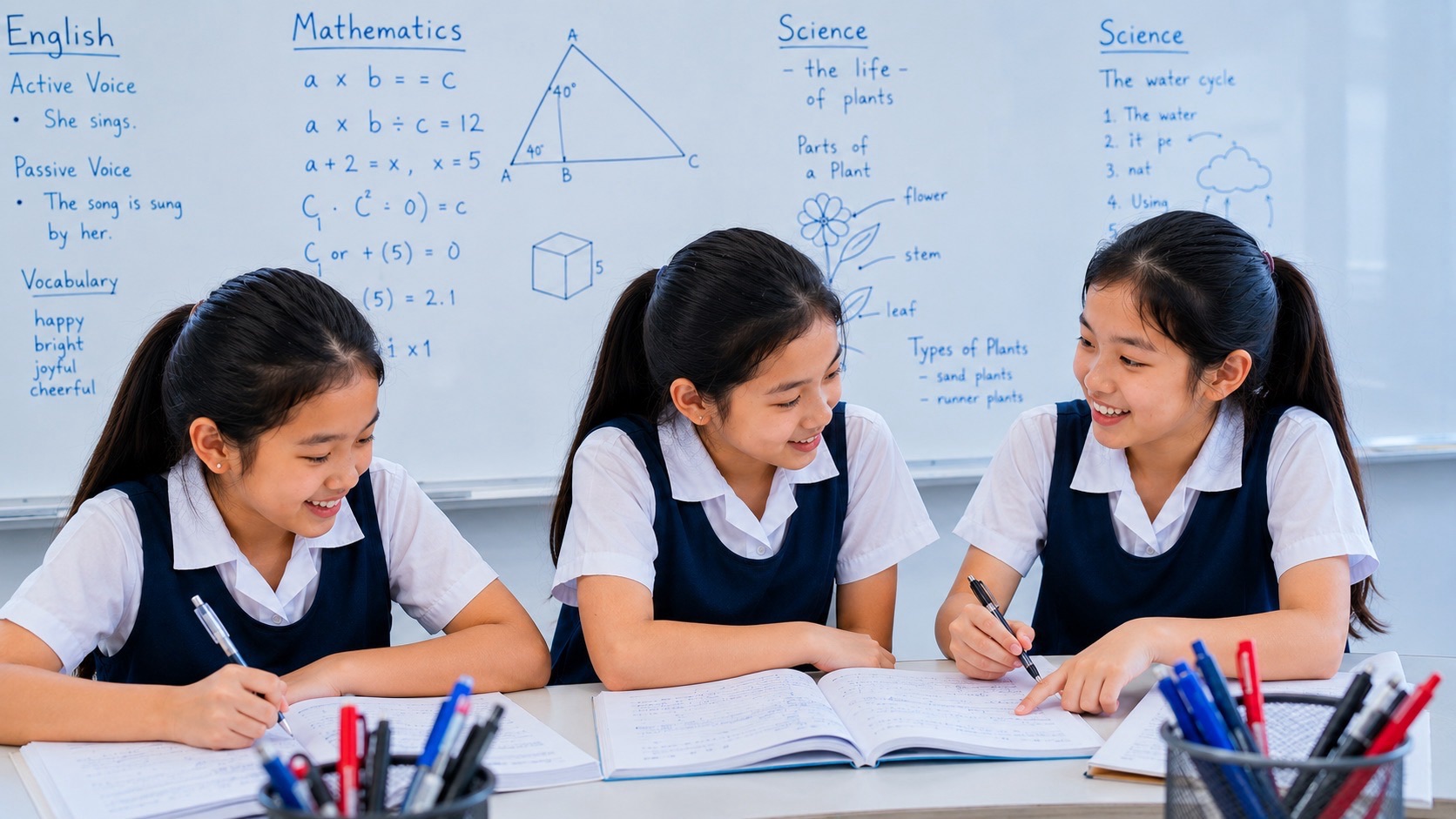
Punggol Creative Writing Enrichment is now an evergreen guide to Primary creative writing, P3 composition, P4 writing, P5 creative writing, P6 Continuous Writing, story ideas, composition planning, character goals, conflict, consequences, endings and independent writing. The original 2017 page was a promotional location article with grade-improvement claims, phone details, tutor marketing and extensive class and travel photography. Those elements are removed. The historical title, URL, original date and featured image remain, while this page now owns one distinct craft job: how to choose a workable story idea before drafting begins.
Families searching for Punggol creative writing enrichment, Primary composition tuition, story-planning help, P3–P6 writing classes or Continuous Writing support often see a child freeze at the blank page. The child may have many ideas, but no way to decide which one can become a complete story. Another child may choose the first idea that appears, start writing immediately, then discover halfway through that there is no real problem, no meaningful decision and no believable ending. The writing difficulty is not always language. Sometimes it is idea selection.
This page does not claim that eduKate currently operates a Punggol creative-writing class at a particular location. The location title is historical. Its present learning job is transferable anywhere: generate possibilities, test them quickly, choose the story with the clearest causal engine, then draft with enough freedom to discover better details along the way. The goal is not to plan every sentence. It is to avoid committing fifteen minutes to an idea that cannot carry a full composition.
The first idea is not automatically the best idea
When a topic appears, many pupils grab the first familiar plot:
- someone loses a wallet;
- someone gets injured;
- someone is late;
- someone is falsely accused;
- someone learns a lesson.
These plots are not bad. The problem is automatic selection. A familiar plot may fit the topic poorly, require unrealistic events or lead to a predictable ending. Strong writers pause long enough to compare possibilities.
A useful rule is:
Generate before you commit.
Even two alternative ideas can improve the final choice.
Primary 3: generate three simple possibilities
Suppose the topic is A Mistake.
A P3 pupil can generate:
- I take the wrong bag home.
- I forget to bring materials for a group activity.
- I send a message to the wrong person.
Now ask one question for each:
What happens because of the mistake?
The strongest idea is often the one with the clearest consequence.
Do not reward the most dramatic idea automatically
Idea 1:
A child forgets a project folder and has to decide whether to admit it before the group presentation.
Idea 2:
A child is chased by criminals, falls into a river, is rescued by a helicopter and wakes in hospital.
The second sounds more dramatic. The first may be easier to develop with believable pressure, dialogue, responsibility and consequence.
Story quality comes from development, not event volume.
The story-viability test
Before choosing an idea, ask five questions:
- Who is the main character?
- What does the character want?
- What prevents the easy path?
- What important choice must be made?
- What consequence can produce an ending?
If an idea cannot answer at least four of these clearly, it may need development before drafting.
Primary 3: identify one main character
Young writers sometimes create:
- five friends;
- two teachers;
- a parent;
- a stranger;
- a police officer.
The story becomes difficult to control.
For most P3 stories, one main character plus one or two important supporting characters is enough.
Idea selection should include cast control.
The main character needs a goal
A story becomes easier to plan when the character wants something specific.
Examples:
- return the borrowed book before lunch;
- finish the display before the teacher arrives;
- find a missing sibling;
- correct a misunderstanding;
- keep a promise.
“Be happy” is too vague.
“Reach the hall before the group is called” is actionable.
Goals create direction
Once the goal is clear, the writer can test every event.
Ask:
- Does this event help the goal?
- Block the goal?
- Change the goal?
- Raise the cost of the goal?
If an event has no relationship to the character’s goal, it may belong to another story.
Primary 4: choose an obstacle that belongs to the goal
Goal:
Return a borrowed book before its owner leaves.
Related obstacles:
- book is not in the expected bag;
- library has closed;
- owner is leaving early;
- the book was passed to another person.
Unrelated obstacle:
A random storm destroys the school roof.
The obstacle should make the existing goal harder, not replace the story.
One obstacle can create several consequences
A missing folder can produce:
- time pressure;
- blame;
- need to search;
- decision whether to admit responsibility;
- need for a backup plan.
A strong idea often contains a compact obstacle that naturally generates several story jobs.
Use the consequence question early
Before drafting, complete:
If the character does nothing, then ______.
If the blank is meaningless, the stakes may be weak.
Example:
“If the character does nothing, the team will begin the presentation without the required notes and another pupil may be blamed.”
Now the problem matters.
Stakes should be believable
For Primary stories, meaningful stakes include:
- trust;
- responsibility;
- time;
- friendship;
- opportunity;
- embarrassment;
- loss or damage of an important object.
The story does not need physical danger to matter.
Primary 4: test whether the character has a real choice
Weak choice:
“Tell the truth and everything becomes perfect, or tell a lie and everything becomes terrible.”
Stronger choice:
“Admit the mistake now and disappoint the group, or hide it and hope the problem can be fixed before anyone notices.”
Both options carry a cost.
That makes the decision worth writing.
A decision is stronger when alternatives are plausible
Ask:
- What else could the character do?
- Why might that option seem attractive?
- What risk does it carry?
If only one option makes any sense, the story may still work, but the turning point may feel less meaningful.
Primary 5: idea selection should include viewpoint
The same event changes depending on who tells it.
Scenario:
A group project is damaged.
Viewpoint options:
- the pupil who caused the damage;
- the pupil who is wrongly blamed;
- the group leader trying to finish on time.
Each viewpoint creates different information, pressure and emotional logic.
Choosing viewpoint is part of choosing the idea.
Ask which character has the most interesting decision
The best protagonist is not always the person closest to the event.
Choose the character whose:
- goal is clear;
- knowledge is incomplete in a useful way;
- decision matters;
- consequence can change them.
Viewpoint should maximise the story’s learning and tension.
Primary 5: test the idea against the topic
Complete:
This story develops the topic because ______.
Topic:
Responsibility.
Weak connection:
“Because the word responsibility appears.”
Strong connection:
“Because the character was trusted with a shared task, failed to complete it and must decide whether to admit the mistake and repair the consequences.”
The topic is built into the mechanism.
Relevance is structural, not decorative
If the topic can be replaced with:
- friendship;
- courage;
- kindness;
- honesty
without changing the plot, the story may be too generic.
A strong idea is shaped by the actual topic.
Use the topic-removal test
Remove the topic from your mind.
Does the story still work unchanged?
If yes, ask where the topic actually affects:
- goal;
- choice;
- consequence;
- ending.
Build the topic into one or more of those positions.
Primary 5: test the ending before writing the opening
You do not need the exact final sentence.
You do need a plausible destination.
Ask:
- What will be different at the end?
- What will happen to the central problem?
- What consequence remains?
- What action shows changed understanding?
If no ending is imaginable, the idea may not yet have enough causal structure.
Backward planning can rescue weak ideas
Suppose the ending you want is:
The character chooses to admit a mistake publicly and helps the group rebuild the project.
Work backwards:
- What pressure would make admission difficult?
- What earlier decision made the problem worse?
- What mistake began the chain?
- What expectation existed before the mistake?
Now the opening can establish responsibility rather than random background.
Primary 6: choose the idea with the clearest complete chain
Under timed conditions, idea quality is partly about manageability.
A viable plan should fit:
setup → disturbance → pressure → choice → consequence → resolution
If the idea requires:
- three locations;
- seven characters;
- multiple flashbacks;
- several unrelated crises;
it may be too expensive for the available writing time.
Complex ideas are not automatically sophisticated
A simple story can contain:
- nuanced motivation;
- subtext;
- strong causality;
- precise language;
- earned reflection.
Complexity should come from relationships, not event count.
Use the story-cost test
| Idea feature | Cost |
|---|---|
| extra character | needs motive, identity and dialogue clarity |
| new location | needs transition and orientation |
| flashback | needs time control and relevance |
| twist | needs setup and fair clues |
| second problem | needs development and resolution |
Ask whether each added feature earns its cost.
Idea selection is also resource management
In a timed composition, resources include:
- minutes;
- attention;
- working memory;
- word count;
- editing time.
A strong idea leaves enough resource for execution.
The most ambitious plan is not always the strongest plan.
Use the two-minute viability grid
| Question | Idea A | Idea B | Idea C |
|---|---|---|---|
| Clear goal? | yes | yes | unclear |
| Related obstacle? | yes | weak | yes |
| Meaningful choice? | yes | no | yes |
| Believable consequence? | yes | yes | unclear |
| Ending visible? | yes | maybe | no |
This is not a scoring competition. It is a thinking aid.
Choose the idea whose structure is clearest and most relevant.
Do not spend ten minutes choosing
Idea comparison should be fast.
For P6, a practical routine might be:
- generate two or three possibilities;
- run the five viability questions;
- choose;
- commit.
Once the idea passes the test, drafting should begin.
Perfectionism in planning can become another form of avoidance.
Use familiar experiences without copying life exactly
Real experiences are excellent raw material.
A child may remember:
- losing an item;
- being late;
- misunderstanding a friend;
- forgetting a responsibility.
The writer can transform details while keeping the emotional logic.
Experience provides plausibility.
World knowledge expands idea options
A child with broader knowledge can imagine:
- how libraries work;
- how public transport works;
- what an information counter does;
- how group projects are organised;
- how different jobs carry responsibilities.
Knowledge creates realistic resources and constraints.
Creative writing improves when the writer knows how the world works.
Reading expands story mechanisms
Read stories not only for “good phrases”.
Ask:
- What did the character want?
- What prevented the easy solution?
- Where did the important choice occur?
- How did the ending grow from the earlier problem?
Readers collect structural possibilities.
Do not copy plots literally
The useful transfer from reading is:
- mechanism;
- structure;
- relationship;
- technique.
Not:
character names, exact events and memorable phrases copied into a new task.
Originality grows from recombination and personal judgement.
Use the “smallest complete story” exercise
Write the story in six lines:
- Character wants…
- But…
- So the character tries…
- Then…
- The character decides…
- Because of that…
If the six-line version is coherent, expansion is easier.
If it is incoherent, the idea needs repair before prose begins.
Use the “one-sentence pitch”
Example:
“A pupil who forgot the group’s presentation file hides the mistake until another teammate is blamed, forcing a choice between avoiding embarrassment and correcting the accusation before the presentation begins.”
The pitch contains:
- character;
- mistake;
- pressure;
- choice;
- deadline.
A clear pitch is strong evidence of story viability.
But do not write the pitch into the composition
The pitch is a planning tool.
The story should dramatise the situation through scene, action and dialogue.
Planning language and narrative language are different.
Use the conflict-source test
Where does the conflict come from?
- external rule;
- time pressure;
- limited information;
- competing responsibility;
- character flaw;
- physical obstacle.
A strong idea often combines two sources naturally.
Example:
time pressure + fear of admitting mistake.
Do not create conflict only by making people unreasonable
Weak:
The teacher becomes angry for no reason.
Stronger:
The teacher must keep an event on schedule while the pupil wants more time.
Both positions have understandable logic.
Conflict becomes richer.
Use the consequence ladder
For the chosen idea, list three levels:
- immediate consequence;
- relationship consequence;
- future-behaviour consequence.
Example:
Immediate:
team loses preparation time.
Relationship:
teammate feels wrongly blamed.
Future:
main character begins checking shared files before leaving.
The idea now has depth without extra disasters.
Use the repair question
If the character causes harm, ask:
What can be repaired?
Possible:
- object;
- time plan;
- misunderstanding;
- trust;
- responsibility routine.
Repair gives the ending something concrete to do.
Endings should be imaginable before drafting, not predetermined word for word
You need the destination, not the final sentence.
Plan:
misunderstanding corrected; main character apologises; group completes simplified presentation.
During drafting, the exact dialogue and final image can emerge.
This balance preserves control and creativity.
Idea selection should leave room for discovery
Overplanning can make prose stiff.
Choose:
- goal;
- obstacle;
- turning decision;
- consequence;
- ending state.
Then allow:
- specific dialogue;
- small gestures;
- precise objects;
- sentence rhythm
to develop while writing.
What to do when the idea stops working halfway
Do not panic.
Ask:
- What is the character still trying to achieve?
- What is the current obstacle?
- What decision can move the story?
Often the draft can be rescued without starting again.
Use the nearest viable ending
If time is running out, do not add another crisis.
Choose the nearest believable resolution of the current problem.
Example:
The missing item is not found, but the character admits responsibility and arranges replacement.
A complete modest ending is stronger than an unfinished ambitious one.
Idea failure is useful feedback
After writing, ask why an idea was difficult.
Possible causes:
- goal vague;
- too many characters;
- obstacle unrelated;
- stakes inflated;
- ending not visible;
- topic connection weak.
The next planning session can target that pattern.
Use an idea-selection error ledger
| Problem | Cause | Future rule | Retest |
|---|---|---|---|
| story stalls halfway | no clear goal | write character wants ___ | new prompt |
| events become random | obstacle unrelated | every event must affect goal | fresh plan |
| ending rushed | destination not imagined | state ending change before drafting | new composition |
| topic feels pasted on | relevance superficial | connect topic to choice/consequence | fresh prompt |
| plot too complicated | idea cost ignored | reduce cast/locations/problems | timed plan |
Small groups can compare idea viability
Give one topic.
Every pupil generates one idea independently.
Then compare:
- goal clarity;
- obstacle fit;
- choice;
- consequence;
- ending visibility.
The purpose is not to choose a “winner”.
It is to learn what makes different ideas workable.
Small groups can repair a weak idea
Weak idea:
“A pupil goes shopping and then loses a wallet and then it rains.”
Ask the group to improve one element at a time:
- Who owns the wallet?
- Why does returning it matter?
- What choice becomes difficult?
- What role does the rain actually play?
Maybe the rain removes the easy route to the information counter. Now it belongs.
A six-week idea-selection cycle
Week 1: goals
Generate stories from one clear character want.
Week 2: obstacle fit
Reject random problems and build related constraints.
Week 3: choices
Design alternatives with believable costs.
Week 4: consequences
Build immediate, relationship and future effects.
Week 5: endings backwards
Plan the destination before the opening.
Week 6: timed selection
Generate three ideas, choose one within a short limit and complete the composition.
The P3 planning routine
Write:
- Who?
- What do they want?
- What goes wrong?
- What do they do?
- What happens because of it?
That is enough structure for many P3 stories.
The P4 planning routine
Add:
- one believable obstacle;
- one decision;
- one consequence.
The story becomes more causal.
The P5 planning routine
Add:
- viewpoint choice;
- information gap;
- relationship effect.
The story gains interpretive depth.
The P6 planning routine
Use five compact lines:
- Topic mechanism.
- Character goal.
- Main pressure.
- Turning decision.
- Ending state.
Then begin drafting.
How parents can help idea generation without writing the story
Ask:
- What does your character want?
- Why does it matter?
- What could make that difficult?
- What are two possible choices?
- What might each choice cause?
Do not supply the plot.
The child should own the decisions.
How tutors can fade planning support
Early:
use full planning questions.
Later:
use only:
“Goal?”
“Pressure?”
“Choice?”
Eventually:
ask the pupil to plan silently and explain afterward.
Planning independence matters as much as drafting independence.
How this page avoids Punggol creative-writing collision
The estate already has a broad Creative Writing Class in Punggol Primary guide and other Punggol English enrichment pages.
This 2017 Punggol Creative Writing Enrichment page therefore owns one narrow mechanism: idea selection and story viability before drafting.
It does not try to replace the general creative-writing owner, the Punggol English enrichment guide or the visual-prompt page.
Frequently asked questions
Is this page claiming current creative-writing classes in Punggol?
No. The location title is historical. Current eduKate service information should be checked through current eduKate channels.
How many ideas should a pupil generate?
Usually two or three is enough. The goal is comparison, not brainstorming for ten minutes.
Should pupils plan every paragraph before writing?
Not necessarily. Plan the core structure and leave room for discovery. Overplanning can slow execution and reduce natural prose.
What is the strongest sign of progress?
The pupil can look at a new topic, generate several plausible story routes, reject weak ones quickly and choose a plan with a clear goal, obstacle, decision, consequence and ending.
Routes
- Creative Writing Class in Punggol Primary — general guide
- Parkway Parade Creative Writing Enrichment — visual-prompt integration
- Writing & Vocabulary Directory
The Punggol idea-selection lesson
Do not marry the first idea.
Generate a few.
Ask who wants what.
Ask what blocks the easy path.
Ask what choice matters.
Ask what consequence can carry the ending.
Then choose the smallest complete story with enough depth to become your own.
Leave a Reply