
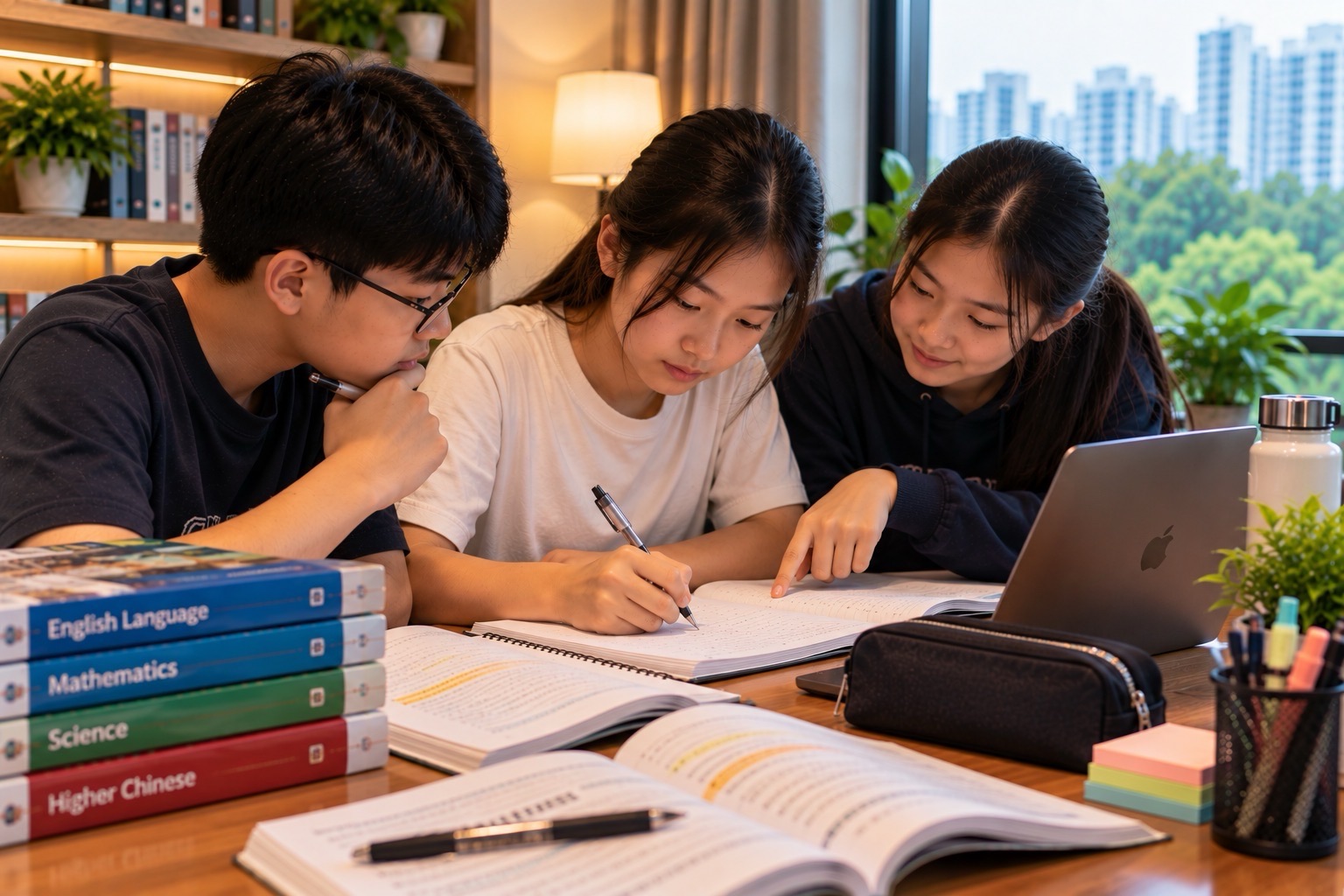
Waterway Point English Tuition for Mee Toh Primary should help pupils move between the receptive and productive sides of English: listen, read and view accurately; then speak, write and represent ideas clearly. Families searching for Mee Toh Primary English tuition, Waterway Point English tuition, Punggol Primary English tuition, P1–P6 English, PSLE English, vocabulary, comprehension, oral and composition often see these skills taught as separate worksheets. In real language use, they feed one another.
Mee Toh School’s current English Language page says the school aims to develop effective and confident communicators with strong foundations in listening, reading, viewing, speaking, writing and representing, alongside grammar and vocabulary knowledge. External tuition should complement that public school context rather than imitate or claim ownership of it. eduKate is independent of Mee Toh School; no affiliation or endorsement is implied. Current school information is available on the official Mee Toh School English Language page.
This 2017 legacy page has therefore been rebuilt as a receptive-to-productive English transfer guide. The old claim that many Mee Toh pupils attended, centre-location marketing, tutor-university claims, outdated 2015 syllabus language, “extreme” examination programme wording, phone number and travel/student galleries are no longer treated as current.
English enters before it comes out
A child cannot produce precise language from an empty input system.
Receptive language includes:
- listening;
- reading;
- viewing.
Productive language includes:
- speaking;
- writing;
- representing.
input → understanding → organisation → output → feedback → better input
A strong tuition lesson should connect the loop.
Reading should feed writing
After reading a strong passage, do not merely answer comprehension questions.
Ask:
- How did the writer open the scene?
- Which verb made the action precise?
- How did the paragraph change?
- Which sentence revealed character?
- How did the writer end?
Then transfer one craft move into a completely different composition.
Listening should feed speaking
In a small group, one pupil speaks.
The next pupil must first summarise the idea accurately before adding another view.
This trains:
- attention;
- paraphrase;
- responsive speaking;
- respectful disagreement.
Good oral communication begins with good listening.
Viewing should feed interpretation
Images, posters, diagrams and visual texts contain information too.
- What is shown?
- What is emphasised?
- What is omitted?
- Who is the intended audience?
- What action is the viewer encouraged to take?
These questions support visual-text comprehension and general media literacy.
Primary 1: oral language before heavy written output
- listen to stories;
- retell events;
- name actions and objects;
- describe pictures;
- write simple connected sentences.
Young pupils should be able to say the idea before being expected to write it independently.
Primary 2: retell with sequence and cause
Ask the child to retell:
- what happened first;
- what changed;
- why it changed;
- what happened because of it.
Then write two or three connected sentences from the oral retell.
Primary 3: evidence should enter comprehension
A useful routine is:
answer → textual clue → explanation
The child should be able to point to the line or event that supports the answer.
Primary 4: grammar should become meaning control
Compare:
Although it was raining, the match continued.
Because it was raining, the match continued.
The grammar changes the logical relationship.
Grammar should therefore be taught inside meaning, not only as isolated correction.
Primary 5: vocabulary should become precise
Compare:
- looked;
- glanced;
- stared;
- peered;
- scanned.
The strongest vocabulary is not merely harder. It has clearer boundaries and more natural collocations.
Primary 6: receptive-to-productive transfer must run under time
For the 2026 PSLE English format, pupils have one hour and ten minutes across Situational Writing and Continuous Writing, and Continuous Writing requires at least 150 words. The examination rewards relevant, well-developed responses while leaving room for originality and personal voice.
By P6, pupils should increasingly be able to:
- read the task;
- organise an idea;
- retrieve suitable language;
- write independently;
- check personal error patterns.
Current PSLE information should be checked with SEAB.
Vocabulary should travel across modes
A word is stronger when the pupil can:
- understand it in reading;
- recognise it in listening;
- explain it orally;
- use it in writing;
- retrieve it later in a new context.
This is more useful than memorising a list for one quiz.
Reading aloud can become a revision tool
When a pupil reads a self-written paragraph aloud, the ear may detect:
- overlong sentences;
- repetition;
- unnatural vocabulary;
- missing transitions;
- unclear pronouns.
Speaking and writing support one another.
Comprehension answers should begin with understanding
Before answer technique, ask the pupil to explain the passage orally.
If the explanation is wrong, repair reading.
If the explanation is correct but the written answer fails, repair scope and expression.
Composition should be built from understood relationships
A strong story does not need maximum drama.
goal → obstacle → choice → consequence → resolution
The pupil should be able to explain this structure aloud before drafting.
Situational Writing should connect viewing and audience
Before writing, identify:
- role;
- audience;
- purpose;
- required information;
- tone;
- desired action.
The visual or source material should be read for relevant information, not copied indiscriminately.
Use a receptive-to-productive error ledger
| Problem | Where the loop broke | Future rule |
|---|---|---|
| Cannot explain passage orally | Reading/listening | Repair meaning first |
| Explains correctly but writes poorly | Production | Use oral plan before writing |
| Knows vocabulary but never uses it | Transfer | Fresh production after retrieval |
| Grammar correct only in worksheet | Production | Find/use it in paragraph |
| Oral answer sounds memorised | Adaptation | Use follow-up questions |
Small-group lessons can connect modes deliberately
- read a short text;
- discuss one inference;
- explain it orally;
- write one precise paragraph;
- revise the paragraph;
- use the same language skill on a fresh topic.
The lesson becomes an integrated language system rather than six unrelated worksheets.
A six-week transfer cycle
| Week | Focus |
|---|---|
| 1 | baseline reading/listening |
| 2 | oral retelling and evidence |
| 3 | vocabulary and grammar in context |
| 4 | written production |
| 5 | revision and independent transfer |
| 6 | fresh unseen task under reduced support |
Questions parents can ask
- Can my child explain what was read?
- Can the child turn that understanding into writing?
- Does vocabulary appear outside the original list?
- Does grammar transfer into composition?
- Can the child respond to an unexpected oral follow-up?
- Is less prompting needed over time?
When extra tuition may not be necessary
A pupil who reads widely, communicates confidently, uses school feedback and continues transferring language independently may not need additional formal English tuition.
Tuition should solve a defined learning problem, not duplicate the school programme.
Frequently asked questions
Is eduKate affiliated with Mee Toh School?
No. This is an independent eduKate learning guide. No school endorsement should be inferred.
Why connect reading, speaking and writing?
Because oral explanation exposes understanding, reading supplies language input, and writing tests whether that understanding can be organised precisely.
Should tuition copy school activities?
No. External support should respond to the child’s specific learning gap while respecting the school’s role and current curriculum.
Waterway Point English Tuition for Mee Toh Primary: the larger lesson
Receive language carefully.
Understand it.
Organise it.
Then produce something of your own.
That movement from input to independent output is one of the clearest signs that English is becoming usable.
Primary English Routes
PRIMARY ENGLISH · WATERWAY POINT · MEE TOH PRIMARY CONTEXT · FROM INPUT TO INDEPENDENT OUTPUT
Primary English becomes more stable when pupils understand that reading, listening and viewing are not separate from writing, speaking and representing. The receptive side of language supplies meaning, vocabulary, syntax and knowledge; the productive side tests whether the child can organise and express those resources independently.
For families arriving through this Waterway Point and Mee Toh Primary historical route, the most useful question is therefore not simply which worksheet component is weak. It is where the flow from input to understanding to organised output breaks down. That is the reader job of this page.
1. Receptive language is active work
Reading, listening and viewing look passive because the pupil is receiving information, but the mind is continuously making decisions. The learner identifies references, updates who or what is being discussed, notices cause and contrast, interprets vocabulary and decides which details matter.
A strong English programme makes some of these hidden decisions visible. Once the child can explain how meaning was recovered, the same habits can be reused in comprehension, writing and oral communication.
2. Productive language reveals what the learner can organise
Speaking and writing require more than remembering language. The pupil must select relevant ideas, choose order, control grammar, retrieve vocabulary and anticipate what another person needs to understand.
That is why a child can appear to understand a text yet struggle to explain it. The gap between receptive understanding and productive control is a useful diagnostic target rather than a reason to label the pupil broadly as weak in English.
3. Input quality matters
A learner cannot produce language that has never entered the system. Reading volume, conversation, listening and exposure to varied texts supply patterns that later become available for writing and speaking.
Tuition should therefore protect meaningful input. If every lesson becomes only correction and examination technique, the pupil may learn to manage familiar formats while the underlying language reservoir grows too slowly.
4. Input should be understood, not merely consumed
More books do not automatically create stronger English if the child reads without comprehension. The tutor should occasionally slow the process and ask what changed, which detail mattered, what a phrase implied and how a paragraph connected to the next.
These questions are not meant to turn leisure reading into constant testing. They are used selectively to teach the child how to notice structure so that later independent reading becomes richer and more efficient.
5. Source awareness begins with simple questions
Primary pupils can learn to ask who produced a text, what its purpose is, what information it provides and what it does not provide. Source awareness at this level is not sophisticated media criticism; it is disciplined attention to context.
A notice, story, advertisement, school message and news-style article invite different expectations. Recognising the text’s job helps the pupil interpret language more accurately and later write for purpose and audience.
6. Purpose changes how language should be read
A text written to entertain uses detail differently from a text written to instruct. A persuasive message may emphasise benefits. An explanatory text may organise causes and effects. Pupils should learn to notice these differences.
Once purpose becomes visible, comprehension improves because the child can predict what kind of information matters. Writing also improves because the learner begins to choose structure and tone according to the intended job.
7. Audience changes what needs to be explained
Writers do not explain everything equally to every audience. A message to a close friend assumes different knowledge from an email to an unfamiliar adult. A child who understands audience can make better choices in situational writing and oral response.
The tutor can make this concrete by asking what the reader already knows, what the reader needs and what tone is appropriate. These decisions turn writing from a template exercise into communication.
8. Reading for gist comes before reading for detail
When a passage is long, pupils benefit from a quick global understanding before chasing individual answers. Who or what is the passage mainly about? What is happening? What is the direction of the text?
Gist gives detail somewhere to belong. Without it, the child may collect isolated facts and still misunderstand the passage. The tutor can train a one-sentence summary before moving into line-level evidence.
9. Reference tracking keeps meaning connected
Pronouns and referring expressions allow writers to avoid repetition, but they also create a common comprehension failure. A pupil who loses track of what “this”, “they” or “such behaviour” refers to can misread an entire paragraph.
Train the child to trace the reference backwards and test whether the substitution still makes sense. Reference tracking is a small skill with large effects because it protects continuity across sentences.
10. Connectives reveal relationships
Words such as because, although, however, therefore, meanwhile and unless tell the reader how ideas relate. Pupils who notice the words but not the relationship may read each sentence separately rather than as part of an argument or sequence.
Teach connectives through meaning: cause, contrast, condition, sequence and result. Then use the same relationships in writing so comprehension and production reinforce one another.
11. Vocabulary meaning is shaped by context
A dictionary definition provides a starting point, but the surrounding sentence often determines which meaning or shade is intended. Pupils need to combine word knowledge with contextual clues.
Ask what nearby details make one interpretation stronger. Then compare a near-synonym and discuss why it would change tone or precision. This moves vocabulary from memorisation into reading judgement.
12. Collocation is part of vocabulary knowledge
English words have preferred partners. We draw a conclusion, pose a question, take responsibility and show concern. Pupils may know each word separately and still produce unnatural combinations.
Teach useful collocations inside real sentences and retrieve them later. Collocation strengthens both comprehension and writing because the child begins to recognise and produce language as connected units.
13. World knowledge supports comprehension
Texts often assume knowledge that is not fully explained. A child who knows little about the topic may understand the words but miss the situation. Reading widely gradually builds the background knowledge that helps unfamiliar passages make sense.
Tutoring can support this by using varied non-fiction and short discussions, not by attempting to pre-teach every possible topic. The goal is a widening knowledge base and the habit of using context carefully when knowledge is incomplete.
14. World knowledge must not override the text
Background knowledge can help, but pupils sometimes answer from what they already know instead of what the passage actually says. Comprehension answers must remain grounded in the given evidence.
Teach the distinction explicitly: what do I know from the text, what do I know from elsewhere, and which source does this question require? This keeps inference disciplined.
15. Evidence selection is a separate skill
Finding the relevant paragraph does not guarantee a good answer. The pupil must choose which details actually support the response and which are merely nearby.
Use a locate-select-shape routine. Locate the evidence area, select the required information, then shape it to match the question. This prevents large copied chunks from replacing reasoning.
16. Inference is evidence plus a justified bridge
An inference goes beyond exact wording but should not float free of the passage. The learner identifies clues, considers what they imply in context and then states a bounded conclusion.
Ask the child to point to the clue before giving the inference. If several interpretations are possible, compare them and identify which is best supported. This builds precision without turning inference into guesswork.
17. Answer scope matters
A response can be correct in idea and still lose control by being too broad, too narrow or partly irrelevant. Pupils need to judge how much explanation the question requires.
Train answer scope by comparing versions. Which one directly answers the question? Which includes an unsupported extra claim? Which omits a necessary causal link? The child learns that relevance is part of accuracy.
18. Paraphrasing is not random synonym replacement
Pupils sometimes change individual words mechanically in an attempt to avoid copying. That can distort meaning. Good paraphrasing begins with understanding the idea, then expressing it naturally in another form.
Ask the child to close the passage and explain the point orally before writing. If the explanation preserves meaning, the written paraphrase is more likely to be accurate.
19. Summary habits can begin early
Even before formal summary tasks, pupils can practise compressing a paragraph into one sentence. They learn to separate central meaning from detail.
This habit improves comprehension, note-taking and later writing because the learner becomes better at identifying the information that deserves space.
20. Reading should feed composition
A strong passage can provide more than vocabulary. It can show how a writer opens a scene, creates contrast, handles dialogue, controls pacing or selects sensory detail.
The tutor should identify one reusable craft move and ask the pupil to apply it in a new context. The goal is not imitation of the entire text but transfer of a useful writing decision.
21. Reading should feed situational writing
Functional texts show how real communication changes with purpose and audience. Notices, emails, instructions and reports can become examples of clarity, sequencing and tone.
When situational writing is taught, connect its decisions back to authentic reading: what information appears first, what is assumed, how the reader is guided and how tone is kept appropriate.
22. Reading should feed oral communication
A short article or story can become the basis of discussion. Ask the pupil to state the main idea, agree or disagree with a decision, connect the issue to experience and explain a reason.
This converts receptive input into spontaneous output. It also reveals whether vocabulary and ideas are available in real time rather than only on paper.
23. Listening should feed speaking
After listening to a short audio text, the child can retell the main idea, explain one detail and respond personally. This moves information from reception into organised speech.
The tutor can gradually reduce preparation time. The pupil learns to hold meaning, select what matters and respond without memorising a script.
24. Viewing should feed language
Photographs, diagrams, posters and multimodal texts are increasingly common in everyday communication. Pupils need to interpret what visual information adds, omits or emphasises.
Ask what the image shows directly, what must be inferred and how the words change interpretation. This strengthens visual literacy and supports oral conversation and comprehension.
25. A composition plan is a form of representation
Before writing, the pupil externalises the story structure. A short plan reduces working-memory load and makes cause and consequence easier to inspect.
The plan should not become a rigid template. Its purpose is to preserve the important decisions—situation, disruption, response, turning point and outcome—so the writer can spend more attention on language during drafting.
26. A paragraph needs a job
Pupils often write paragraphs because they were told to leave a line, not because the idea changed. Teach each paragraph to perform a function: set up, develop, complicate, reveal, resolve or reflect.
When every paragraph has a job, composition becomes easier to revise. The child can ask whether the paragraph moves the story or argument rather than only checking sentence-level errors.
27. Detail should be selective
More description is not automatically better writing. Strong detail directs the reader’s attention to what matters at that moment.
Ask what the reader should notice now and why. The answer determines whether the writer needs a sound, gesture, object, line of dialogue or brief setting detail. Selection creates both clarity and pace.
28. Dialogue should create movement
Dialogue earns its place when it reveals information, changes a relationship, creates tension or forces a response. Lines that merely repeat facts can slow the writing.
After each exchange, ask what is now different. If nothing changes, the pupil may be able to shorten or remove the dialogue. This makes speech part of the story’s causal structure.
29. Grammar should transfer into production
A pupil can complete a tense worksheet and still shift tense in composition. The gap is transfer. After explicit grammar work, use the pattern inside real sentences and later writing.
The tutor should not assume that drill success equals writing control. The grammar target remains active until it survives independent production and later retrieval.
30. Vocabulary should transfer into production
New words become useful when the child can retrieve them without the vocabulary list and choose them appropriately in a new context.
Ask for oral use first, then sentence use, then later writing. If the word appears naturally and accurately after delay, it is moving from recognition into the productive lexicon.
31. Revision is a productive skill
Revision requires the writer to read their own work as a reader. The pupil must notice gaps, redundancy, unclear reference, weak cause or imprecise vocabulary and decide what to change.
Teach revision in layers. First meaning and structure, then paragraph flow, then sentence control, then surface accuracy. Fixing spelling first can distract from a story whose larger logic is still broken.
32. Self-questioning converts tutor prompts into learner prompts
Many tutor questions can eventually become internal questions: What is the question asking? Where is the evidence? What changed? What does the reader need? Does this sentence say what I mean?
Write a short self-question list and gradually stop supplying it. Independence grows when the pupil carries the tutor’s useful questions into unaided work.
33. Source comparison can be introduced carefully
Older Primary pupils can compare two short texts on the same topic and notice differences in purpose, emphasis or detail. The aim is not to conduct advanced source criticism but to build discernment.
Ask what both texts agree on, what one includes that the other does not, and which text better answers a particular question. These are transferable reading habits.
34. Claims should be separated from evidence
A text may make a claim and then support it with examples, reasons or data. Pupils benefit from seeing this structure because it helps both comprehension and writing.
In a passage, underline the claim and circle the support. In writing, reverse the exercise: state the point, then add the evidence or example that earns the claim.
35. Opinion and evidence can coexist
A pupil’s opinion is valuable in oral and some writing tasks, but it should be distinguished from what the source states. The child can say, “The passage says…” and then, separately, “I think…”
This simple distinction protects comprehension accuracy while encouraging personal voice. It teaches the learner that response and evidence can be connected without being confused.
36. Reading stamina is built gradually
Longer passages become difficult when decoding, vocabulary and reference tracking consume too much attention. Stamina should grow through regular reading, not only through timed examination passages.
Increase length and complexity gradually while preserving comprehension. A pupil who reads more efficiently can spend more attention on inference and answer construction later.
37. Writing stamina is different from writing speed
A pupil may write quickly but lose organisation, or write slowly because every sentence is being invented from scratch. Good writing stamina includes maintaining structure, grammar and idea control over a longer piece.
Planning, vocabulary availability and sentence fluency all contribute. The tutor should diagnose which part causes the slowdown before prescribing timed writing.
38. Oral fluency is different from speed
Speaking rapidly can hide weak organisation. Strong oral fluency means ideas arrive in a coherent order and the speaker can respond to follow-up questions.
Use pauses productively. A brief pause to think is often better than filling space with repeated phrases. The tutor can model calm pacing and clear idea development.
39. The child should learn to recognise uncertainty
Strong readers know when they are unsure. Weak readers may continue with a mistaken interpretation without noticing. Metacognitive awareness is therefore part of comprehension.
Ask the child which sentence or word created uncertainty and what could resolve it. This makes confusion actionable instead of embarrassing.
40. A tutor should not resolve every uncertainty immediately
Some uncertainty is productive because it motivates rereading and comparison. If the adult supplies the answer at the first sign of doubt, the child never practises recovery.
Allow the learner to test an interpretation, locate another clue or restate the passage. Intervene when the search stops producing new information.
41. Homework can extend the input-output loop
Home tasks should have a purpose: read and retell, retrieve vocabulary, revise one paragraph, answer a fresh inference question or prepare an oral response from a new stimulus.
A small task that completes the learning loop can be more valuable than a large packet of disconnected exercises. The pupil should know why the homework exists.
42. School feedback should enter the loop
Marked schoolwork shows how the learner performs outside tuition. Bring selected pieces into the lesson and compare the errors with the active learning targets.
If the same issue appears across contexts, the mechanism deserves attention. If the tuition skill transfers into schoolwork, that is strong evidence that learning is becoming portable.
43. A weekly ledger keeps the route visible
Record one input target, one output target, one active error family and one transfer test. Keep the record small enough to guide the next lesson.
The ledger might say: reference tracking improving; vocabulary production still prompted; paragraph causality secure; fresh inference retest next week. This is more useful than a diary of pages completed.
44. P1–P2 should prioritise the input foundation
Younger pupils need decoding, listening, oral vocabulary, sentence meaning and confidence with short texts. Production should grow from this foundation rather than becoming premature examination drilling.
Short retellings, sentence building and shared reading can reveal more about language development than large comprehension packets at this stage.
45. P3–P4 should strengthen evidence and connection
Middle Primary pupils can increasingly justify answers, connect grammar to meaning and use reading as a resource for writing. This is a powerful period for teaching the input-output loop explicitly.
The pupil begins to see that the clue found in reading, the word learned in context and the paragraph structure discussed orally can all reappear in writing.
46. P5 should deepen stamina and transfer
Primary 5 raises language load. Longer passages, more nuanced vocabulary and stronger writing expectations expose fragile foundations. The tutor should diagnose rather than simply increase volume.
Use the year to strengthen reading stamina, inference, vocabulary depth, grammar production and composition revision before the final Primary year.
47. P6 should integrate the system under examination conditions
PSLE practice matters, but it should test a language system that is still developing. Use papers to identify which receptive or productive mechanism breaks under time.
Leave the full-paper format to repair that mechanism, then return later. This prevents examination preparation from becoming endless repetition of the same failure.
48. Current PSLE information should remain separate from durable learning principles
SEAB currently lists English Language as subject code 0001 for the 2026 PSLE. Examination arrangements can change, so administrative details should always be checked against the current official source.
The durable learning work remains broader: read accurately, build language knowledge, select evidence, organise meaning, communicate clearly, revise and recover independently.
49. Independence means the loop continues without the tutor
A mature learner can receive new language, notice structure, check understanding, produce a response, review feedback and improve the next attempt without requiring constant adult direction.
The tutor may still help with genuinely difficult material, but the basic loop belongs increasingly to the child. That is the long-term purpose of connecting receptive and productive English.
50. The final aim is discernment plus expression
Strong English is not only the ability to consume text or produce polished sentences. It is the ability to judge what information means, what evidence supports, what matters for the purpose and how to express a response clearly.
When pupils can move from input through discernment into purposeful output, English becomes a transferable capability rather than a collection of school components.
51. Note-taking should preserve meaning, not copy everything
Older Primary pupils can begin learning compact note-taking from short non-fiction. The goal is to capture key ideas, relationships and useful terms without reproducing the whole passage.
A simple heading, two or three points and one connection are enough. Later, ask the child to explain the text using the notes. This tests whether notes support understanding rather than replace it.
52. Dictionary use should answer a specific question
Looking up every unfamiliar word interrupts reading and teaches dependence. The learner should first decide whether the word blocks understanding, whether context provides enough clues and which meaning fits the sentence.
When a dictionary is needed, compare the entry with the original context and note useful collocations or word forms. The tool becomes part of discernment rather than an automatic reflex.
53. Questions can be generated by the learner
After reading a passage, ask the pupil to write one literal question, one inference question and one question about purpose or language. Generating questions forces the learner to notice how texts create answerable relationships.
The exercise also improves comprehension because the child sees passages from the examiner’s side. Later, the pupil becomes better at recognising what a real question is asking.
54. Digital reading needs the same evidence discipline
Screens can encourage fast scanning, link-following and fragmented attention. Pupils should still know how to identify the main source, track the central claim and distinguish the text from surrounding interface elements.
Use short digital articles occasionally and ask the same durable questions: who produced this, what is the purpose, what evidence is actually present and what remains uncertain? The medium changes; the reading discipline remains.
55. Headlines and captions should not replace the full text
Short labels can frame how a reader interprets an image or article. Pupils should notice that a headline summarises or attracts attention but may not contain all the important qualifications.
Ask the child to predict from the headline, then revise the prediction after reading. This teaches a valuable habit: initial interpretation can change when fuller evidence arrives.
56. Home conversation can strengthen productive English
Not every productive-language task needs to look like homework. Asking a child to explain a school topic, describe a choice or retell something interesting gives oral practice with low stakes.
Parents do not need to correct every sentence. The value lies in sustained expression, follow-up questions and the child learning to make meaning clear to another person.
57. Reading identity matters for long-term input
Children read more when they can find subjects, genres and formats that genuinely interest them. A tutor can broaden reading while respecting preference rather than forcing every child through the same list.
A pupil who sees reading as a source of curiosity is more likely to keep feeding the language system after tuition ends. That long-term input matters more than any single comprehension worksheet.
58. Small-group discussion can widen interpretation
When three pupils read the same passage, they may notice different details or draw different inferences. Comparing those interpretations is useful if every claim returns to evidence.
The tutor should ask which clue supports each reading and where an interpretation goes too far. The group becomes a laboratory for calibrated reasoning rather than a contest for the fastest answer.
59. Timed practice should come after the reading method is stable
A timer can reveal paper-control problems, but timing an unstable comprehension method only produces faster errors. First make question demand, evidence location and answer scope reliable.
Then use short timed sections. Observe what deteriorates: rereading quality, evidence selection, sentence control or checking. Timing becomes diagnostic instead of merely stressful.
60. A marked paper should become a map for the next week
After an assessment, do not simply calculate the total. Group lost marks by mechanism: reference, vocabulary, inference, answer scope, grammar, writing structure, oral planning or time.
Choose one or two high-leverage targets and design the next week around them. This converts assessment into an input for teaching instead of letting the score end the conversation.
61. Release means the learner can run the loop
A pupil is ready for less support when new texts can be read with reasonable independence, evidence can be selected, writing can be planned and revised, and uncertainty triggers a recovery routine rather than immediate rescue.
Release does not mean the learner will never need help. It means help becomes targeted and occasional because the everyday language-learning loop now belongs to the child.
62. The Waterway Point legacy route should lead somewhere useful
A historical local page earns its place when it answers a real learning question and connects the reader to deeper owners rather than repeating generic tuition language.
This page therefore keeps its local title while owning a distinct educational job: how pupils turn receptive English into discerning, purposeful output from P1 through PSLE preparation.
63. Evidence should change the response, not merely decorate it
The final discipline is to let evidence alter what the learner says or writes. A clue should narrow an inference, a reader’s need should change the tone, and feedback should change the next draft. Evidence is useful only when it affects a decision.
When pupils learn to revise an interpretation instead of defending the first answer automatically, receptive English and productive English finally meet. The child is no longer just receiving information or producing language; the child is reasoning with language.
A compact input-to-output routine
- Receive: read, listen or view carefully.
- Locate: identify the main idea, target and relevant details.
- Interpret: track reference, relationships, vocabulary and implied meaning.
- Select: choose evidence and ideas that matter.
- Organise: decide the order and purpose of the response.
- Produce: speak, write or represent clearly.
- Review: check meaning before surface accuracy.
- Transfer: repeat the decision on a fresh text or prompt.
Continue the Primary English route
- English Tuition & Learning Hub
- Primary English Directory
- Student Diagnostics Hub
- The Library
- SEAB 2026 PSLE formats
The strongest Primary English learning loop is not input alone or output alone. It is the repeated movement between the two: receive carefully, understand accurately, express purposefully, review honestly and return to new language with a stronger system.
2026 REBUILD · PRIMARY ENGLISH · SOURCE AWARENESS · EVIDENCE · INFERENCE · READING-TO-PRODUCTION TRANSFER
This 2017 article is retained at its original title and URL. Its rebuilt job is to connect receptive English—reading, listening and viewing—to productive English—speaking and writing—through disciplined source awareness, evidence, inference and answer scope.
This is an independent educational guide and is not an official Mee Toh School page. Waterway Point and Mee Toh remain historical context; current examination arrangements should be checked directly with SEAB.
1. Read the source before answering the question
Primary English becomes more reliable when the pupil treats the text as the source of truth. Before answering, identify what kind of text it is, who appears to be speaking, what the text is trying to do and which information is directly stated.
This creates a disciplined starting point. The pupil is less likely to answer from memory, personal opinion or what usually happens in real life when the passage itself gives a different account.
Practice with short texts first. Ask the child to name the source, audience, purpose and one explicit fact before moving into inference or evaluation.
2. Track reference deliberately
Pronouns and repeated noun phrases connect sentences. When reference breaks, the reader can lose who acted, what changed or which idea a later sentence is discussing.
Train pupils to point backwards. What does “it”, “they”, “this” or “that decision” refer to? If more than one candidate is possible, which one makes the sentence coherent?
Reference tracking should eventually become automatic, but explicit practice makes the invisible decision visible while the skill is still developing.
3. Track sequence before detail
A reader who cannot hold the order of events will struggle with cause, motive and consequence. Sequence is therefore more than remembering what happened first.
Ask the pupil to compress a paragraph into three moves: before, change, after. Then compare that summary with the original. Missing links often reveal the exact point where comprehension weakened.
This sequence habit later supports composition because the learner becomes more sensitive to whether events in a story actually lead into one another.
4. Separate cause from coincidence
Two events appearing next to each other in a text are not automatically causally linked. Pupils need to notice explicit signals and infer causal relationships carefully.
Ask what changed because of what, and which phrase proves the link. If the text only shows sequence, do not upgrade it into cause without evidence.
This discipline reduces over-inference and also improves writing, where pupils learn to make consequences arise from earlier choices rather than simply occur afterwards.
5. Use contrast to detect the writer’s direction
Words such as although, however, instead, yet and despite often signal that the writer is changing direction. Missing that turn can distort the whole paragraph.
Teach pupils to pause at contrast markers and ask what expectation has been reversed. The sentence before and the sentence after should be read together.
This is especially useful in comprehension, visual texts and non-fiction where the writer’s real point may appear after the contrast rather than before it.
6. Distinguish fact, claim and opinion
Primary pupils do not need advanced rhetoric to benefit from basic source distinctions. Some statements report observable information, some make claims that require support, and some express preference or judgement.
Ask what could be checked, what would need evidence and what depends on viewpoint. These questions sharpen source awareness without turning a simple passage into an adult debate.
The habit later supports online reading, situational writing and oral discussion because the learner becomes more careful about what can be asserted confidently.
7. Locate before selecting
Searching a passage is easier when the learner first narrows the likely area. A question about the character’s reaction after an event should not trigger a reread of the entire passage every time.
Use paragraph function, keywords, sequence and reference to locate the evidence region. Only then decide which words or ideas matter.
This two-stage search reduces cognitive load and prevents the pupil from copying the nearest sentence simply because it contains a familiar keyword.
8. Select evidence to match the demand
The correct evidence is not always the longest sentence or the sentence containing the same word as the question. It is the information that completes the question’s job.
Teach pupils to ask whether the evidence supplies a reason, example, comparison, reference, feeling, consequence or explanation. The category helps filter irrelevant text.
Selection is one of the most transferable English skills because writing and oral communication also depend on deciding which detail deserves space.
9. Shape the answer after selecting evidence
Evidence copied without shaping may not answer the exact question. The learner needs to transform the selected material into a sentence that fits the grammar and logic of the prompt.
Ask whether the response makes sense if read without the question. Does it identify the correct subject? Does it include the causal link? Has unnecessary wording been added?
Answer shaping is where comprehension meets writing. The pupil turns understanding into controlled language rather than merely pointing at the source.
10. Keep inference proportional
Inference is strongest when the claim is only one step beyond the evidence. A small clue can support a careful conclusion; it should not support an elaborate story that the passage never suggests.
Use the bridge clue → interpretation → conclusion. Ask whether each stage is visible and whether a weaker or stronger conclusion would be more defensible.
Over time, pupils learn that sophistication does not mean saying more. It often means saying exactly what the evidence allows.
11. Distinguish emotion from motive
A text may show that a character is angry, but a question may ask why the character acts. Emotion and motive are related but not identical.
Teach pupils to separate what the character feels, what the character wants and what the character does. Evidence for each may come from different parts of the text.
This distinction improves inference and composition because characters begin to act from understandable motives rather than random events.
12. Read vocabulary through context and collocation
Meaning is constrained by surrounding language. A word that fits the dictionary definition may still sound wrong because it does not naturally combine with the words around it.
Ask what grammatical form is needed, what tone fits and which collocations are plausible. This creates a richer decision than searching for a single synonym.
Vocabulary learned this way is easier to transfer into composition because the learner remembers the word inside relationships, not as an isolated label.
13. Use grammar to unpack difficult sentences
Long sentences become manageable when pupils identify the main clause, supporting clauses and connective relationships. Grammar is therefore part of comprehension, not merely an editing exercise.
Ask what the sentence would say if extra detail were removed. Then add the clauses back and explain what each contributes.
This approach reduces the intimidation of complex syntax and prepares pupils for longer texts in upper Primary and Secondary English.
14. Read punctuation as a meaning signal
Commas, colons, quotation marks, dashes and paragraph breaks guide the reader through emphasis and structure. Pupils often notice them only when correcting writing.
During reading, ask what the punctuation is doing. Is it introducing an explanation, separating speech, adding a pause, or signalling a list?
Seeing punctuation from the reader’s side makes later writing choices more purposeful because the learner understands the effect on interpretation.
15. Read visual layout deliberately
Visual texts use size, position, colour, image and spacing to direct attention. The most important information is not always the longest piece of text.
Ask what the eye notices first, what action is expected and which elements support credibility or urgency. Then connect the visual choice to the message.
This strengthens viewing skills and helps pupils understand that communication can be designed through more than sentences alone.
16. Retell to test the mental model
Retelling reveals what the reader has actually built from the source. A pupil who omits the turning point or reverses a causal sequence is showing more than a memory problem.
Ask for a concise retelling with the key people, change and consequence. Then compare it with the text and repair only the missing relationship.
Retelling is especially useful before written comprehension because it makes the learner’s internal representation visible without the extra burden of formal answer language.
17. Summarise without copying
Summary begins with deciding what can be left out. Pupils who copy entire sentences often have not yet separated central ideas from supporting detail.
Ask for one sentence that preserves the main relationship, then one supporting example only if it is necessary. Compression forces selection.
This skill supports later note-making, oral preparation and Secondary-level study because the learner can carry meaning forward in a more compact form.
18. Speak the reasoning before writing it
When a child cannot explain an answer orally, the problem may sit in the thinking rather than the sentence. Spoken reasoning gives the tutor a clearer view.
Let the pupil say the answer in ordinary language, point to the evidence and explain the connection. Only then shape it into formal written English.
This sequence separates conceptual difficulty from sentence-construction difficulty and makes correction more precise.
19. Use reading craft in new writing
A text can teach pacing, viewpoint, suspense, description and paragraph movement. The aim is not to copy the author’s phrases but to identify the craft decision.
Ask what the writer achieved, then let the pupil attempt the same effect in a different setting with different language.
Transfer keeps the lesson ethical and educational: the child learns a technique rather than reproducing another writer’s surface.
20. Build composition from consequence
Before vocabulary and description, establish what changes and why. A character wants something, meets a problem, makes a choice and faces a consequence.
If the causal chain is weak, the story will often feel like a list of events. Strengthen the chain first, then use detail to make important moments vivid.
This keeps writing purposeful and helps pupils judge which scenes deserve more space.
21. Use detail selectively
Strong writers choose details that reveal something important. The untied shoelace, the unanswered call or the wet envelope can imply urgency or trouble without a long explanation.
Ask what the reader should notice at this exact moment. If the detail does not change understanding, mood, character or action, it may not deserve space.
Selection improves both writing quality and pacing because the pupil stops describing everything equally.
22. Make dialogue earn its place
Dialogue is useful when it reveals information, changes a relationship, increases tension or forces a decision. Speech that repeats known information slows the story.
After each line, ask what becomes different because it was said. If nothing changes, revise the line or remove it.
This simple test helps pupils use dialogue as action rather than decoration.
23. Revise one high-leverage feature at a time
A draft may contain many imperfections. Trying to repair all of them at once can overwhelm the writer and make feedback feel like replacement.
Choose the issue with the greatest effect: causal structure, paragraph purpose, repeated grammar, vocabulary precision or the ending. Repair it with the learner.
Then test the same decision in a fresh paragraph. Revision becomes learning when the child can reproduce the improvement elsewhere.
24. Situational writing begins with purpose
The pupil must identify who is writing, to whom, why and which information must be included. A memorised template cannot rescue a misunderstood task.
Ask the child to state the communication job in one sentence before drafting. That decision determines tone, structure and content selection.
Templates are useful only after purpose and audience are clear.
25. Oral responses should remain alive
Prepared language can help pupils organise ideas, but a strong oral response still needs to react to the question and to follow-up prompts.
Practise answer → explain → example → connection, then vary the follow-up so the pupil cannot simply recite.
Responsive speaking shows that ideas and vocabulary are available in real time.
26. Listening needs a two-pass strategy
On the first listen, focus on the main point, speaker relationship and broad sequence. On the second, add precise evidence and details.
This prevents the learner from trying to memorise every word equally. Structure gives detail somewhere to attach.
The same habit transfers to reading: understand the whole before over-focusing on isolated phrases.
27. Retrieval should revisit old reading moves
Reference tracking, inference, evidence selection and answer scope should not disappear when a new unit begins.
Bring one old decision back at the start of a lesson. The pupil should attempt it without reopening the previous explanation.
Spaced retrieval makes the reading system durable and reduces the need to reteach the same strategy before every examination.
28. Mixed comprehension trains recognition
A worksheet labelled “inference” tells the child what to do before the question begins. Real papers mix reference, cause, vocabulary, purpose and evidence.
After individual skills are stable, mix them. Ask the learner to identify the question demand before answering.
This trains selection, which is one of the central differences between practice and examination performance.
29. Primary 1–2 should protect language input
Younger pupils need oral language, decoding, listening, vocabulary and simple sentence meaning. Heavy exam drilling can crowd out the input system that later English depends on.
Read aloud, discuss, retell and write short connected sentences. Let language remain meaningful and enjoyable while accuracy develops.
These early years are not a waiting room for PSLE. They build the reading system that makes later independence possible.
30. Primary 3–4 should connect evidence to output
At these levels, pupils can begin to explain why an answer is supported and why a detail matters in a piece of writing.
Use the same habit across modes: identify a clue in a passage, then create a purposeful clue in a story; identify a paragraph job, then build a paragraph with a clear job.
The child begins to see English as one connected system.
31. Primary 5 should deepen reading stamina
Longer passages expose weaknesses in working memory, reference tracking and vocabulary. P5 is a high-value year for diagnosis because there is still time to repair before P6.
Increase difficulty gradually while preserving accurate reading. Combine inference with answer scope and revision rather than simply increasing paper volume.
A stable P5 reader enters the final Primary year with fewer hidden dependencies.
32. Primary 6 should integrate and manage time
PSLE English requires writing, language use, comprehension, listening and oral communication. Current examination details should always be checked with SEAB.
Use full papers to test integration, stamina and timing. When a specific error mechanism appears, leave the paper format, repair it in a smaller task, test it fresh and return later.
This prevents full-paper practice from becoming repeated exposure to the same unresolved mistakes.
33. Small groups can improve interpretation
Three pupils may select different clues or phrase answers differently. Comparing those choices can reveal why one interpretation is stronger or one response is better scoped.
Discussion should come after individual attempts. Otherwise one confident pupil can supply the thinking for everyone.
Finish with a fresh individual task so the tutor can see what each learner now controls alone.
34. The destination is source-faithful independence
The historical Waterway Point and Mee Toh wording remains because the title and URL are preserved. The current role is broader: help pupils receive language accurately and produce responses that remain faithful to the source.
Independent English means the learner can identify what the source says, what it implies, what it does not justify and how to respond clearly.
That standard remains useful beyond one school, one locality and one examination year.
A compact reading-to-production routine
- Identify source, audience and purpose.
- Build the main structure before collecting detail.
- Track reference, sequence, cause and contrast.
- Locate and select evidence.
- Separate text evidence from prior assumptions.
- Keep inference proportional to the clues.
- Shape the response to the required scope.
- Transfer the same reasoning into a fresh text or writing task.
Leave a Reply