
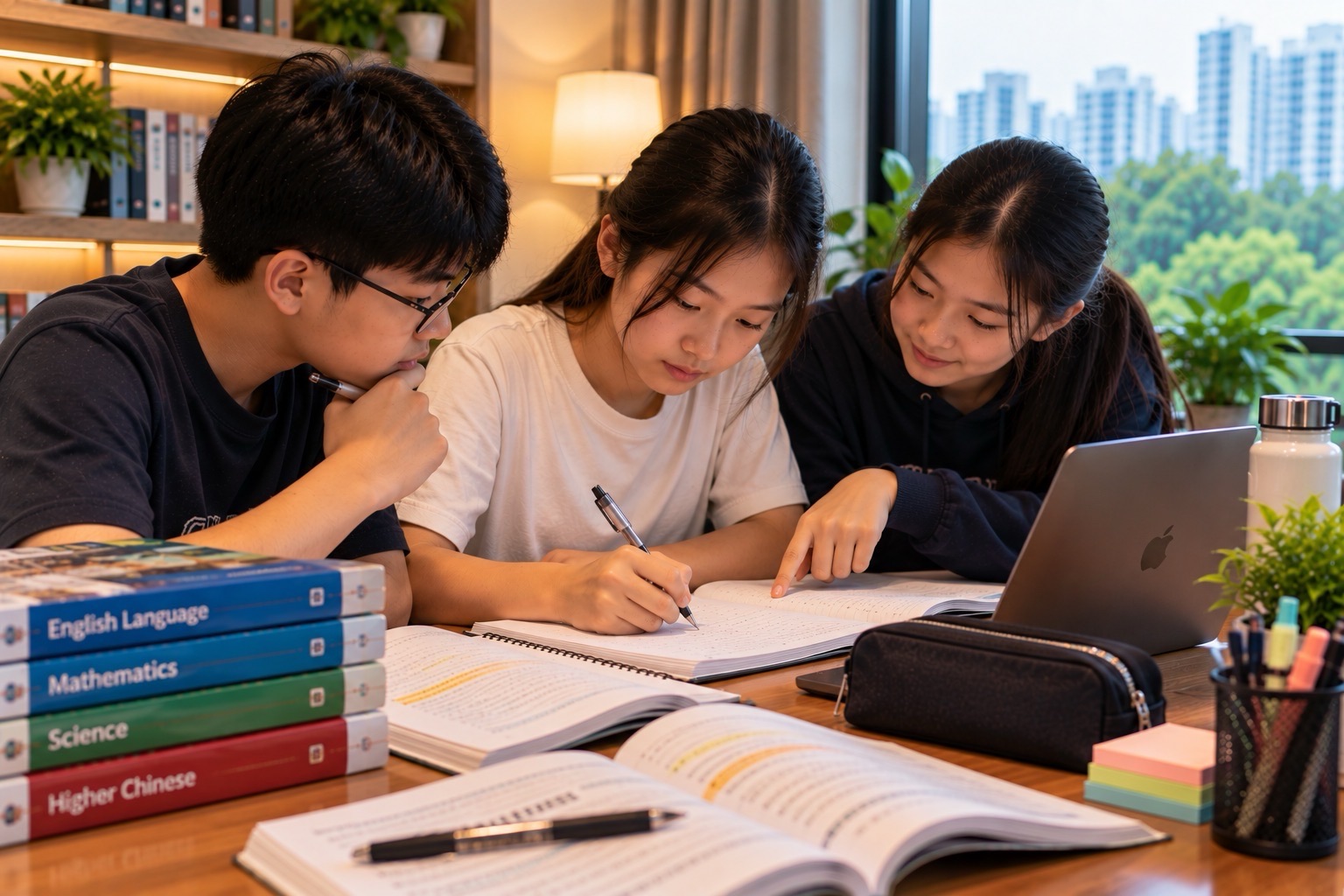
Photos of edukate Punggol Tuition Small Group English Math Science is a historical photo-archive title, and this rebuild keeps that identity rather than pretending it is an ordinary tuition article. Families searching for Punggol tuition photos, small-group tuition, English Maths Science tuition, Primary tuition, Secondary tuition, classroom environment, student–tutor interaction and what a tuition class looks like often want visual evidence before they read a long explanation.
Photographs can be useful. They can show room layout, proximity between tutor and students, whether learners are seated around shared work, whether written materials are being used, and something of the atmosphere at a particular moment. They can also mislead if treated as proof of academic quality. A smiling student does not prove understanding. A crowded table does not prove collaboration. A neat worksheet does not prove transfer. A photo freezes appearance; good teaching has to be judged through what happens before, during and after the image.
The original 2017 body was essentially a raw wall of dozens of image files with almost no editorial explanation. This version preserves a small representative set of historical classroom photographs and gives the page a useful job: document the visual history of eduKate’s small-group classes while teaching parents how to read classroom photos critically, what to look for in a real lesson, and why teaching quality must ultimately be judged through learner evidence rather than imagery.
A historical classroom archive, not current-service proof
The photographs below come from the older eduKate image archive. They are preserved as historical records of classrooms and learning environments from that period.
They should not be used to infer current schedules, branch locations, staff assignments, class sizes or programme availability. Those operational details can change over time and should be verified through current channels.
Historical photograph 1

What this kind of photo can show
A classroom image can reveal physical proximity. In a genuinely small group, the tutor may be close enough to inspect a student’s page, hear an explanation and notice hesitation.
That visibility is one of the potential benefits of small-group tuition. The educational value appears only when the tutor uses the proximity to make better teaching decisions.
What the same photo cannot show
The image cannot tell us whether the student understood the task, whether the tutor diagnosed the correct error or whether the skill was retained a week later.
Those questions require evidence from the learning process.
Historical photograph 2

Look for student work, not just student faces
When evaluating a tuition environment, one useful visual question is whether students appear to be producing their own work. Are there written attempts, diagrams, calculations or annotations? Is the tutor positioned to inspect them?
A lesson should generate visible evidence of thinking.
But a completed page is not the same as learning
A worksheet can be completed through understanding, copying, guessing or heavy prompting.
The stronger questions are:
- Can the student explain the method?
- Can the student solve a changed version?
- Can the student retrieve the idea later?
- Can the student correct an error independently?
These cannot be photographed in one frame.
Historical photograph 3

Small-group tuition should create individual visibility
The phrase “small group” has educational meaning only if the tutor can still see what each learner is doing.
A strong group should allow:
- inspection of full working;
- individual questioning;
- targeted feedback;
- different follow-up difficulty;
- independent thinking between tutor check-ins;
- peer explanation without peer copying.
The room size is a condition. The pedagogy is what matters.
Historical photograph 4

English tuition: what a good photo cannot capture
English learning often happens in interpretation and revision. A student may be reading silently, discussing evidence or deciding how to change a sentence.
A photograph cannot show whether an inference is supported, whether vocabulary is being used naturally or whether a composition has a coherent causal structure.
Parents should therefore ask how the tutor reads student writing and how feedback changes the next attempt.
Historical photograph 5

Mathematics tuition: the working matters
For Mathematics, the most useful evidence often sits in the line-by-line working rather than the final answer.
A tutor should be able to identify whether the student misunderstood the relationship, selected the wrong method, made an algebraic error, calculated inaccurately or failed to check.
A classroom photo may show the page. It cannot diagnose the error for us.
Historical photograph 6

Science tuition: explanation is often invisible in a still image
A student may know the keyword and still not understand the mechanism. Science tuition should ask the learner to connect evidence, concept, cause and outcome.
A useful reasoning chain is evidence → concept → mechanism → outcome.
That chain can be written or spoken, but a photograph cannot confirm whether it exists.
Historical photograph 7

Why the old image wall was reduced
The original article displayed dozens of large image files with little explanation. That made the page heavy and gave readers very little help in interpreting what they were seeing.
A curated archive is more useful: fewer images, clearer context and an explicit distinction between history and current service information.
What classroom photographs are genuinely useful for
Photos can help parents inspect:
- physical layout;
- distance between tutor and learners;
- whether tables support individual work or shared discussion;
- whether students have space to write;
- whether the environment appears calm and usable;
- what kinds of learning materials are visible.
These observations can inform questions. They should not become final judgements.
What classroom photographs cannot prove
- student understanding;
- tutor expertise;
- academic improvement;
- exam results;
- quality of feedback;
- how often the student is prompted;
- whether the learner can transfer knowledge;
- whether the current class still operates in the same way.
A smiling student is not a learning metric
Enjoyment matters. A student who feels safe and engaged may be more willing to ask questions and persist.
But happiness should not be used as proof of mastery. A lesson can be enjoyable and shallow. A lesson can also be difficult and deeply productive.
The better standard is whether the learner becomes more capable.
A serious face is not a learning metric either
Concentration can look serious. Confusion can also look serious. One frame cannot tell us which.
Parents should avoid reading too much psychology into a photograph.
What a real lesson should make visible over time
Teaching quality becomes clearer through a sequence of evidence.
- Baseline: what can the student do without help?
- Intervention: what concept or routine is taught?
- Independent attempt: can the student use it?
- Transfer: does it survive a changed question?
- Retrieval: can the student use it after a delay?
- School evidence: does the improvement travel back into ordinary work?
This is a much stronger record than one photograph.
How parents can use photos before a trial lesson
Use images to generate questions:
- How many students are normally in the group?
- Does the tutor inspect every student’s work?
- How much independent time is there?
- Do students work on the same question or different levels?
- How are corrections handled?
- What happens when one learner is much faster?
Then use the trial lesson or consultation to seek actual answers.
How parents can use photos after a trial lesson
Compare the image with what you observed. Did the class function as expected? Was the tutor able to see each learner? Did students have enough independent space?
The trial provides richer evidence than the archive.
Small-group photographs and privacy
Historical classroom archives also remind us that images of children require care. Current educational practice should treat student privacy, consent and dignity seriously.
Photographs should not be used to expose private academic results, sensitive information or embarrassing mistakes.
Do not use student awards as universal proof
Historical education sites often displayed awards and high-scoring students. Those examples may be genuine moments in the archive, but they do not guarantee that every future learner will achieve the same outcome.
The relevant question is how the programme responds to the learner in front of it.
Do not infer current branch locations from old photographs
Images can outlive the premises in which they were taken. A 2017 classroom photograph does not prove a 2026 branch location, timetable or service.
Current operational information should always be checked separately.
Worked example: what one classroom photo might make us ask
Suppose a photograph shows three students working at a table and a tutor seated close by.
Useful questions include:
- Does each student complete an independent attempt?
- Can the tutor see all three pages?
- Does the tutor circulate attention or remain with one learner?
- What are the others doing while one receives help?
- Can stronger students receive extension without simply waiting?
The picture starts the inquiry. It does not finish it.
Worked example: the impressive wall of worksheets
A photo may show many completed papers. That can indicate practice. It can also indicate volume without correction.
Ask whether errors are classified, redone and later retested. A smaller amount of deliberate practice may be more valuable than a large pile of unanalysed work.
Worked example: the cheerful group
A friendly atmosphere can support participation, particularly for students who fear mistakes. The tutor should still maintain intellectual standards.
Warmth and rigour are not opposites.
The visual standard for small-group tuition
A good classroom photograph can suggest visibility, proximity and a usable learning environment. The final standard remains behavioural: does the tutor use that environment to diagnose accurately, teach clearly, test independently and reduce support as competence grows?
The archival standard
A useful historical photo page should make clear what is old, preserve enough visual context to document the past, and avoid presenting historical imagery as current commercial evidence.
That is the purpose of this rebuilt page.
Continue through current eduKate routes
Archive note: this page intentionally preserves a small representative set of 2017 classroom photographs while removing the original raw image dump. The images are historical records, not evidence of current schedules, locations, class sizes or guaranteed results.
How to read a classroom photograph intelligently. The historical images above are useful because they preserve a visual record of an earlier eduKate learning environment. They are not academic outcome data. The deeper educational value of this page comes from learning to distinguish what an image can document from what teaching quality still requires us to verify through student work.
1. A photograph captures presence, not learning
A student can be seated at a desk, holding a pen and looking attentive without understanding the task.
Learning is a change in capability. To know whether it occurred, we need evidence before and after the image: an attempt, explanation, correction, fresh task or later retrieval. The photograph is context, not conclusion.
2. Room size is not the same as instructional visibility
A small room can contain teaching that is still generic. A larger room can sometimes be organised well.
The useful question is whether the tutor can see and respond to each learner’s thinking. Small-group tuition earns its educational value when individual attempts remain visible enough to change the next instruction.
3. A neat worksheet is not proof of independent work
Completed pages can result from understanding, copying, heavy prompting or correction after the fact.
Parents should ask what the page looked like before feedback, what the student could explain and whether a changed question was solved independently. The pathway matters more than the cleanliness of the final sheet.
4. Tutor proximity can help, but only if it changes feedback
A photograph may show a tutor physically close to a learner.
That proximity is useful when it allows the tutor to notice a sign error, vague sentence, wrong inference or hesitant start quickly. Physical closeness without diagnostic attention does not automatically create better learning.
5. Eye contact is not a proxy for understanding
Classroom images often reward visible engagement: looking at the tutor, smiling, raising a hand.
Those signals can be positive, but students also learn through quiet reading, writing, thinking and revision. Strong lessons include both social interaction and individual cognitive work.
6. Group discussion needs individual accountability
A lively conversation can look excellent in a photograph.
The educational question is whether every learner eventually produces an answer of their own. Discussion should clarify thinking, not allow quieter students to borrow the strongest student’s reasoning indefinitely.
7. Silence can also be productive
A still photograph of students writing may look less dramatic than one of animated discussion.
Independent silence can be valuable when learners are retrieving, planning, calculating or revising. The tutor’s job is to know whether the silence contains thought or disengagement, something the photograph alone cannot determine.
8. Tables reveal layout, not pedagogy
A round table can support collaboration, but furniture does not create collaboration automatically.
Students need routines for explaining, comparing, questioning and returning to individual work. The educational architecture is behavioural, not merely physical.
9. Whiteboards can display teaching, but not transfer
A board full of clear notes may show that the tutor organised the explanation well.
The next question is whether the learner can close the notes and reconstruct the idea. A photographed explanation becomes meaningful learning only when the student can use the structure independently.
10. Books and notes show resources, not relevance
Visible materials can signal preparation, but more resources do not guarantee better selection.
Strong teaching chooses the material that fits the current learning job. One precise task can be more useful than a large stack of generic worksheets.
11. Small-group English should expose language decisions
In English, the tutor needs to hear and see how students interpret questions, select evidence, choose vocabulary and structure writing.
A photograph may show a discussion, but useful teaching requires learners to explain why one answer fits better than another and then apply the principle to new work.
12. Small-group Mathematics should expose representations
Mathematics errors often begin before calculation.
The tutor should see how each learner represents the quantities and relationships: diagrams, bar models, equations, graphs or tables. A finished answer hides this decision process; visible working reveals it.
13. Small-group Science should expose causal reasoning
Science learning is more than remembering keywords.
Students should connect observation to concept, mechanism and outcome. A classroom photograph cannot show whether that chain exists, so written explanations and oral reasoning remain important evidence.
14. The best classroom evidence is often ordinary
A corrected sentence, a cleaner second attempt or a student choosing a better representation may not make a dramatic photograph.
These modest changes are often the real work of learning. Educational quality tends to live in repeated small improvements rather than photogenic moments.
15. Historical photos should not be treated as current operating claims
The images on this page belong to an earlier period.
They should not be used to infer current branch locations, schedules, tutor assignments, class sizes or programme availability. Archive continuity is valuable only when the boundary between past and present remains clear.
16. Image date and article date are different questions
A page can retain its historical publication date while receiving a new featured image for the current site.
Readers should distinguish the archive content being discussed from the modern visual used to present the page. Good editorial practice makes that distinction rather than blending periods into one implied claim.
17. Media literacy begins with asking what is outside the frame
Every photograph selects.
We do not see the five minutes before, the correction after, the full room, the student’s earlier attempt or the later test. This is why one image should never be used to make a broad claim about outcomes.
18. Captions should state what is known
A responsible caption describes the visible or documented context.
It should avoid inventing a student’s emotion, ability or result. “Historical small-group classroom image” is safer and more accurate than claiming the image proves confidence or mastery.
19. Privacy is part of educational professionalism
Classroom images involve real people and should be handled with care.
Historical archives should avoid adding new personal claims about identifiable students. The educational discussion can focus on classroom design, materials and teaching processes rather than speculating about individual learners.
20. A photo archive should age gracefully
Operational details change. Teaching principles can remain useful much longer.
That is why this page now uses the images to discuss visibility, feedback, practice and independence rather than preserving old schedules or promotional claims that may no longer be current.
21. What a parent can observe during an actual class visit
A live visit gives more evidence than a photograph.
Notice whether students attempt before receiving answers, whether the tutor asks for explanations, whether feedback differs among learners, and whether students return to independent work after discussion.
22. Watch who does most of the thinking
A tutor can be energetic, articulate and impressive while students remain mostly passive.
Strong tutoring keeps a meaningful share of the cognitive work with the learners: reading, choosing, explaining, calculating, drafting, checking and correcting.
23. Watch how the tutor responds to a wrong answer
The response reveals the teaching culture.
Does the tutor simply supply the answer, or ask where the reasoning changed? Is the mistake treated as information? Does the learner get another chance to apply the repaired principle? These moments matter more than polished explanations.
24. Watch whether prompts fade
Good support is temporary.
A tutor may initially ask guiding questions, but the student should gradually carry more of the sequence. If every task requires continuous prompting, the class may produce completion without independence.
25. Watch whether strong students are still thinking
A small group can be ineffective for a strong learner if the class always moves at the safest common pace.
Extension should add decisions: compare methods, justify interpretations, change conditions and predict consequences. Strong students need depth, not simply more of the same worksheet.
26. Watch whether struggling students are still participating
A weaker learner can disappear even in a small room if the group moves too quickly.
The tutor should create an entry point without doing the work for the student. Individual visibility is only useful when the tutor acts on what is seen.
27. Look for retrieval, not only new teaching
A strong lesson does not assume last week’s learning remained intact.
Short retrieval brings older skills back and shows whether they are available without notes. This protects continuity across time and reduces dependence on last-minute revision.
28. Look for variation
If every question in a set has the same surface, students may succeed by imitation.
Variation changes numbers, contexts, diagrams, question wording or genres while preserving the underlying structure. It tests whether the student recognises the principle rather than merely the template.
29. Look for mixed work
Real assessments do not always announce the method.
Mixed questions require learners to decide what kind of problem they are facing. This makes method selection visible and is especially important after the basic procedures are secure.
30. Look for deliberate checking
Checking should be visible enough to become a habit.
Students might verify units, reread question scope, estimate an answer, check evidence or review a paragraph’s purpose. The routine should be targeted to known risks rather than a vague instruction to “check everything”.
31. Look for revision, not only first drafts
Learning often appears between attempts.
A strong class gives students time to improve an answer after feedback and then apply the same principle elsewhere. The difference between first and second attempts is often more revealing than the final page alone.
32. Look for delayed retesting
Immediate correction can create a temporary sense of mastery.
Returning to the skill later shows whether the learner can retrieve it after some forgetting. This is a stronger indicator of durable learning.
33. Look for student explanations
When students explain why a method or answer fits, hidden assumptions become visible.
Explanations also reveal whether knowledge is conceptual or merely procedural. A tutor can then target the exact gap more accurately.
34. Look for purposeful peer learning
Peers can contribute ideas, alternative methods and useful questions.
The tutor should structure the exchange so students learn from one another without copying. Comparison is valuable when it sharpens judgement and is followed by individual application.
35. Look for workload that fits the week
A strong classroom can still be part of a poor weekly system if homework and travel overwhelm the learner.
Families should consider the total footprint: school, CCA, tuition, assignments, meals, reading, sleep and recovery. Educational quality includes sustainable dosage.
36. Photographs are strongest when paired with explanation
A photo plus a clear description of the teaching job is more useful than a gallery alone.
The caption or surrounding text can explain whether students were drafting, reviewing, discussing evidence or practising Mathematics. This gives readers context without claiming outcomes the image cannot prove.
37. Before-and-after work is stronger evidence than before-and-after imagery
Academic change is best shown through capability.
A first attempt and a later independent attempt can reveal better reasoning, cleaner structure or fewer repeated errors. Photographic comparison of faces or classrooms cannot provide the same evidence.
38. Progress logs can complement visual archives
A simple learning record can note the active error family, repair, fresh test and delayed result.
This kind of evidence is less visually dramatic than photographs but far more useful for understanding whether teaching changed performance.
39. Parent conversation is part of the evidence chain
Parents can describe how homework starts at home, whether reminders have reduced and whether the child can explain what was learned.
These observations should not replace school evidence, but they can reveal transfer into ordinary routines. The tutor can compare them with classroom performance.
40. Student voice is also evidence
Learners can often describe where effort rises or confidence falls.
A student who says “I understand the passage but don’t know how much to write” is offering a more specific clue than a score alone. Good teaching listens, then verifies the clue through work.
41. An archive can teach source evaluation
This page itself can be used as an English-enrichment exercise.
Students can distinguish primary visual evidence from editorial interpretation, identify what a photograph supports, notice what remains uncertain and write a cautious claim. The archive becomes a lesson in media literacy and evidence.
42. Suggested student exercise: observation versus inference
Choose one historical classroom image.
Write five statements that describe only what can be observed. Then write five possible inferences and list what extra evidence would be needed to justify each one. This teaches disciplined reading of images and transfers directly to Science observation and English comprehension.
43. Suggested student exercise: caption precision
Write three captions for the same image: factual, promotional and analytical.
Compare how word choice changes the reader’s impression. Which caption makes claims beyond the evidence? Which one is precise? This is a practical lesson in tone, purpose and source responsibility.
44. Suggested student exercise: design the evidence you would want
If a photograph cannot prove learning, what would?
Students can propose a small evidence set: an initial task, tutor feedback, a fresh variation and a delayed retest. This turns media criticism into a simple model of educational research.
45. Suggested parent checklist
- Does every learner attempt independently?
- Can the tutor see individual thinking?
- Does feedback name the error mechanism?
- Are corrections retested?
- Do prompts fade?
- Is older learning retrieved?
- Is mixed work used appropriately?
- Does homework have a clear purpose?
- Is the weekly workload sustainable?
- Can the programme explain how independence grows?
These questions are more informative than asking whether the room looks busy or cheerful in a photograph.
46. What these historical photos are best for
They preserve atmosphere, layout, materials and a visual trace of an earlier eduKate period.
Their value increases when they are read carefully. They are archive evidence of a place and moment, not universal proof of teaching quality or present-day operations.
47. What the modern page adds
The current article turns a gallery into a media-literacy and classroom-evaluation guide.
Readers can appreciate the archive while learning to ask harder questions about teaching: what is visible, what is hidden, what counts as evidence and how a learner’s independence can actually be verified.
48. The deeper lesson
Education is full of visible proxies: busy rooms, thick files, highlighters, boards of notes, stacks of books and smiling photographs.
Some of those things can support learning. None of them are learning itself. The durable outcome is a student who can understand, act, explain, correct, transfer and continue with increasing independence.
Current routes
This page preserves a historical Punggol photo archive. For current Punggol-local information use eduKatePunggol. For diagnosis and recovery use eduKateYishun and its subject learning hubs. Historical photographs should not be treated as current branch, staffing or programme evidence.
How to turn visual impressions into better questions
Parents often begin with what can be seen because photographs are immediate. The more useful move is to convert each visual impression into a question that can be answered with learning evidence.
If the room looks calm
Ask whether students are thinking independently, whether they know what to do without repeated prompting and whether the tutor can notice when quietness means confusion. Calmness is useful when it supports focus; it is not proof of understanding.
If the room looks lively
Ask whether discussion ends in an individual attempt. Conversation can deepen reasoning, but each learner still needs to produce work that shows what was personally understood.
If the tutor is beside one student
Ask what kind of feedback is being given. Is the tutor correcting the answer, asking for an explanation, identifying the error mechanism or helping the learner start? The same physical posture can represent very different teaching.
If several students share one table
Ask how the tutor prevents passive following. Strong group routines may require silent first attempts, individual explanations, different follow-up questions or later cold-start work. Shared seating becomes educational only when individual responsibility remains visible.
If the materials look advanced
Ask whether the difficulty fits the learner. Hard-looking worksheets can impress adults while creating poor learning if prerequisites are unstable. Appropriate challenge is more important than visual complexity.
If the materials look simple
Ask what mechanism is being repaired. A short, plain task may be deliberately isolating one error family before the learner returns to age-appropriate work. Simplicity can be precise rather than remedial in a permanent sense.
If the student is smiling
Enjoy the positive atmosphere, but do not infer academic outcomes from expression alone. The better evidence is what the learner can explain, apply and retrieve later.
If the student looks serious
Serious concentration can be productive, but a still image cannot tell us whether the learner is confidently working, confused or simply waiting. The lesson process supplies the missing context.
If the board is full
Ask what remains after the board is erased. Can students reconstruct the idea? Can they solve a changed version? Information displayed by the tutor becomes learning only when it can be carried by the learner.
If the workbook is full
Ask how much of the work was completed independently and what happened to mistakes. A dense file is evidence of activity. It becomes evidence of learning when corrections lead to changed performance.
If a class advertises small numbers
Ask what smallness enables. Does the tutor inspect every student’s work during the lesson? Can feedback differ? Can the teacher hear each student’s reasoning? The number matters because it can support visibility, not because “small” is automatically superior.
If a programme shows many photographs
Ask what the gallery is trying to prove. Photos can document history and atmosphere honestly. They become less reliable when used to imply outcomes, current operations or student success that the image itself cannot establish.
A better evidence package
For a fuller picture of teaching quality, combine several sources: one classroom observation, one initial piece of student work, one corrected version, one fresh transfer task, one delayed retest and a short explanation from the learner about what changed.
This package is still not perfect, but it is far stronger than appearance alone because it connects instruction to capability.
Why the distinction matters
Education is vulnerable to visual shortcuts. Busy classrooms look productive. Thick folders look rigorous. Advanced worksheets look ambitious. None of these are meaningless, but all are proxies.
The central question remains: what can the student now understand and do with less help than before? When that question stays in view, photographs become useful context instead of misleading proof.
The archive’s final purpose
These 2017 photographs preserve a piece of eduKate history. The rebuilt page keeps that visual record while giving it a more durable educational role: teaching readers to evaluate classroom evidence carefully, respect the limits of images and look for the real signs of learning in student thinking, feedback, transfer and independence.
A short visual-evidence protocol for families
When photographs influence a tuition decision, use a simple sequence. First, describe only what is visible. Second, list the educational claims you are tempted to make. Third, ask what additional evidence would be needed before each claim becomes reasonable.
For example, a photograph may show three students at a table with books open. The image supports the statement that a small group was present at that moment. It does not establish how often that class size occurred, whether the students understood the work, whether the tutor differentiated the lesson or whether the same arrangement exists today.
Move from appearance to mechanism
If the class looks attentive, ask what students are attending to. If the tutor looks engaged, ask what the tutor is noticing. If the materials look substantial, ask what skill they are designed to reveal. If the room looks collaborative, ask how individual thinking is preserved.
This shift from appearance to mechanism is useful beyond tuition. It is a general critical-reading habit: do not confuse a vivid example with enough evidence for a broad conclusion.
Move from mechanism to outcome
Once the teaching mechanism is clear, ask what evidence would show that it worked. A learner who initially needed prompts may later start alone. A student who repeatedly lost marks through unsupported inference may later cite evidence more accurately. A Mathematics learner who chose the wrong model may later represent changed quantities correctly.
These are outcomes that can be observed in work. They connect teaching to capability more directly than a photograph can.
Move from one outcome to durability
One successful attempt is encouraging. Durable learning requires another question: does the improvement survive time and variation?
A later retrieval task, a changed context or a school assessment can provide stronger evidence. The purpose is not to demand perfection. It is to avoid declaring mastery from one favourable moment.
Use photographs for what they do best
Images are powerful at preserving atmosphere, environment, materials and historical context. They help readers imagine a classroom in a way text alone may not.
When used within those limits, the archive becomes more trustworthy. The image is allowed to be an image. The learning claims are supported by learning evidence. Keeping those two roles separate makes both stronger.
The final evidence question
After looking at any classroom image, return to one question: what can the learner now do that could not be done as reliably before? That question directs attention away from appearance and toward capability.
The answer may involve clearer comprehension evidence, stronger Mathematics representation, more precise Science explanation, better self-correction, faster retrieval or greater independence. Those changes require work samples, explanations and retesting to verify.
A historical photograph remains valuable because it preserves a place and moment. It becomes more educationally useful when readers understand its limits and know what evidence must be added before claims about teaching quality or learning outcomes are made.
Archive standard: preserve the historical image honestly, describe only what can be supported, separate past context from current service claims, and attach educational interpretation to evidence rather than appearance. This keeps the page useful as both a visual record and a guide to careful reasoning.
For families, the practical takeaway is simple: photographs can help you imagine the environment, but student work, tutor feedback, fresh transfer tasks and delayed retesting tell you whether the environment is actually producing learning.
Leave a Reply