
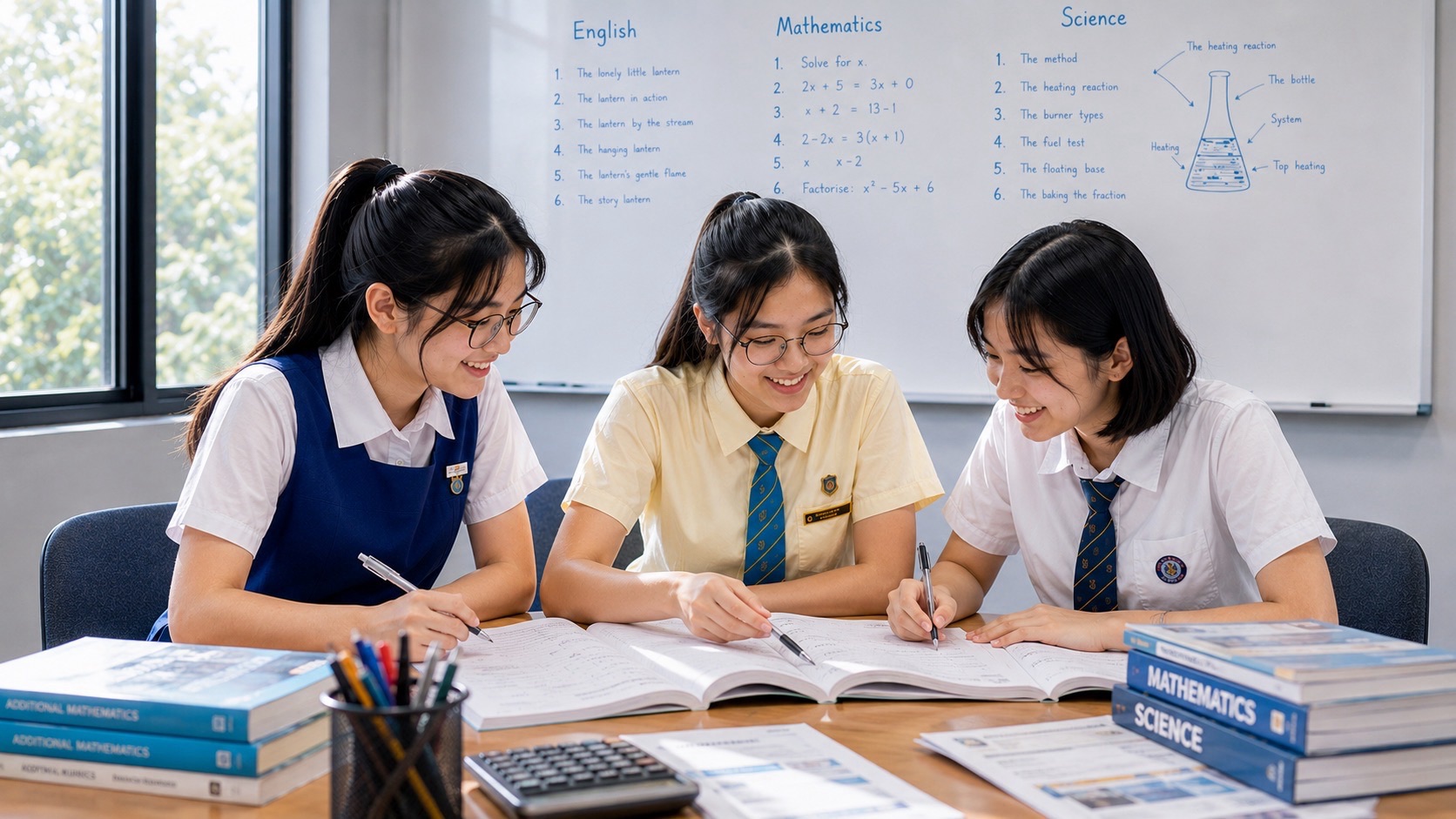
Secondary 3 and 4 Maths Tuition for Compassvale Secondary Sec3 Sec4 Small Group E and A Math Tuition is now a guide to Compassvale Secondary Mathematics tuition, Sec 3 Maths tuition, Sec 4 Maths tuition, G2 Mathematics, G3 Mathematics, Additional Mathematics, small-group Maths tuition, marked-paper diagnosis, error recovery and SEC examination preparation. The original 2017 article promised quick grade jumps and instant improvement. Those claims have been removed. This rebuild keeps the title and URL while giving the page one distinct job: how to turn a marked paper into a precise repair plan rather than simply doing another paper.
Families searching for Compassvale Secondary Maths tuition, Sec 3 E Math tuition, Sec 4 E Math tuition, A Math tuition, G2 Maths tuition, G3 Maths tuition or small-group Secondary Mathematics tuition near Sengkang and Punggol often receive a simple instruction after a weak test: practise more. Practice matters, but the wrong practice can repeat the same failure. A student who chose the wrong method needs different work from one who chose the right method and made an algebra error. A student who understands everything but leaves questions unfinished needs a performance plan, not another chapter explanation.
For 2027 SEC school candidates, SEAB lists G2 Mathematics K210, G3 Mathematics K310, G2 Additional Mathematics K232 and G3 Additional Mathematics K341. Students should use the current syllabus for their subject level and examination year. eduKate is independent of Compassvale Secondary School; no affiliation or endorsement is implied.
A marked paper is a map of decisions
Do not begin with the final score.
Begin with the first failed decision on each question.
For every lost mark, ask:
- Did the student understand the question?
- Did the student choose the right method?
- Did the student know the method but execute badly?
- Did the student ignore a condition?
- Did the student run out of time?
- Could the error have been caught by a known check?
This converts a paper from judgment into data.
Use a seven-part error taxonomy
| Error family | Typical symptom | Repair |
|---|---|---|
| Reading | target or condition misunderstood | restate question and annotate givens |
| Knowledge | concept/formula missing | reteach concept |
| Recognition | method known but not selected | mixed comparison practice |
| Representation | diagram/equation/model wrong | externalise relationship |
| Execution | algebra/arithmetic fails | targeted fluency and checking |
| Condition | domain, interval, unit, instruction ignored | condition-first routine |
| Performance | paper unfinished or rushed | timed sections and triage |
The taxonomy matters because “careless” is not precise enough to repair.
Find the first failed line
A student may lose five marks in one question.
The first wrong line caused the later errors.
Correcting all five lines separately wastes attention.
Instead, locate:
the first line where the mathematical model diverged from the correct path.
That is usually the repair point.
Do not confuse a knowledge error with a memory lapse
If a student cannot recall a formula once, that may be retrieval.
If the student cannot explain what the formula represents, that is deeper.
Ask:
- What quantities does the formula connect?
- When does it apply?
- What units should appear?
- How could you derive or verify it?
Understanding creates more recovery options than memorisation alone.
Reading errors deserve explicit training
Mathematics is also a reading subject.
Train students to identify:
- what is given;
- what is required;
- which quantities are linked;
- which conditions limit the answer;
- which representation may help.
Before calculating, the student should know the mathematical job.
Representation errors often hide behind wrong arithmetic
A word problem may be wrong before any calculation begins.
The student may define the wrong unknown, draw the wrong diagram or build the wrong equation.
Ask the student to represent the relationship first.
Possible representations:
- equation;
- table;
- graph;
- diagram;
- ratio;
- labelled figure.
A correct representation reduces later guesswork.
Method-selection errors require mixed practice
Topical practice says:
“This is a quadratic question.”
Mixed practice asks:
“What kind of problem is this?”
A student can be excellent at topical exercises and weak in examination conditions because the chapter label has been doing part of the thinking.
Use small mixed sets regularly.
Compare methods explicitly
After a question, ask:
- Was there another valid method?
- Which method is shortest?
- Which is easiest to check?
- Which depends on a special structure?
- Which would still work if the numbers changed?
This develops method judgement rather than rote recognition.
Execution errors need a different response
If the student chose the correct method and failed in algebra, do not reteach the whole concept.
Target:
- signs;
- brackets;
- fractions;
- substitution;
- indices;
- calculator entry;
- units.
Short deliberate practice may be more efficient than another full paper.
Algebra should be treated as infrastructure
Upper-secondary Mathematics repeatedly depends on symbolic control.
A student with weak algebra may appear weak in:
- functions;
- trigonometry;
- coordinate geometry;
- Additional Mathematics;
- calculus.
But the real failure may be common across them.
Look for the shared dependency.
Condition errors are highly preventable
Students often know the Mathematics and lose marks because they forget:
- units;
- intervals;
- domain restrictions;
- rounding instructions;
- exact-form requirements;
- question-specific conditions.
Create a condition-first habit.
Before solving, underline or write the condition.
Sec 3 correction should build foundations for later
Sec 3 papers reveal whether the student is carrying dependency debt.
After every assessment, identify:
- the top three repeated error families;
- the most important prerequisite;
- one old topic that has been forgotten;
- one topic that works only with chapter cues.
That becomes the next month’s repair plan.
Sec 4 correction should increasingly include paper control
By Sec 4, add:
- time lost per question;
- where checking disappeared;
- which questions trapped the student;
- which reachable marks were never attempted.
The paper is now both a Mathematics diagnostic and a performance diagnostic.
Use an error ledger
| Date | Error | Cause | Future rule | Retest |
|---|---|---|---|---|
| Week 1 | wrong equation | unknown not defined | state variable before equation | fresh word problem |
| Week 2 | sign error | compressed brackets | one transformation per line | mixed algebra |
| Week 3 | wrong trig answer | interval ignored | write interval before solving | fresh trig equation |
| Week 4 | paper unfinished | hard-question trap | move-on threshold | timed section |
The ledger should not become a museum of mistakes.
Remove errors once delayed retesting shows they are genuinely stable.
Corrections should produce fresh questions
Redoing the exact same question may show memory.
Use a structurally similar but visibly different question.
Change:
- numbers;
- diagram;
- context;
- wording;
- order of information.
The student should recognise the relationship.
Retest after a delay
A useful sequence:
- same day — understand correction;
- 2–3 days later — fresh variant;
- 1–2 weeks later — mixed retrieval;
- later — timed section.
The exact spacing can vary.
The principle should remain.
Small-group correction can be powerful
Two students may arrive at the same wrong answer for different reasons.
One chose the wrong method.
One made an algebra error.
Comparing them teaches that a wrong answer does not reveal the whole mechanism.
The tutor can ask the group to locate the first failed line in each solution.
Wrong solutions can be teaching tools
Present two anonymised solutions.
Ask:
- Where does each first diverge?
- Which error is conceptual?
- Which is execution?
- Which future rule would prevent it?
This turns error analysis into mathematical reasoning.
But corrections should not become public embarrassment
The purpose is to analyse methods, not pupils.
Use anonymised work where helpful.
Normalise error as information while maintaining standards.
General Mathematics: common repair zones
Frequent high-leverage areas include:
- algebra;
- graphs;
- geometry;
- trigonometry;
- ratio and rate;
- statistics;
- problem modelling.
Each should be tied to the actual syllabus for the student’s level.
Additional Mathematics: common repair zones
For students taking Additional Mathematics, common high-leverage areas include:
- quadratics;
- functions;
- surds and algebra;
- polynomials;
- exponential and logarithmic work;
- trigonometric manipulation;
- coordinate geometry;
- calculus for G3 where applicable.
SEAB’s 2027 G3 Additional Mathematics K341 syllabus assumes knowledge of G3 Mathematics.
This is why General Mathematics foundations still matter.
Functions: diagnose notation versus concept
A student may fail a function question because:
- notation is misunderstood;
- substitution fails;
- graph meaning is weak;
- composition/inverse ideas are confused;
- algebra fails afterward.
Identify which one before teaching the whole chapter again.
Trigonometry: separate geometry, algebra and conditions
Ask:
- Did the student identify the correct relationship?
- Did the student interpret the diagram correctly?
- Was the calculator mode correct?
- Did the algebra work?
- Were all required solutions included?
One topic can contain several independent failure mechanisms.
Calculus: separate technique from post-calculus algebra
A student may differentiate correctly and then solve the resulting equation incorrectly.
Record:
calculus correct; algebra failed.
This matters because the repair is different.
Timed work should diagnose speed, not merely create pressure
“Too slow” can mean:
- slow reading;
- slow method selection;
- slow algebra;
- too much rewriting;
- too long on one difficult question;
- checking without a plan.
Use timed clusters to locate the bottleneck.
Teach a move-on rule
- Read again.
- Write what is known.
- Try one sensible method.
- If progress remains blocked beyond the planned threshold, mark the question.
- Move to reachable marks.
- Return later.
This is paper management.
It is not giving up.
Checking should come from the error history
One student needs to check signs.
Another needs to check units.
Another needs to check intervals.
Another needs to check calculator mode.
A personal checking routine is more useful than generic “check carefully”.
From prelim paper to revision plan
After a prelim or major school paper:
- Classify every significant loss.
- Rank error families by marks and repetition.
- Choose the top two repair targets.
- Create short targeted practice.
- Retest with fresh questions.
- Return to a timed mixed section.
- Compare error profile, not only total score.
The cycle is more useful than immediately starting another full paper.
Look for leading indicators
Before marks move dramatically, students may show:
- faster independent starts;
- fewer repeated algebra errors;
- better method selection;
- clearer working;
- more complete conditions;
- fewer tutor hints;
- more effective checking.
These changes matter because they precede reliable examination performance.
How parents can talk about a marked paper
Instead of:
“Why did you lose so many marks?”
ask:
- What is the largest repeated error?
- What caused it?
- What future rule are you using?
- When will you retest it?
This turns the conversation toward repair.
How to evaluate Sec 3–4 Maths tuition
- Does the tutor classify errors precisely?
- Does the tutor identify the first failed line?
- Are corrections retested on fresh questions?
- Does mixed practice train method selection?
- Are G2/G3 pathways handled correctly?
- Are General and Additional Mathematics diagnosed separately?
- Does timed work locate the speed bottleneck?
- Is there a personal checking system?
- Does prompting reduce?
- Does the error ledger shrink?
Red flags
- guaranteed grade jumps;
- instant-improvement claims;
- every error labelled careless;
- doing more full papers without analysing the last one;
- old syllabus labels presented as current;
- one correction followed by no retest;
- constant tutor hints;
- no plan for independence.
Frequently asked questions
Is eduKate affiliated with Compassvale Secondary School?
No. This is an independent tuition and learning guide.
What are the 2027 SEC Mathematics codes?
SEAB lists G2 Mathematics K210, G3 Mathematics K310, G2 Additional Mathematics K232 and G3 Additional Mathematics K341 for school candidates.
Should a student redo every wrong question?
Understand every significant error, but do not stop there. A fresh variant is needed to test whether the correction transferred.
What is the most useful thing to do after prelims?
Build an error profile, repair the largest repeated mechanisms, retest them, then return to timed mixed work.
Current official and internal routes
- SEAB — 2027 SEC G2 Syllabuses
- SEAB — 2027 SEC G3 Syllabuses
- eduKateYishun Mathematics Tuition & Learning Hub
- Companion Sec 3–4 dependency and revision guide
The marked-paper standard
Do not ask only how many marks were lost.
Ask where the reasoning first failed.
Repair that mechanism.
Retest it on something new.
Then return to the paper with one less repeated weakness.
That is how correction becomes learning.
Leave a Reply