
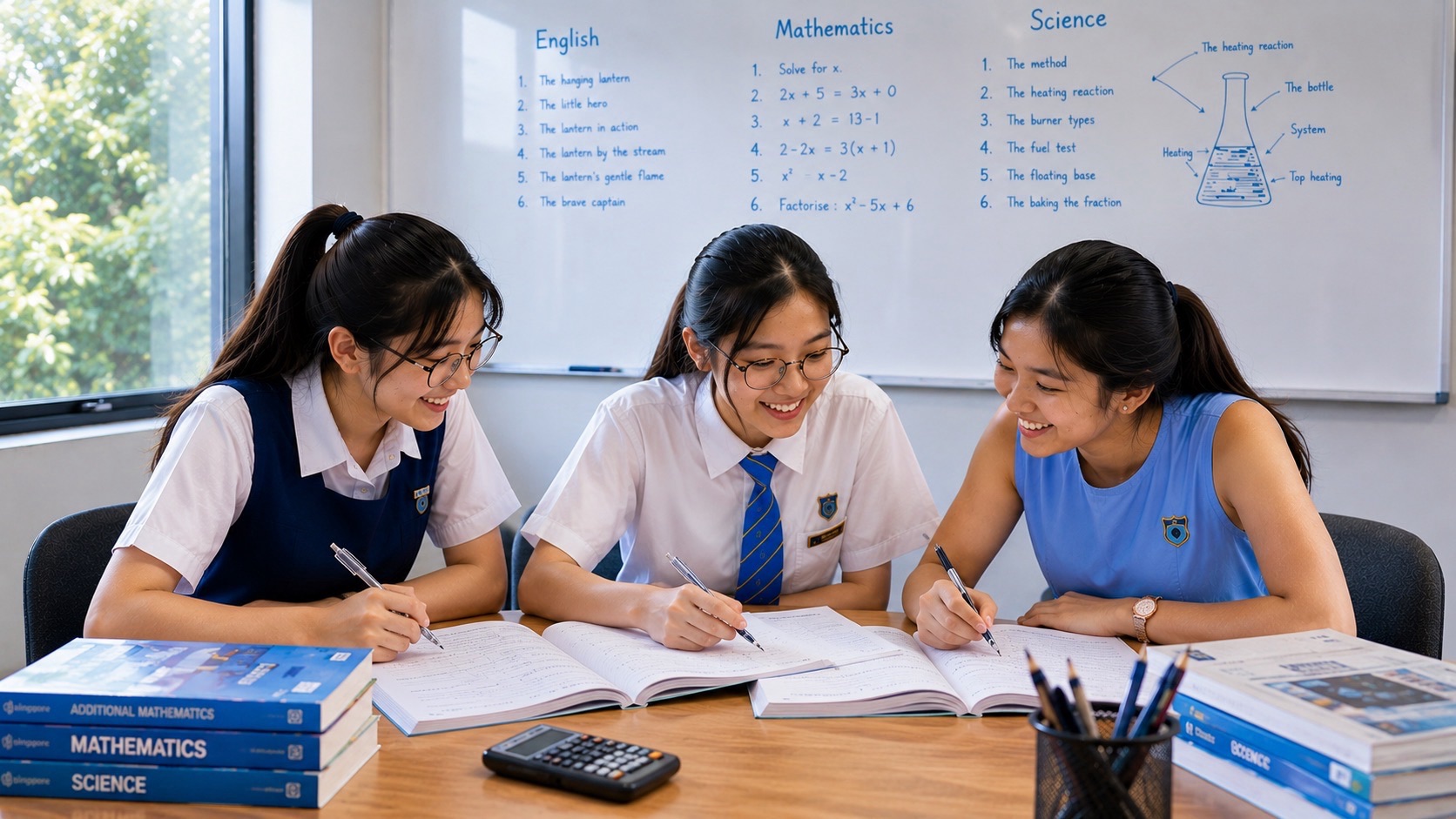
Current-status note: “GCE O-Level A Maths” is retained as legacy title language. Current 2027+ Additional Mathematics preparation should route through the Additional Mathematics Directory and the learner’s current G2 or G3 SEC subject level rather than treating the old O-Level label as the present examination name.
Punggol GCE O level A Maths Tuition is a historical title for a subject that is now moving into a new Singapore examination framework. Students searching for Punggol A Maths tuition, Additional Mathematics tuition, O-Level A Math, Secondary 3 A Math, Secondary 4 A Math, G3 Additional Mathematics or small-group Mathematics support need two things at once: the current syllabus for their cohort and an honest diagnosis of whether the difficulty is algebra, method selection, reasoning, working, timing or an earlier General Mathematics foundation.
For the 2026-and-earlier reference system, G3 Additional Mathematics is associated with subject code 4049. From the 2027 Singapore-Cambridge Secondary Education Certificate, SEAB lists G3 Additional Mathematics as K341; G2 Additional Mathematics is listed separately as K232. The examination name is changing, but the core educational problem remains familiar: A-Math becomes difficult when students try to memorise advanced procedures without enough algebraic control to understand what those procedures are doing.
This 2017 legacy page has therefore been rebuilt as a guide to choosing and using Additional Mathematics tuition well. The old guarantees of A1 results, “tricks”, historical class-size claims and tutor marketing are no longer presented as current promises. Students should verify the syllabus for their examination year on the SEAB G3 syllabus page. The job of tuition is not to guarantee a grade. It is to make the student’s mathematical decisions more reliable.
Additional Mathematics is not simply “harder E-Math”
General Mathematics and Additional Mathematics share foundations, but A-Math increases the density of symbolic reasoning.
Students spend more time manipulating expressions, analysing functions, reasoning through trigonometric relationships, working with logarithmic or exponential forms and, at G3, studying calculus.
The current K341 G3 syllabus includes assessment objectives that test standard techniques, problem solving in varied contexts, mathematical connections, formulation, interpretation, reasoning and communication.
This is why memorising a page of formulas is not enough.
The student must recognise structure.
The first readiness test is algebra
A-Math often appears to fail in calculus, trigonometry or logarithms when the deeper bottleneck is algebra.
Before blaming the advanced topic, check whether the student can reliably:
- expand and factorise expressions;
- handle negative signs and brackets;
- rearrange equations;
- work with indices;
- manipulate fractions containing algebra;
- solve equations without losing equivalence;
- move between symbolic and graphical forms.
If these operations consume all working memory, every later topic becomes more difficult than it needs to be.
A readiness diagnostic should separate six failure types
| Failure type | Example | First response |
|---|---|---|
| Foundation | Indices or algebraic fractions unstable | Repair prerequisites |
| Concept | Does not understand what derivative represents | Rebuild meaning before procedure |
| Method selection | Knows several tools but chooses wrong one | Mixed classification practice |
| Execution | Correct method, algebra breaks down | Focused fluency work |
| Communication | Answer appears with missing reasoning | Train mathematical working |
| Timing | Understands but cannot complete paper | Pacing and decision practice |
Students with different failure types should not receive the same homework.
The first broken link matters more than the final wrong answer
An A-Math solution can be wrong for many lines after the first mistake.
Suppose the student differentiates correctly, substitutes the correct value, then solves a quadratic incorrectly.
The failure is not “calculus”.
It is algebra.
Suppose the student knows every differentiation rule but does not recognise that a maximum/minimum question requires a stationary-point approach.
The failure is method selection.
Good tuition finds the earliest invalid decision because that is where the next lesson should begin.
Functions are the central map
Many A-Math topics become easier when students understand functions rather than treating each chapter separately.
A function can be represented as:
- an equation;
- a graph;
- a table;
- a mapping;
- a verbal relationship.
Quadratics, exponentials, logarithms, trigonometric functions and calculus all become more coherent when students can move among these representations.
A strong tutor repeatedly asks:
- What does the equation tell us?
- What would the graph show?
- Where are the roots?
- How does changing a parameter alter the graph?
- What does the derivative say about the function’s behaviour?
Quadratics are a foundation, not an isolated chapter
Students meet quadratic structure repeatedly.
- factorisation;
- roots;
- discriminant;
- graphs;
- inequalities;
- stationary-point problems;
- substitution into later topics.
A student who can solve a routine quadratic but cannot recognise quadratic structure after substitution has learned a procedure without enough transfer.
Practice should therefore vary the surface while preserving the underlying form.
Exponents and logarithms need relationship sense
Students often memorise laws of indices and logarithms as separate lists.
A stronger approach connects them.
Logarithms describe exponents.
When students understand that relationship, many rules become less arbitrary.
They should also learn to ask about domain and validity rather than manipulate symbols blindly.
Trigonometry should move beyond formula substitution
Additional Mathematics trigonometry becomes difficult when students know identities but cannot see when or why to use them.
Useful practice includes:
- recognising equivalent forms;
- deciding which side of an identity is easier to transform;
- checking domain restrictions;
- solving equations across the required interval;
- connecting graphs with solutions.
The objective is not to collect identities.
It is to recognise structure quickly enough to choose a useful transformation.
Calculus should begin with meaning
The current G3 Additional Mathematics syllabus treats the derivative as gradient of a tangent and as a rate of change, and includes applications such as stationary points, tangents, normals, connected rates and optimisation. Integration is treated as the reverse of differentiation and as accumulation, including areas.
Students should therefore learn more than rule execution.
- What does the derivative mean here?
- Why does setting it to zero identify a stationary point?
- What does the sign of the derivative tell us?
- What does the definite integral represent?
- Why can area below the axis create signed value?
Meaning makes procedures easier to select and verify.
Working is part of the mathematics
Students sometimes think the only real object is the final answer.
In examination Mathematics, working has several jobs:
- make the method visible;
- preserve partial credit where applicable;
- help the student locate errors;
- make checking possible;
- communicate mathematical reasoning.
The 2027 G3 Additional Mathematics syllabus explicitly includes reasoning and mathematical communication among its assessment objectives.
Clear working is not cosmetic.
Do not learn “tricks” without the condition that makes them valid
Shortcuts can be useful.
They become dangerous when students remember the move and forget the conditions.
Every shortcut should answer:
- Why does it work?
- When is it valid?
- When would it fail?
- How can the result be checked?
A shortcut with conditions is a method.
A shortcut without conditions is a trap waiting for a slightly unfamiliar question.
Blocked practice creates false confidence
If a worksheet is titled “Differentiation”, the student has already been told what tool to use.
Examinations ask for selection.
Once a method is stable, mix it with:
- quadratics;
- trigonometry;
- coordinate geometry;
- logarithms;
- other calculus forms.
Before solving, ask the student to classify the structure and justify the method choice.
An A-Math error ledger should classify mechanisms
| Error | Example | Repair |
|---|---|---|
| Sign | Negative lost during expansion | Externalise brackets and slow first line |
| Algebra | Incorrect factorisation | Target structure and reverse-check |
| Selection | Wrong calculus method | Compare question cues |
| Domain | Invalid logarithm/trig solution | State restrictions before solving |
| Communication | Jumped steps obscure logic | Write decisive transformations |
| Timing | Overinvests in one hard problem | Timed mixed sections |
The ledger is useful only if it changes the next practice set.
What good Additional Mathematics tuition should do
- diagnose prerequisite algebra;
- teach concepts before compressing them into procedures;
- make method selection explicit;
- use mixed practice once fluency is stable;
- inspect working rather than final answers only;
- store repeated errors;
- retest after delay;
- train timing progressively;
- reduce prompts as independence grows.
A student should leave tuition with more control over the problem, not more dependence on a familiar worksheet sequence.
Small-group A-Math tuition: the group should improve reasoning
A small group is useful when students compare legitimate solution routes.
One student may factorise. Another uses the quadratic formula. A third uses a graphing interpretation where permitted and appropriate.
The tutor can ask:
- Which method is shortest here?
- Which is most robust?
- Which depends on recognising a special structure?
- How could the answer be checked?
The educational advantage is not simply a smaller room.
It is visible mathematical decision-making.
One-to-one A-Math tuition may suit a narrow repair
One-to-one support can be valuable when a student has a specific high-leverage gap, joins the subject late, or needs short-term intensive rebuilding.
Its risk is immediate rescue.
The tutor should deliberately create independent thinking time rather than responding to every pause.
A-Math performance requires the student to tolerate uncertainty long enough to choose a method.
Secondary 3: stabilise the operating system
For many students, Secondary 3 is the first serious encounter with Additional Mathematics.
The most valuable early work is not racing through the syllabus.
Stabilise:
- algebra;
- function notation;
- equation solving;
- graph reading;
- working discipline;
- error correction.
If these become reliable, later topics attach to a stronger system.
Secondary 4: shift from chapters to performance
By the final year, students need mixed retrieval and examination control.
A strong progression is:
- repair recurring concept gaps;
- mix topics;
- practise method classification;
- use timed sections;
- complete full papers;
- analyse every lost-mark mechanism;
- retest the repaired mechanism later.
Full papers should not merely generate scores.
They should generate the next training plan.
A six-week examination runway
| Period | Main job |
|---|---|
| Weeks 6–5 | Repair high-leverage algebra and concept gaps. |
| Weeks 4–3 | Mixed topic retrieval and method selection. |
| Week 2 | Timed sections and full-paper integration. |
| Week 1 | Error-family retests, pacing and light consolidation. |
The exact schedule should follow the student’s evidence and school calendar.
How parents can judge whether A-Math tuition is working
- The student can explain why a method applies.
- Algebraic working contains fewer repeated breakdowns.
- Old topics remain retrievable.
- The learner can solve changed versions, not only near copies.
- Working becomes clearer.
- Timed sections become more stable.
- The child asks more precise questions when stuck.
- Prompts from the tutor are decreasing.
One test score is useful evidence, not the whole story.
What this historical title means in 2026–2027
The URL says “GCE O level A Maths” because the page was published in 2017.
Students sitting the older examination system should follow the syllabus for their own cohort.
From 2027, the SEC framework uses new subject codes. SEAB lists G3 Additional Mathematics as K341 with 4049 shown as the reference code for 2026 and earlier, while G2 Additional Mathematics is K232 with 4051 as the reference code.
The safe rule is simple:
Use the syllabus for the year and subject level you are actually sitting.
Frequently asked questions
Is O-Level Additional Mathematics disappearing?
The examination framework is changing for the 2027 graduating cohort. G3 Additional Mathematics is listed under the Singapore-Cambridge Secondary Education Certificate as K341. Students should follow the arrangements for their own cohort.
What is the biggest prerequisite for A-Math?
Strong algebraic control is one of the highest-leverage prerequisites because it appears throughout functions, trigonometry, exponentials/logarithms and calculus.
Should students memorise model solutions?
Worked examples are useful for studying structure, but students must be able to select and adapt methods on unfamiliar questions. Memorisation without recognition is fragile.
How many papers should a Secondary 4 student do?
No fixed number guarantees improvement. Full papers become useful when errors are classified, repaired and retested rather than merely counted.
What should I ask an A-Math tutor?
Ask what the student’s first broken link is, how it was diagnosed, how the repair will be tested on fresh questions, and how support will reduce as independence grows.
Punggol GCE O level A Maths Tuition: the larger lesson
Additional Mathematics becomes manageable when students stop seeing every chapter as a bag of tricks.
Algebra is the language.
Functions are the map.
Methods are tools with conditions.
Working is communication.
Mixed problems train selection.
Marked papers create error maps.
And good tuition gradually moves the decisive thinking out of the tutor’s head and into the student’s.
Leave a Reply