
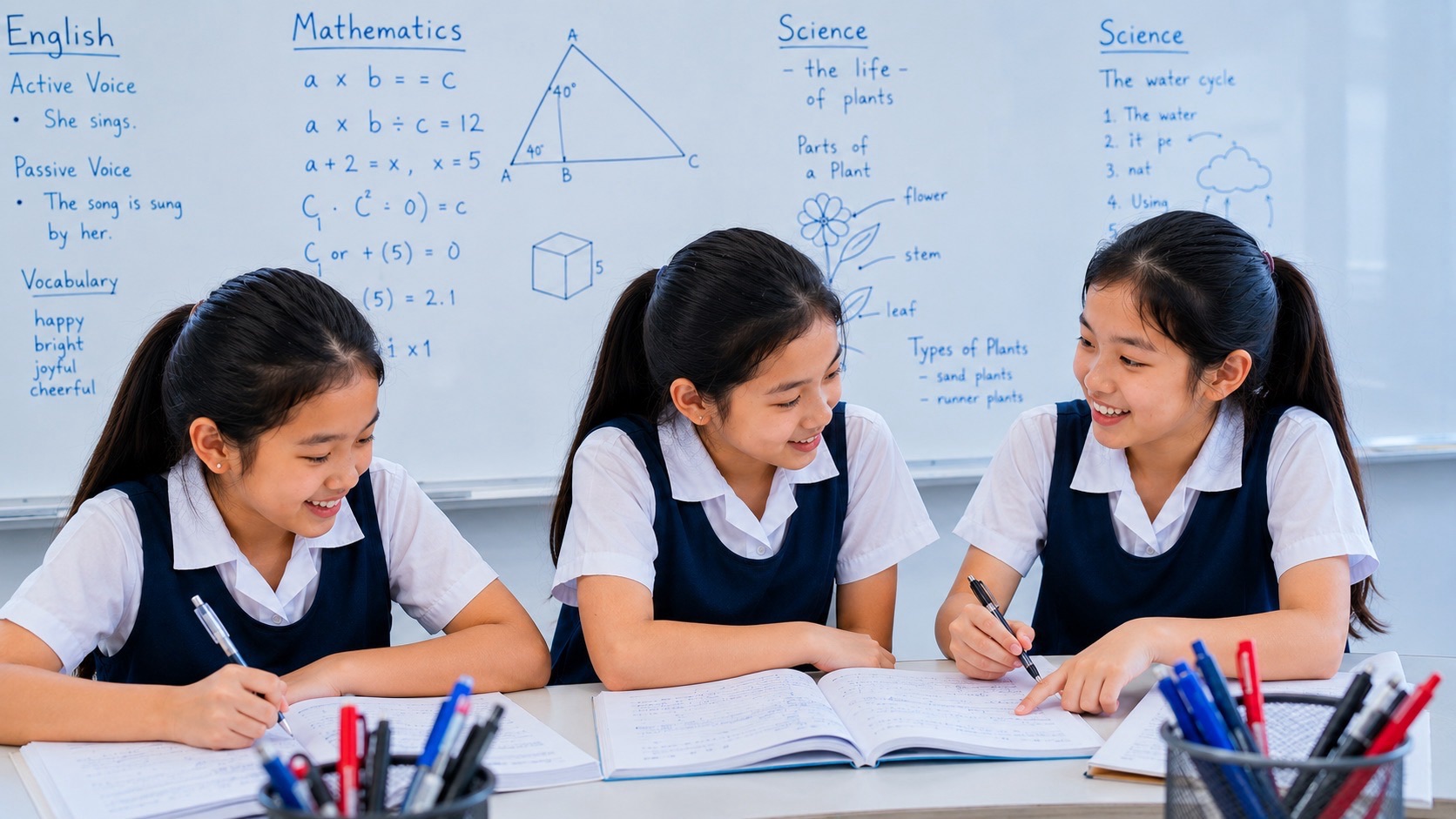
Tutor in Punggol Primary Secondary English Math and Science covers a wide span of schooling, so the useful question is not whether one tuition centre can print worksheets for every level. Parents searching for Punggol tuition, Primary tuition, Secondary tuition, English tuition, Maths tuition, Science tuition, PSLE tuition, O-Level tuition or small-group tutors in Punggol need to know how teaching should change as a child moves from concrete Primary learning into increasingly abstract Secondary work.
The subjects change too. English develops reading, writing and communication. Mathematics develops representation, relationships and symbolic reasoning. Science develops conceptual models, evidence and explanation. A serious tuition programme must preserve those subject differences while building common habits: accurate reading, deliberate practice, error diagnosis, retrieval, transfer and independence.
That creates one central proposition for this article: good tuition is a progression system. It should meet the learner at the current level, identify the constraint, teach the next useful mechanism and gradually remove support. Primary and Secondary tuition should therefore feel connected without being identical.
Primary and Secondary are different learning environments
Primary students often need more concrete examples, shorter feedback loops and explicit routines. Secondary students increasingly need abstraction, independent planning, multi-topic retrieval and stronger self-management.
| Dimension | Primary | Secondary |
|---|---|---|
| Representation | Concrete examples, diagrams, models | Symbols, graphs, arguments, abstract models |
| Reading | Build fluency and evidence habits | Interpret nuance and larger structures |
| Independence | Routines are taught explicitly | Student increasingly manages method and revision |
| Assessment | Foundation plus PSLE preparation in upper Primary | School assessment, O-Level/SEC or IP pathways |
| Tutor role | Model and scaffold heavily when needed | Diagnose, challenge and reduce support |
English progression: from sentence meaning to sustained control
Primary English builds reading comprehension, grammar, vocabulary, writing and oral communication. Secondary English asks students to sustain those skills across longer texts, more demanding writing and more nuanced interpretation. The bridge is greater control, not merely harder vocabulary.
Mathematics progression: from visible relationships to symbolic ones
Primary Mathematics often uses bar models, diagrams and concrete relationships. Secondary Mathematics compresses many of those relationships into algebra, graphs and functions. A student who learned to ask “What does this quantity represent?” is better prepared to ask “What does this variable represent?” later.
Science progression: from observation to explanatory models
Primary Science introduces systems, interactions, cycles, forces, energy and living things through accessible contexts. Secondary Science increases disciplinary depth. Physics, Chemistry and Biology demand more precise models and language. The bridge is the habit of asking what changed, what caused it, what evidence supports the claim and which model explains the observation.
The common learning loop across all three subjects
- Observe: read the passage, problem, diagram or data.
- Attempt: work independently before receiving rescue.
- Judge: compare the response with the actual demand.
- Explain failure: identify where reasoning broke.
- Repair: teach the missing knowledge or method.
- Retrieve: return to it after a delay.
- Transfer: change the surface of the task.
- Promote: reduce tutor support when the skill survives.
Diagnose before customising
“Customised tuition” is meaningful only if the tutor has evidence. Recent school papers, written work and live attempts reveal whether the problem is knowledge, reading, method, expression, time or transfer.
Small-group tuition should use peer differences intelligently
In a three-student group, students can share a topic while receiving different next steps. One learner may need a foundation example, another a standard question, and another a transfer problem. The group also creates comparison: another explanation, another mathematical method or another Science inference can become teaching material.
Marks are outputs; error patterns are inputs
| Subject | Score-level observation | Teaching-level observation |
|---|---|---|
| English | Lost 6 comprehension marks | Inference answers repeatedly lack supporting evidence |
| Mathematics | Lost 8 marks in problem solving | Begins calculation before representing quantities |
| Science | Lost 5 open-ended marks | Names process but does not explain cause and effect |
Do not teach marking-scheme tricks as magic
The old version of this article claimed that certain keywords could instantly award marks. That is too simplistic. Students should understand command words, content points, working requirements and the precision expected in explanations. The goal is alignment with the task, not collecting magical phrases.
PSLE preparation: integrate without panicking
By Primary 6, students need to retrieve knowledge across several years and apply it under time pressure. Tuition should gradually move from topic teaching into mixed practice, timed sections, error analysis and independent checking. Turning every lesson into a full mock paper too early can reduce time available for actual repair.
Secondary examination preparation: train method selection
Secondary papers increasingly require students to decide which knowledge applies without chapter labels. English students decide what evidence and structure fit. Mathematics students identify a relevant method. Science students select the correct concept and explanatory chain. Mixed practice matters because it trains selection.
A note on the 2026–2027 Secondary transition
Students sitting the 2026 Singapore-Cambridge GCE O-Level examinations remain under the O-Level syllabuses for that cohort. From 2027, Singapore introduces the Singapore-Cambridge Secondary Education Certificate, with subjects offered at G1, G2 and G3. Future families should therefore check the current SEAB subject syllabus rather than assume an older O-Level structure.
Homework should have a clear function
Students already carry schoolwork across multiple subjects. Tuition homework should have a clear function: retrieval, practice, transfer, correction or examination preparation. A ten-question set that targets a recurring error can be more useful than forty unrelated questions.
The tutor should reduce help as the student improves
Support should be temporary. Early in learning, the tutor may model heavily. Later, the tutor should ask questions rather than give steps. Eventually, the student should attempt unfamiliar work in silence. Examinations remove the helpful adult, so tuition has to prepare for that removal.
A cross-subject help ladder
- Wait.
- Ask the student to restate the task.
- Ask what is known.
- Ask what representation or evidence may help.
- Offer one small cue.
- Model one step.
- Explain fully only when the missing prerequisite is clear.
How parents can support a multi-subject tuition plan
- Keep recent school papers organised.
- Tell the tutor when school workload or assessment dates change.
- Ask the child what the current learning priority is.
- Avoid adding unrelated worksheets simply because marks dipped once.
- Protect sleep and independent study time.
- Look for repeated patterns across subjects.
What parents should ask a Punggol multi-subject tutor
- Which subjects and levels are taught regularly?
- How are Primary and Secondary teaching approaches different?
- How are students placed into small groups?
- How are recurring errors tracked?
- How is subject-specific expertise protected?
- How are strong students stretched?
- How is tutor dependence reduced?
- How are school assessments used to adjust the plan?
What progress looks like across the years
- the student reads instructions more accurately;
- working and written answers become easier to follow;
- old mistakes repeat less often;
- the student explains methods more clearly;
- skills survive changed questions;
- revision becomes more organised;
- the student asks more precise questions;
- the tutor provides less rescue for familiar task types.
The long arc from Primary to Secondary
Primary and Secondary tuition belong in the same article because the learner does not reset at Secondary 1. Reading habits, number sense, curiosity, error patterns and independence all cross the boundary.
Good Primary tuition prepares the student for later abstraction. Good Secondary tuition respects the foundations that came before. English moves from understanding sentences to controlling arguments. Mathematics moves from visible models to symbolic systems. Science moves from observing phenomena to using increasingly precise explanatory models.
The strongest tutor therefore does not merely move a child through levels. The tutor helps the learner carry useful habits forward: read accurately, represent clearly, explain reasoning, learn from failure, retrieve old knowledge and become progressively less dependent on help.
Related Punggol tuition reading
- Punggol Tutor for English
- Tutor in Punggol for Maths Primary and Secondary
- Top Science tutor in Punggol for Primary PSLE and Secondary GCE O level
Leave a Reply