
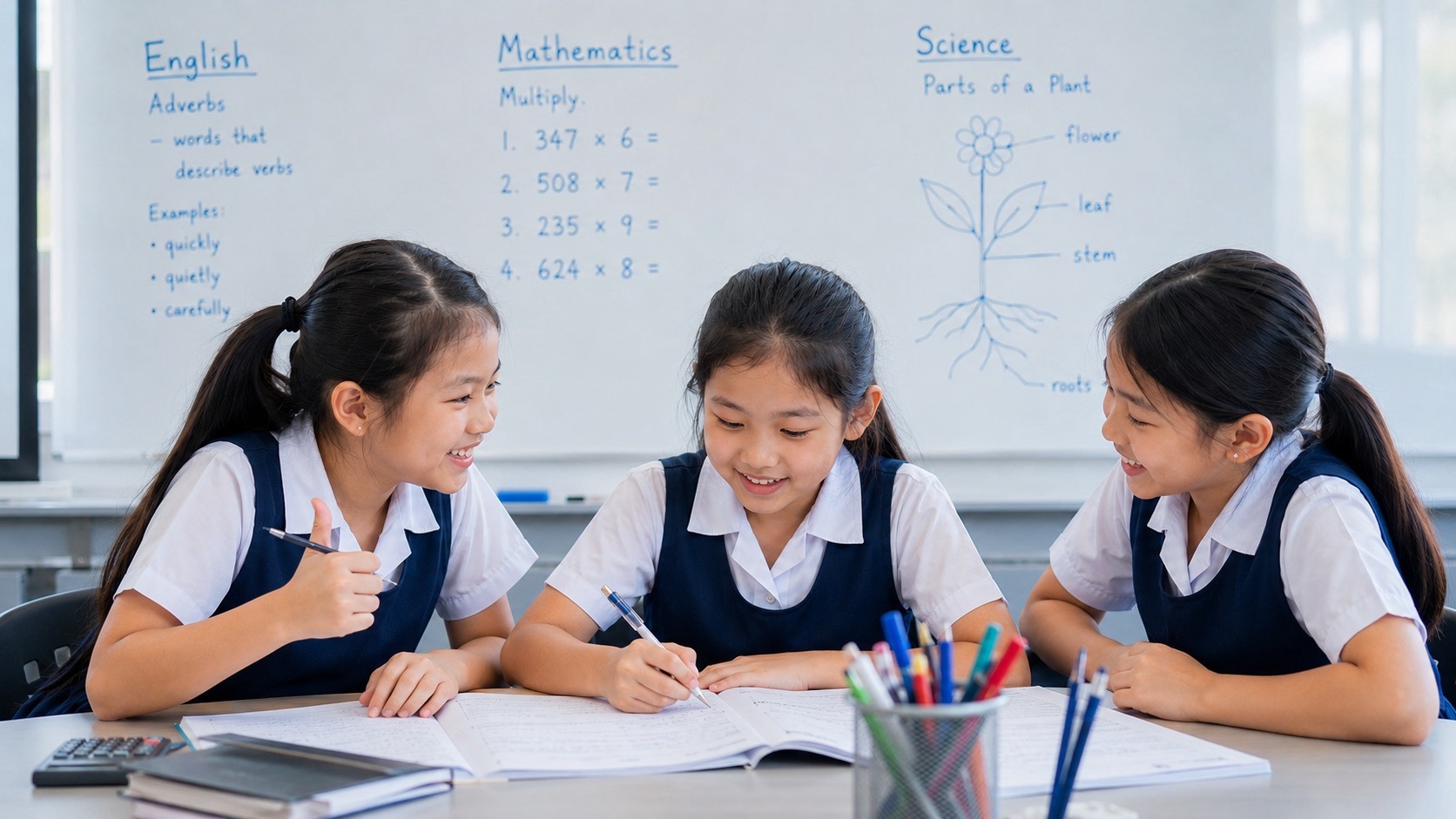
Primary 2 tuition in Punggol or Tampines should be judged by one question before anything else: does the support make the child more capable of learning independently? At age seven or eight, Primary 2 English tuition, Primary 2 Mathematics tuition, lower-Primary tuition and small-group tuition should strengthen reading, sentence construction, number sense, basic operations, word-problem representation, classroom confidence and work habits. It should not turn Primary 2 into an early PSLE boot camp.
Parents searching for Primary 2 tuition, English and Maths tuition, P2 tuition classes, Primary school tuition or enrolment information often encounter programmes promising acceleration, worksheets, school papers and exam techniques. Those features can be useful later, but the central Lower-Primary job is foundation. A child who can read instructions, understand a short text, express an idea in a sentence, represent a Mathematics problem, retrieve basic facts and correct a simple mistake has an operating system that can carry much more difficult learning in Primary 3 and beyond.
This 2015 page originally contained enrolment details for old eduKate Tampines and Punggol branch arrangements. The title and historical URL are preserved, but old addresses, phone numbers, class-size claims, tutor-background claims and programme availability are not presented as current. The rebuilt article is a comprehensive guide to Primary 2 English, Mathematics, lower-Primary learning, homework, small-group teaching, confidence, parent support and readiness for Primary 3. For current eduKate services, use the present-day branch websites rather than this historical enrolment page.
Primary 2 Has a Distinct Learning Job
Primary 2 is not simply “another year before Primary 3”.
It is the year in which early school routines should begin to become reliable.
By the end of Primary 2, a learner should increasingly be able to:
- read age-appropriate instructions independently;
- understand the main idea of a short passage;
- write connected sentences;
- use basic grammar with growing control;
- understand place value;
- add and subtract accurately;
- develop multiplication and division foundations;
- represent simple word problems;
- check simple work;
- manage basic school materials and routines.
Those foundations matter because Primary 3 expands the system.
Do Not Diagnose Primary 2 Through Marks Alone
A low score can come from several different causes.
English:
- weak decoding or fluency;
- limited vocabulary;
- poor listening to instructions;
- grammar instability;
- question-reading problems;
- writing that is too short to show understanding.
Mathematics:
- weak number sense;
- place-value confusion;
- slow basic facts;
- misreading of symbols;
- difficulty translating words into operations;
- rushing.
The intervention should match the mechanism.
Primary 2 English: Reading Before “Exam Technique”
At Lower Primary, fluent reading changes everything.
A child who reads slowly uses so much attention on decoding that comprehension has less working space.
Useful reading development includes:
- phonics where gaps remain;
- sight-word recognition;
- phrasing;
- punctuation awareness;
- vocabulary in context;
- retelling;
- simple inference.
Reading Fluency Is Not Racing
A fast reader who ignores punctuation or meaning is not necessarily fluent.
Fluency combines:
- accuracy;
- appropriate pace;
- phrasing;
- expression;
- understanding.
Read-aloud practice can help when used briefly and positively.
Retelling
After reading, ask the child to retell the text in their own words.
A useful sequence is:
- who;
- where;
- what happened first;
- what changed;
- how it ended.
Retelling reveals whether the child built a coherent mental model of the passage.
Vocabulary in Context
Do not treat every unfamiliar word as a flashcard.
Ask:
- What does the sentence suggest?
- Is the word positive or negative?
- What action is happening?
- What word might fit here?
Then confirm the meaning.
This builds contextual inference.
Grammar: Build Patterns
Primary 2 grammar is easier to learn when students notice patterns.
Examples include:
- singular and plural nouns;
- simple tense relationships;
- subject–verb agreement;
- pronouns;
- prepositions;
- conjunctions;
- sentence punctuation.
The child should see grammar inside meaningful sentences, not only isolated blanks.
Sentence Construction
A simple Primary 2 sentence can be strong.
The dog ran.
Then extend deliberately:
The wet dog ran across the playground.
Then:
The wet dog ran across the playground because it was frightened by the thunder.
Students learn that sentence expansion adds information and relationships.
Writing: From Sentence to Paragraph
A paragraph needs connection.
A useful early structure is:
- main sentence;
- detail;
- example or action;
- closing sentence.
Students should learn that a paragraph is not simply four unrelated sentences.
Creative Writing at Primary 2
Creative writing should be playful but structured enough to build control.
Useful activities include:
- continue the story;
- describe a picture;
- write what a character says;
- change the ending;
- write three sentences using one new word;
- put events in order.
The goal is confidence and coherence.
Do Not Overload Primary 2 With Model Phrases
A child who memorises:
“The scorching sun hung mercilessly in the azure sky…”
may still struggle to write:
“I forgot my water bottle and felt thirsty during recess.”
Control of ordinary language comes first.
Spelling
Spelling develops through:
- phonics;
- word families;
- morphology;
- frequent reading;
- retrieval;
- correction.
Copying the same word ten times may help temporarily, but retrieval after a delay provides stronger evidence.
Primary 2 Mathematics: Build Number Sense
Number sense means more than knowing number names.
A student should increasingly understand:
- magnitude;
- place value;
- part-whole relationships;
- combinations that make ten or one hundred;
- relationships between operations;
- estimation.
These ideas reduce later dependence on mechanical methods.
Place Value
Students should know that in 347:
- 3 represents 300;
- 4 represents 40;
- 7 represents 7.
But understanding should go further.
Ask:
- What happens if we add 100?
- What is 10 more?
- Which number is closer to 400?
- How can 347 be decomposed differently?
Addition and Subtraction
Students should develop:
- mental strategies;
- standard written methods;
- estimation;
- inverse checking.
For example, if 287 + 145 = 432, subtraction can be used to check.
Multiplication Foundations
Multiplication should begin as equal groups and repeated structure.
Students can represent 4 × 3 as:
- four groups of three;
- three groups of four;
- an array;
- repeated addition;
- a number-line pattern.
Fluency grows from meaning plus retrieval.
Division Foundations
Division can mean:
- sharing equally;
- finding how many groups fit.
Students benefit from seeing both.
Word Problems
Teach:
- What do I know?
- What do I need?
- What relationship is described?
- Can I draw it?
- Which operation fits?
- Does my answer make sense?
This is more durable than hunting for keywords such as “altogether”.
Why Keyword Methods Fail
Students are sometimes told:
- “altogether” means add;
- “left” means subtract.
But language is more complicated.
“Ali has 4 bags with 3 apples altogether in each.”
The word alone does not determine the operation.
Understand the relationship.
Bar Models
Simple pictorial models can make relationships visible.
Students can draw:
- part-whole bars;
- comparison bars;
- equal groups.
The model should clarify, not become another memorised ritual.
Measurement
Measurement concepts become stronger through real objects.
Students can estimate and measure:
- length;
- mass;
- capacity;
- time;
- money.
Always connect units to meaning.
Time
Reading a clock combines:
- number knowledge;
- spatial position;
- language;
- duration.
Practice should include real daily schedules.
Money
Money problems can connect Mathematics to daily life.
Students can:
- make amounts;
- compare prices;
- calculate change;
- estimate whether money is enough.
Problem Solving Should Begin Early
Primary 2 students can reason.
Ask:
- How do you know?
- Can you show another way?
- Which answer cannot be right?
- What changed?
- What stayed the same?
Reasoning does not need advanced content.
Confidence in Mathematics
Confidence grows through successful control.
A useful sequence is:
- model;
- guided attempt;
- independent attempt;
- mixed question;
- later retrieval.
Work Habits
Primary 2 is a good age to build:
- date and title habits;
- clear handwriting;
- showing working;
- checking;
- putting materials away;
- finishing one task before changing activities.
These look small until workload increases.
Homework Independence
Parents should distinguish help from takeover.
Helpful:
- clarify instructions;
- ask the child to explain;
- break a large task into parts;
- check after completion.
Less helpful:
- give every answer;
- rewrite every sentence;
- stand beside the child for the entire session.
The Prompt Ladder
When a child is stuck, move through increasingly direct prompts.
- What is the question asking?
- What do you already know?
- Can you show it with a drawing?
- What happened in the example?
- Which first step might help?
Do not jump immediately to the answer.
Reading Instructions
A surprising amount of school difficulty begins with instructions.
Teach children to identify action words:
- circle;
- underline;
- match;
- complete;
- compare;
- explain;
- write.
Attention
Attention is easier when:
- the task is clear;
- materials are ready;
- devices are away;
- the work block is age-appropriate;
- a break has a clear end.
Do not expect adult-length concentration from a seven-year-old.
A Primary 2 Study Block
A simple home routine might be:
- 20–25 minutes focused work;
- short movement break;
- 20–25 minutes second task;
- reading;
- pack bag.
The exact length depends on the child.
Sleep
Primary 2 students need enough sleep to learn, regulate emotions and attend in class.
Late-night worksheets can create the illusion of diligence while reducing tomorrow’s learning quality.
Reading for Pleasure
Reading for pleasure supports:
- vocabulary;
- sentence awareness;
- background knowledge;
- imagination;
- reading stamina.
Not every reading session needs comprehension questions.
Parent Reading Conversation
After reading, ask one or two questions:
- What surprised you?
- Which character did you like?
- What do you think happens next?
- Which word was new?
Keep reading enjoyable.
Small-Group Tuition for Primary 2
A small group can be useful when the tutor can still observe:
- reading fluency;
- sentence construction;
- working habits;
- number strategies;
- attention;
- independence.
The group should not be so fast that a child hides.
One-to-One Support
One-to-one tuition may help when:
- reading requires intensive repair;
- the child has an unusual learning profile;
- confidence has collapsed;
- a short targeted intervention is needed.
But the long-term goal remains independence.
Do Primary 2 Students Need Science Tuition?
Formal Primary Science begins later, so a Primary 2 child generally does not need “Science tuition” in the same examination sense.
However, parents can build scientific thinking through:
- observing plants;
- sorting materials;
- asking what changed;
- making predictions;
- measuring;
- simple experiments.
Curiosity is a useful foundation.
Preparing for Primary 3 Science
Helpful habits include:
- reading instructions carefully;
- drawing and labelling;
- describing observations;
- using because to connect cause and effect;
- asking testable questions.
Assessment Anxiety
Primary 2 assessments should not become a family emergency.
If a child is anxious:
- reduce adult emotional amplification;
- practise in small sets;
- use familiar routines;
- focus on one correction at a time;
- protect sleep.
Marks and Learning
A mark is one data point.
Also look for:
- faster reading;
- better explanation;
- fewer repeated errors;
- more independent starts;
- clearer handwriting and working;
- less adult rescue.
Build an Error Notebook
Keep it simple.
| I got wrong | Why | What I do next |
|---|---|---|
| Forgot full stop | Rushed | Read sentence aloud |
| 27 + 18 wrong | Place-value carry | Use tens/ones then retest |
| Did not answer question | Misread instruction | Underline action word |
Primary 2 Tuition Should Not Create Dependency
Watch for warning signs:
- the child refuses to start without the tutor;
- the tutor supplies every sentence;
- every difficult Maths problem becomes a demonstration;
- homework is completed only in tuition;
- the child cannot explain what was learned.
Support should reduce over time.
Three Primary 2 Learner Pathways
Foundation repair
Reading or number sense is weak enough to affect many tasks.
Stabilisation
The child can do the work but is inconsistent.
Extension
The child is secure and needs richer reading, reasoning and problem solving rather than accelerated worksheet volume.
What Extension Can Look Like
For English:
- richer books;
- story retelling from another character’s view;
- short independent writing;
- word families.
For Mathematics:
- open-ended problems;
- multiple methods;
- logic puzzles;
- estimation;
- explain-your-thinking questions.
Preparing for Primary 3
Before the transition, check:
- Can the child read instructions alone?
- Can the child write a coherent paragraph?
- Are basic operations reasonably fluent?
- Can the child draw a simple model for a word problem?
- Can the child sit for a focused work block?
- Can the child correct a simple mistake?
- Can the child ask for help appropriately?
These are more useful readiness indicators than being “ahead”.
Historical Enrolment Information
The original 2015 page listed old Tampines and Punggol addresses, a six-pupil maximum, specific tutor backgrounds and old phone contact details.
Those are historical records and are not reproduced as current service claims.
Families seeking current class information should use current eduKate branch sites.
Parent Questions Before Enrolling
- What exactly does my child need help with?
- How will the tutor diagnose that?
- How much independent work happens in class?
- How is reading checked?
- How is Mathematics understanding checked?
- How much homework is given?
- How will progress be communicated?
- How will help be reduced over time?
Frequently Asked Questions
Does Primary 2 need tuition?
Not automatically. Tuition is useful when a meaningful difficulty is not resolving or when targeted extension is appropriate. Many children can progress well through school, reading and home routines alone.
Should Primary 2 children do assessment books every day?
Not necessarily. Practice should support a learning goal. Reading, conversation, play and sleep also matter.
How much homework should tuition give?
Enough to retrieve and practise the intended skill without overwhelming school workload.
Should Primary 2 start PSLE papers?
No need. Build foundations appropriate to the child’s level.
What is the most important Mathematics skill?
There is no single skill, but strong number sense and understanding of operations provide a powerful foundation.
What is the most important English skill?
Reading with understanding supports almost everything else. Writing, vocabulary, grammar, listening and speaking then build on it.
The Best Primary 2 Outcome Is Quietly Powerful
The child opens the book without drama.
Reads the instruction.
Tries.
Makes a mistake.
Notices something is wrong.
Corrects it or asks a useful question.
Finishes.
Packs the work away.
Then goes to play, read, eat and sleep.
That ordinary independence is the foundation on which later academic performance is built.
Current Routes
- Current eduKate Punggol information
- eduKateYishun Tuition Centre Hub
- English Tuition & Learning Hub
- eduKateYishun Library
Properly taught kids shine a bright light into the future.
How to Read This Primary 2 Enrolment Legacy Page Today
This 2015 page preserves a historical title about Primary 2 tuition in Punggol and Tampines. It should not be treated as current enrolment information, a current timetable or a current branch directory. Its modern purpose is to help parents understand what Primary 2 learning support should and should not do.
Primary 2 is an important foundation year because children are still consolidating fluent reading, basic writing, number sense, classroom routines and confidence with independent work. The goal of additional support should be to strengthen those foundations without turning an eight-year-old’s week into a long examination-preparation schedule.
Primary 2 Is About Fluency, Meaning and Learning Routines
At this stage, students benefit when basic operations become increasingly automatic. Reading common words should require less effort. Number facts should become more accessible. Simple sentence writing should become smoother. Instructions should be followed with less adult repetition.
Fluency matters because working memory is limited. A child who uses most attention decoding every word has less attention available for comprehension. A child who struggles to recall basic number facts has less capacity available for multi-step reasoning later.
English: Reading Before Worksheets
Primary 2 English support should protect real reading. Children need books, stories, poems and informational texts—not only short passages followed by questions. Reading volume builds vocabulary, sentence familiarity and background knowledge.
Close reading still matters. Adults can ask simple but meaningful questions: Who is speaking? What changed? Why did the character do that? Which word tells you how the person felt? The questions teach children to connect evidence and meaning.
Writing: Build Sentences and Small Paragraphs
Primary 2 writers benefit from strong sentence foundations: complete thoughts, basic punctuation, consistent tense and enough vocabulary to describe actions clearly. Short paragraph work can introduce sequence and simple elaboration without demanding long compositions before the child is ready.
Writing activities can be connected to real life: describe a family outing, explain how to make a sandwich, retell a short story or write a note. Purpose helps children understand why written language needs order and clarity.
Mathematics: Protect Number Sense
Primary 2 Mathematics support should make quantities meaningful. Students need place value, addition, subtraction, multiplication ideas, division as sharing or grouping, measurement and early problem solving. Procedures should be connected to representations and concrete examples.
A child who can produce an answer but cannot explain what the numbers represent may be memorising steps without a stable model. Tutors should ask “What does this number mean?” and “How do you know?” often enough that thinking remains visible.
Why Over-Acceleration Can Backfire
Parents sometimes feel pressure to move far ahead of school. Early exposure can be helpful when the child is secure and curious, but racing through future chapters can create shallow familiarity while current foundations remain unstable.
Depth is usually more valuable: read more fluently, explain number relationships, write more clearly, ask better questions and become more independent. Those capabilities make future content easier to learn.
A Primary 2 Lesson Rhythm
- 10 minutes: reading or oral language warm-up.
- 15 minutes: retrieval of earlier vocabulary or number facts.
- 20 minutes: explicit teaching of one central idea.
- 20 minutes: guided practice.
- 15 minutes: independent application.
- 10 minutes: review, correction and one small continuation task.
Young children need variety and movement. Ninety minutes is a maximum structure, not a requirement for continuous seated work.
Attention and Behaviour Are Part of the Learning System
A Primary 2 child may struggle not because the content is impossible but because the task is too long, instructions are unclear or the environment contains too many distractions. Adults should adjust task length and clarity before labelling the child careless or unmotivated.
Short successful work periods can be expanded gradually. The child learns that focused effort has a clear beginning and ending.
Homework Should Be Small and Purposeful
At Primary 2, homework should reinforce a narrow skill, support reading or retrieve earlier learning. Large additional worksheets can crowd out reading, sleep and play without producing proportional benefit.
Parents should know why the task exists. If a child already demonstrates secure mastery, more identical questions may add little.
How Parents Can Help at Home
- Read aloud and let the child read aloud.
- Talk about stories and daily experiences.
- Use money, cooking and measurement as informal Mathematics.
- Keep a simple homework routine.
- Ask the child to explain before correcting.
- Protect sleep and unstructured play.
When Additional Support May Be Useful
Support may be useful when the child repeatedly struggles with basic reading, cannot retain core Mathematics ideas, avoids writing because sentence construction is too difficult, or needs so much adult prompting that ordinary homework becomes a daily conflict.
The intervention should remain specific. A reading problem needs reading support; it does not automatically justify tuition in every subject.
What Progress Should Look Like
Progress at Primary 2 is visible in smoother reading, more confident oral explanations, stronger number relationships, clearer sentences and less adult prompting. Marks can matter, but daily independence is often the better leading indicator.
Frequently Asked Questions
Should Primary 2 students do examination papers?
Primary 1 and 2 do not have weighted assessments and examinations under current MOE policy. Learning should focus on foundations, classroom performance and meaningful practice rather than high-stakes paper drilling.
Should a child study ahead?
A little pre-teaching can be useful if foundations are secure. It should not replace deeper mastery of current skills.
The Durable Primary 2 Principle
Primary 2 support should make basic language, number and learning routines increasingly effortless. The best sign of success is not that the child completes more worksheets, but that ordinary school learning becomes easier to manage with less adult help.
Primary 2 Support Should Make School Easier, Not Create a Second School
Young children already spend a substantial part of the day following instructions and learning in structured settings. Additional support should clarify and strengthen, not recreate a second full timetable at home. Short purposeful tasks usually fit the developmental stage better than large homework packs.
If tuition causes repeated late nights, rushed meals or resistance to reading, the overall system should be reviewed. More academic time can produce less learning when the child is exhausted.
A Primary 2 Reading Ladder
Begin with books the child can read comfortably. Add slightly more demanding texts with richer vocabulary or longer sentence structures. Keep some easy reading available so reading remains fluent and enjoyable rather than becoming a continuous test.
Parents can alternate reading roles: the child reads a page, the adult reads a page, then both discuss one interesting word or event. The purpose is volume, comprehension and positive association.
A Primary 2 Number Routine
Use short retrieval of number facts, place-value questions and mental strategies several times a week. Ask children to show a second way where reasonable: objects, drawings, number lines or equations. Multiple representations deepen understanding.
Speed should develop from familiarity, not pressure. A child who understands the relationship but is still slow needs practice; a child who is fast but cannot explain may need deeper conceptual work.
Oral Language Supports Reading and Writing
Conversation is an underused literacy tool. Ask the child to retell a story, explain a school activity or describe how a simple process works. Speaking forces ideas into sequence and gives adults a chance to model vocabulary naturally.
Children who can organise an explanation aloud often have an easier foundation for organising it in writing.
The Adult Prompt Should Fade
At first, an adult may say, “Read the question again. What does it ask?” Later, the child can use a small checklist. Eventually, the child should ask the question internally without the checklist. This fading process is how support becomes independence.
Use Praise That Points to a Behaviour
“You checked the last line and found your own mistake” teaches the child what successful learning behaviour looks like. “You are so smart” gives less guidance and can make future struggle feel threatening.
Specific feedback builds a connection between action and improvement.
When to Seek More Assessment or Specialist Advice
If a child shows persistent difficulty with reading, language, attention, hearing, vision or other areas that significantly affect learning despite appropriate teaching, families can discuss concerns with the school and relevant qualified professionals. Tuition is not a substitute for appropriate assessment when a broader need is suspected.
The aim is not to label quickly, but to make sure the child receives the right kind of support.
A Monthly Primary 2 Progress Check
- Is reading smoother?
- Are basic number relationships easier to retrieve?
- Can the child write clearer complete sentences?
- Does homework require fewer reminders?
- Is the child still curious and willing to try?
These indicators are more developmentally meaningful than treating every week as preparation for a high-stakes test.
A Primary 2 Parent–Teacher–Tutor Information Loop
Young children cannot always explain why schoolwork feels difficult. Adults can help by comparing evidence without overwhelming the child. Teacher comments show classroom patterns; home observations show homework behaviour; tuition can provide slower diagnostic work. When all three point to the same issue, the intervention becomes more precise.
Keep communication simple. The goal is not a weekly conference among adults. It is a shared understanding of the current priority.
Reading Fluency Should Be Measured with Meaning Intact
A child who races through words but cannot explain the story is not reading fluently in the fullest sense. Fluency combines accuracy, reasonable pace and expression while preserving comprehension. Ask one or two meaning questions after oral reading so speed never becomes the only target.
Number Facts Should Support Reasoning
Quick recall of basic facts is useful because it reduces mental load, but children should also understand the relationships behind the facts. Knowing that 7 + 8 can be seen as 7 + 3 + 5 gives the learner a strategy when memory fails.
Fluency and understanding should grow together.
The Primary 2 Exit Condition
Additional support can be reduced when the child reads and works at an age-appropriate level, school learning is progressing and ordinary homework no longer requires disproportionate adult help. The aim is stable participation in school, not permanent enrichment for its own sake.
Primary 2 Should Preserve Curiosity
Formal schooling expands rapidly in the early years, but children still learn through stories, play, building, movement and conversation. These activities are not distractions from learning. They give language and Mathematics something to attach to.
A child who cooks with a parent encounters measurement and sequence. A child who builds with blocks encounters shape, balance and comparison. A child who tells a story about the day practises chronology and vocabulary. Good tuition should strengthen school foundations while leaving room for these broader experiences.
The strongest Primary 2 plan therefore remains proportionate: enough structure to repair genuine gaps, enough repetition to build fluency, and enough ordinary childhood left over for curiosity to keep growing.
A Final Primary 2 Family Check
At the end of each term, ask whether the child is reading more easily, understanding school instructions, retrieving basic number facts, writing clearer sentences and managing routine homework with less help. Those changes show that the foundation is becoming stronger.
If the answer is no, narrow the problem further. Primary 2 support works best when it solves a specific obstacle while preserving confidence and curiosity.
The Primary 2 Learning Environment Should Feel Predictable
Young children benefit from knowing when work begins, where materials belong and what happens when they are stuck. Predictability reduces unnecessary anxiety and frees attention for the actual task.
A simple routine might be: unpack, read for ten minutes, complete one school task, take a short break, then finish a small practice item. The exact sequence matters less than consistency.
When the environment is predictable, adults can more accurately distinguish a learning difficulty from a routine problem. This makes later decisions about support more precise.
The Most Important Primary 2 Outcome
The end goal is a child who can enter Primary 3 with fluent enough foundations that new reasoning demands do not overwhelm basic operations. Reading should feel more natural, number relationships more secure, written sentences clearer and ordinary school routines more manageable.
That is a better measure of readiness than how far ahead the child has travelled through the next year’s textbook. Strong foundations make acceleration possible later if it is genuinely useful; weak foundations make every future chapter more expensive.
Primary 2 support should therefore remain calm, specific and temporary where possible. The child is building the operating system that later learning will depend on.
If those foundations are secure, Primary 3 can add complexity without forcing the child to relearn basic operations at the same time. That is the real purpose of strong Primary 2 support.
Parents should therefore judge the year by the strength of the child’s learning foundations and growing independence, not by how much future syllabus content has been covered early.
The Final Primary 2 Measure
A strong Primary 2 year ends with the child needing less effort for basic reading, basic number work and routine classroom tasks. That freed attention becomes available for the greater reasoning demands of Primary 3.
Parents should therefore value smoother learning and greater independence as much as early acceleration. Those foundations are what later achievement rests on.
That is a more durable advantage than simply being ahead for a few weeks.
Strong foundations compound over time.
Leave a Reply