
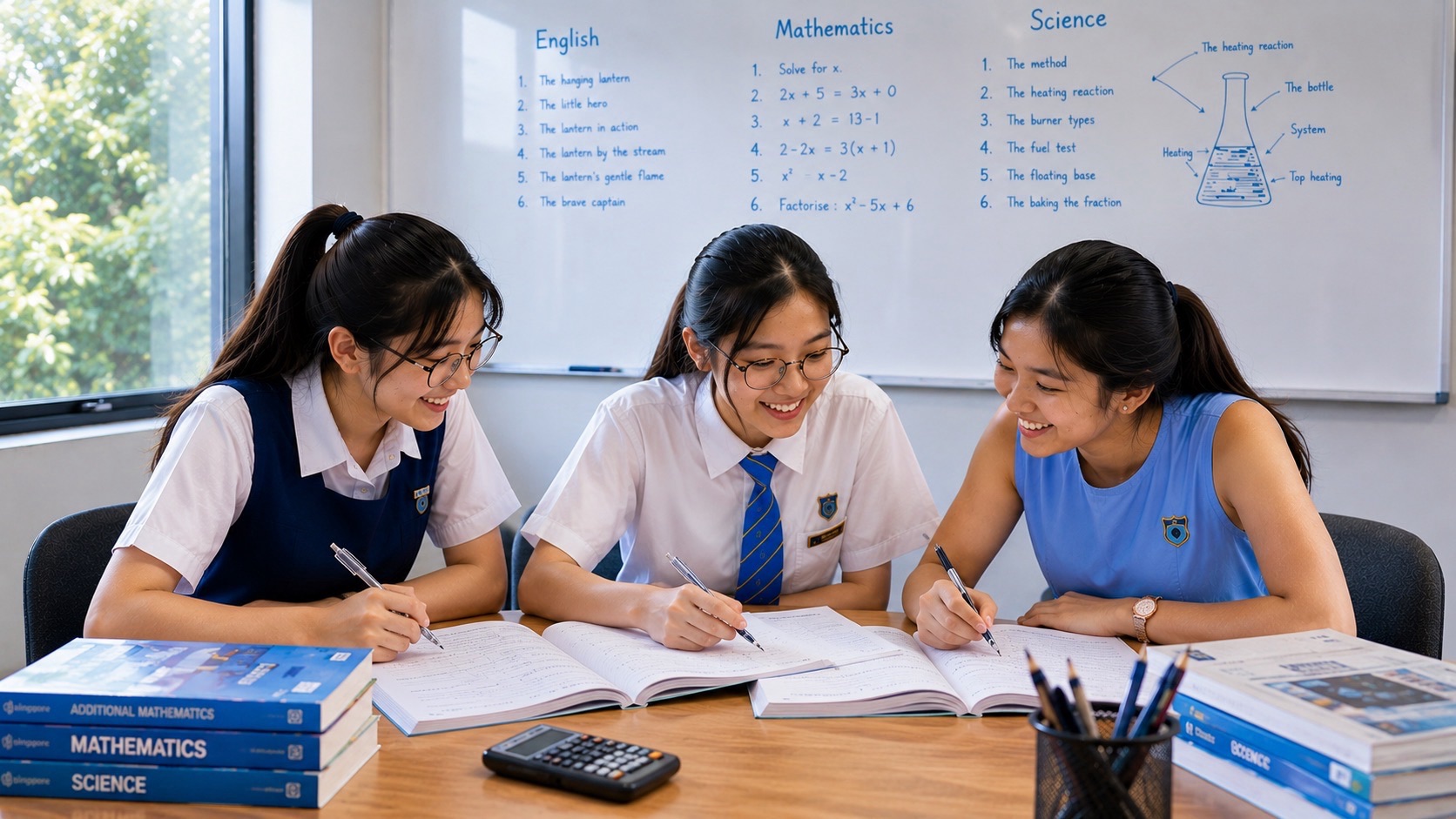
eduKate Yishun · Reading, Vocabulary and Independent Learning
There is a particular kind of silence that worries parents. It is the silence of a child sitting beside a book without entering it.
The pages are open. The eyes move. Five minutes pass. Then the child asks how many pages are left.
That moment is often described as a reading problem, but “does not like reading” is not yet a diagnosis. A child may dislike the book, not reading. The text may be too difficult. The topic may mean nothing to the child. The vocabulary load may be too high. The child may decode accurately but understand too little to feel rewarded. Reading may have become associated with correction, worksheets and judgement. The child may read happily about football statistics, animals, aircraft, fashion, Minecraft, weather, cooking, mythology or machines, while refusing the novel an adult believes a “good reader” ought to enjoy.
The useful question is therefore not, “How do I make my child read?” It is, “What has to become true for this child to choose reading, understand what is read, return to it voluntarily and gradually become able to read more difficult material?”
This guide rebuilds eduKate’s original 2014 article around that question. The old article had several strong instincts: reading should feel enjoyable rather than punitive; curiosity is a powerful doorway; materials should be matched to the child rather than selected only by adult taste; stories become richer when children explore the world around them; parents can model intellectual curiosity; and libraries, bookshops and digital reading can all be useful routes. Those ideas remain. What changes here is the architecture around them.
The aim is not merely to produce a child who can finish books. The aim is to build a reader who can move from curiosity to knowledge, from knowledge to vocabulary, from vocabulary to comprehension, from comprehension to judgement, and from judgement to independent learning. That is a much larger job than persuading someone to sit still with a novel.
Choose your route through this guide
- My child refuses books. Start with Diagnose the real reading problem, then go to Reduce the friction around reading.
- My child reads only one kind of thing. Go to Use interests as a bridge, not a cage and Build a reading ladder.
- My child can read the words but does not understand much. Start with Teach comprehension as active thinking.
- My child’s vocabulary is weak. Go to Build vocabulary through repeated meaningful encounters.
- My child reads willingly but I want stronger thinking and writing. Start with Turn reading into a knowledge system and Connect reading to writing.
1. The first job is not to increase pages. It is to improve the relationship.
Parents often begin with volume: twenty minutes a day, ten pages before bed, one book a week, one chapter before screen time. Volume can eventually matter, but it is a poor first lever when the relationship with reading is already strained.
Imagine two children. The first reads thirty pages because a timer is running and closes the book the instant permission is given. The second reads twelve pages, stops to ask why a character made a strange decision, looks up a map mentioned in the story, tells a sibling about one scene and returns after dinner to continue. The second child has read less text but has entered reading more deeply. That depth creates the possibility of future volume.
Reading becomes self-sustaining when the child receives something from it: surprise, knowledge, humour, mastery, belonging, suspense, competence, emotional recognition, useful information or access to a world the child wants to enter. If the only reward is adult approval at the end of a required task, reading remains externally powered.
This does not mean children should read only easy or entertaining material. Education requires effort. Some important texts are demanding before they become rewarding. The mistake is to begin by removing every source of intrinsic reward and then wonder why effort collapses.
The first stage is therefore relational. We want the child to discover that text is useful, interesting, funny, powerful, moving or personally meaningful. Once that belief exists, adults can widen the range, increase the difficulty and teach the stamina required for less immediately attractive material.
A child who says “I hate reading” may actually mean “I hate being bad at this”, “I hate books chosen for me”, “I hate being tested after every page”, “I hate not knowing the words”, “I hate how long this takes”, or “I do not see why this matters”. Each sentence requires a different response.
That is why the next step is diagnosis.
2. Diagnose the real reading problem
“Reluctant reader” is a description, not an explanation. Before selecting books, incentives or programmes, observe what actually happens when the child reads.
| What you observe | Possible underlying problem | Useful next step |
|---|---|---|
| Reads aloud slowly and guesses unfamiliar words | Word recognition or decoding may be insecure | Use appropriately levelled text and seek skilled teaching if the difficulty is persistent |
| Reads fluently but cannot explain what happened | Comprehension, vocabulary or background knowledge may be weak | Pause for meaning, vocabulary and connections rather than increasing speed |
| Understands when an adult reads aloud but struggles alone | Text-reading skill may lag behind listening comprehension | Combine read-alouds with accessible independent reading |
| Reads facts about favourite topics for long periods but refuses fiction | Preference, not general reading refusal | Use nonfiction as a bridge while gradually widening forms |
| Reads only very easy books | Confidence protection or avoidance of challenge | Keep a comfort lane but add a supported stretch lane |
| Abandons books after a few pages | Poor match, slow entry, excessive difficulty or weak stamina | Try shorter forms, stronger hooks and deliberate book sampling |
| Becomes angry when corrected | Reading may be associated with failure or public judgement | Reduce constant interruption and separate reading for pleasure from instruction |
| Reads willingly but vocabulary and writing remain narrow | Reading range may be too repetitive | Broaden genres, topics, authors and linguistic difficulty |
One observation is not enough. Look for patterns across several days and several text types. A child who struggles with a dense information text after a long school day may not have a general reading problem. A child who repeatedly misreads common words, avoids reading aloud, loses the line, or shows persistent difficulty despite appropriate instruction deserves more careful attention than a motivational slogan.
The most useful diagnostic question is: Where does meaning stop?
Does meaning stop because the words cannot be read? Because too many words are unknown? Because the sentences are syntactically dense? Because the child lacks the background knowledge needed to interpret the ideas? Because attention collapses? Because the child can follow literal events but not infer motives and causes? Because the text is simply a poor fit?
Once you can locate the point at which meaning breaks, intervention becomes more precise.
3. Reduce the friction around reading
Children often read less because reading has too many small barriers. The book is in another room. The library books have already been returned. The only available titles were chosen months ago. The reading light is poor. The child is expected to begin immediately after exhausting homework. Every reading session ends with a quiz. The adult interrupts each mispronunciation. The child must ask permission to stop a book that is clearly not working.
None of these barriers is dramatic. Together they can make reading feel like a task that requires preparation before reward appears.
A low-friction reading environment has three qualities: books are visible, choice is easy and starting requires little negotiation.
- Keep several current books within reach where the child actually spends time.
- Rotate rather than display an overwhelming number.
- Include different forms: stories, nonfiction, comics, magazines, biographies, reference books, poetry, illustrated books and short articles.
- Allow sampling. Reading three pages and deciding a book is not right can be a legitimate act of judgement.
- Create recurring moments when reading can happen naturally rather than only as punishment for unfinished work.
- Keep at least one “easy return” text available for tired days.
One useful family rule is this: we do not force completion of every book, but we do require an honest attempt and a reason for abandoning it.
This teaches discernment. “Boring” can be unpacked. Was the plot too slow? Were the characters uninteresting? Was the language confusing? Did the topic feel irrelevant? Was the book too easy to create tension? The child learns to notice what makes reading work.
Reducing friction does not mean eliminating discipline. It means reserving discipline for the reading itself rather than wasting it on preventable obstacles around the reading.
4. Curiosity is the oldest reading technology
The original eduKate article emphasised curiosity, and that idea deserves to remain central. Children are often willing to read difficult material when they urgently want the information inside it.
A child who refuses a graded reader may spend twenty minutes decoding the statistics on a football card. Another may read an article about black holes containing vocabulary far above the level of the assigned story. A child fascinated by sharks will tolerate scientific terms that would feel impossible in an unrelated worksheet.
Curiosity changes the cost-benefit calculation. The words are still difficult, but the answer matters enough to keep going.
Parents and teachers can deliberately create curiosity without turning every conversation into a lesson. Start with a remarkable fact, a contradiction, a mystery or an unfinished story.
- Why are there months named after people?
- How can an animal survive without drinking fresh water?
- Why do some bridges move?
- How did a tiny island become a major port?
- Why do witnesses remember the same event differently?
- How can two words have almost the same meaning but feel completely different in a sentence?
Then stop before explaining everything. Give the child a route to discover more.
The point is not manipulation. The point is to remind the learner that text contains answers to real questions. Once reading is connected to inquiry, it becomes less like a school ritual and more like a tool for navigating the world.
Curiosity also creates memory hooks. Information has somewhere to attach because the child already holds a question. This is one reason a seemingly random fact told at the dinner table can lead to a surprisingly deep reading trail.
5. Use interests as a bridge, not a cage
Adults sometimes worry when a child reads only about one topic. The concern is reasonable if the range never expands, but the first response should not be to remove the interest. Use it.
Suppose a child loves trains. That interest can lead to:
- an illustrated book about train design;
- a history of railways;
- a biography of an engineer;
- a map-reading activity;
- a novel involving a journey;
- an article about urban planning;
- a physics explanation of braking;
- a news feature about high-speed rail;
- a persuasive text about public transport;
- a piece of descriptive writing set in a station.
The topic remains familiar while the genre, vocabulary, conceptual demand and text structure change. This is how interest becomes a bridge to breadth.
The same technique works with football, dinosaurs, dance, Roblox, manga, cooking, fashion, insects, military history, space, animals, cars or music. The adult’s job is to widen the radius gradually.
A useful principle is one step sideways before one step upward. If the child reads only one series, first offer a different series with similar appeal. Then add nonfiction on the same topic. Then a more linguistically demanding text. Then a related but broader topic. Sudden jumps in both interest and difficulty create unnecessary resistance.
Interests become a cage only when adults stop building doors out of them.
6. Build a reading ladder
A reading ladder is a planned sequence from what the child already reads willingly to material that is slightly more demanding. It solves a common family argument. The parent wants “better books”. The child wants familiar books. The ladder respects both.
Think in four lanes:
| Lane | Purpose | What belongs here |
|---|---|---|
| Comfort | Maintain pleasure, fluency and reading identity | Easy favourites, familiar series, rereads |
| Current | Independent growth | Books the child can read with manageable difficulty |
| Stretch | Increase language, ideas and stamina | More demanding texts with occasional support |
| Shared | Access material beyond independent level | Read-alouds, audiobooks with text, parent-child reading, teacher-supported texts |
The error is to fill the entire reading life with stretch books. Difficulty then becomes the defining feature of reading. The opposite error is to keep everything in the comfort lane. Fluency grows, but vocabulary, syntax, knowledge and stamina may plateau.
A healthy reading diet includes all four lanes. On a tired weekday, a comfort reread may be perfect. On Sunday morning, a stretch text may be manageable. During a shared evening read, an adult can open language and ideas that would be inaccessible alone.
The ladder is dynamic. What is stretch today may become current next month. What is current may become comfort. That visible movement is motivating because the child experiences growth as expanded choice rather than merely harder assignments.
7. Read aloud long after the child can read alone
Families often stop reading aloud once a child becomes an independent reader. That removes a valuable bridge too early.
Listening allows children to enter texts that may be beyond their current independent reading level. An adult can carry the decoding load while the child experiences richer vocabulary, longer sentence structures, more complex plots and unfamiliar knowledge.
Read-alouds also create social meaning. A book becomes something the family shares, quotes, predicts and argues about. That changes reading from solitary schoolwork into culture.
Do not stop every paragraph to test comprehension. Pause when the pause itself adds value:
- to clarify a crucial unfamiliar word;
- to predict what might happen next;
- to notice a character’s hidden motive;
- to connect the text with prior knowledge;
- to admire an especially effective sentence;
- to resolve confusion that would otherwise make the rest meaningless.
Sometimes the best response is simply laughter, surprise or silence. Not every good reading moment needs to become instructional commentary.
Older children may prefer shared audiobooks, dramatic readings, speeches, essays, long-form journalism or nonfiction chapters. The principle is the same: listening can widen access while independent reading continues to grow.
8. Fluency is not the same as speed
Parents sometimes push children to read faster because slow reading looks weak. Speed matters when reading is painfully laborious, but raw speed is not the goal. Skilled readers adjust pace.
A joke may be read quickly. A difficult Science explanation may require rereading. A mystery clue may send the reader backwards. A poem may deserve slow attention. A timetable or chart requires scanning rather than ordinary prose reading.
Fluency means that word recognition and phrasing are sufficiently secure that mental energy can be used for meaning. A fluent reader can usually read connected text smoothly, group words into meaningful phrases and notice when meaning breaks down.
If a child reads aloud word by word, misreads many common words or uses so much effort on decoding that comprehension disappears, simply asking for more silent reading may not solve the problem. The child may need explicit, skilled instruction matched to the actual difficulty.
For readers whose basic word reading is secure, fluency can be supported through rereading short passages, reading dialogue with expression, shared reading and exposure to lots of manageable text. The emphasis should remain on meaningful phrasing, not racing a stopwatch.
9. Build vocabulary through repeated meaningful encounters
Vocabulary growth is one of the great long-term rewards of reading, but it does not happen automatically from exposure alone. A child can pass over an unfamiliar word many times without learning it precisely.
Useful vocabulary learning has three layers:
- Notice the word. The learner recognises that the word carries meaning worth understanding.
- Build a usable meaning. The learner can explain it in context and distinguish it from nearby words.
- Meet and use it again. The word returns in reading, conversation or writing until access becomes easier.
Suppose the text uses the word reluctant. A weak vocabulary routine copies “reluctant = unwilling” into a notebook and never returns. A stronger routine asks: reluctant to do what? How is reluctant different from refusing? Can someone be reluctant but still agree? What would a reluctant smile look like? Which character in a story acted reluctantly? Can the child use the word naturally tomorrow?
This depth creates semantic connections. The word becomes part of a network rather than an isolated definition.
Do not stop the reading flow for every unknown word. Choose words strategically. Explain immediately when the word is essential to understanding the passage. For useful but nonessential words, mark them and return later. For highly specialised words, a quick gloss may be enough.
A practical family vocabulary routine
- Choose three to five worthwhile words from a week of reading.
- Write a child-friendly meaning, not a dictionary paragraph.
- Keep the original sentence.
- Add one contrasting example.
- Use the word in conversation over the next few days.
- Invite the child to use it in writing only when it fits naturally.
Five words learned deeply can be more useful than fifty copied mechanically.
10. Teach comprehension as active thinking
Comprehension is not what happens after reading when the worksheet appears. Comprehension is the thinking that happens during reading.
A strong reader is continuously building and revising a mental model. Who is present? What changed? What caused it? What does this pronoun refer to? What does the writer assume I already know? Which detail matters? Is the narrator reliable? Why did the author choose this example? What is the relationship between this paragraph and the previous one?
Children often need these invisible processes made visible.
One of the simplest parent techniques is the occasional think-aloud. Read a short section and say:
I thought he was angry, but this sentence makes me change my mind. He may actually be embarrassed because he avoids looking at them.
The child hears inference as a process rather than a magic answer.
Good comprehension conversations use evidence. Instead of asking only “What do you think?”, ask “What in the text made you think that?” This keeps interpretation anchored.
Five useful comprehension moves
- Clarify: notice when meaning breaks and repair it.
- Connect: link new information with what is already known.
- Infer: combine textual evidence with knowledge to reach what is implied.
- Summarise: preserve the important structure while discarding detail.
- Evaluate: judge claims, choices, reliability, evidence and effect.
These moves matter far beyond English. Science, Mathematics word problems, Humanities and general learning all depend on the ability to construct meaning accurately from text.
11. Background knowledge changes what a child can understand
Two children can read the same words and understand different amounts because they bring different knowledge to the page.
Imagine a passage about a parliamentary debate, coral bleaching, a lunar eclipse or a hawker centre during lunch hour. Vocabulary matters, but so does knowing how those worlds work. Prior knowledge helps readers fill gaps, interpret references, predict likely events and understand why details matter.
This is why wide reading compounds. Reading about volcanoes makes later Earth Science easier. Reading history makes political speeches easier to interpret. Reading biographies gives human examples for abstract ideas like ambition, loyalty, compromise and failure. Reading fiction exposes social situations and motives. Reading Science builds conceptual frameworks that support future Science texts.
A child who “needs better comprehension” may partly need more knowledge.
Families can help by building knowledge around reading rather than treating the book as an isolated object. Look at maps. Watch a short documentary after reading. Visit a museum. Cook the food mentioned. Find photographs of the setting. Compare two accounts of the same event. Ask where the information came from.
This is not distraction from reading. It is the construction of the mental world that makes future reading easier.
12. Turn reading into a knowledge system
The old article said “the story does not stop there”. That remains one of the most useful ideas in the original piece.
A strong reading culture allows one text to open several doors. A novel set during a historical period can lead to a map, a biography, a photograph archive, a speech, a museum page and a second novel from a different perspective. A Science article about electricity can lead to the history of the light bulb, household safety, power grids, batteries and renewable energy. A newspaper feature on urban heat can lead to trees, materials, city design and climate.
The key is not to turn every book into a research project. Follow only the branches that genuinely interest the child.
This creates what we can call a knowledge loop:
Read → become curious → investigate → gain knowledge → understand more difficult reading → become curious again.
Once this loop begins, reading becomes cumulative. New knowledge makes later text easier, and easier comprehension makes further reading more rewarding.
This is also how reading supports independence. A learner who knows how to follow a question across several sources no longer waits for an adult to deliver every explanation.
13. Fiction teaches more than story structure
Fiction is sometimes defended only because it helps composition. That is too narrow.
Good fiction asks readers to track goals, motives, causes, consequences, perspective, hidden information, irony, change and conflict. A child must remember what happened earlier, infer what characters know, recognise when words do not match intentions and update predictions as new evidence appears.
These are demanding cognitive acts.
Fiction also develops sensitivity to language. The same event can be described as a child “walked”, “stalked”, “crept”, “stumbled” or “charged” across a room. Those verbs do not merely decorate the sentence. They encode manner, energy, attitude and sometimes judgement.
When children read enough varied prose, they begin to develop expectations about how sentences sound, how dialogue is punctuated, how scenes are paced and how writers control what the reader knows.
Do not reduce fiction reading to “find five good phrases to copy”. That teaches imitation without understanding. Instead ask what the writer is doing and why it works.
- Why did this scene begin here rather than earlier?
- Why did the author withhold that fact?
- What does the dialogue reveal that the narration does not say directly?
- Which detail makes the setting feel tense?
- How did the ending change the meaning of an earlier event?
These questions help a reader become a writer without turning reading into extraction.
14. Nonfiction is not second-class reading
Some children who resist novels will read pages of factual material. Treat that as a strength.
Nonfiction exposes children to different text structures: cause and effect, comparison, chronology, problem and solution, classification, explanation, argument and evidence. These structures are central to school learning.
Nonfiction also expands technical vocabulary and background knowledge. A child reading about weather encounters pressure, humidity, evaporation, condensation and forecast. A child reading about ancient cities learns trade, empire, agriculture, defence and governance. Those words and concepts later reappear across subjects.
Teach children to read nonfiction actively. Headings, captions, diagrams, tables, maps and sidebars are not decorations. They are part of the meaning system.
Ask:
- What question is this section answering?
- Which diagram makes the explanation clearer?
- What is the difference between an example and evidence?
- Which claim is supported, and by what?
- What would you still want to verify elsewhere?
This kind of reading is essential in a century where children encounter more information than they can possibly accept uncritically.
15. Comics, graphic novels and illustrated texts can be serious bridges
Adults sometimes dismiss comics or graphic novels because they contain fewer words. That can be a mistake.
Visual narratives require readers to integrate image, sequence, dialogue, gesture, layout and unstated transitions. Meaning often exists between panels rather than in a sentence. For some children, the visual support reduces decoding load enough to make sustained reading possible. That success can strengthen reading identity.
The useful question is not whether the format counts as “real reading”. The useful question is what the child is learning to do with meaning.
A graphic novel can sit in the comfort or current lane while prose books occupy the stretch lane. Illustrated nonfiction can introduce a difficult topic before denser text. Comics can lead to mythology, history, science, journalism or biography.
Do not make the child “graduate” from visual texts as if pictures were childish. Adults read charts, maps, interfaces, diagrams, infographics and visual journalism constantly. Multimodal literacy is part of modern literacy.
The goal is breadth: children should become comfortable with many forms, including sustained prose. Graphic texts can help build the road rather than block it.
16. Digital reading: use the medium deliberately
The original article treated digital reading as an emerging opportunity. Today it is simply part of ordinary literacy. Children read on phones, tablets, laptops, e-readers, learning platforms and websites. The question is no longer whether digital text counts. The question is whether the environment supports the kind of reading required.
Digital reading has advantages. Search is fast. Definitions are accessible. Text can be enlarged. Audiobooks and text can be paired. Children can reach specialised information quickly. Libraries can extend beyond the building.
It also introduces friction of another kind: notifications, hyperlinks, advertising, endless feeds and the temptation to switch tasks.
Use digital reading deliberately.
- For sustained reading, reduce notifications and unrelated tabs.
- For research, teach children to open links with a purpose rather than wander indefinitely.
- For difficult vocabulary, use built-in definitions as support but still discuss important words.
- For long texts, teach annotation and note-making so information does not disappear after scrolling.
- For source evaluation, ask who produced the page, why and what evidence is offered.
Technology can either lower access barriers or fragment attention. The device does not decide which outcome occurs; the reading routine does.
17. Libraries and bookshops are discovery systems
Libraries and bookshops do more than store books. They make accidental discovery possible.
Online search is efficient when you know what you want. Physical browsing is powerful when you do not. A child looking for one dinosaur book may notice a shelf on fossils, then volcanoes, then early humans. A display can place an unexpected title in the child’s path.
Make browsing a skill.
- Read covers and blurbs.
- Open to a random page and sample the language.
- Check the table of contents.
- Compare two books on the same topic.
- Notice whether the book looks too easy, too difficult or just challenging enough.
- Choose one safe title and one experiment.
Do not demand that every borrowed book be finished. Borrowing is part of selection practice. Children need enough freedom to discover their own criteria.
Parents can browse too. A child who sees an adult genuinely choosing, rejecting, comparing and reading books receives a different message from a child whose parent only supervises the child’s reading.
18. Be the model, but do not perform virtue
The original article called this “be the pillar of knowledge”. The underlying point is that children notice what adults value.
Modelling reading does not require parents to sit theatrically with a classic novel every evening. Authenticity matters more than performance.
Let children see adults use text for real purposes:
- read a long article and discuss an idea from it;
- check a recipe and adapt it;
- compare product information before buying;
- look up the history of a place before visiting;
- read instructions carefully instead of guessing;
- follow an argument and disagree with evidence;
- learn about a hobby through books or articles.
This shows the child that literacy is not a school subject confined to marks. It is how competent adults solve problems, make decisions and expand their worlds.
Parents also model intellectual humility when they say, “I do not know. Let us find out.” That sentence is powerful because it turns ignorance into inquiry rather than embarrassment.
The goal is not to become the parent who knows everything. It is to become the adult who knows what to do when knowledge is missing.
19. Conversation is part of reading
Children become better readers partly by talking about what they read. Conversation lets them rehearse ideas, test interpretations, hear more precise language and notice perspectives they missed.
The quality of the conversation matters. Interrogation makes reading feel like a test. Genuine conversation makes the text worth sharing.
Instead of a fixed set of comprehension questions, try prompts such as:
- What surprised you?
- Which part did you not believe at first?
- Who made the worst decision?
- What changed your mind?
- Which detail mattered more than it seemed?
- What would you ask the writer?
- What is still unclear?
- What does this remind you of?
The adult should answer too. A discussion is not a quiz if both people are thinking.
For nonfiction, ask where the information comes from. For fiction, ask about motive and consequence. For persuasive writing, ask what the writer wants the reader to believe. For news, ask what is known, what is claimed and what remains uncertain.
These habits build critical reading without requiring a worksheet.
20. Do not turn every book into school
Parents who care deeply about education can accidentally destroy the private pleasure of reading by attaching a task to everything.
Finish a book, write a summary. Learn five words. Answer ten questions. Copy three good phrases. Write a reflection. Identify the moral. Explain the main character. Eventually the child learns that reading is the first half of a worksheet.
Instruction is necessary. Children need explicit teaching in vocabulary, comprehension and writing. But not every reading experience needs to carry every instructional burden.
Keep separate lanes:
- Pleasure reading: no required output.
- Shared reading: conversation and occasional explanation.
- Instructional reading: explicit teaching of a particular skill.
- Assessment reading: independent performance under defined conditions.
When a child knows which lane is active, resistance often falls. The child can enjoy some books without waiting for the inevitable worksheet.
21. What to do with a child who says every book is boring
“Boring” can mean many things. Treat it as a clue.
Ask the child to compare three sampled books and rank them. The child must give a reason for the ranking. This turns rejection into discernment.
You may discover that the child wants:
- faster plots;
- shorter chapters;
- more humour;
- more facts;
- older protagonists;
- less description;
- stronger visual support;
- real events rather than invented ones;
- mystery rather than fantasy;
- books connected to an existing obsession.
Use this information to choose the next book. Do not immediately argue that the child’s preferences are unsophisticated. Taste develops through experience.
At the same time, do not allow “boring” to become a veto over all challenge. Some texts take time to open. Teach the difference between not for me, too difficult right now, slow but promising and I am avoiding effort.
That vocabulary helps the child make better choices and accept reasonable challenge.
22. What to do with the strong reader who never stretches
Not all reading problems look like refusal. Some children read constantly but remain inside one narrow linguistic band.
They may reread the same type of series, consume plot quickly and avoid anything with unfamiliar structure, older vocabulary, denser ideas or nonfiction argument. Because the child reads a lot, adults assume development will continue automatically.
Use breadth rather than prohibition.
- Keep favourite series.
- Add one book from a different genre each month.
- Add narrative nonfiction.
- Add biography.
- Add essays or long-form articles.
- Add older literature with support.
- Add books from different cultures and historical periods.
- Add texts where ideas matter more than plot speed.
The child should feel expansion, not confiscation.
Strong readers also benefit from deeper conversation. Ask them to compare authors, notice structure, test claims and explain why a book succeeds. Quantity has already been achieved; now increase range and quality of attention.
23. What to do when English is not the child’s strongest language
Children who use more than one language may have uneven profiles. A child can understand sophisticated ideas in one language while lacking the English vocabulary to express them. Another may speak conversational English comfortably but struggle with the academic language of textbooks.
Do not mistake limited English vocabulary for limited intelligence.
Use knowledge the child already possesses. If the child understands a concept in another language, connect the English words to that concept rather than teaching as if nothing is known.
Support can include:
- pre-teaching a few essential words before reading;
- using illustrations and diagrams;
- discussing the topic orally before reading;
- reading a simpler text on the topic first;
- pairing audio with print;
- allowing brief clarification in the stronger language when necessary;
- returning to the English text once meaning is secure.
The goal is not permanent dependence on support. The goal is to keep meaning available while English knowledge grows.
Wide reading is especially valuable because vocabulary and syntax accumulate across many encounters. But the child still needs text that is comprehensible enough for those encounters to be meaningful.
24. Reading and writing should talk to each other
Reading supplies writers with language, structures, possibilities and knowledge. Writing makes readers notice how texts are built. The relationship should be reciprocal.
Do not reduce this relationship to copying “good phrases”. Instead, teach craft.
- How did the writer open the scene?
- Where was information withheld?
- How did sentence length change during tension?
- How did the writer move between general claim and example?
- How were facts grouped?
- How was a quotation introduced?
- What made the ending feel complete?
Then invite the child to try the technique in a new context.
For example, after reading a scene where tension grows through small sensory details, the child can write a different scene using the same principle rather than the same phrases. After reading a clear nonfiction explanation, the child can explain another process using a similar structure.
This produces transfer. The child learns what writers do, not merely what one writer wrote.
25. Build a writer’s notebook from reading
A writer’s notebook can capture useful discoveries without turning every book into homework.
Keep categories such as:
- interesting words;
- strong verbs;
- surprising facts;
- character decisions;
- openings that work;
- ways writers create tension;
- ways nonfiction explains difficult ideas;
- questions worth researching;
- sentences worth studying for rhythm or clarity.
The notebook is not a phrase bank to raid mechanically. It is a record of noticing.
Over time the child begins to see language as designed. A sentence could have been written differently. A paragraph has an order. A writer chooses what to name and what to imply. That awareness improves both reading and composition.
26. Reading for school examinations without killing reading
School examinations create a legitimate need for targeted reading practice. Students must interpret questions, understand passages, retrieve evidence, infer, summarise, distinguish meanings and respond precisely. The answer is not to pretend examinations do not matter. The answer is to keep examination training in its proper lane.
Use authentic reading to build the wider system: vocabulary, knowledge, stamina, sentence sense and curiosity. Use targeted practice to teach examination-specific skills.
For example, a child may read widely for pleasure during the week and complete one focused comprehension exercise where the family or tutor analyses:
- what the question is actually asking;
- where the evidence lies;
- what inference is required;
- how much information the answer needs;
- whether the response answers the exact command.
This preserves the difference between reading as a human activity and comprehension as an assessed performance.
The child needs both.
27. A twelve-week reading reset
When reading has become a source of conflict, a structured reset can help. The following twelve-week model is deliberately gradual. It is not a medical or diagnostic programme. It is a family reading framework.
Weeks 1–2: observe and repair the relationship
- Stop arguing about book prestige.
- Observe what the child reads voluntarily.
- Sample several formats and topics.
- Begin one shared read-aloud.
- Remove unnecessary quizzes from pleasure reading.
- Identify whether difficulty is motivational, linguistic, comprehension-based or related to word reading.
The goal is to learn what kind of reader is actually in front of you.
Weeks 3–4: build access and routine
- Create a small visible rotation of books.
- Establish one dependable reading moment.
- Use the comfort/current/stretch/shared lanes.
- Visit a library or bookshop for discovery.
- Allow legitimate abandonment with a reason.
The goal is low-friction starting.
Weeks 5–6: deepen conversation
- Have short genuine conversations about books.
- Use evidence-based questions.
- Notice one or two worthwhile words a week.
- Follow one curiosity trail beyond the book.
The goal is richer meaning, not more interrogation.
Weeks 7–8: widen the radius
- Add one related genre.
- Add one new topic connected to an existing interest.
- Add one nonfiction text if fiction dominates, or one narrative if nonfiction dominates.
- Keep the favourite lane intact.
The goal is breadth without rupture.
Weeks 9–10: increase challenge
- Introduce a more demanding shared text.
- Teach the child to notice when meaning breaks.
- Use vocabulary support strategically.
- Ask for short summaries of important sections.
The goal is productive difficulty.
Weeks 11–12: hand over more control
- Let the child choose the next reading target.
- Ask the child to explain why the choice fits.
- Invite the child to recommend a book to someone else.
- Review how reading preferences and stamina have changed.
The goal is ownership.
28. A weekly family reading rhythm
Families often ask for a schedule. A schedule should support reading, not consume it. One simple rhythm is:
| Day | Reading job |
|---|---|
| Monday | Independent comfort/current reading |
| Tuesday | Shared reading or read-aloud |
| Wednesday | Independent reading plus one vocabulary discussion |
| Thursday | Nonfiction or article connected to an interest |
| Friday | Free choice; no output required |
| Weekend | Longer reading, library/bookshop browsing or a curiosity trail |
This is only a model. Some children prefer long weekend sessions. Others do better with short daily reading. The system should fit the family’s real week.
What matters is the mix: pleasure, challenge, conversation, knowledge and choice.
29. How to know whether the system is working
Do not measure progress only by pages or books completed. Look for behavioural and cognitive changes.
- The child starts reading with less negotiation.
- The child can sustain attention longer.
- The child abandons fewer books for avoidable reasons.
- The child can explain what is confusing.
- The child asks more questions generated by reading.
- The child uses new vocabulary accurately.
- The child connects one text with another.
- The child talks about authors, ideas or evidence rather than only plot.
- The child chooses slightly more demanding books voluntarily.
- School comprehension or writing begins to show richer knowledge and language.
These changes often appear unevenly. A child may become more willing before comprehension improves. Vocabulary may grow before writing uses it. Reading stamina may increase before book difficulty rises.
Look for direction, not instant transformation.
30. A worked case: the Primary 4 child who “hates reading”
Consider a fictional Primary 4 student, Aaron. His parents say he hates reading. He avoids storybooks, rushes through school reading assignments and asks for screen time instead.
Observation reveals something more interesting. Aaron reads football tables, player profiles and match reports without being asked. He watches tactical videos and can explain formations in detail. His reading refusal is selective.
The family stops insisting that he begin with award-winning children’s fiction. They build a ladder:
- football articles;
- a children’s biography of a player;
- a book about the history of the World Cup;
- an illustrated book on stadium design;
- a novel about a school football team;
- an article on sports psychology;
- a short piece on statistics in performance analysis.
Now several things happen. Aaron reads more words because the information matters. He encounters vocabulary such as formation, possession, trajectory, endurance and controversial. The family discusses those words. His father asks him to compare two match reports describing the same game. Aaron notices that the writers emphasise different causes.
After several weeks, the family adds a mystery novel rather than another sports book. Aaron accepts it because reading itself no longer feels like a punishment. The interest was not the destination. It was the bridge.
31. A worked case: the Primary 6 child who reads but cannot answer comprehension questions
Mei reads quickly and finishes novels. Her parents assume comprehension is strong. School papers show otherwise: inference and open-ended comprehension marks are inconsistent.
A closer look shows that Mei often answers from general memory of the passage rather than returning to exact evidence. She gives plausible answers, but not always text-supported ones.
The intervention is not “read more books”. She already reads plenty. Instead, one weekly session trains evidence discipline:
- identify what the question asks;
- locate the exact line or event that supports an answer;
- state what must be inferred;
- separate inference from invention;
- write the answer at the required level of detail.
Her pleasure reading remains untouched. Examination comprehension receives separate targeted instruction.
This distinction matters. Reading quantity did not solve the assessed skill because the weakness was not general reading exposure. It was precision in evidence-based response.
32. A worked case: the child who can read aloud but understands little
Daniel reads a page smoothly enough that adults assume he understands it. When asked to explain the paragraph, he repeats fragments but cannot describe the central idea.
The family slows down. They discover that each paragraph contains several academic words Daniel does not really know. Because his pronunciation is accurate, the vocabulary problem was hidden.
They change the routine. Before a difficult nonfiction passage, they preview three essential words. After each section, Daniel says the important idea in his own words. When meaning breaks, they identify whether the problem is vocabulary, sentence structure or missing background knowledge.
They also add easier books on the same topics. This gives Daniel more repeated encounters with the concepts and vocabulary.
Reading becomes slower for a while, but comprehension becomes deeper. Later, speed returns because more words and ideas have become familiar.
The lesson is important: smooth oral reading can conceal shallow meaning. Always check whether the child can build a coherent mental model of what was read.
33. A worked case: the child who reads only easy series
Sara reads every night, but almost everything comes from one familiar series. Her fluency is excellent and reading is part of her identity. Her parents worry that vocabulary and ideas are no longer expanding.
They do not ban the series. Instead they create a 3:1 pattern: for every three comfort books, Sara chooses one book from a “discovery shelf”. The shelf contains mystery, biography, historical fiction, narrative nonfiction and a graphic memoir.
Sara rejects some. That is acceptable. She finishes others and begins to identify new preferences. Her comfort series remains available, so challenge does not feel like punishment.
Within a few months, the discovery shelf is no longer an adult project. Sara begins requesting titles herself.
This is the reading ladder at work: security makes expansion possible.
34. Reading difficulty deserves precision and, sometimes, specialist help
Motivation strategies should not be used to explain away persistent reading difficulty.
If a child repeatedly struggles to recognise words, reads with unusual effort, avoids print because it is genuinely difficult, or makes little progress despite appropriate teaching and practice, the family should discuss the pattern with the child’s school and qualified professionals who can assess the relevant skills.
Similarly, if reading triggers extreme distress, if attention difficulties affect many areas of daily life, or if vision, hearing, language development or other concerns are present, a blog article cannot diagnose the cause.
The reason for saying this is not to medicalise ordinary reluctance. It is the opposite: precision protects children from being labelled lazy when the task is harder for them than adults realise.
Good teaching begins by locating the obstacle accurately.
35. Reading rewards should not replace reading rewards
Sticker charts, points, prizes and screen-time exchanges can sometimes help establish a routine, especially when a child needs a temporary external structure. But they should be used carefully.
The danger is that the reward communicates that reading itself is the unpleasant price paid for something better.
If external rewards are used, connect them to process rather than quantity alone. Reward honest effort, thoughtful book selection, returning to a difficult text, asking a good question or keeping a reading routine for a week.
Then gradually fade the reward as intrinsic reasons strengthen.
The strongest long-term reward is access: the child can now enter a series, topic, argument, joke, community or body of knowledge that was previously closed.
That sense of competence is powerful because it belongs to the child.
36. Reading identity matters
Children build stories about themselves: “I am a Maths person”, “I am bad at spelling”, “I am not creative”, “I do not like books”. These identities influence what they attempt.
Be careful with labels, even positive ones. Calling one sibling “the reader” can quietly make another sibling “the non-reader”.
Instead, describe behaviour and growth:
- You stayed with that chapter even when the opening was slow.
- You noticed that the article contradicted the first source.
- You chose a harder book because you wanted to know more.
- You used that new word accurately.
- You went back because the paragraph did not make sense the first time.
These statements teach the child what skilled readers do.
Eventually the child may say, “I am a reader,” but the identity will be built on accumulated experiences rather than adult declaration.
37. The book is not the final product. The mind is.
Families sometimes become fixated on finishing. Did you finish the book? How many books this month? How many pages today?
Completion is useful information, but the real product of reading is change in the reader.
After sustained reading, does the child know more? Notice more? Ask better questions? Understand more words? Follow longer arguments? Recognise motives? Compare sources? Write with greater control? Choose books more intelligently? Persist through difficulty? Detect confusion earlier?
A short, difficult book that changes how a child thinks may matter more than five rapidly consumed titles. A reread can reveal new structure. An abandoned book can teach taste. An article can trigger a month of inquiry.
The page count is not the education. It is one trace of the education.
38. A parent’s decision tree
When reading stalls, use this sequence instead of repeating “go and read”.
- Can the child read the words with reasonable accuracy? If not, prioritise skilled support for word reading.
- Does the child understand the vocabulary and ideas? If not, reduce difficulty, build knowledge and teach key words.
- Is the text a reasonable match for interest and maturity? If not, change the selection.
- Is reading associated mainly with correction or assessment? If yes, restore a pleasure-reading lane.
- Can the child sustain attention for this length? If not, shorten and build gradually.
- Does the child have genuine choice? If not, offer bounded choice.
- Is there a next bridge from current interests? If not, build one.
- Is a persistent difficulty appearing across contexts? If yes, discuss it with school and appropriate professionals.
This decision tree prevents motivation from becoming the default explanation for every problem.
39. Frequently asked questions
How long should my child read every day?
There is no single useful number for every age, reader and school week. A short session with genuine attention can be more valuable than a long session spent negotiating, guessing and watching the clock. Build consistency first, then increase duration as stamina and interest grow. For independent readers, regular reading across the week matters more than hitting an arbitrary daily number at all costs.
Should I make my child finish every book?
No. Adults abandon books too. Require an honest sample and a reason, especially if abandonment becomes habitual. Finishing difficult but worthwhile books is an important skill, but forcing every poor match teaches children that selection does not matter.
Are audiobooks cheating?
No. Audiobooks provide access to language, ideas and stories through listening. They do not replace every form of print reading because children still need to develop independent text reading. Used together, audio and print can widen access and support shared reading.
Should I correct every mispronounced word?
Correct strategically. If the error changes meaning, reflects a recurring pattern or blocks comprehension, help. Constant interruption can destroy fluency and confidence. During instructional reading, more correction may be appropriate than during pleasure reading.
What if my child reads only comics?
Use comics as a secure reading lane and build outward. Add graphic nonfiction, prose books connected to the same themes, novels with strong illustrations and shared read-alouds. The goal is not to eliminate comics but to broaden the range of forms the child can handle.
What if my child reads only nonfiction?
Nonfiction is valuable reading. Use narrative nonfiction, biography and true stories as bridges toward fiction if broader literary reading is a goal. Do not treat factual curiosity as a defect.
Should I test vocabulary from every book?
No. Select a few useful words for deeper attention. Too much interruption makes reading fragmented. The best vocabulary targets are important to the text, broadly useful or especially rich in meaning.
How do I know whether a book is too hard?
Look at the total experience. If unfamiliar words, complex sentences and missing background knowledge combine so heavily that the child cannot maintain meaning, the book is probably too difficult for independent reading right now. It may still work as a shared or read-aloud text.
Can screen reading build literacy?
Yes. Digital text is still text, but the environment can encourage distraction. Use digital reading intentionally and teach children how to manage links, notifications, sources and annotation.
My child reads a lot but writing is still weak. Why?
Reading exposure helps, but writing also requires explicit practice in planning, sentence construction, organisation, revision and audience awareness. Connect reading to craft deliberately instead of assuming transfer will happen automatically.
40. A thirty-day starter plan
If the entire guide feels too large, begin with thirty days.
Days 1–5: observe
- Notice what the child reads without prompting.
- Sample five different kinds of text.
- Listen to the child read briefly.
- Ask what makes a book enjoyable or difficult.
- Do not change everything yet.
Days 6–10: create access
- Build a small reading basket or digital shelf.
- Include comfort, current and stretch choices.
- Start one shared read-aloud.
- Choose one regular reading window.
Days 11–15: create conversation
- Have three short discussions about what was read.
- Ask for evidence once or twice.
- Follow one curiosity question outside the book.
- Select two useful vocabulary words.
Days 16–20: widen
- Add one related topic.
- Add one new genre.
- Visit a library or browse a bookshop.
- Let the child make one independent selection.
Days 21–25: deepen
- Use one think-aloud.
- Ask the child to summarise one important section.
- Notice one example of writer’s craft.
- Return to the earlier vocabulary.
Days 26–30: hand over control
- Ask the child to choose the next book.
- Ask why it was chosen.
- Ask what kind of reader the child thinks he or she is becoming.
- Decide together what to try next month.
The thirty-day plan is successful if reading becomes clearer, less adversarial and more self-directed—not if a predetermined number of books is completed.
41. What reading looks like when it is working
Healthy reading does not look the same in every child. One reader devours fantasy. Another moves slowly through biographies. One rereads. One collects facts. One loves being read to. One reads in intense bursts and then pauses for several days.
What matters is the direction of development.
Reading is working when the child can increasingly:
- choose appropriate texts;
- persist through manageable difficulty;
- notice confusion;
- repair comprehension;
- learn words from context and instruction;
- connect ideas across texts;
- distinguish claim from evidence;
- ask questions that lead to more reading;
- use knowledge from reading in conversation and writing;
- read for purposes beyond school compliance.
That is a far stronger target than “reads thirty minutes a day”.
42. The reader we are trying to build
At the beginning of this guide, the child sat beside an open book and asked how many pages were left.
The transformation we want is not cinematic. There may be no morning when the child suddenly loves every book. Real change is quieter.
The child begins to know what kinds of books work. The child can say why a passage is confusing. An unfamiliar word becomes a question rather than a wall. A book leads to a map. A map leads to a historical question. The child asks for the next title in a series. Then, later, chooses something completely different. The child notices when an online article offers a claim without evidence. A new word appears naturally in conversation. A composition contains a more precise verb because years of reading have made precision feel normal.
Reading has moved from obedience to capability.
That capability matters because childhood ends. No parent or tutor can pre-teach every concept a young person will eventually need. The long-term educational task is to build a learner who can enter unfamiliar territory and find a way through it.
Reading is one of the most powerful tools for doing that.
The reading rule
Do not measure a reading life only by how many pages a child finishes. Measure whether text is becoming a tool the child can use to understand more of the world without waiting for someone else to explain it first.
Start with curiosity. Match the material. Protect pleasure. Teach the difficult skills explicitly. Build vocabulary and knowledge. Let one text open into another. Give the child increasing ownership.
That is how reading becomes independent learning.
Edition note: This guide preserves the useful principles in the original 2014 eduKate article—enjoyment, curiosity, individual matching, knowledge around the story, adult modelling and varied access to books—while replacing dated framing with a modern reader-development system.
43. The mechanics of book matching: interest, difficulty, form and purpose
When adults say a book is “at the right level”, they often mean only that the words look appropriate for the child’s age. Real book matching is more complicated. A book can be easy in vocabulary but difficult in structure. It can be linguistically simple but emotionally mature. It can be factually dense but highly motivating because the topic matters. A child can manage a difficult book on a familiar subject while struggling with an easier book that assumes unknown background knowledge.
A useful match therefore considers four variables at once: interest, difficulty, form and purpose.
Interest asks whether the child has a reason to care. Interest does not have to be pre-existing. A strong opening, surprising image or adult introduction can create it. But if there is no interest at all, the text needs to offer some other reward: humour, suspense, usefulness, social relevance or intellectual challenge.
Difficulty includes word recognition, vocabulary, sentence structure, density of ideas, length and the amount of unstated information the reader must infer. A child can cope with one or two sources of difficulty at once. Problems arise when all of them are high.
Form matters because readers develop experience with conventions. A child familiar with comics knows how panels, speech bubbles and visual sequence work. A child familiar with information books knows how headings and diagrams organise meaning. A first encounter with poetry, argument, biography or historical fiction may feel harder simply because the form is unfamiliar.
Purpose changes how much challenge is appropriate. A bedtime comfort read can be easy. A school learning text may require support. A curiosity-driven research article may be worth struggling through. A shared family novel can sit well above independent level because an adult carries part of the load.
Use a simple matching conversation before committing to a long book:
- What makes you want to open this?
- Read one page. How many places made you stop?
- Can you explain what happened or what the paragraph taught?
- Does the format feel familiar?
- Do you want to keep going?
- If it is difficult, is it difficult in an interesting way?
The last question is important. Productive difficulty feels like effort toward something worth reaching. Unproductive difficulty feels like pushing through fog with no sense of progress.
Parents do not need to calculate a perfect reading level before every choice. They need enough information to avoid repeated mismatches. Over time children can learn to make these judgements themselves. That independence is part of becoming a reader.
44. The first ten pages: how to enter a book
Some children abandon books because they do not yet know how to enter them. Beginnings often ask readers to tolerate temporary uncertainty. New names appear. A setting is unfamiliar. The central problem has not emerged. The writer may deliberately withhold context.
Experienced readers know that orientation will come. Inexperienced readers may interpret confusion as failure.
Teach a “first ten pages” routine. The number is flexible; the idea is to help the reader establish a foothold.
- Find the basic coordinates. Who seems important? Where are we? What time or situation are we in?
- Notice the first disturbance. What changes, goes wrong or creates a question?
- Keep names provisional. Do not panic if every character relationship is not immediately clear.
- Mark one question. What do you now want to know?
- Read a little further before judging. Some books reveal their promise slowly.
Parents can model this by admitting uncertainty: “I am not sure why she is afraid of that house yet. I think the author wants us to wonder.” This tells the child that not knowing is part of reading, not proof of incompetence.
For nonfiction, the entry routine is different. Preview the title, headings, diagrams and opening paragraph. Ask what question the book or chapter appears to answer. Then read with that question in mind.
The broader lesson is that texts have entry procedures. Teaching those procedures reduces unnecessary abandonment.
45. Teach children what to do when meaning breaks
One of the clearest differences between weak and strong reading is what happens after confusion. Weak readers often continue moving their eyes across the page after meaning has already disappeared. Strong readers notice the break and attempt repair.
This monitoring can be taught explicitly. Give the child a repair menu:
- Reread the sentence more slowly.
- Read the sentence before it again.
- Identify the pronoun or reference that is unclear.
- Look at punctuation and sentence boundaries.
- Work out an unfamiliar word from context, word parts or a dictionary.
- Check a diagram, caption or heading.
- Summarise the paragraph in simpler language.
- Ask what background knowledge might be missing.
- Read on briefly to see whether later information resolves the confusion.
- Ask for help if the problem remains central.
Do not tell a child to use every strategy every time. The skill is selecting the repair that matches the problem.
For example, a child confused by “Although the storm had passed, the harbour remained closed” may need to understand the relationship signalled by although. A child confused by “the vessel” may need to connect the noun with “ship” from the previous paragraph. A child confused by why the harbour remains closed may need knowledge about damage, debris or safety checks.
After repair, ask the child to state what caused the confusion. This develops metacognition: awareness of one’s own reading process.
Eventually the child should not need an adult to say, “You did not understand that.” The child should notice it independently.
46. Sentence architecture: the hidden difficulty in older reading
As children move into upper primary and secondary reading, difficulty often shifts. Individual words may be familiar, but sentences become longer, denser and more layered.
Consider the difference between:
The town flooded. The rain was heavy. The drains were blocked.
and:
Although the rain had eased by dawn, several streets remained flooded because debris carried into the drainage system during the night had restricted the flow of water.
The second sentence contains familiar ideas but demands more grammatical processing. The reader must track contrast, cause, time and modification.
Teach children to unpack sentence architecture. Find the main clause first. Then add dependent information.
- Main message: several streets remained flooded.
- Contrast: although the rain had eased.
- Cause: because debris restricted the flow.
- Extra detail: the debris was carried into the drainage system during the night.
This technique is useful in Science and Humanities as much as English. Dense textbook sentences often compress relationships that children can understand once the grammar is opened.
Parents do not need to conduct formal grammar lessons at every reading session. Occasionally showing how a difficult sentence is built can prevent children from assuming that the problem lies in intelligence or memory.
47. Word families, roots and morphology: vocabulary that multiplies
Vocabulary becomes more efficient when children notice that words belong to families. Learning predict can support prediction, predictable, unpredictable and predictive. Learning a root or affix can help with many future words.
This is especially valuable in academic reading, where related forms appear across subjects.
Take the word construct. A child may later meet construction, reconstruct, constructive and deconstruct. Rather than storing each as an unrelated item, the child can notice the stable meaning around building or putting together.
Use a word-family routine:
- What is the base word?
- What prefix or suffix was added?
- How did the word class change?
- What meaning stayed stable?
- Can you find another word with the same part?
Do this selectively with useful words. The aim is not to turn every reading session into morphology analysis. The aim is to give the child tools that make future unfamiliar words less intimidating.
Word-part knowledge also supports spelling and writing because the child begins to see structure beneath surface form.
48. The difference between knowing a word and owning a word
Vocabulary knowledge is not binary. A child may recognise a word but be unable to explain it. The child may explain it but never use it. The child may use it in one memorised phrase but misunderstand its tone.
Think of four stages:
- Seen: I recognise this word.
- Understood: I know what it means in this context.
- Flexible: I can recognise it in different forms and contexts.
- Owned: I can use it precisely in my own speech or writing.
Do not force every reading word to Stage 4. That would be exhausting. Some words only need recognition. High-value words deserve deeper learning.
To move a word toward ownership, use contrast. If the word is furious, compare it with annoyed, angry and enraged. Ask what changes in intensity and tone. If the word is glimpse, compare it with stare, glance and observe. Precision grows through boundaries.
Then return to the word later. A word that appears once in a notebook is easy to lose. A word that appears in reading, conversation and writing becomes part of the child’s usable language.
49. Reading across sources: from comprehension to judgement
Older children need to move beyond understanding one text. They need to compare texts.
Choose two accessible sources on the same topic. They might be two news reports, two biographies of the same person, two explanations of an event or a company page and an independent review.
Ask:
- What facts appear in both?
- What details appear in only one?
- Do the writers explain causes differently?
- What language suggests approval or criticism?
- What evidence is cited?
- What might each source want the reader to do or believe?
- What remains uncertain after reading both?
This develops source awareness without requiring university-level media theory. Children learn that texts are made by people for purposes and audiences.
The exercise also improves ordinary comprehension. Comparing two sources forces the reader to identify central claims, distinguish detail from importance and notice how wording shapes interpretation.
In a world of search engines, social feeds and AI-generated text, the ability to compare and question sources is not optional enrichment. It is part of functional literacy.
50. Reading with AI and search tools without outsourcing thought
Children increasingly have access to tools that can summarise, define, translate and answer questions about text. These tools can lower barriers, but they can also remove the very thinking the child needs to practise.
Use a simple rule: attempt meaning before requesting replacement meaning.
If a paragraph is difficult, the child should first identify what is understood and where the break occurs. Then a tool can be used for a specific purpose: define one word, explain a sentence structure, provide background knowledge or offer a simpler parallel explanation. After that, return to the original text.
A poor use of AI is: “Summarise this chapter so I do not have to read it.” A stronger use is: “I think this paragraph says X, but I do not understand how sentence three supports it. Explain that connection without summarising the rest.”
The difference is agency. The tool supports the reader rather than replacing the reader.
Children should also learn that generated explanations can be wrong or incomplete. Important facts should be checked against reliable sources. AI literacy belongs inside reading literacy because both involve interpreting claims and evidence.
51. Note-making: preserve meaning without copying the page
As texts become longer, children need ways to preserve what matters. Copying entire sentences feels productive but often requires little judgement.
Teach note-making as selection.
After a section, ask:
- What is the central idea?
- Which two details are necessary to understand it?
- Which example is useful but optional?
- What question remains?
- What word or concept should be remembered?
A simple note might contain one heading, three bullets and one question. That is often more useful than a page of copied text.
For younger children, drawing can function as note-making. A labelled diagram or sequence of boxes forces the learner to decide what happened and how parts relate.
For older children, notes can compare sources, track arguments or organise causes and effects.
The objective is not beautiful stationery. It is external memory that reflects understanding.
52. Rereading: when it helps and when it becomes passive
Rereading has a mixed reputation because it can mean two very different things. Passive rereading is moving through familiar text again while attention drifts. Strategic rereading is returning with a purpose.
Useful reasons to reread include:
- clarify a confusing passage;
- locate evidence for an inference;
- notice foreshadowing after finishing a story;
- study how a paragraph is constructed;
- retrieve a fact before checking;
- compare an earlier claim with later information;
- hear rhythm and phrasing in a well-written sentence.
Before rereading, ask what you are looking for. This converts repetition into inquiry.
For younger readers developing fluency, rereading a short familiar passage can also reduce decoding effort and support expressive reading. Again, the purpose should be clear.
The broader principle is simple: repetition becomes powerful when attention changes on the second pass.
53. Memory and reading: close the book occasionally
Reading can create an illusion of knowledge because the information remains visible. To learn from reading, children sometimes need to close the source and reconstruct what remains.
After a short section, close the book and ask for one of the following:
- Explain the main idea in one sentence.
- Draw the process.
- List the three causes.
- Retell the scene from another character’s perspective.
- State the argument and one piece of evidence.
- Write the new vocabulary word and explain it.
Then reopen the text and check. The purpose is not to catch failure. It is to reveal what was encoded and what disappeared.
This technique is especially useful for school learning, where children often reread notes until they feel familiar and then discover during a test that they cannot retrieve the information.
Reading and retrieval should therefore alternate. Input builds the model; retrieval tests whether the model can be reconstructed.
54. Reading stamina: increase duration without turning reading into endurance theatre
Longer texts require stamina, but stamina grows through appropriate challenge, not through repeated misery.
If a child currently reads with good attention for fifteen minutes, forcing sixty minutes every night may teach avoidance. Instead, extend gradually. Add five minutes, a chapter or a natural section. Stop while comprehension remains intact.
Stamina is easier to build when difficulty is controlled. A long easy book and a short difficult article stress different systems. Do not increase length, vocabulary complexity, conceptual density and unfamiliarity all at once.
Use occasional long-form reading sessions on weekends or holidays. Prepare water, remove digital interruptions and allow a short break between sections. Afterwards, ask the child what changed as fatigue increased. Did reading become faster but shallower? Did names blur? Did the child stop noticing unfamiliar words?
This develops awareness of endurance rather than simply demanding it.
Exam preparation benefits from this skill because comprehension papers and content-heavy subjects require sustained attention. But the foundation should be genuine reading, not only timed worksheets.
55. Family reading culture without forcing everyone to like the same books
A reading family does not need to sit in one room reading matching novels. Culture is created through shared norms.
In a healthy reading culture:
- books and articles are ordinary objects;
- people recommend things to one another;
- questions are followed up;
- not knowing is acceptable;
- different tastes are respected;
- information can be challenged;
- children see adults read for real purposes;
- reading is not discussed only when school marks fall.
One family member may love novels, another history, another recipes, another technology reviews. The common value is not identical taste. It is respect for text as a source of pleasure, knowledge and decision-making.
Small rituals help. Share one interesting thing from the week. Keep a place for books waiting to be read. Visit a library together occasionally. Send an article to an older child because it connects to a conversation. Let children recommend things upward to adults.
When children become contributors to the family’s reading culture rather than targets of it, ownership grows.
56. Reading during busy school terms
Reading routines often collapse during examination periods because every spare minute is reassigned to assessed work. This is understandable, but completely removing authentic reading can be counterproductive if sustained for long periods.
During busy terms, shrink rather than erase.
- Keep ten minutes of pleasure reading before bed.
- Use short articles instead of long books temporarily.
- Continue the family read-aloud at a slower pace.
- Let nonfiction overlap with current school topics.
- Use commuting or waiting time for audiobooks.
The purpose is continuity. Reading identity can survive a busy month if the routine bends.
After examinations, widen again. Visit the library, choose a longer book or begin a new shared title. Mark the transition from assessment season back to broader learning.
57. Reading during school holidays: depth instead of worksheets alone
Holidays create time for reading projects that ordinary weeks cannot support.
Choose one theme and build a small world around it. For example, “oceans” could include a novel set at sea, a nonfiction book on marine ecosystems, a documentary, a visit to an aquarium, a map of ocean currents and a short writing project. “Cities” could include architecture, transport, local history, maps and fiction set in different urban environments.
The theme creates coherence. Vocabulary repeats. Background knowledge grows. Different forms reinforce one another.
Do not schedule every hour. Leave room for the child to follow unexpected branches. The best holiday reading project may end somewhere the adult did not predict.
This is an opportunity to show what independent learning feels like when it is driven by a question rather than a syllabus box.
58. A practical library visit protocol for reluctant readers
A library visit can overwhelm a reluctant reader because the choice set is enormous. Give the visit a loose mission.
- Choose one known interest.
- Find two books connected to it.
- Choose one visually different format.
- Choose one book recommended by someone else.
- Sample all four before borrowing.
- Borrow no more than the child can realistically explore.
For a child who already reads widely, reverse the challenge: choose one unfamiliar shelf and explore it deliberately.
After the visit, do not demand that every book be completed. At the end of the borrowing period, discuss the selection. Which choice worked? Which failed? What should we look for next time?
This turns library use into a feedback loop. The child becomes better at choosing, and better choosing increases the chance of reading.
59. The transition from Primary to Secondary reading
The move into secondary school often surprises strong primary readers. Texts become denser, vocabulary becomes more specialised and subjects assume more background knowledge. English reading also shifts toward more complex argument, perspective and tone.
Prepare by widening reading before the transition.
- Read longer nonfiction articles.
- Practise following arguments across several paragraphs.
- Read biography and history.
- Read popular science written for general audiences.
- Discuss opinion pieces and evidence.
- Continue fiction with more complex character motives and structures.
Teach note-making and sentence unpacking. These skills become increasingly important as students encounter textbooks where the content cannot simply be memorised line by line.
Most importantly, preserve independent reading during the transition. Secondary school can become so assessment-heavy that reading narrows to required material. Students who maintain a broader reading life continue building vocabulary and knowledge that later support every subject involving text.
60. The long game: what a decade of reading can build
Parents naturally look for immediate evidence: better comprehension marks, stronger vocabulary, longer reading sessions. Those outcomes matter. But the deepest return on reading is cumulative and often invisible in the short term.
Across years, reading can build a vast network of words, facts, stories, concepts, sentence patterns, historical references, scientific ideas, cultural knowledge and examples of human behaviour. Each new text has more places to connect.
A teenager who has read widely does not approach a new article with an empty mind. Names, places, systems and concepts already have partial structure. A difficult text still requires work, but less of the world is completely unfamiliar.
This accumulated knowledge supports writing because the student has something to say. It supports comprehension because references are recognised. It supports judgement because claims can be compared against prior knowledge. It supports curiosity because new information raises better questions.
The process is not linear. Children will have reading droughts. Interests change. School workload rises. Some years contain more books than others. The goal is not perfect consistency. It is to keep rebuilding the pathway back to reading.
That is why the parent’s job gradually changes. At first, adults select, read aloud, explain and organise. Later, they recommend, discuss and occasionally intervene. Eventually the young person finds, evaluates and learns from texts independently.
The successful ending is not a child who obeys a reading schedule forever. It is an adult who knows how to learn when nobody has prepared the lesson.
61. Final parent checklist
When you next wonder how to get your child to read, run through this checklist before adding pressure.
- Have I identified the actual obstacle rather than assuming laziness?
- Is the material matched to interest, difficulty, form and purpose?
- Does the child have some genuine choice?
- Is there a pleasure-reading lane with no worksheet attached?
- Are we still reading aloud or sharing difficult texts?
- Do we discuss meaning rather than only pages completed?
- Are useful new words returning often enough to be learned?
- Are we building background knowledge around reading?
- Does the child know what to do when meaning breaks?
- Are we widening interests gradually rather than confiscating favourites?
- Are digital tools supporting thought or replacing it?
- Does the child see adults use reading for real purposes?
- Are persistent difficulties being taken seriously?
- Is the child becoming more capable of choosing and learning independently?
If several answers are no, fix the environment before blaming the reader.
62. The final scene
Years after the arguments about reading, the outcome parents really want may look very ordinary.
A teenager encounters something unfamiliar in class. Instead of immediately saying, “I do not know this,” and stopping, the teenager searches for a reliable explanation. One article is confusing, so another is found. A word is checked. A diagram helps. Two sources disagree, so the evidence is compared. Notes are made. A question becomes more precise. The teenager returns to the original problem with more knowledge than before.
No adult had to assign the process.
That is the deeper purpose of childhood reading. Books are not merely objects to be completed and counted. They are practice in entering what is not yet known.
When reading is properly taught, protected and widened, the child eventually carries the library inside as a habit: curiosity, attention, vocabulary, knowledge, comparison, judgement and the confidence to continue when the first page is difficult.
That reader no longer needs to be made to read.
63. Reading development across Primary 1 to Primary 6
Parents often compare children across ages as though “reading” were a single stable skill. It is not. The job changes as children grow. Early readers are learning how print maps onto spoken language, how sentences work and how to maintain meaning across short texts. Later primary readers increasingly face denser vocabulary, longer passages, more implied information, unfamiliar knowledge and texts written to explain or persuade rather than simply narrate.
This means the family reading system should evolve rather than simply demand more pages each year.
In Primary 1 and Primary 2, the priority is secure access to print and a positive reading identity. Children need many successful experiences with text they can actually read, alongside richer language they can access through read-alouds. Adults should pay attention to word reading, phrasing, oral language and whether the child understands the story rather than celebrating speed alone. Picture books remain valuable because they support inference, vocabulary and story structure. Repetition is not a weakness; rereading familiar books can build fluency and confidence.
In Primary 3 and Primary 4, the balance begins to shift. Children encounter more reading to learn rather than only learning to read. Textbooks and worksheets assume knowledge of paragraph structure, subject vocabulary and information organisation. This is a good time to teach how headings, diagrams, captions and topic sentences support comprehension. Reading range matters. Children who remain inside a very narrow series may become fluent in that world without developing enough exposure to new vocabulary and knowledge.
In Primary 5 and Primary 6, reading becomes increasingly strategic. The child must handle inference, reference, tone, comparison, dense explanations and examination questions that require precise evidence. Wider knowledge begins to matter more because texts assume a larger world. Students need practice with longer nonfiction, articles, biographies, explanations and arguments, not only stories. They also need to learn how to slow down for difficult sentences and how to distinguish what a text states from what it implies.
The important point is that a child can appear to be “a good reader” at one stage and encounter difficulty at the next because the demands have changed. A Primary 2 child who reads stories smoothly may later struggle with Science explanations. A Primary 4 child who loves information books may later struggle with literary inference. Development is not a straight ladder where one test proves permanent mastery.
Parents should therefore ask a changing question each year: What kind of reading is school and life now asking this child to do that was not required before?
That question keeps support aligned with development rather than habit.
64. The Primary 1–2 reading environment: protect success while language expands
For younger primary children, reading can become fragile when every session feels like a performance. Adults hear a misread word and correct immediately. The child restarts the sentence. Another word goes wrong. The adult corrects again. Five minutes later both people are tense.
Instruction matters, but young readers also need continuity. Decide what the session is for. If the goal is explicit reading instruction, correction can be more frequent and focused. If the goal is enjoyment and story meaning, support should be lighter. A parent can supply a difficult word quickly so the story continues.
Use three kinds of text during the week:
- Easy independent text that allows the child to experience competence.
- Instructional text where a small number of new patterns or words can be taught deliberately.
- Rich read-aloud text where language and ideas are more advanced than the child could manage alone.
This prevents the false choice between “only easy books” and “books that challenge”. Different texts perform different jobs.
Oral language remains crucial. Talk about pictures, events, causes and motives. Ask the child to retell a story in sequence. Invite predictions. Explain interesting words. Sing songs, enjoy rhyme and notice word play. These activities build language that supports later reading comprehension.
Do not rush to remove pictures. Pictures can support inference and vocabulary when adults ask children to integrate visual and verbal information. The eventual goal is not picture dependence, but children do not become stronger readers simply because adults hide useful meaning.
If a child is persistently struggling with word recognition despite instruction, seek precise support rather than assuming more home reading will automatically repair the problem. Early difficulty deserves early clarity.
Most of all, protect the belief that reading is something the child can become good at. Early reading identity is built from hundreds of small experiences of understanding.
65. The Primary 3–4 bridge: from stories to reading for knowledge
Primary 3 and Primary 4 often mark a quiet transition. School texts become more informational. Science introduces concepts that must be learned through explanation. Mathematics word problems require careful reading of relationships. English comprehension passages become longer and questions require more than literal recall.
Children who were successful early readers can be surprised by this change because decoding is no longer the main challenge. The challenge is organising meaning.
Teach children to recognise information structure. A paragraph may describe a sequence, compare two things, explain a cause, classify examples or present a problem and solution. Once the structure is visible, details become easier to organise.
For example, after reading a paragraph about plant dispersal, ask the child not only “What did you learn?” but “How was the information organised?” Perhaps the paragraph compared wind and animal dispersal. Perhaps it explained why a particular seed structure suits one method. That structural awareness prepares the child for later note-making and writing.
This is also the stage to widen knowledge systematically. Choose rotating themes: weather, inventions, animals, transport, ancient societies, oceans, space, health, local geography, art or engineering. Read several short texts around one theme so vocabulary repeats. Repetition across sources is powerful because the child meets the same concepts in different sentences.
Keep fiction strong too. Fiction at this stage can develop inference about character, cause and consequence. Ask why someone acted, what a character misunderstood and how one event changed another.
The goal for the middle-primary reader is flexibility: the child should begin to recognise that different texts require different reading behaviours.
66. The Primary 5–6 bridge: from understanding to precision
Upper-primary reading adds a new demand: precision. A child may understand the overall passage yet lose marks because the answer does not match the exact question. The reader now needs both broad comprehension and local control.
Teach a disciplined sequence for difficult comprehension questions:
- Identify the command: what kind of answer is required?
- Locate the relevant part of the text.
- Separate what is directly stated from what must be inferred.
- Identify the evidence that supports the inference.
- Shape the response to the question rather than copying an entire sentence.
- Check whether every required part has been answered.
This sequence should not dominate all reading. It belongs to the examination lane. Pleasure reading continues separately so the child still experiences immersion rather than constant analysis.
Upper-primary students also benefit from reading texts that contain more abstract language. Words such as consequence, significant, reluctant, contrast, justify, evidence and interpret occur across subjects. Building this academic vocabulary reduces friction later.
Longer nonfiction becomes increasingly valuable. Students should experience explanations that extend beyond one page and require information to be connected across sections. They should practise summarising after several paragraphs rather than after every sentence.
At this stage, reading can also become part of examination resilience. Students who are used to unfamiliar texts are less likely to panic when a comprehension passage concerns a topic they have never seen before. Wide reading does not guarantee a particular paper will feel easy, but it increases the number of worlds that are not completely foreign.
67. How to build vocabulary by domain, not only by random lists
Random vocabulary lists can teach useful words, but they often lack the conceptual connections that help words stick. A stronger approach combines general high-value vocabulary with domain clusters.
Suppose the family spends two weeks reading about storms. The child may repeatedly encounter forecast, humidity, evacuate, devastate, precaution, debris, intensify and disrupt. Because the words appear within a coherent world, their relationships become visible.
Then the child can transfer general words beyond the topic. Disrupt can describe a storm disrupting transport, noise disrupting concentration or a new technology disrupting an industry. The domain provides the first strong context; later encounters widen the meaning.
Build a vocabulary cluster with four columns:
| Word | Meaning in this topic | Related/contrasting words | New context |
|---|---|---|---|
| intensify | become stronger | strengthen, weaken, subside | The debate intensified. |
| precaution | action taken before danger | prevention, risk, safeguard | Back up files as a precaution. |
| disrupt | interrupt normal activity | disturb, interrupt, maintain | Construction disrupted traffic. |
Do not ask children to complete enormous tables for every word. Three or four words studied deeply can be enough. The point is to make vocabulary relational.
Domain reading also builds conceptual knowledge alongside language, giving comprehension two supports at once.
68. Build a world-knowledge rotation
Children cannot predict which topics future texts will assume. One practical response is to build broad world knowledge gradually rather than waiting for examination passages to expose gaps.
Create a loose annual rotation across domains:
- living things and ecosystems;
- Earth, weather and climate;
- space and astronomy;
- technology and engineering;
- health and the human body;
- Singapore history and geography;
- world history and civilisations;
- economics, trade and money;
- art, music and architecture;
- transport and cities;
- law, government and civic life;
- biographies of scientists, artists, explorers, leaders and inventors.
This is not another syllabus. Follow curiosity within each domain. The rotation simply prevents the family reading diet from remaining permanently inside two favourite topics.
Use age-appropriate materials: illustrated books for younger children, narrative nonfiction and articles for older ones, documentaries as supplements and real-world visits where possible.
After each domain, ask the child to name five things now understood that were previously unknown. This makes accumulation visible.
World knowledge strengthens reading because unfamiliar references become less costly. It strengthens writing because examples become richer. It strengthens conversation because the child has more material with which to think.
69. Teach the difference between fact, claim, opinion, inference and speculation
Critical reading becomes easier when children can name different kinds of statements.
A fact is a statement that can in principle be checked against evidence. A claim is something a writer asserts and may need to support. An opinion expresses a judgement or preference. An inference is a conclusion drawn from evidence plus reasoning. Speculation goes beyond what the available evidence can firmly support.
Children do not need philosophical perfection. They need enough distinction to avoid treating every sentence on a screen as equally secure.
Use ordinary examples. If a review says, “This is the best phone for students,” ask what “best” depends on. If a news article says an event “may have been caused by” something, notice the uncertainty. If a Science text states a measured result, ask how it was obtained. If a character says another person is selfish, ask whether that is fact or perspective.
Then ask the central critical-reading question: What would make me more or less confident in this statement?
This habit scales. It supports comprehension today and responsible information use later.
70. Teach summarising as compression with structure
Children often think summarising means making something shorter. That is necessary but not sufficient. A good summary preserves the structure of what matters.
Teach a three-step process:
- Identify the central job. Is the section explaining, arguing, narrating, comparing or describing?
- Select the load-bearing ideas. Which details must remain for the section to make sense?
- Rebuild in fewer words. Use your own language where possible while preserving relationships.
For narrative, summary may track problem, major actions and outcome. For explanation, it may preserve cause and effect. For argument, it should include the claim and main support. For comparison, both sides and the central contrast must survive.
A useful exercise is to summarise at three lengths: one sentence, three sentences and one paragraph. The child learns that summary depth depends on purpose.
This skill supports note-making, comprehension, revision and writing. It also reveals misunderstanding quickly. A child who cannot compress a paragraph may not yet know what holds it together.
71. Reading logs that do not become clerical punishment
Reading logs can support reflection, but many become attendance sheets: title, author, pages, parent signature. Children learn to fill them efficiently without thinking about reading.
If you use a home reading log, keep it sparse. Record only information that will shape the next choice.
| Book/text | What worked | What was difficult | Next move |
|---|---|---|---|
| Mystery novel | Fast plot, liked clues | Too many characters at first | Try another mystery with shorter chapters |
| Space article | Strong interest | Technical vocabulary | Find illustrated book on same topic |
Older children can add one line: “What did this change or add to what I knew?”
Do not require daily entries if the log becomes the reason the child avoids reading. The tool exists to improve selection and reflection, not to create paperwork.
A good log eventually becomes unnecessary because the child internalises the questions: What do I like? What challenges me? What should I try next?
72. Parent language: what to say when reading goes badly
Language around difficulty shapes reading identity. Compare “You are not concentrating” with “Where did the meaning disappear?” The first assigns fault to the child. The second opens a diagnostic problem.
Useful parent phrases include:
- Show me the exact place where it stopped making sense.
- Is the problem the word, the sentence or the idea?
- What do you understand so far?
- Would a diagram help?
- Do we need an easier explanation first?
- This book may be a poor match. What would make the next choice better?
- You do not have to know yet. What can we do to find out?
- Let us read this part together, then you try the next section.
Useful phrases after success are equally specific:
- You went back when the sentence did not make sense.
- You used the diagram rather than guessing.
- You connected that word with one we learned last week.
- You changed your interpretation because you found better evidence.
Specific feedback teaches strategy. Generic praise such as “good reading” feels pleasant but gives less information about what to repeat.
73. What a tutor or teacher should add that home reading cannot
Home reading is powerful, but professional teaching has a different job. A skilled teacher or tutor can diagnose patterns across texts, select instruction precisely, model hidden thinking and design practice that moves the student from supported performance to independence.
For a child with weak comprehension, good teaching should identify whether the main problem lies in vocabulary, sentence parsing, reference, inference, background knowledge, question interpretation or answer construction. “Do more comprehension” is not enough.
For vocabulary, teaching should move beyond definitions to relationships, morphology, context and retrieval. For writing, reading should be used to study craft rather than harvest decorative phrases. For examinations, the tutor should teach how to locate evidence and match answers to commands.
The support should then fade. A learner who succeeds only while an adult asks the guiding questions is not yet independent.
A strong instructional sequence looks like this:
Model → practise together → prompt lightly → observe independently → revisit after a delay → transfer to a new text.
That last transfer step matters. The goal is not mastery of one passage. It is a reader who carries the strategy into the next passage without being reminded.
74. A ninety-day independent-reader build
For families who want a longer programme, use ninety days in three phases.
Days 1–30: access and trust
The first month repairs the environment. Establish the comfort/current/stretch/shared lanes. Sample widely. Create a regular reading window. Begin a shared book. Reduce unnecessary testing of pleasure reading. Observe whether difficulties are motivational, linguistic or related to word reading. Start only a light vocabulary routine.
Success at Day 30 means the child starts more easily, has several viable reading choices and can explain preferences with greater precision.
Days 31–60: meaning and range
The second month develops comprehension and breadth. Follow curiosity trails. Add nonfiction if reading has been fiction-heavy, and narrative if reading has been fact-heavy. Teach a repair menu for confusion. Build one or two vocabulary clusters around topics. Compare two short sources. Introduce note-making for a longer text.
Success at Day 60 means the child notices confusion earlier, uses at least a few repair strategies and tolerates a wider range of texts.
Days 61–90: independence and transfer
The final month shifts responsibility. The child selects more books, plans one small knowledge project, keeps brief notes and recommends texts to others. Older children can use search or AI tools for specific support while checking important claims. One school comprehension passage per week can be used for precision training without taking over the reading life.
Success at Day 90 means the adult is doing less. The child increasingly knows what to choose, what to do when meaning breaks and how to follow a question beyond one source.
Ninety days will not complete reading development. It can change the direction of the system.
75. A reading dashboard for parents who want evidence
Some parents are more comfortable when progress can be seen. Use a small dashboard, but measure capabilities rather than only volume.
| Dimension | What to observe monthly |
|---|---|
| Willingness | How much prompting is needed to start? |
| Stamina | How long can meaning be sustained before quality drops? |
| Selection | Can the child choose an appropriate text and explain why? |
| Vocabulary | Are useful new words understood and later reused? |
| Repair | Does the child notice confusion and know what to try? |
| Knowledge | Can the child connect new reading with earlier learning? |
| Critical reading | Can the child distinguish claim, evidence and uncertainty? |
| Independence | How much adult support is still required? |
Rate each dimension informally as emerging, developing or dependable. Add one sentence of evidence. Do not turn the dashboard into another score the child must defend.
Review every four to six weeks. Choose one or two next priorities. If willingness is strong but vocabulary is weak, broaden and deepen language. If vocabulary is strong but independence is low, reduce prompting. If stamina is weak, extend duration gradually.
The dashboard exists to prevent random intervention. It should simplify decisions, not create bureaucracy.
76. The full system in one map
This long guide can be reduced to one operating map.
- Access: Can the child read the words and enter the text?
- Match: Is the text appropriate in interest, difficulty, form and purpose?
- Meaning: Can the child build a coherent mental model?
- Repair: Does the child notice when meaning breaks and know what to do?
- Vocabulary: Are useful words becoming part of an interconnected language system?
- Knowledge: Is reading building background knowledge that supports future reading?
- Breadth: Is the child widening genres, topics, authors and forms?
- Judgement: Can the child compare claims, sources and evidence?
- Expression: Is reading feeding richer conversation and writing?
- Ownership: Is the adult gradually becoming less necessary?
If reading is not progressing, locate the weak stage instead of adding pressure everywhere. A child with a word-reading problem needs different help from a child with a selection problem. A child with weak vocabulary needs different help from a child who reads only one genre. A strong reader who cannot evaluate sources needs a different next step from a reluctant beginner.
The system works because it treats reading as a chain of capabilities rather than a personality trait.
And the reason for building the chain is larger than English marks. A child who can independently enter unfamiliar text, construct meaning, repair confusion, learn vocabulary, connect knowledge and judge evidence possesses a general-purpose learning technology that can operate for decades.
That is the goal: not more pages for their own sake, but a learner who can use reading to go somewhere new.
Continue Through eduKateYishun
Reading development sits inside the Primary English system and connects directly to vocabulary, comprehension, writing and parent-supported learning routines.
Leave a Reply