
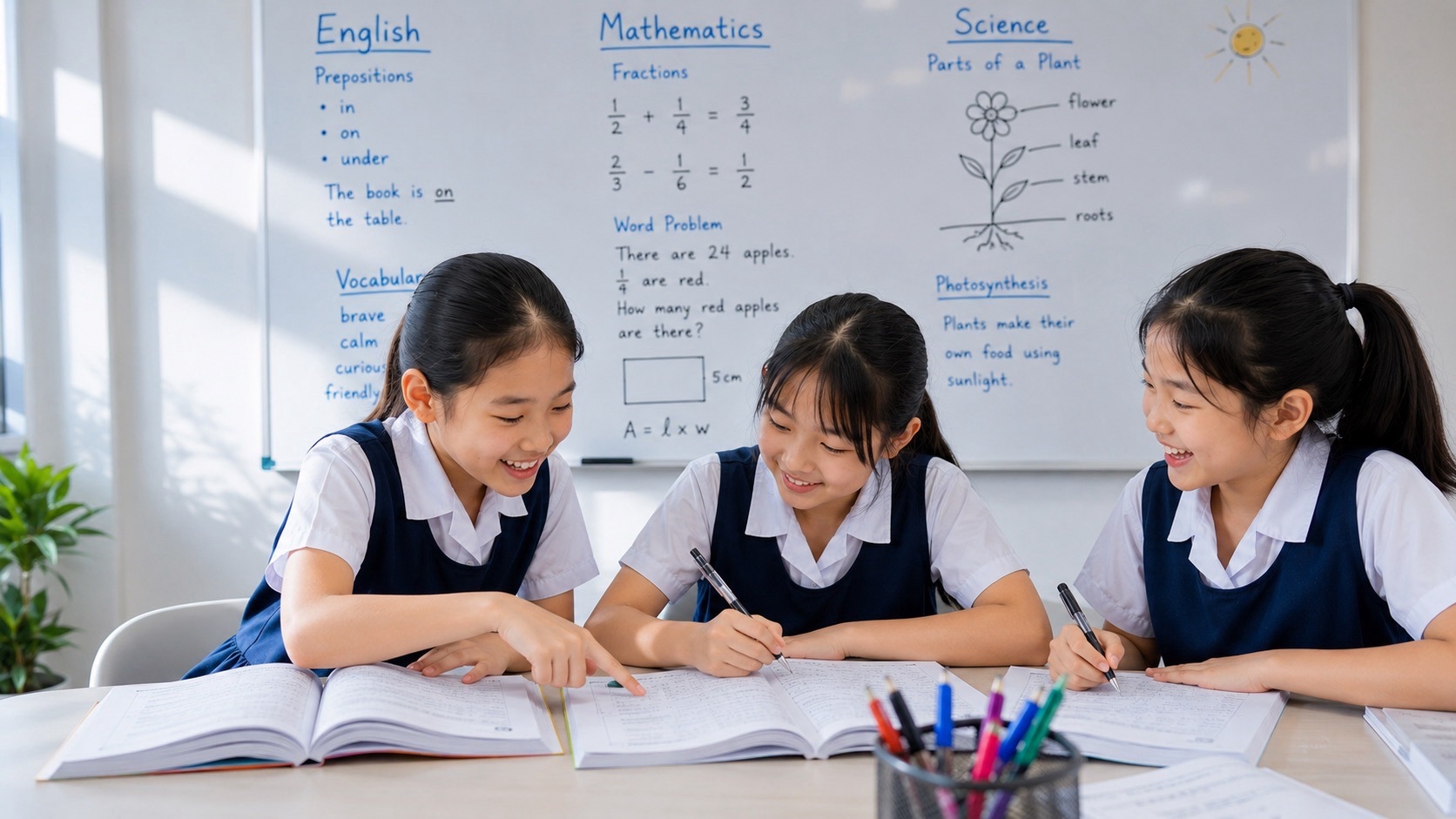
A sign of things to come in the Primary levels is not one sudden leap at Primary 6. It is a six-year progression in which Primary English, Primary Mathematics and Primary Science gradually ask children to read more independently, reason more precisely, explain more clearly and manage a larger share of their own learning. For parents searching for primary school tuition in Singapore, P1 to P6 learning support, PSLE preparation or stronger foundations, the useful question is therefore not simply, “What should my child practise?” It is, “What should my child be able to do independently at this stage?”
Strong primary learning is built from connected foundations: literacy, numeracy, scientific reasoning, vocabulary, memory, attention, problem solving and study habits. A Primary 1 child learning to follow a two-step instruction is building a skill that later appears in multi-part Mathematics problems and examination directions. A Primary 3 child learning to explain why an answer is correct is preparing for the evidence-based reasoning demanded in upper primary. A Primary 5 child learning to organise revision is rehearsing the self-management needed for PSLE and the transition to secondary school.
This article keeps its original title because it came from an earlier moment in eduKate’s history, but its purpose is now evergreen. Instead of forecasting one particular school year, it maps what tends to change from Primary 1 to Primary 6, what parents can watch for, how English, Mathematics and Science interact, and how to tell the difference between a temporary stumble and a foundation that needs repair. Think of it as a field guide to the road ahead.
Primary School Is a Sequence of Transitions
Children do not simply receive more difficult work each year. The nature of the work changes.
At the beginning of primary school, much of learning is visible. Teachers can point to letters, counters, pictures, objects, number bonds and concrete examples. Instructions are short. New skills are practised many times. By upper primary, more of the work moves inside the child’s head. Students must retrieve information, select methods, compare possibilities, infer unstated relationships and organise longer responses.
That movement from visible support to internal control is the story underneath P1 to P6.
A child may appear to “suddenly” struggle in Primary 4 or Primary 5 when the real problem began earlier. Perhaps multiplication facts were never automatic. Perhaps reading fluency remained effortful. Perhaps vocabulary was adequate for simple instructions but too narrow for inference. Perhaps the child could follow a demonstrated Mathematics method but could not choose a method independently.
Later difficulty often exposes earlier fragility.
The Learning Floor: What Every New Skill Stands On
Before discussing year levels, it helps to identify the floor beneath them. Primary learning depends on several capacities working together.
- Attention: staying with a task long enough to process it.
- Language: understanding instructions, vocabulary and sentence relationships.
- Memory: retrieving facts, methods and concepts without rebuilding them from zero.
- Reasoning: connecting information and deciding what follows.
- Fluency: performing familiar operations with enough ease to free attention for harder thinking.
- Self-monitoring: noticing when an answer does not make sense.
- Persistence: continuing through productive difficulty without collapsing into guessing or avoidance.
Weakness in one area can masquerade as weakness in another. A child who takes a very long time to complete a Mathematics word problem may not have a Mathematics concept problem at all. The bottleneck could be reading. A child who “forgets Science” may understand the concept but possess weak retrieval habits. A child whose composition is short may not lack imagination; the child may lack vocabulary or planning structure.
Diagnosis should therefore happen before extra practice.
Primary 1: Build Trust in Learning
Primary 1 is a year of foundations, but it is also a year of identity. Children are learning what school feels like and what kind of learner they think they are.
In English, the priority is stable access to language: phonics where needed, word recognition, oral vocabulary, sentence meaning, basic comprehension, handwriting or keyboard habits where appropriate, and the ability to express an idea in a complete sentence. Reading should gradually become less like decoding a puzzle and more like receiving meaning.
In Mathematics, children build number sense. They need to understand quantities, place value, addition, subtraction and the early relationships behind multiplication and division. MOE’s current Primary Mathematics syllabus places strong emphasis on mathematical concepts, skills and problem solving across the years. At P1, the most important thing is not racing ahead. It is making number relationships feel sensible.
A child who knows that 8 + 7 = 15 is useful. A child who can also see 8 + 7 as 8 + 2 + 5 and explain why that helps is beginning to think mathematically.
What parents can watch for at P1
- Can the child follow a short instruction without repeated prompting?
- Can the child read a simple passage and tell what happened?
- Can the child explain a simple answer in their own words?
- Can the child represent a number in more than one way?
- Can the child sit with a manageable task without immediately asking for rescue?
At this age, confidence should come from successful effort, not from being told that everything is easy.
Primary 2: Turn Beginnings into Fluency
Primary 2 is where early skills need to become more automatic. This matters because working memory is limited. If a child must spend enormous effort decoding every word or calculating every basic fact, little mental space remains for comprehension or problem solving.
Fluency does not mean mindless speed. It means reliable access.
In English, students should read increasingly smoothly, build vocabulary through meaningful texts and write connected sentences. Comprehension begins to move beyond locating obvious facts. In Mathematics, arithmetic relationships become more established, and students benefit from seeing multiple representations rather than memorising isolated procedures.
This is a useful year to teach checking habits. Does the answer fit the question? Does a sentence have a subject and a clear action? Does a number answer make sense? Young children can learn metacognition in simple language: “What did I do? Why did I do it? How can I check?”
Primary 3: The Curriculum Opens Out
Primary 3 often feels like the first substantial expansion. Science becomes a formal subject in mainstream primary school, English texts and writing demands grow, and Mathematics becomes more varied.
This is where students begin to experience the cost of weak foundations more clearly. Reading is now needed not only for English but also for understanding Science questions and Mathematics word problems. Vocabulary widens across subjects. A child may know the everyday meaning of a word but not its academic use.
Consider the word observe. In ordinary conversation, it might simply mean “look.” In Science, observation is evidence gathered through the senses or instruments. The distinction matters. Academic language is increasingly precise.
The P3 question changes from “Can you do it?” to “Can you explain it?”
A student may identify the correct Science answer but struggle to explain the relationship. A student may solve a Mathematics problem but be unable to describe the method. A student may understand a story but answer with a phrase too vague for the question.
Explanation is not an ornament added after understanding. It is evidence of understanding.
Primary 4: The Independence Year
Primary 4 is a useful checkpoint because students are no longer beginners, yet there is still time to repair weaknesses before the upper-primary workload becomes heavier.
At this stage, parents should watch how the child starts work. Does the child need an adult to sit beside them for every page? Can homework begin without a long negotiation? Can the child locate a mistake after being told only that one exists? Can the child revise a topic from notes and examples rather than waiting for someone to reteach it?
These are independence questions.
English writing benefits from paragraph control and planning. Mathematics increasingly rewards choosing the right representation rather than applying the last method taught. Science requires more precise use of concepts and evidence. A child can no longer rely entirely on recognition.
Primary 5: When Small Gaps Become Expensive
Primary 5 has a reputation for being difficult because several demands rise at once. Content becomes richer. Questions combine ideas. The distance between knowing a fact and applying it becomes larger. Students also carry more school, CCA and social responsibilities.
The most dangerous response is panic followed by volume: more worksheets, more classes, more hours, more everything.
When performance drops, first ask what changed.
- Did the student encounter unfamiliar question structures?
- Is recall too slow?
- Are earlier fractions, ratio or grammar foundations unstable?
- Is the student reading questions inaccurately?
- Is revision still passive?
- Is time management becoming a problem?
- Has workload increased faster than the child’s planning habits?
Primary 5 is an excellent time to establish an error ledger. Instead of filing away a marked paper after checking the score, students record recurring mistakes and the correction principle. Over time, the ledger turns disappointment into usable information.
Primary 6: PSLE Preparation Without Turning the Year into One Long Alarm Bell
PSLE preparation works best when it begins from control rather than panic. By Primary 6, the student should increasingly know what is weak, what is stable and what needs practice.
The year can be divided into overlapping phases.
- Foundation check: repair gaps that keep reappearing.
- Syllabus consolidation: make sure major topics and language demands are understood.
- Mixed practice: remove chapter labels so the student must choose methods.
- Timed execution: practise pacing, question selection and checking.
- Error reduction: target the mistakes that remain under pressure.
- Final stabilisation: protect sleep, routine and confidence rather than introducing chaos at the last moment.
PSLE is important, but it is not helped by treating every practice paper as a referendum on the child’s future. A paper is evidence. The useful question remains: what does this paper tell us to teach next?
English Across P1 to P6: From Access to Precision
The broad English progression can be understood as a movement from access to precision.
- Lower primary: decode, read fluently, understand literal meaning, build vocabulary, form complete sentences.
- Middle primary: infer, organise paragraphs, use grammar deliberately, explain answers.
- Upper primary: manage longer texts, distinguish relevant evidence, write with audience and purpose, paraphrase accurately and sustain ideas.
Reading is the engine room. A child who reads widely meets vocabulary, sentence structures, ideas and knowledge in context. But reading volume alone does not guarantee comprehension. Students also need to notice how texts work.
A useful family routine is to discuss one short text each week without turning dinner into an oral examination. Ask what surprised the child, what the author wanted the reader to notice, which sentence carried the main idea and what the child disagreed with. Conversation helps language become thought.
Mathematics Across P1 to P6: From Quantity to Structure
Primary Mathematics is not a six-year collection of tricks. It is a growing network of relationships.
Whole numbers lead to operations. Operations lead to multiplicative thinking. Fractions, decimals, ratios and percentages express related ideas in different forms. Measurement connects number to the physical world. Geometry develops spatial reasoning. Word problems require students to translate language into mathematical relationships.
This is why understanding matters. A child who memorises that “of means multiply” may succeed on a narrow set of questions but fail when language changes. A child who understands part-whole relationships can adapt.
Three Mathematics habits worth protecting
- Represent: draw a model, number line, diagram or table when the relationship is unclear.
- Estimate: decide roughly what a sensible answer should look like before trusting the calculator in the brain.
- Explain: state why the chosen method fits the problem.
MOE’s 2021 Primary Mathematics syllabus applies to Primary 1 through Primary 6 from 2026, providing a useful current reference for parents who want to understand the official progression.
Science Across P3 to P6: From Facts to Explanations
Young students often begin Science by collecting facts: plants need light, magnets attract some materials, heat can change temperature, forces affect motion. Facts are necessary. Explanations are the next step.
A strong Science answer connects evidence to a concept and the concept to the observed outcome. That chain is more important than using grand vocabulary.
Suppose two identical plants receive different amounts of light and one grows less well. A weak answer might say, “The plant had less light so it was weaker.” A stronger explanation identifies the relevant process and uses the experimental difference as evidence. The child has moved from description to mechanism.
Science revision should therefore include “why” and “how” questions, not only recall. Ask students to predict what would happen if one condition changed, identify which variable matters and explain the evidence they would expect to observe.
The Hidden Subject: Learning How to Learn
Every primary student is also taking an unofficial subject: learning management.
By the end of P6, students benefit enormously from knowing how to:
- break a large task into smaller parts;
- retrieve information without staring at notes;
- space revision across several days;
- mix old and new topics;
- correct mistakes deliberately;
- ask a precise question when confused;
- begin work without waiting for perfect motivation;
- stop when fatigue makes practice meaningless;
- prepare materials before a study session; and
- review progress honestly.
These habits do not appear automatically on the first day of Secondary 1. Primary school is where they can be rehearsed gently.
Retrieval Beats Re-reading
One of the most useful changes a student can make is to stop confusing familiarity with memory. Looking at notes feels comfortable because the answer is present. Examinations require the student to retrieve information when the answer is absent.
After reading a Science page, close the book and explain the concept from memory. After learning vocabulary, hide the definitions and retrieve them later. After a Mathematics lesson, attempt one question without the worked example beside it.
The small discomfort of retrieval is productive. It tells the brain, “You may need this again.”
Spacing Beats the Sunday Marathon
Primary children often revise in bursts because school life encourages deadlines. A spelling list is memorised the night before. A Science chapter is reviewed just before a test. This can produce short-term performance without durable learning.
Spacing distributes contact with a topic across time. Ten focused minutes on three separate days can be more useful than one exhausted thirty-minute session because each return requires retrieval and reconstruction.
Spacing also makes family life calmer. Revision stops being an emergency service.
Do Not Turn Every Mistake into a Character Judgment
“Careless,” “lazy” and “not trying” are tempting labels because they are short. They are also often poor diagnoses.
A child who repeatedly misses a negative sign may have a checking problem. A child who avoids writing may be overwhelmed by planning. A child who delays homework may not know how to begin a large task. A child who forgets a concept may have used recognition-based revision instead of retrieval.
Behaviour matters, of course. Responsibility must grow. But responsibility grows faster when the child knows what action to take.
A Better Way to Read a Report Book or Test Paper
A score is a summary. Parents need the mechanism underneath.
When results change, compare more than the number:
- Was the paper harder?
- Did the child finish?
- Which question types caused losses?
- Were mistakes conceptual or procedural?
- Did the child misread instructions?
- Was revision completed early enough?
- Can the child now correct the errors independently?
- Is the same weakness appearing in another subject?
The final question often reveals cross-subject bottlenecks. Weak reading can affect English, Mathematics and Science simultaneously. Poor retrieval can make every subject feel harder. Disorganised working can create “careless” mistakes across the board.
Three Student Pathways: Repair, Stabilise, Extend
Repair
The child is already struggling with current work because an earlier skill is unstable. Repair returns to the earliest point that is still affecting performance. It is not a complete restart.
Stabilise
The child understands much of the work but performance is inconsistent. Stabilisation focuses on recall, checking, timing, question reading and repeated error patterns.
Extend
The child is secure and needs greater challenge. Extension should deepen reasoning, transfer and independence rather than simply moving into next year’s textbook as quickly as possible.
These pathways can differ by subject. A student may need repair in English writing, stabilisation in Mathematics and extension in Science. Children are not single scores.
What Good Tuition Should Add
Primary tuition is useful when it performs a job that the student genuinely needs. More volume is not automatically more value.
A strong small-group or individual learning environment can add:
- diagnosis of specific misconceptions;
- slower explanation where school pace has moved on;
- faster extension where the student is ready;
- deliberate retrieval of older learning;
- feedback on the student’s actual working process;
- structured writing and reasoning practice;
- timed practice when examination execution becomes relevant; and
- a gradual transfer of responsibility back to the student.
If tuition merely duplicates school homework, the family may be buying repetition when the child needs diagnosis.
What Parents Can Do Without Becoming the Second Teacher
Parents do not need to reteach the entire curriculum. Their most useful role is often environmental.
- Protect a predictable place and time for focused work.
- Keep books available and reading normal.
- Ask the child to explain rather than immediately supplying the answer.
- Praise correction, not only first-attempt success.
- Use school feedback as information rather than ammunition.
- Help the child break large tasks into visible steps.
- Protect sleep before important assessments.
- Allow manageable consequences when the child forgets a responsibility.
Independence requires room to practise independence. If an adult checks every line before the child can move on, the child may become very good at waiting for an adult.
A Simple Weekly Learning Cycle
A primary-school week does not need a military timetable. It benefits from a repeatable cycle.
- Learn: encounter the new idea at school or tuition.
- Attempt: use it with support.
- Retrieve: return without looking at the example.
- Mix: combine it with an older topic.
- Correct: identify the exact error.
- Explain: say why the correction works.
- Store: record the rule, word, concept or method worth remembering.
- Return: test it again after time has passed.
This cycle is small enough to use with spelling, vocabulary, fractions, Science concepts or comprehension strategies. The content changes. The learning mechanism stays surprisingly stable.
Preparing for the Primary-to-Secondary Transition
The best preparation for Secondary 1 is not finishing the Secondary 1 syllabus early. It is leaving Primary 6 with a usable learning system.
A student entering secondary school benefits from being able to:
- read instructions carefully;
- manage a notebook or digital file system;
- retrieve prior learning;
- ask specific questions;
- work for a focused period without constant supervision;
- correct mistakes independently;
- plan a week containing several subjects;
- handle an unfamiliar question without immediate panic; and
- recognise that not understanding something yet is a normal part of learning.
Those abilities travel well. They work in English, Mathematics, Science and almost everything that comes after.
Frequently Asked Questions
When should parents worry about a drop in marks?
One result is not enough to diagnose a trend. Look at the paper, the difficulty level, whether time ran out and whether the same weakness appears repeatedly. A persistent pattern deserves attention sooner than one unusual score.
Should a child learn ahead?
Pre-learning can reduce surprise when foundations are secure. It becomes counterproductive when new material is piled onto unstable earlier knowledge merely to claim faster progress.
How much homework is enough?
The useful amount depends on the child and the learning job. Ten questions that reveal a misconception can be more valuable than fifty repetitive questions completed on autopilot.
Is memorisation bad?
No. Some knowledge needs to be available from memory. The issue is what is memorised and whether it is connected to understanding. Multiplication facts, vocabulary and Science terminology are useful to know fluently; students should also understand how and when to use them.
Should parents correct every mistake immediately?
Not always. A prompt such as “One step here does not make sense—can you find it?” preserves the child’s opportunity to diagnose. Immediate rescue can remove the very thinking the exercise is meant to develop.
Useful Routes and Current References
- Primary English directory at eduKateYishun
- Primary Mathematics directory at eduKateYishun
- Science Tuition & Learning Hub at eduKateYishun
- MOE Primary Mathematics Syllabus, P1 to P6
- MOE Committee of Supply 2026 education announcements
The Sign of Things to Come
The original version of this article looked ahead to one new school year. The more useful view now is longer.
Primary 1 is preparing for Primary 2, but it is also preparing for Primary 6. Primary 3 Science is preparing a child to reason with evidence years later. A multiplication fact learned fluently can free mental capacity for algebra in secondary school. A habit of explaining an answer can become the foundation of argument. A child who learns to correct an error without embarrassment is acquiring a skill that survives every syllabus change.
The future does not arrive only at PSLE. It arrives quietly in the small habits children practise on ordinary Tuesdays.
That is why the primary years matter so much. They are not merely six levels to complete. They are the years in which children gradually learn to carry more of their own thinking—and eventually more of their own future.
The Hidden Progression Across the Primary Years
The Primary years are often described as six separate school levels, but the more useful picture is cumulative. Primary 1 does not disappear when Primary 2 begins. Early decoding, number sense, oral language, sentence control, attention routines and willingness to attempt unfamiliar tasks remain inside later performance. By Primary 5 and Primary 6, they are simply carrying heavier loads.
This is why an apparently small weakness can become more visible later. A child who reads accurately but slowly may cope when passages are short, then struggle when comprehension requires longer texts and more inference. A child who memorises arithmetic procedures without understanding place value may produce correct answers early, then lose control when fractions, ratio and multi-step problems demand flexible reasoning. The later problem is often an earlier concept operating under greater complexity.
Parents therefore benefit from asking a developmental question: what is this year preparing the child to do next? A good Primary education is not only about clearing the present worksheet. It builds tools that will still work when the task becomes longer, less familiar and more independent.
What Changes from Lower to Upper Primary
Primary 1 and 2: build the operating foundations
Lower Primary should make basic classroom operations increasingly automatic. Students learn to read instructions, sustain attention for longer periods, organise materials, write legibly, handle basic number relationships, listen to a sequence of directions and ask for help in a useful way. Academic content matters, but so do the routines that make academic content learnable.
Because MOE has removed weighted assessments and examinations for Primary 1 and 2, these years are especially important for building secure foundations rather than manufacturing test anxiety. The absence of high-stakes school exams does not mean the absence of rigour. It means progress can be observed through daily work, reading, oral explanation, written responses and the child’s growing independence.
Primary 3 and 4: connect knowledge and reasoning
The middle Primary years expand the system. Science enters more formally, texts become richer, Mathematics requires stronger problem solving, and English increasingly asks students to infer, organise and express ideas. Students who were relying on memory alone begin to meet tasks that require selection: which operation, which evidence, which explanation, which writing structure.
Primary 3 and 4 are therefore excellent diagnostic years. A child is old enough to show clear patterns but still has time to repair them before Primary 5 and 6 compress the runway.
Primary 5 and 6: integrate, transfer and execute
Upper Primary increases content, abstraction and examination demand. Students must retrieve knowledge across longer intervals, combine several ideas in one question, explain reasoning more precisely and manage time. At this stage, weak foundations become expensive because every new topic assumes earlier control.
The objective is not to turn every Primary 5 lesson into PSLE rehearsal. It is to make the underlying English, Mathematics and Science systems sufficiently stable that PSLE-style integration becomes manageable.
A First-Principles Primary Learning Method
1. Find the earliest unstable point
When a child cannot solve a current question, move backwards only as far as necessary. A ratio error may come from multiplication facts, fraction sense or failure to identify the whole. A comprehension error may come from vocabulary, sentence parsing or question scope. Repair the actual bridge rather than repeating an entire previous year.
2. Teach the model before the shortcut
Shortcuts are useful after understanding. Before that, they can hide confusion. Students should know why regrouping works, why equivalent fractions preserve value, why evidence supports an inference and why a paragraph needs a controlling idea.
3. Reduce complexity, then rebuild it
If a task contains five sources of difficulty, the teacher cannot easily see which one caused failure. Fence the target skill in a simpler example, stabilise it, then add complexity back deliberately.
4. Ask the child to explain
Explanation reveals whether a correct answer was understood or guessed. A student who can say what was noticed, why a method was chosen and how the answer was checked is developing a portable learning process.
5. Retrieve after a delay
Learning is not secure because it worked immediately after teaching. Bring the idea back tomorrow, next week and inside a mixed task. Delayed retrieval shows whether knowledge is becoming durable.
What a 90-Minute Primary Learning Session Can Contain
- 10–15 minutes of retrieval from earlier learning
- 15–20 minutes of explicit teaching around one central idea
- 20 minutes of guided practice with explanation
- 15–20 minutes of independent application
- 10 minutes of mixed or transfer questions
- 5–10 minutes of error review and a small continuation task
The exact timing changes with age and subject, but the rhythm matters. A lesson should not be ninety minutes of teacher talk or ninety minutes of worksheets. Students need explanation, attempt, feedback, independence and review.
Three Primary Student Pathways
Repair
This child is already carrying a gap that interferes with current work. The priority is to identify the earliest cause and rebuild it without shame. Repair should be narrow enough to be achievable and connected quickly back to age-appropriate material.
Stabilise
This child understands most work but performance varies. The focus shifts to routines: checking, retrieval, reading the question, showing working, planning and finishing tasks within reasonable time.
Extend
This child is secure and needs depth rather than acceleration for its own sake. Good extension includes unfamiliar applications, alternative methods, richer reading, explanation, creative production and problems where the route is not announced in advance.
The Most Useful Early Warning Signs
An early warning sign is useful only if it leads to a specific next action. “Careless” and “lazy” are poor diagnoses because they do not tell us what to teach.
- the child cannot explain a method that was used correctly
- reading is accurate but very slow
- instructions are repeatedly misread
- homework requires constant adult prompting
- knowledge disappears after a short delay
- the child can do blocked practice but not mixed questions
- writing contains ideas but no clear organisation
- basic number errors increase sharply inside multi-step problems
- the child avoids showing working or revising a first draft
Each sign points somewhere different. Slow reading requires fluency work. Forgotten methods require retrieval and spacing. Dependence on prompting requires scaffolds that are deliberately faded. Mixed-question failure requires recognition and transfer practice.
How Parents Can Support Without Becoming the Second Teacher
Home support works best when it protects routines and curiosity without turning every evening into a parallel school. Parents can help the child begin on time, provide a workable environment, ask the child to explain what the task requires, and encourage checking. They do not need to supply every method or correct every sentence.
One useful rule is to delay rescue. If the child is stuck, first ask what is known, what the question asks, what similar problem has been seen before and what a reasonable first step might be. The goal is to help the child restart thinking, not to replace it.
Reading together remains valuable throughout Primary school. With younger children, adults can read aloud and discuss pictures, vocabulary and predictions. With older children, conversation can move toward viewpoint, evidence, cause, motive and whether a claim is supported.
What Progress Should Look Like
Progress is visible when the child begins tasks with less friction, remembers earlier learning after a gap, explains reasoning more clearly, notices mistakes, asks more precise questions and recovers from difficulty without immediately abandoning the task.
Marks are one signal, but not the only one. A child moving from dependence to independence is making important progress even before a large assessment jump appears. Durable learning often becomes visible first in behaviour and explanation, then later in scores.
Frequently Asked Questions
Should Primary students study ahead of school?
A small amount of pre-teaching can make school learning easier when foundations are secure. Rushing through future chapters is less useful if current concepts are unstable. Depth and transfer normally matter more than speed.
When should parents worry about a low test?
One low score is information, not a diagnosis. Look for repeated patterns across several pieces of work. If the same weakness appears repeatedly, act on the mechanism behind it.
Is tuition necessary throughout Primary school?
No. Some students learn well through school, reading, home routines and independent practice. Additional support is most useful when it addresses a specific gap, provides needed extension or helps a child become more independent.
How much practice is enough?
Enough to achieve accurate, independent retrieval and transfer. Large volumes of repetitive work can create fatigue without improving recognition. Quality, spacing and feedback matter.
What is the most important preparation for Primary 6?
A stable foundation across language, numeracy, subject knowledge and learning routines. Primary 6 becomes much harder when students must repair old gaps while also managing new content and examination timing.
Helpful Reading
- MOE Primary Mathematics Syllabus
- MOE Primary English Language Syllabus
- eduKateYishun Student Diagnostics Hub
- Learning Problems Hub
- The Library
The Sign of Things to Come
The most important signs in Primary school are rarely dramatic. They are the small operations that repeat every day: whether a child can read an instruction accurately, retrieve an earlier idea, explain a choice, persist through uncertainty, revise an answer and learn from a mistake.
Those operations become the hidden infrastructure of Secondary school. When they are strong, new subjects and harder examinations sit on a stable base. When they are weak, complexity exposes them. The Primary years are therefore not merely preparation for one examination. They are the long construction period for how a child will learn when the questions become less familiar and the adult support becomes less immediate.
Leave a Reply