
A Yishun child taking Secondary 1 G1 Mathematics can make progress in fractions, decimals and percentages by naming the whole before choosing a calculation. Three quarters, 0.75 and 75% can describe the same share of one quantity. They give different amounts when the whole changes. Once your child can explain that relationship, calculations about prices, quantities, percentage changes and missing totals become easier to organise.
Begin with a small example your child can draw or measure. Ask what counts as 100%, what part is known and what the question wants. Have them write a labelled calculation and check the answer against the original quantity. Use their first independent attempt to decide whether to revisit place value, fraction operations or the meaning of the percentage. Their school’s current G1 outline can help you choose a suitable next question.
- Identify the whole and its unit before converting a fraction, decimal or percentage.
- Connect familiar equivalents through equal parts, place value and “out of one hundred.”
- Separate finding a percentage of a whole from finding the whole when a percentage part is given.
- For an increase or decrease, label the original amount and calculate the change from that base.
- Ask which amount a comparison uses as its reference. Reversing the comparison can change the percentage.
- Check a correction with fresh numbers or a new situation so you can see what the learner can now do independently.
What Secondary 1 G1 expects pupils to learn
The MOE G1 Mathematics syllabus includes operations on fractions and decimals, including negative values, in Secondary 1. Its percentage content covers conversion, finding a whole from a percentage part, expressing one quantity as a percentage of another, comparing quantities, percentages above one hundred, and increases and decreases. These skills connect with ratio and with approximation and estimation. Learning them together helps a child see why a calculation works across different topics.
The Yishun Secondary School 2026 Sec 1 G1 outline provides a local example of sequencing. It introduces arithmetic and fractions, then ratio, before the percentage chapter. The outline includes percentage conversions, values above one hundred, percentage parts, comparisons, missing wholes, increases and decreases, and a profit and loss topic. It gives a plan for that school and year. Check the current Mathematics outlines and your child’s classwork for what has been introduced.
A child may remember procedures from primary school and still need to rebuild the explanation. Some pupils have had more experience with one form of the same quantity than another. A pupil can calculate half of forty quickly and hesitate when the question uses 50%. Another pupil can type 0.5 into a calculator and be unsure why the result is a half. Let them use the form they understand first and then connect it to the other forms. The aim is to recognise a quantity when it appears in a different representation.
The examples below are original teaching tasks. Numbers in money situations are hypothetical and are chosen for manageable calculations. The early tasks use positive values, and a later section connects the arithmetic to signed numbers after those operations have been taught. Exercises involving repeated changes are marked as optional applications. Ask the teacher about their current assessment scope if a workbook mixes several years or subject levels under a single heading.
Check your child’s actual subject level on the timetable. Posting Group 1 is used at secondary school entry, while an individual student may be offered Mathematics at another eligible level. This guide follows the Secondary 1 G1 content. The school can explain what applies if your child takes G2 or G3 Mathematics. Bring a sample calculation when asking for advice so the teacher can see how the pupil interprets the quantity, selects an operation and performs the arithmetic.
Find one whole and keep it visible
Put twenty counters on a table and call that collection one whole. Five of the counters make one quarter of the collection because four equal groups of five make twenty. The same five counters form 25% of the whole. Ask what changes if the whole contains forty counters. One quarter now contains ten counters. The fraction has the same relationship to the whole, and the actual number in the part has changed because the whole is larger.
Next keep the five counters and change the comparison. Five out of twenty is one quarter. Five out of ten is one half. Five out of fifty is one tenth. The numerator tells you the amount being considered in these examples; the denominator names the total used as the whole. A child who treats five counters as “always 25%” needs to name the reference collection again. Ask “five out of how many?” and show the new whole beside the selected five.
In a measurement problem the whole can be a length, mass, volume or duration. If a bottle holds 800 ml when full, 200 ml is a quarter of its capacity. If another bottle holds 500 ml, the same 200 ml is two fifths, or 40%, of that capacity. Write the bottle’s full capacity next to a rough drawing and shade the amount of liquid. Make clear whether the question asks about the proportion of capacity used or the amount of liquid in millilitres.
A whole can also be the total money before a price change, the cost used to calculate profit or the original value before an increase. Read the words that identify the reference amount. In a price-discount problem, the original price commonly represents 100%. When you later compare the discount with the amount paid, you are using another reference amount. Both questions can be sensible, and each needs its own denominator. This is why a useful first line says which amount is being taken as the whole.
| Situation | Whole or reference amount | Known part | Relationship |
|---|---|---|---|
| 6 pupils from a group of 24 complete a task | 24 pupils | 6 pupils | One quarter, or 25%, of the group. |
| A jug contains 300 ml out of 1,200 ml capacity | 1,200 ml | 300 ml | One quarter of capacity. |
| A 60-dollar item has a 15-dollar reduction | Original 60 dollars | Reduction of 15 dollars | Reduction is 25% of the original price. |
| A 40-minute session spends 10 minutes on a demonstration | 40 minutes | 10 minutes | Demonstration is 25% of the session. |
Let your child write a short label above the relevant number rather than colouring every part of a word problem. For example, label 24 as “whole group” and 6 as “selected pupils.” Then let the fraction follow from the labels. With money or measurement, check units before comparing. Six hundred millilitres out of two litres requires a unit conversion before dividing. Both amounts could be written in litres, 0.6 and 2, or in millilitres, 600 and 2,000. The ratio is the same after a correct conversion.
Check the whole with four short questions
- Eight of 32 seats are occupied. What fraction is occupied?
- A 90-minute activity uses 18 minutes for preparation. What fraction of the time is preparation?
- A container holds 250 ml and has capacity 1 litre. What fraction of the capacity is used?
- A learner says 15 is 15% of any total. Give a total for which 15 is one half and another for which it is 10%.
For question 1, write 8/32, which simplifies to 1/4. For question 2, 18/90 simplifies to 1/5. For question 3, use 250/1,000, again 1/4. For question 4, 15 is half of 30 and 10% of 150. Ask the pupil to point to the total in each calculation. If the fraction is wrong but the pupil can describe the equal groups accurately, help them connect the description to the fraction line before assigning another long set.
Contents · Previous section · Next section
Connect fractions, decimals and percentages
A percentage gives a comparison per hundred. For example, 35% is 35/100, which simplifies to 7/20 and is written as 0.35. Use a hundred-square grid if that helps your child see thirty-five of one hundred equal parts. Then show the fraction as a division, 35 divided by 100. The decimal tells the same story through tenths and hundredths. Three tenths plus five hundredths is thirty-five hundredths.
To convert 3/5, make an equivalent fraction with denominator 100: multiply numerator and denominator by twenty to obtain 60/100. That is 60%, or 0.6. Alternatively, divide three by five to get 0.6 and multiply the decimal by one hundred to express it as a percentage. Ask the pupil to explain which method they prefer for that particular fraction. Equivalent fractions are convenient when a denominator easily makes one hundred; division is useful more generally.
Place value helps with small percentages. One percent is 1/100, or 0.01. Half of one percent is 0.5%, which is 0.005 as a decimal. Compare 0.5% with 50%. The first is five thousandths of a whole and the second is half a whole. Testing them against a whole of 200 makes the distinction visible: 0.5% gives 1, while 50% gives 100. A learner who loses the percent sign during a calculation may have multiplied by the wrong factor.
| Fraction of the whole | Decimal | Percentage | A useful explanation |
|---|---|---|---|
| 1/2 | 0.5 | 50% | Half of one hundred equal parts. |
| 1/4 | 0.25 | 25% | A quarter of one hundred. |
| 3/4 | 0.75 | 75% | Three groups of a quarter. |
| 1/5 | 0.2 | 20% | One of five equal shares. |
| 3/5 | 0.6 | 60% | Three groups of one fifth. |
| 1/8 | 0.125 | 12.5% | Half of a quarter. |
A decimal with fewer digits can still be larger. Compare 0.7 and 0.65 by writing 0.70 and 0.65. Seventy hundredths is larger than sixty-five hundredths. The matching percentages are 70% and 65%. Now compare 0.08 with 0.8, which are 8% and 80%. Both comparisons become easier if your child reads the decimal in place-value language before calculating. The number of digits after the decimal point does not measure size.
Percentages above one hundred compare an amount with a smaller reference whole. If the original order was 40 booklets and a new order contains 60, the new amount is 60/40 = 1.5 times the original, or 150% of it. It contains the whole original forty plus another twenty. That extra twenty is 50% of the original forty, so the increase is 50%. Distinguish the percentage represented by the new total from the percentage change, and label each answer in words.
Convert and compare independently
- Write 7/20 as a decimal and percentage.
- Write 0.45 as a percentage and a fraction in simplest form.
- Write 125% as a decimal and a mixed number.
- Put 0.6, 65% and 3/5 in order, showing any equality.
- Compare 0.4% and 4% using decimal multipliers.
The answers are 0.35 and 35% for question 1. In question 2, 0.45 is 45%, and 45/100 simplifies to 9/20. In question 3, 125% is 1.25 or 1 1/4. For question 4, 0.6 equals 3/5 and both are less than 65%. In question 5, the multipliers are 0.004 and 0.04, so 4% is ten times 0.4%. When checking, ask which operation the pupil used to remove the percent sign and whether the size still makes sense.
Contents · Previous section · Next section
Use fraction and decimal operations to calculate a part
To find 3/4 of 28, first divide 28 into four equal groups, giving seven in each, then take three groups to get 21. The calculation can be written as 28 × 3/4 = 21. The word “of” describes multiplication here, and the grouping explains why. A child who learns only the word cue can be unsure when the story changes. Ask how many equal groups make the whole and how many are being taken. Then use a whole such as 20 or 36 to check the same idea again.
Addition asks a different question. Three quarters of a litre plus one eighth of a litre gives 6/8 + 1/8 = 7/8 litre. To add, both parts must use equal-sized units. An eighth and a quarter are different sizes, which is why adding numerators and denominators directly gives the wrong relationship. Draw one strip in eighths and show the six eighths covered by three quarters. The same drawing supports subtraction: 3/4 − 1/8 = 5/8.
A product of fractions can be understood through a part of a part. Suppose half a sheet of card is set aside, and a pupil uses two thirds of that half. The share of the entire sheet is 2/3 × 1/2 = 1/3. Draw a rectangle, shade one half and split that half into three equal pieces. Two of those pieces occupy one third of the full rectangle. The result is smaller than the half the pupil began with because only part of that half was used. This size check is helpful when a multiplication algorithm produces an implausible result.
Division can ask how many groups of a chosen size fit into a quantity. A jug contains 1 1/2 litres, and each serving is 1/4 litre. There are six quarter-litre portions because 1 1/2 litres is 6/4 litres. The calculation 3/2 ÷ 1/4 = 3/2 × 4 = 6 matches that interpretation. If a child knows the reciprocal rule but obtains a fraction of a serving, ask them to count quarter litres in a diagram. The answer should be larger than one because the jug holds several servings.
Decimal operations also need a size check. To calculate 1.25 × 4, use four groups of 1.25 to get 5.00. For 1.25 × 0.4, the multiplier is less than one, so the result must be less than 1.25. Four tenths of 1.25 is 0.50. In division, 3.6 ÷ 0.6 asks how many groups of 0.6 make 3.6, which is six. The equal calculation 36 ÷ 6 also gives six. Scaling both numbers by ten preserves their relationship. Scaling only one of them changes the question.
Try a mixed calculation with a practical quantity. There are 2.4 litres of juice. Half is poured into a second jug. Then 0.35 litre is taken from that second jug. The second jug contains 1.2 − 0.35 = 0.85 litre afterward. Ask the child which amount each operation uses. Some pupils subtract 0.35 from the full 2.4 and then halve the result, giving 1.025. That correctly evaluates a different sequence of actions. Put a small sketch beside each step to show when the half is taken.
Four operations practice
- Calculate 2/3 + 1/6 and 2/3 − 1/6.
- Calculate 3/5 of 45.
- Calculate 3/4 × 2/3.
- How many 0.25-litre servings fit in 1.75 litres?
- Work out 2.8 − 0.65 + 0.4.
- A 2.4-metre ribbon is cut into equal lengths of 0.3 metre. How many lengths are there?
For question 1, convert two thirds to four sixths; the sum is five sixths and the difference three sixths, or one half. Question 2 gives 27. In question 3 the product is 6/12, or one half. For question 4, seven quarter litres make 1.75 litres. Question 5 gives 2.55. In question 6, 2.4 ÷ 0.3 = 24 ÷ 3 = 8 lengths. Ask the pupil to label the unit in each practical answer. Seven servings, 0.85 litre and eight lengths describe different kinds of result.
Contents · Previous section · Next section
Find a percentage part and recover a missing whole
Finding 15% of 80 starts with the known whole, 80. One method is to find 10% as 8 and 5% as 4, then add to get 12. Another method writes 15% as 0.15 and calculates 0.15 × 80 = 12. Let the pupil choose the approach they can explain. If they find 15% by dividing eighty by fifteen, ask which operation would give 100% when the percentage is one hundred. The known whole is being multiplied by the chosen fraction of itself.
Use a hypothetical price. An item originally costs 48 dollars and has a 25% reduction. One quarter of 48 is 12, so the reduction is 12 dollars. The new price is 48 − 12 = 36 dollars. If the question asks for the reduction, stop at 12 dollars. If it asks for what the customer pays, the answer is 36 dollars. Label the intermediate amount so a correct calculation does not become the wrong final response.
Now reverse the information. The reduction is 12 dollars and equals 25% of the original price. One quarter is twelve, so four quarters make 48 dollars. A formal calculation is 12 ÷ 0.25 = 48. The original price is the whole being recovered. Taking 25% of twelve would find a quarter of the already reduced part, giving three. Ask the child to point to the amount representing 25% and say whether the whole should be larger or smaller.
For less familiar numbers, use one percent or the decimal divisor. If 35% of a quantity is 42, then 1% is 42 ÷ 35 = 1.2. Multiply by 100 to find 120. Alternatively, 42 ÷ 0.35 = 120. Check with 0.35 × 120 = 42. The unitary method makes the scale explicit, and the decimal method is compact. Both need the same interpretation of the known 42 as a part of an unknown whole.
A known value can represent more than 100%. If a larger quantity is 144 and equals 120% of a reference amount, the reference amount is 144 ÷ 1.2 = 120. Here the recovered whole is smaller than the given 144 because the given value is one and one fifth times it. A pupil who assumes a percentage part must always be smaller than its whole needs to revisit comparisons above one hundred. Draw a full reference strip and an extra one fifth, then label their combined length 144.
| Information given | Calculation | Result and check |
|---|---|---|
| Find 30% of 90 | 0.30 × 90 | 27; three tenths of ninety. |
| 30% is 27; find the whole | 27 ÷ 0.30 | 90; 30% of ninety returns twenty-seven. |
| Find 120% of 90 | 1.20 × 90 | 108; twenty percent above ninety. |
| 120% is 108; find the reference whole | 108 ÷ 1.20 | 90; multiplying by 1.20 returns 108. |
Choose the direction of the calculation
- Twenty percent of a group of 65 people choose a morning session. How many people is that?
- Thirteen people are 20% of a group. Find the full group.
- A container holds 750 ml, which is 60% of its capacity. Find the capacity.
- A printer produces 135 pages, which is 150% of a small target. Find the target.
- An item’s price after a 20% reduction is 56 dollars. Find its original price.
Questions 1 and 2 give 13 and 65 respectively. For question 3, 750 ÷ 0.60 = 1,250 ml. For question 4, 135 ÷ 1.50 = 90 pages. For question 5, the amount paid is 80% of the original, so 56 ÷ 0.80 = 70 dollars. Twenty percent of seventy is fourteen; subtracting fourteen returns fifty-six. The last problem asks the pupil to identify the percentage represented by the supplied final price before dividing. It is a useful check of whether they are choosing the reference quantity consciously.
Contents · Previous section · Next section
Express a comparison as a percentage
Suppose a class prepares 18 blue cards and 30 yellow cards. Blue cards are 18/30 × 100% = 60% of the yellow-card number. Yellow cards are 30/18 × 100% = 166 2/3% of the blue-card number. Each sentence has a different reference amount. The phrase after “of” identifies the denominator in these examples. Blue as a percentage of yellow uses yellow as the reference. Read the full question aloud before calculating. A pair of quantities can support several different percentage statements.
If the question asks what percentage of all cards are blue, the reference whole is 18 + 30 = 48. The answer becomes 18/48 × 100% = 37.5%. Three different questions have used the same two starting numbers. Write the reference in words beside each fraction. This is a good exercise for a pupil who knows the formula but keeps choosing whichever number appears first in the story.
Change to two amounts with different units. A container holds 0.6 litre of water and has capacity 1,500 ml. Convert 0.6 litre to 600 ml before forming 600/1,500. The fraction is two fifths, giving 40%. Alternatively, convert the capacity to 1.5 litres and use 0.6/1.5. The two methods agree because both compare like units. A pupil who calculates 0.6/1,500 needs a unit check before any practice with percentage multipliers.
For school assessment scores, compare proportions. A pupil scores 18 out of 24 on one practice and 21 out of 30 on another. The first is 75%, and the second 70%. Twenty-one marks is a larger raw number, while the proportion of available marks is smaller. Such a comparison does not by itself prove a change in understanding because the tasks can differ. It does show why the available total must be included when comparing the scores mathematically.
Use a precise rounding instruction for a repeating result. Twenty out of thirty is two thirds, or 66 2/3%. If the question requests one decimal place, give 66.7%. Keep enough digits during the calculation and round the final requested result. A parent checking the work can accept an exact fraction alongside the percentage and ask the learner to show where rounding occurs. Rounding 2/3 to 0.7 before multiplying by one hundred changes the answer to 70%, which is a much coarser approximation.
Comparison practice with the reference labelled
- A group completes 24 tasks out of a target of 40. What percentage of the target is completed?
- A group completes 45 tasks against a target of 36. What percentage of the target is completed?
- A pupil spends 18 dollars on books and 12 on materials. What percentage of all spending was on materials?
- Express 800 g as a percentage of 2 kg.
- Compare 14 out of 20 and 18 out of 25 as percentages.
The first answer is 60%. The second is 125%, meaning the group completed the entire target plus another quarter of it. For question 3, the whole spending is 30 dollars and the materials share is 40%. For question 4, use 800/2,000 to obtain 40%. In question 5, the values are 70% and 72%, so eighteen out of twenty-five is the higher percentage. Ask the pupil to write the denominator in words for any wrong answer before trying another problem.
Contents · Previous section · Next section
Calculate a percentage increase or decrease
A quantity grows from 50 to 65. The change is 15. To describe the percentage increase, compare the change with the original fifty: 15/50 × 100% = 30%. The final sixty-five is 130% of the original. Label “change” above fifteen and “original” above fifty. A learner may calculate 65/50 and write 130% as the increase. That number correctly describes the final amount relative to the starting amount. The question about increase asks only for the additional part.
If a quantity falls from 80 to 68, the reduction is twelve and the percentage decrease is 12/80 × 100% = 15%. The final value is 85% of eighty. The original amount is the reference for the change. Starting from 68 and asking what increase returns to 80 gives a different percentage: 12/68 × 100%, about 17.65%. The actual difference is still twelve, but the denominator has changed. Use that pair to explain why undoing a decrease takes a different percentage increase.
There are two convenient ways to find a final amount after a known change. To increase 120 by 15%, find 15% as 18 and add to obtain 138. Or use 115% of the original: 1.15 × 120 = 138. For a 15% decrease, find eighteen and subtract, giving 102, or use 85%: 0.85 × 120 = 102. A child who understands both approaches has a way to check one calculation against another. The multiplier combines the whole original with the part added or retained.
When the final amount and the change rate are given, identify the retained or increased percentage before recovering the original. An order rises by 25% to 150 items. The final amount is 125% of the original. Calculate 150 ÷ 1.25 = 120. The increase was thirty and thirty is a quarter of one hundred and twenty. If a pupil subtracts 25% of the final 150, they get 112.5, which uses the new quantity as a base. Ask which amount the story said was increased.
A reduction of 40% leaves 60% of the original. If the final volume is 360 ml, then the original was 360 ÷ 0.60 = 600 ml. Check that forty percent of six hundred is two hundred and forty; the remaining amount is three hundred and sixty. This can be drawn as five equal portions, each twenty percent. Three retained portions make 360, so each is 120 and the original five make 600. Diagrams, unitary reasoning and decimal multipliers can all express the same relationship.
Profit and loss as an application
In a hypothetical school craft sale, an item costs 16 dollars to make and is sold for 20 dollars. The profit is four dollars. A percentage profit based on the cost is 4/16 × 100% = 25%. The four-dollar profit is also 20% of the selling price, because 4/20 is one fifth. Those are different comparisons. Read which reference the question requests. A learner who understands the quantities can use the precise denominator rather than choosing a percentage based on a familiar answer.
If an item costs 25 dollars and is sold at 22 dollars, the loss is three dollars. As a percentage of cost, the loss is 3/25 × 100% = 12%. The selling price is 88% of cost. The current Yishun Secondary 2026 outline includes profit and loss as a percentage application. Use the class’s definitions and wording when practising. A parent can avoid changing the question by labelling cost, selling price and difference before asking the child for the percentage. Yishun Secondary’s G1 content outline.
Optional application with two changes
Once single changes are secure, compare a 20% increase followed by a 20% decrease. Start at 100. The increase gives 120, then the decrease takes 20% of 120, which is 24. The final amount is 96. The two changes use different original amounts at their respective stages. A small two-line record keeps the base visible. This is an application of the percentage-change ideas; check the school’s current scope before treating a multi-stage example as required assessment practice.
For a second optional example, a hypothetical item is reduced by 10% and then by a further 5%. Start with 80 dollars. The first stage gives 72 dollars. Five percent of seventy-two is 3.60, so the second stage gives 68.40 dollars. A single 15% reduction from eighty would give 68 dollars. The order of the question and the current base are what distinguish the stories. A student can stop after a correct single-stage calculation if the later application is still unfamiliar.
Percentage change practice
- A display grows from 40 photographs to 52. Find the percentage increase.
- A group reduces its paper use from 250 sheets to 210. Find the percentage decrease.
- Increase 75 by 12%.
- Decrease 180 by 35%.
- A quantity increases by 20% and becomes 84. Find the original.
- An item costs 30 dollars and is sold for 36. Find percentage profit based on cost.
Question 1 has change twelve and original forty, giving 30%. Question 2 has change forty and original two hundred and fifty, giving 16%. For question 3, 12% of 75 is 9, so the final amount is 84. For question 4, 65% of 180 is 117. In question 5, 84 ÷ 1.20 = 70. For question 6, the six-dollar difference is one fifth of thirty, or 20%. Every answer can be checked by calculating the stated part of the original and then reconstructing the final amount.
Contents · Previous section · Next section
Handle signed values and calculator results carefully
The Secondary 1 G1 number content includes negative fractions and decimals. Begin with number-line meaning before combining sign work with a percentage situation. For example, −0.75 + 0.20 equals −0.55. Starting at negative three quarters and moving two tenths to the right leaves a negative result closer to zero. A common slip is to add the absolute values and produce −0.95. Ask the pupil to say which direction adding the positive amount moves them.
For fractions, −3/4 + 1/2 equals −3/4 + 2/4 = −1/4. Similarly, 1/2 − 3/4 equals −1/4. The two expressions share the same final value, and their starting points differ. Draw each on a number line if the pupil needs the meaning. For multiplication, −0.6 × 0.5 = −0.3, while −0.6 × (−0.5) = 0.3. Ask the child to identify both the magnitude and the sign using the operations already taught. One correct signed answer does not prove the sign rule is secure across operations.
Use percentage comparisons with positive reference quantities for the core tasks in this guide. A temperature rising from negative two to positive three is a change of five degrees, but describing it as an ordinary percentage increase relative to a negative starting temperature introduces interpretation issues beyond the simple positive-base examples. Practise the signed difference as a number question. That preserves the purpose of each exercise and avoids teaching a misleading shortcut based on a negative denominator.
A calculator can check arithmetic after the mathematical relationship is chosen. Before entering a percentage, write its decimal multiplier. For 18% of 250, the line is 0.18 × 250, giving 45. If the child uses eighteen times two hundred and fifty, the result is 4,500 and fails the size check. Eighteen percent is less than one fifth, so the answer should be slightly below fifty. This check gives the pupil a reason to revisit the entry rather than merely accepting whatever appears on the screen.
Keep units and rounding visible. If a question asks for a money amount to the nearest cent, complete the relevant calculation and round at the requested stage. For a hypothetical reduction of 12.5% from 19.90 dollars, the retained amount is 0.875 × 19.90 = 17.4125 dollars, which rounds to 17.41 dollars. Check whether a real-world context specifies its own rounding procedure. In an exercise, use the instruction printed on the page. Repeatedly rounding intermediate values can cause a different result.
The G1 Mathematics syllabus includes approximation and estimation alongside calculator calculations. Let the student use an estimate before pressing the keys. For 62% of 398, sixty percent of about four hundred is about 240. The exact calculation is 0.62 × 398 = 246.76, which agrees with that approximate size. An entry giving 24.676 or 2,467.6 should lead the pupil back to the line with the decimal multiplier.
Contents · Previous section · Next section
Diagnose the first error before choosing more practice
Read one worked response from the top. Ask the pupil which number represented the whole and why they chose the operation. If the story was translated correctly, check the arithmetic. If the arithmetic is accurate for the line written, compare that line with the story. A pupil who found 20% of the final price instead of reconstructing the original needs a question about the percentage represented by the known amount. A pupil who correctly divided by 0.8 and miskeyed the calculator needs a different follow-up.
| What the pupil writes | What to ask | A revealing new example |
|---|---|---|
| 3/4 becomes 0.34 | “How many quarters make one whole?” | Convert 1/4, then take three of them. |
| 7% becomes 0.7 | “Is seven percent more or less than one tenth?” | Compare 7% of 100 and 70% of 100. |
| A 20% reduction from 50 is answered as 10 dollars when price paid was requested | “What does the ten describe?” | Find both reduction and final price from 80. |
| Known 30% part is multiplied by 0.30 again | “Which number is the part and which is missing?” | If 50% is 18, find the whole. |
| Percentage increase divides the change by the final amount | “Which amount was there before the increase?” | Compare a rise from 40 to 50 with a rise from 50 to 60. |
| Different measurement units enter the same fraction | “Can both amounts be written in millilitres?” | Express 250 ml as a percentage of one litre. |
Say what worked before identifying the point to repair. For example, “You correctly found the increase of twelve. Now use the original forty as the reference.” The next task can use a different total with the same relation. If the pupil solves it independently, change the wording. A third task can ask for the final amount instead of the change. This checks whether the pupil is following the quantities rather than repeating the position of a number in a template.
Keep a correction small enough to revisit. Instead of copying a full solution, the child can write “56 is 80%, so divide by 0.8 to recover 100%,” then do the calculation and check it. That sentence records the decision that mattered. At a later attempt ask the child to supply the sentence before calculating. A response that identifies the whole in unfamiliar wording is useful evidence to show a teacher when discussing what has become more secure.
Contents · Previous section · Next section
An independent transfer set with fully worked checks
Use a clean page for this set and let the pupil choose the representation. They may use a diagram, a fraction, a unitary method or a decimal multiplier. Ask for a label on the quantity being found and enough working to show which amount is the reference. Check one item together only after the student has attempted it. If they need help, record the prompt so you can distinguish an independent answer from one produced after an explanation.
- A club orders 120 badges. Three fifths are blue. How many blue badges are there, and what percentage are blue?
- A model uses 0.45 metre of a 1.2-metre strip. What percentage of the strip has been used?
- A completed display uses 84 cards, which is 70% of all the cards prepared. How many cards were prepared?
- A group’s target was 48 completed pieces. It finishes 60. What percentage of the target is completed, and what percentage above target is that?
- A bag originally costs 64 dollars. Its price is reduced by 12.5%. Find the reduction and the amount paid.
- A 15% reduction leaves a price of 51 dollars. Find the original price.
- Water use falls from 160 litres to 136 litres. Find the percentage decrease.
- Compare an increase from 40 to 50 with an increase from 50 to 60. Are their percentage increases equal?
- Four pupils each need 0.375 litre of drink. A container holds 2 litres. How much remains after the four servings?
- A hypothetical item costs 24 dollars to make and is sold for 30 dollars. Find the profit as a percentage of cost and as a percentage of the selling price.
Solutions to the transfer set
For question 1, divide 120 by five to obtain twenty-four, then multiply by three to obtain seventy-two blue badges. The equivalent percentage is 60%. Check that 0.60 × 120 returns 72. For question 2, the share is 0.45/1.2 = 0.375, or 37.5%. Multiplying 1.2 by 0.375 returns 0.45 metre. The amount used is a little more than one third of the strip, so a result of 3.75% would be too small.
For question 3, the known eighty-four corresponds to 70%. Divide 84 by 0.70 to recover 120 cards. Thirty percent were unused, which is thirty-six cards, and 84 + 36 = 120. In question 4, 60/48 = 1.25, so 125% of the target is completed. The extra twelve represents 12/48 = 0.25, or 25%, above target. Label both answers because they respond to different parts of the question.
For question 5, 12.5% is one eighth. One eighth of sixty-four is eight, so the reduction is eight dollars and the amount paid is fifty-six dollars. For question 6, the retained price represents 85% of the original. The calculation 51 ÷ 0.85 = 60 gives sixty dollars. Fifteen percent of sixty is nine, and sixty minus nine returns fifty-one. This is a good place to check whether the pupil can identify the retained percentage without an adult saying “divide.”
Question 7 has a fall of twenty-four litres from an original one hundred and sixty. Dividing 24 by 160 gives 0.15, so the decrease is 15%. In question 8, each increase is ten units, but the first reference amount is forty and the second is fifty. Their percentages are 25% and 20% respectively. The equal differences produce different percentage changes because the starting amounts differ.
In question 9, four lots of 0.375 litre make 1.5 litres. The remainder is 2 − 1.5 = 0.5 litre. Three eighths of a litre is another way to write each serving, which allows four servings to be seen as twelve eighths, or one and one half litres. In question 10, the profit is six dollars. Compared with cost, 6/24 = 25%; compared with selling price, 6/30 = 20%. The same six-dollar amount is being compared with two different wholes.
Contents · Previous section · Next section
Questions parents ask about percentages at the start of secondary school
Should my child always convert every fraction to a decimal?
Choose the form that makes the relationship easy to understand and the arithmetic reliable. One quarter of forty-eight can be found by dividing by four. Thirty-five percent of one hundred and twenty may be convenient as 0.35 × 120. Both can be checked with another representation. Ask the pupil to explain why the chosen form suits the numbers. A child who uses fractions fluently can gradually connect that strength to decimal multipliers, while another can use a fraction diagram to check what a calculator entry means.
What if my child knows the method but keeps losing marks?
Look at whether the final answer describes the requested quantity. A correct discount calculation can be presented as the final price, or an increase can be presented as the final amount’s percentage of the original. Ask the pupil to write “change,” “final amount” or “original whole” beside the relevant line. Then check units and rounding. If the interpretation is right and the calculation repeatedly goes wrong, practise one short arithmetic skill separately and return to a new contextual question afterward.
How much practice should we do after a correction?
Choose a small set with a reason for each item. One can repeat the same relationship with different numbers, another can change the wording and a third can ask for a different quantity. Give the pupil time to explain why the calculation changes. A few independent examples can reveal more than a page completed with continuous prompting. Keep one corrected response and one fresh attempt to discuss with the teacher if the difficulty continues.
Where can a pupil begin when percentages seem to mean too many things?
Start with one whole of one hundred counters or squares. Find ten percent, one percent and fifty percent, then change the whole to a smaller manageable number. Ask how the same share changes in actual size. Once those links feel stable, try a problem where the part is known and the whole is missing. Let the pupil draw or explain before choosing multiplication or division. The explanation gives the parent a clear next step and gives the learner a way to organise the next unfamiliar question.
Parent check: does your child know which number is the whole?
Use this original two-stage example as a diagnostic rather than a memorised shortcut. A school bag costs S$80. Its displayed price first rises by 15%, then a promotion reduces the new price by 15%. The increase is S$12, making the intermediate price S$92. The later discount is 15% of S$92, or S$13.80. The final price is S$78.20, not S$80. The two percentages are equal but they refer to different wholes. A pupil who writes “15% up and 15% down cancel” needs practice identifying the reference quantity before calculating.
For a second, genuinely different test, a class has 240 reusable cards. Thirty-five percent are blue. The learner should calculate 0.35 × 240 = 84 blue cards, then explain why 240—not 84—was treated as 100%. If you instead tell them that 84 cards are 35%, they should recover the original total by 84 ÷ 0.35 = 240. The inverse question reveals whether the idea is understood, not just one operation.
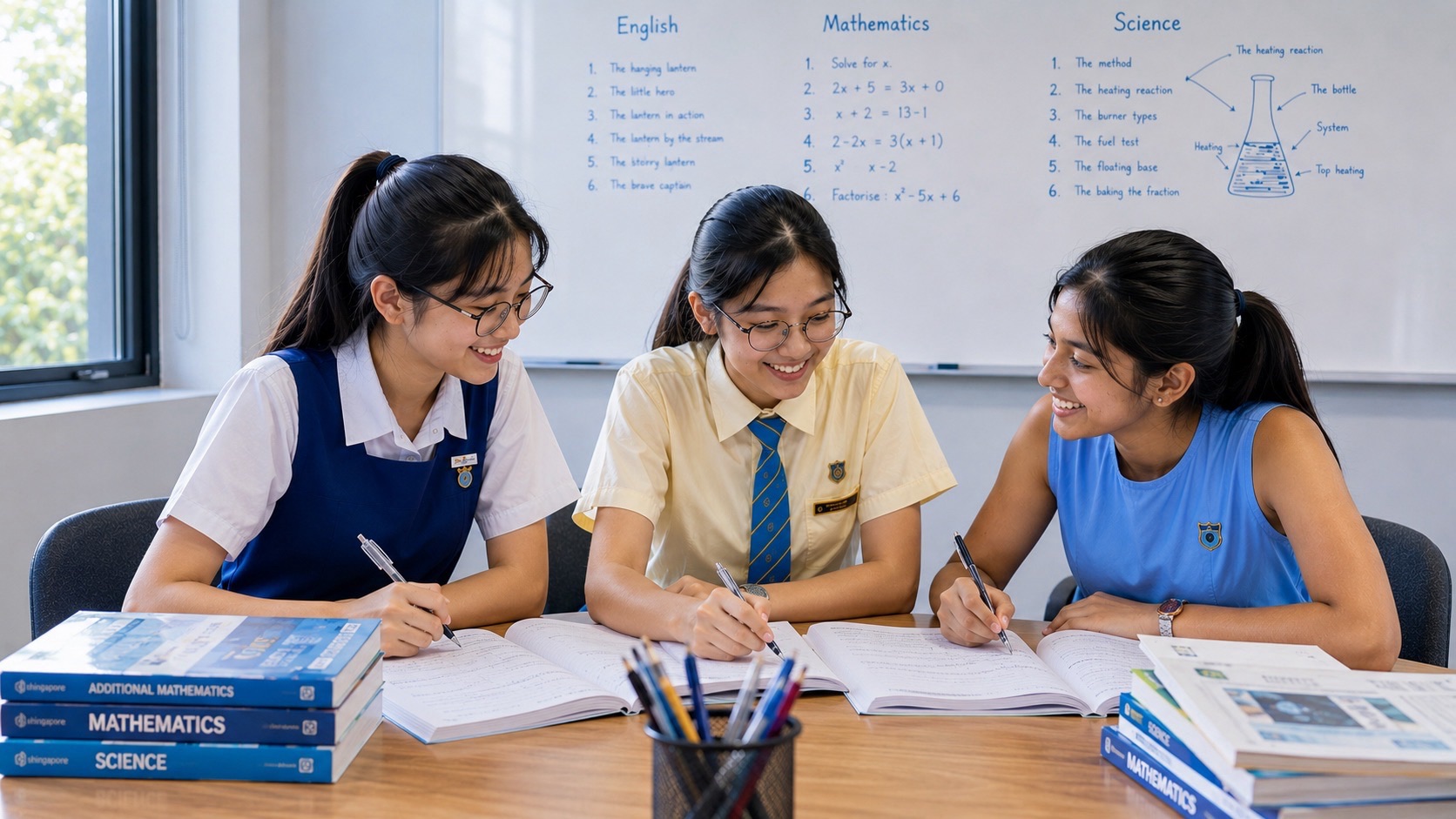
In a three-pupil tutorial, one learner labels the base quantity, a second checks every unit and arithmetic step, and a third explains why the alternative method is wrong. Rotate the roles and ask each learner to solve one new example alone. Parents can check three things: the stated whole, a sensible estimate and a final answer with a unit. Keep the difficulty aligned with the school’s actual Secondary 1 G1 assignments. MOE’s G1 Mathematics syllabus is the curriculum reference; SEAB’s SEC information relates to national examinations beginning in 2027, not a Secondary 1 national examination.
Leave a Reply