
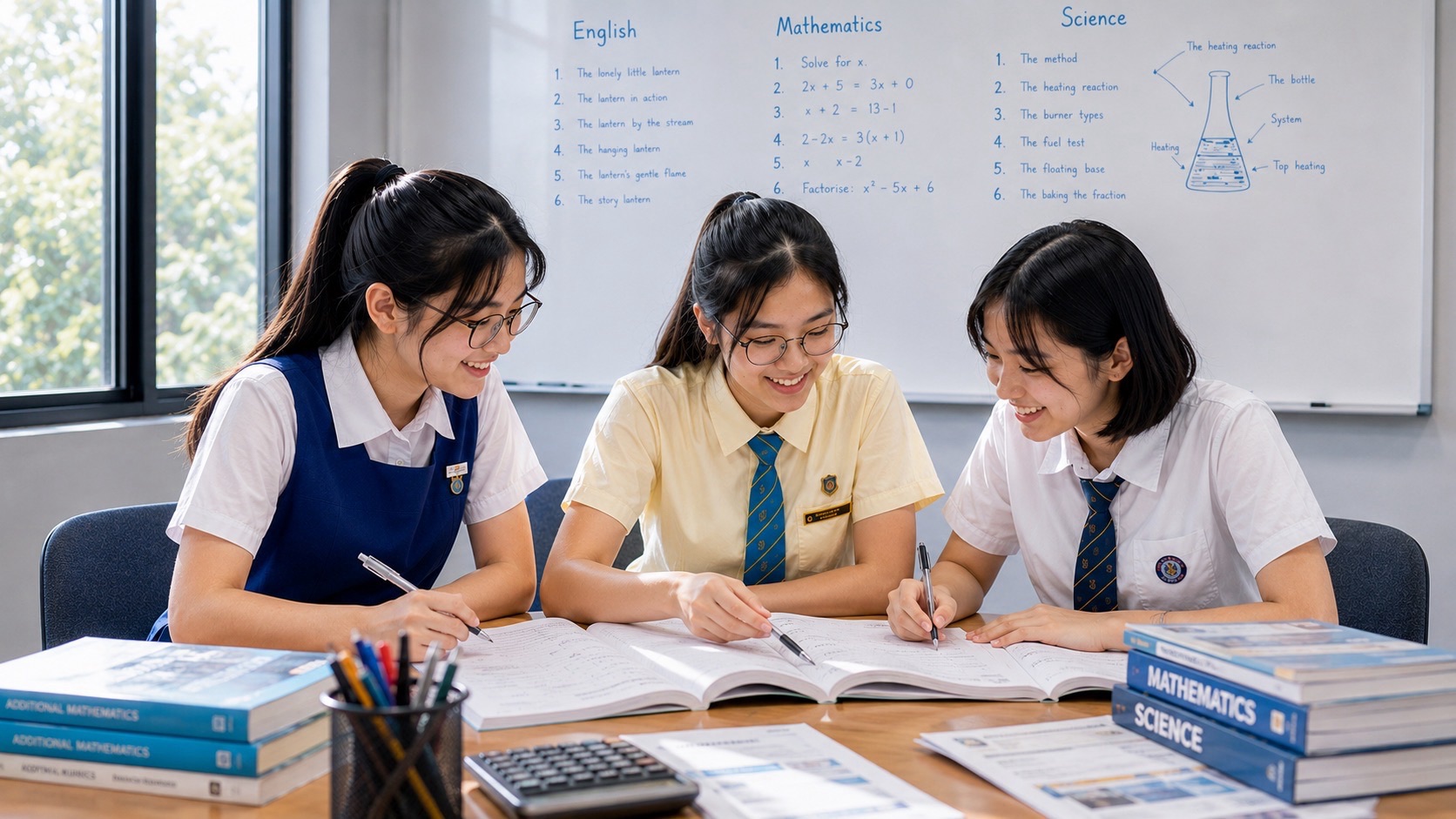
Students entering Secondary 1 through PSLE Posting Group 2 usually begin English Language at G2. The most useful preparation is to carry four familiar skills into more independent work. Read a text closely enough to explain an answer, write with a specific reader in mind, listen for what someone needs you to do and speak clearly enough for a listener to follow your reasoning. Those habits matter whether your child took Standard or Foundation English in Primary 6.
Start with one piece of recent work and ask where your child made a decision without prompting. A child who can select good evidence may need help putting the link into words. A child who speaks readily may need to organise an answer once the question is unfamiliar. The school’s Secondary 1 English outline will tell you what the class is learning now. The official PSLE and Secondary Education Certificate documents serve different examination years, so match the document to the task before using it to plan practice.
- Check that the posted school has confirmed the child’s English level. Posting Group 2 is the admission route, while G2 names the level of an individual subject.
- Use the separate 2026 SEAB formats for Standard English Language and Foundation English Language when looking back at PSLE work.
- Compare a few ordinary samples. Notice what the child can read, write, hear and explain without a model.
- Start with a single improvement your child can test again on fresh material.
- Ask the teacher for the school’s actual Term 1 expectations and one example of the kind of answer the class is learning to produce.
- Keep the 2027 G2 SEC English syllabus as a dated examination reference. Check your child’s own examination year and subject entry later.
Contents
- Read the report slip and school notice together
- Separate the two PSLE English formats
- Use the Secondary 1 curriculum for your first decisions
- Read an inference by showing the clue and its effect
- Write so the reader has everything needed to act
- Build a narrative around the moment something changes
- Listen for the information that changes the plan
- Speak in a way that makes your thinking easy to follow
- Use the SEC document at the right time
- Make the next conversation with the teacher specific
Read the report slip and school notice together
Posting Group 2 comes from the overall PSLE result and the applicable posting arrangements. G2 English is a level for English Language. Under Full Subject-Based Banding, a child may study other subjects at different levels. Under the published entry criteria, a PG2 student with AL5 or better in Standard-level PSLE English can be offered G3 English at the beginning of Secondary 1. The posted school explains offers and the response needed. Northbrooks Secondary School’s 2026 Full Subject-Based Banding notes show how a local school communicates the entry criteria.
Foundation-level PSLE subjects receive Foundation grades. For the overall posting calculation, Foundation A, B and C are mapped to AL6, AL7 and AL8 respectively. Keep the original grade and the level at which your child took the paper when talking about classroom preparation. The mapped number explains one part of the total. The teacher can learn more about the child’s starting skills by seeing how the child actually reads, writes, listens and speaks. See the MOE guide to PSLE scoring for the calculation.
Picture two students who have both been assigned G2 English. Hana can retell the main events in a story and notices changes in a character’s mood, but she usually needs someone to start the written answer for her. Daniel spots sentence errors and can write to a familiar format, but when asked why an advertisement is convincing he repeats the slogan. Their shared subject level helps the school organise instruction. Their next learning tasks are different. Hana can practise forming her own first sentence from a question. Daniel can practise pointing to a detail and explaining how the intended reader may respond to it.
If your child has a G3 offer and you are deciding whether to accept it, bring two ordinary samples to the conversation. Ideally, one should come from a lesson where they had time to plan and the other from a fresh task completed independently. Ask the teacher which demands will change most at the higher level and how the school reviews a placement later. If your child starts G2, ask the same questions about what good G2 progress looks like. A report from the child about how they completed the work adds information that the mark alone leaves out.
Separate the two PSLE English formats
SEAB’s PSLE formats examined in 2026 list English Language as 0001 and Foundation English Language as 0031. Both have papers for writing, language use and comprehension, listening comprehension, and oral communication. Format details vary between the levels. For instance, the Foundation language-use paper includes form filling, while the Standard language-use paper includes vocabulary cloze and synthesis or transformation. Use the relevant document when picking an old piece of work to discuss.
Start with the skill the task required. In a form-filling task the student may have had to identify exactly which detail belongs in a field and copy it accurately. That habit transfers to a school announcement with a date, place and action. A synthesis exercise may have required combining two ideas without changing how they relate. That habit helps a student make a clearer point when two characters have different reasons for acting. The surface format changes while the thinking remains useful.
The same perspective helps with writing and oral work. Both 2026 PSLE formats ask students to write for a situation and to produce a continuous piece. Both include reading aloud and a conversation based on a stimulus. Look back at what your child did well. Did they notice who would receive a message? Did they work out what a story’s main moment was? Could they use an example when asked to expand a spoken answer? These observations give a better starting task than simply repeating an entire old paper during the holidays.
Keep one or two pieces of PSLE work that show a real strength and a place where help is still useful. Label each sample with what happened around it. For example, “read independently and found the clue, discussed the answer before writing once” gives a teacher more context than a highlighter mark next to an incorrect response. If the child has no papers at home, make a fresh short task together. The examples in this guide can supply enough evidence for an initial conversation.
Use the Secondary 1 curriculum for your first decisions
Ask the school for its current English curriculum outline or for the section your child is working on first. The Yishun Secondary School English and Literature outlines illustrate what a school may publish by level. Its posted 2025 G2 English outline included work on narrative structure and informal letters in Term 1, with listening comprehension appearing later in that example. Another school, or the same school in a later year, may organise topics differently. Use the school’s current schedule and work samples for this actual class.
A short planning note can prevent the family from trying to solve every English difficulty at once. Put the current task at the top, the skill under it, and the next chance to use it at the bottom. For example, “Informal letter to a classmate” is a task, “include details a reader needs to act” is the skill and “try it again when the next letter has different instructions” is the check. A teacher might phrase the skill differently. Use their wording where it helps your child recognise the expectations in class.
Some secondary classrooms use longer texts or ask students to work across several kinds of text. When the child says, “There were too many words,” find out what happened. They may have lost track of who was speaking, missed a contrast signalled by a word such as “although”, or spent too long looking up several terms before reading the whole paragraph. Ask the child to show the place where the difficulty began. A reading task gets easier to repair when the family can see which decision broke down.
School English extends into other parts of the day. A child summarising a group’s plan for a teacher, finding instructions in a CCA notice or explaining a practical observation is doing language work. Encourage your child to notice one real example in a week and explain what made it more or less clear. That kind of attention turns useful reading and speaking habits into something the student can recognise beyond the English worksheet.
Read an inference by showing the clue and its effect
Use a short original passage. “A nervous hush fell over the room as Eli reached the last line of the speech. He folded the paper, looked at his classmates and told them about the afternoon their front gate flooded. Two students leaned forward. When the bell rang, nobody reached for a bag.” Ask, “What suggests the class was interested once Eli went off script?” Give the child time to choose a clue before either of you offers an answer.
A first answer might read, “Nobody reached for a bag.” That selects a useful detail. A stronger response explains why it matters. “The students stayed focused even after the bell, when they would usually start to leave. Their decision to wait suggests they wanted to hear what happened next.” If your child selects the students leaning forward, ask how that behaviour supports the same inference. Different clues can support a similar reading when the student explains the connection.
The feedback changes depending on where the child got stuck. If they simply copied “a nervous hush fell”, ask which words in the question mark the time after Eli put the paper away. They can draw a line between those moments. If they chose an appropriate detail but wrote only “they were interested”, ask what you would see if the child’s interpretation were true. The answer might describe the class turning towards the speaker or pausing the usual movement at the bell. Let the student first explain it aloud and then build the written answer.
Watch for an inference that goes beyond what the text can support. “Every student admired Eli from then on” is a bigger conclusion than the passage gives. Ask the child to identify the moment the question concerns and to choose a verb or phrase that fits the strength of the evidence. “They wanted him to continue” is easier to support. This adjustment teaches the student to judge what a clue makes likely and where the clue runs out.
Try a fresh passage a few days later. Write three sentences about a student leaving an umbrella near a busy doorway and coming back to move it. Ask for a reason why they might have moved it, using two details you put in the passage. Give the student a chance to write the answer independently. If they can make a claim and explain two clues without a reminder, the first practice has transferred. If they find the clues and stop there, make the explanation the next small target.
Write so the reader has everything needed to act
Try this original task. A class reading group must meet at a different place on Friday. The new place is the library discussion room. The meeting starts at 2.45 pm. Each person should bring a short book review and reply before noon if unable to come. Ask your child to send a short message to the group. The situation gives the writer a reader, a reason to write and information that changes what the reader will do.
Read the first attempt as a classmate. Suppose the student writes, “Hi everyone, our Friday meeting changed. Please come at 2.45 pm and remember the work. Let us know if you are busy.” The message gives a time but leaves the reader guessing about place, what work to bring and when to reply. Have the child circle any words that require the group to guess. Ask them to replace one vague reference at a time, keeping the language natural for classmates.
A clear revision could say, “Hi everyone, our Friday reading group will meet in the library discussion room at 2.45 pm. Please bring your short book review. If you can’t make it, reply before noon so we can plan the discussion.” Explain which part performs which job. “Reading group” identifies the activity, the place and time tell the reader what changed, and the next two sentences give actions. The reason at the end helps the group understand why the deadline matters. A student can build an effective message in their own words.
Next, change the reader to the teacher in charge. The student now needs to say who they are, request use of the room and explain how the group will leave it ready for the next class. This changes the purpose and the information selected. Ask the child to compare the opening lines of the two messages and describe what the teacher needs to know first. A change in audience becomes meaningful once it causes the student to change the content or the level of formality.
Use one editing pass for meaning and one for accuracy. For meaning, read only to see whether the reader can act. For accuracy, check the date, time, names and one recurring language issue. A child who often joins complete thoughts with a comma can try dividing an overlong sentence, then reread both pieces to see whether each is clear. A child who varies tense unnecessarily can underline the relevant verbs and see whether the time relationship makes sense. This keeps editing connected to what the sentence is meant to communicate.
Build a narrative around the moment something changes
A child may bring a Primary 6 story with a lively opening and several events but little space for the most important decision. Ask them to mark the moment when a character could have chosen between two actions. That point may deserve extra attention. The beginning should give a reader enough context to understand the choice. The ending can show how the character’s action changes the situation or what they understand about another person.
Here is an original planning prompt. A class has agreed who will introduce the final performance. On the day, the chosen speaker calls from outside the hall and says they have lost their voice. One classmate has the speech on a phone, another knows the first paragraph and a third is afraid to go on stage. Ask your child to decide which character the story follows and what choice that character has to make in two minutes. A clear response may focus on the shy student pointing out that the teacher could introduce the class, then deciding to deliver just the first line themselves.
Let the child draft the decisive moment before expanding the rest. Ask them to include a detail someone in that character’s position might notice, an action and a line of dialogue that changes what happens. If every character explains what they are thinking, try replacing one explanation with a reaction another person could see. If too much time is spent on how the class travelled to the hall, ask whether those events help the reader understand the choice and how briefly that information could be given.
After reading the draft, ask the child to explain their choice of ending. An ending with a successful performance can work. So can a performance that goes awkwardly but changes how the character thinks about helping. A useful ending grows from the action the character took. Ask the writer which sentence shows that change. If they can identify it, they can decide whether to leave the sentence explicit or make the change clear through what the character does next.
Listen for the information that changes the plan
Read this short announcement at conversational speed. “Bring your library book to the hall after recess on Tuesday. The original message said the group would meet in the classroom. The hall will be open only from 10.45. If your book is still at home, write down its title and tell your group leader before lunch.” Ask the student to say what they will do on Tuesday and what changes if their book is at home. A listener needs to distinguish the original instructions, the new place and the second action that depends on their situation.
Check each missed detail by asking what the student heard just before and after it. If the places got mixed up, talk about the words “original message” and “the hall”. A student can write a quick cue that marks old and new information, then try it on another message. If the date and place were correct but the conditional instruction disappeared, have the student listen for “if” and identify who needs to act. Give feedback about the signal the student can reuse.
A similar skill applies to longer explanations. Play a short talk on a familiar topic or read one paragraph aloud. Ask the student to record only the speaker’s main point, one example and an unanswered question. Have them compare the notes with a sibling or parent. Different examples may be useful if they support the same point. The comparison helps the child decide which words to keep and which can be left out of the next page of notes.
Speak in a way that makes your thinking easy to follow
Ask the child whether a school reading corner should have a quiet area and a small place for book discussions. Begin by letting them choose a position, give a reason and describe a time when the arrangement might matter. An answer might say, “Yes. Some students come before a lesson to finish reading and some want to talk about a book together. If both groups share one small area, the talk could distract someone who came to read. I’d keep a table for discussion a short distance away.”
Follow with a genuine question. “What if the room only has space for one table?” A child who has prepared a memorised answer may need a moment. Give them time to make a different suggestion. They might propose certain discussion times or ask the librarian to identify another space. The ability to respond to a new condition matters in class discussions. It also shows whether the child understood their own argument.
For reading aloud, take a short paragraph and ask whom the words are addressed to. Have your child mark a place to pause because an idea has ended or a speaker has changed. Read it once to a listener and ask what meaning came across most clearly. If the listener misses a key event, the student can experiment with a clearer pause or with emphasis on a verb. A short discussion about meaning gives pronunciation, phrasing and pace a reason to improve together.
Carry one practice through to a school task
Agree on a simple change the child wants to make during the next real task. A listener can write only action words and dates when instructions are given. A reader can put a mark beside the part of the text that answers a question. A speaker can pause before giving a reason. Some changes work in more than one setting. Let the child try the action in class, then ask what was different from trying it at home.
If the change helped at home but was forgotten at school, make the cue easier. A student who could think of a reason during a calm conversation may need a note with the word “because” before a group talk. A student who can write a complete message on a quiet afternoon may need a small checklist when several assignments arrive on the same day. Once the child uses a cue reliably, they can see whether they remember the action when the cue is no longer in front of them.
Use the SEC document at the right time
The 2027 G2 SEC syllabuses for school candidates list G2 English Language under syllabus code K200. The syllabus for that examination has papers for writing, comprehension, listening and oral communication. That broad pattern gives parents a sense of the skills that continue beyond lower secondary. A student starting Secondary 1 should work from their school’s current curriculum and use the SEC document for their actual examination year when available.
Look at what can carry forward across years. An explanation of a clue, attention to audience, careful listening and an example that makes a spoken answer easier to follow are useful in many classroom tasks. Precise marks, timings and question requirements belong to the relevant examination document or the particular assessment instructions. When an older resource uses a different subject code, have the student and teacher decide which skill the resource can help them practise and whether its format is still relevant.
Make the next conversation with the teacher specific
Bring one piece of work and explain how independently it was done. A useful question might be, “She explained the clue when we read it together but copied it as her whole written answer. What would you like her to add on the next question?” A parent could also ask, “He remembers the place and time when I read a notice aloud, then misses a change announced halfway through. Is there a listening routine he can practise in class?” The teacher can respond to a visible pattern and suggest a next step that suits the group.
After the conversation, agree on one action and one review point. A family might choose a short paragraph of original material, complete a pair of school questions or review a message the student writes for a real purpose. In a fortnight, look for the same behaviour on a different task. If improvement appears only with a familiar example, change the reading text or context. If the skill transfers, ask the child how they remembered the step. That answer will help the family decide how to make the routine more independent.
Some children feel uncertain when their old school marks and new results look different. Compare two pieces of work with comments before interpreting the change. The format may have changed, the text may have been longer or the child may have used a different amount of help. Ask the teacher what a reasonable early-term change would look like. An individual target, such as completing explanations on two fresh questions, gives the student something they can observe between marks.
Can a child start this practice on their own?
Yes. Pick one short school task, mark the part that feels uncertain and say what you think the reader or listener needs from you. Try the task, check one thing and keep the attempt. If you take it to a teacher, say what you tried and where you got stuck. This gives the teacher a clear starting point. Return to the same skill one or two weeks later and see whether you needed fewer reminders.
How much practice is enough before the first term?
Start with a pair of short tasks within a normal week. One can be done together and the other independently with fresh material. When the child can explain their choice in the second task, let that result guide what to practise next. Families who have a busy transition can use a real message, a short conversation about a book or a clear set of spoken instructions. The practice is useful when the child makes a small decision they will need again in class.
What if my child can do the work slowly but struggles in class?
Ask whether the child can identify the right method in a short task with ordinary instructions. If they can, explore which step takes longest. It could be finding the right part of a passage, getting the first sentence down or rereading every line of a draft. Practise that step briefly in isolation, then return to a similar set of school questions. Discuss with the teacher whether class tasks allow the same approach and what useful improvement to look for before introducing stricter time limits.
What can a family review if English homework is usually finished alone?
The student can pick one answer to discuss after they have finished and checked it. Let them explain which words in the question guided their decision and which part of the text, announcement or draft they used. A parent can ask what alternative they considered or where they nearly lost the thread. The next time the child brings a piece of work, ask whether the same step came up. A two-minute discussion like this gives the family a glimpse of independent thinking without taking over the assignment or asking the student to redo the whole page.
Leave a Reply